
Tailoring Piece Rate by Difficulty: A Multiplier Table You Build Once
A piece rate by difficulty stops hard garments from piling up at the end of the schedule. Here is how to measure minutes, build a five-level multiplier table and see its effect on your prices.
Author:سامي الحيدري
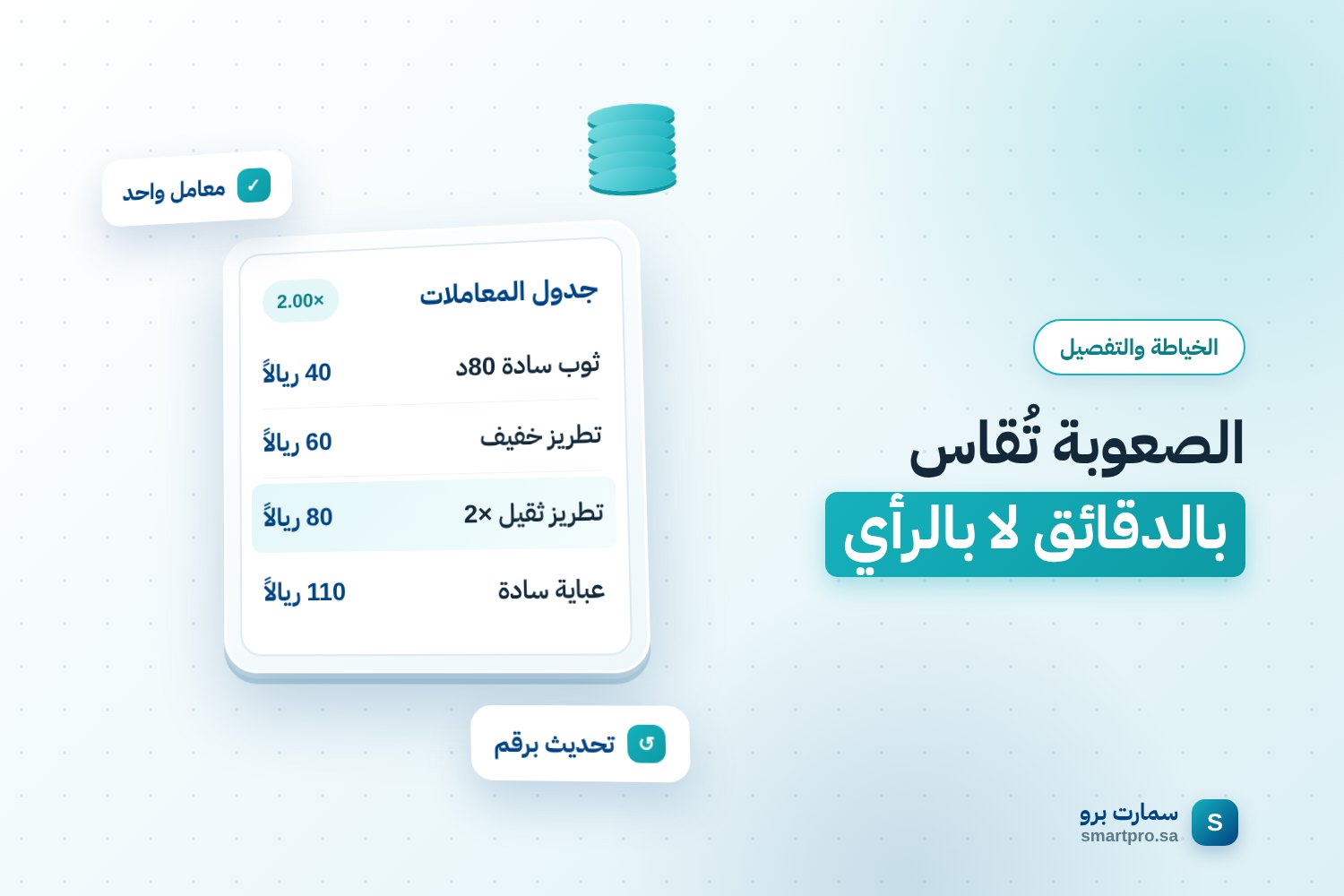
A piece rate by difficulty is the difference between a production schedule that flows and one where the hard garments pile up at the end. A tailor paid one flat rate per thobe will prefer a plain thobe over an embroidered one. That is a rational choice, not bad faith.
The reason is pure arithmetic. If the piece rate is SAR 40, a plain thobe that takes 80 minutes pays the tailor half a riyal per minute. An embroidered thobe that takes 160 minutes pays a quarter of a riyal.
Any tailor will pick the first and leave the second for the end of the day or the end of the week. Then the order runs late, and the tailor is blamed for a problem the pay table created.
Piece rate by difficulty: what a single flat rate breaks
A single rate is not only unfair to the tailor. It breaks three things in the workshop itself.
- Schedule order: hard pieces slide to the end, so the higher-value orders run late. The knock-on effect is covered in handling late orders.
- Quality: a tailor forced to sew a piece that loses him money rushes it, so rework rises on exactly the hardest garments.
- Tailor retention: an experienced tailor who always gets the hard work at the same rate leaves for a workshop that pays the difference.
The fix is not raising the flat rate for everyone, because that makes plain garments expensive for no reason. The fix is a small multiplier table, built once and updated with a few numbers.
Where does difficulty come from?
| Factor | Effect | Measured by minutes alone? |
|---|---|---|
| Number of minutes | The base, and covers most of the difference | Yes |
| Embroidery and its density | Doubles the time and raises the risk of spoiling the piece | No, needs a risk margin |
| Lining and interlining | Extra steps and precise alignment | Mostly yes |
| First-time pattern | Setup and trial time that does not repeat | No, needs a setup item |
| Slippery or heavy fabric | Slows the machine and increases defects | Partly |
| Special or large size | Pattern readjustment | Partly |
The last column is what makes the table more accurate than simply multiplying minutes. Heavy embroidery is not just more time; it is a piece that one needle in the wrong place can ruin, and that risk should be compensated, not ignored.
Still, minutes remain the foundation. Anyone who builds multipliers on general impressions such as "this one is hard" and "this one is easy" ends up back at the starting point in a different form.
Building a multiplier table within the thobe family
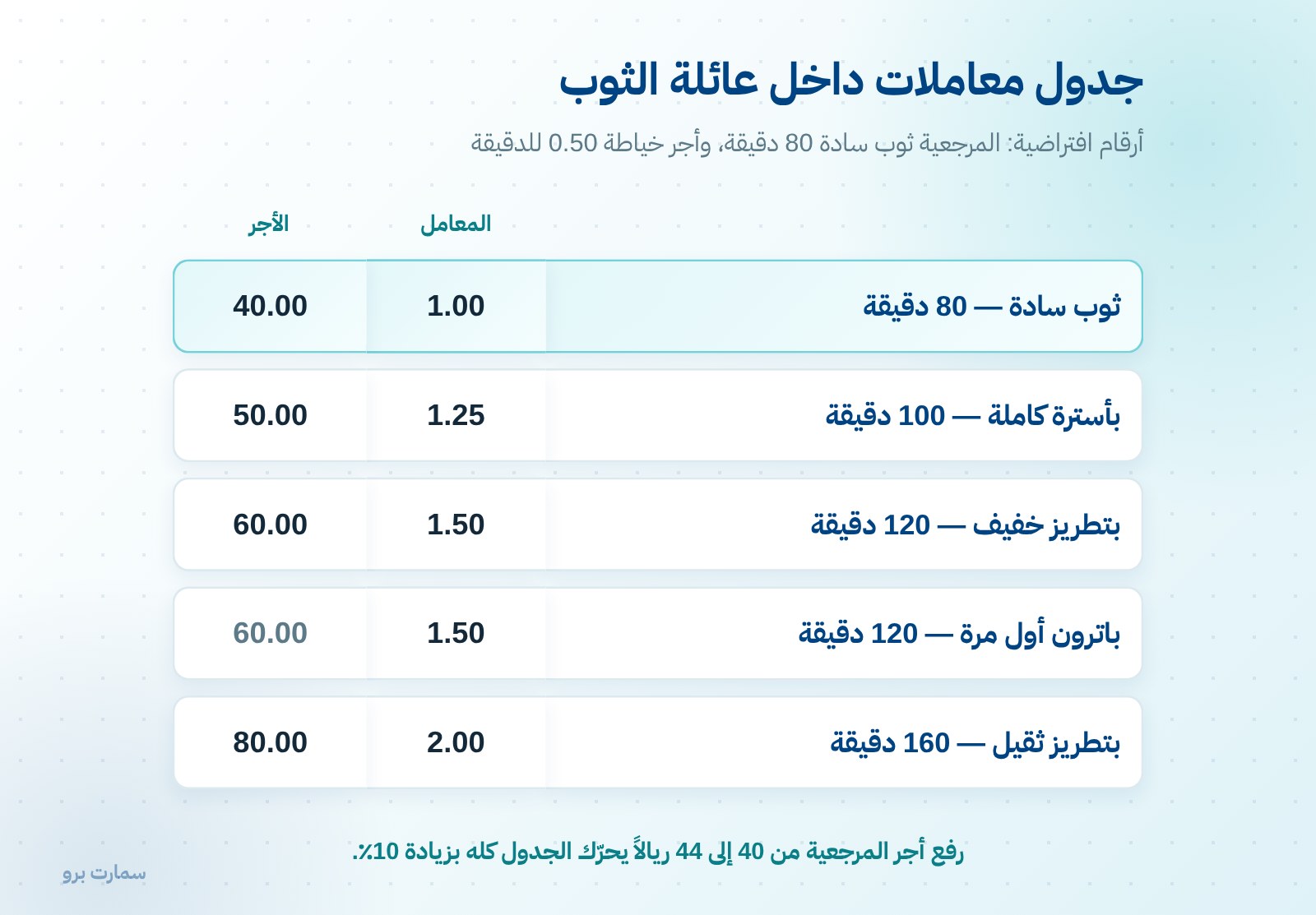
The following figures are hypothetical, to illustrate the method, and do not represent prevailing market prices. We build on the rate published in pricing alterations: a sewing wage of SAR 0.50 per minute. The reference piece is the plain thobe at 80 minutes, so its multiplier is 1.00 and its wage is SAR 40.
| Work | Minutes | Multiplier | Wage (SAR) |
|---|---|---|---|
| Plain thobe | 80 | 1.00 | 40.00 |
| Thobe with full lining | 100 | 1.25 | 50.00 |
| Thobe with light embroidery on collar and cuffs | 120 | 1.50 | 60.00 |
| Thobe on a first-time pattern | 120 | 1.50 | 60.00 |
| Thobe with heavy embroidery | 160 | 2.00 | 80.00 |
Four notes on the table. First, the multipliers are limited to five levels, and that is deliberate: a table with more than six levels is never memorised and never applied.
Second, the multipliers are rounded to the nearest quarter, so you never see 1.37 or 1.62. Rounding makes mental arithmetic easy when assigning work.
Third, "first-time pattern" is a one-off multiplier. Once the pattern becomes routine, it returns to its normal level, and this must be written in the table so it does not become a permanent bonus.
Fourth, a multiplier works within a family, not across families. The thobe multiplier is not used for the abaya, because their bases are different.
A second family: the abaya
| Work | Minutes | Multiplier | Wage (SAR) |
|---|---|---|---|
| Plain abaya | 220 | 1.00 | 110.00 |
| Abaya with partial embroidery | 275 | 1.25 | 137.50 |
| Abaya with full embroidery | 330 | 1.50 | 165.00 |
The abaya base is 220 minutes, as in abaya pricing, so a multiplier of 1.00 there equals SAR 110, not 40.
If the two families were merged into one table, the plain abaya would show a multiplier of 2.75. That number is correct but useless, because every update to the thobe wage would then move the abaya wage for no reason.
Why is a multiplier better than an open price list?
The first advantage is that you update a single number. If you raise the reference piece wage from SAR 40 to SAR 44, a 10% increase, the whole table moves automatically: 50 becomes 55, 60 becomes 66 and 80 becomes 88.
If the rates were written as separate figures, you would need to edit five items, you would forget one, and every item would open a new negotiation.
The second advantage is that the table explains itself. A tailor who sees 2.00 next to heavy embroidery understands the piece is worth double a plain one, and needs no persuading that the number is fair.
The third advantage is that it ties pay to measurement, not mood. The conversation moves from "this one is hard" to "this one is 160 minutes", and that is settled with a sheet of paper, not a raised voice.
How do you measure minutes before setting the multiplier?
- Choose the reference piece, the most frequent garment in each family; it gets a multiplier of 1.00.
- Time each level on at least five real pieces, and take the median, not the fastest or the slowest.
- Time at the sewing stage of the order flow: received → cutting → sewing → ironing → ready → delivered. Do not mix cutting and ironing minutes with sewing minutes.
- Record the time on the order sheet, not from memory; the details are in the tailor worksheet.
- Divide by the reference minutes and round to the nearest quarter.
- Re-measure every six months, because times change as tailors and machines change.
Measurement methods, and which ones suit monthly tracking, are covered in tailor productivity.
How does the multiplier affect the garment price?
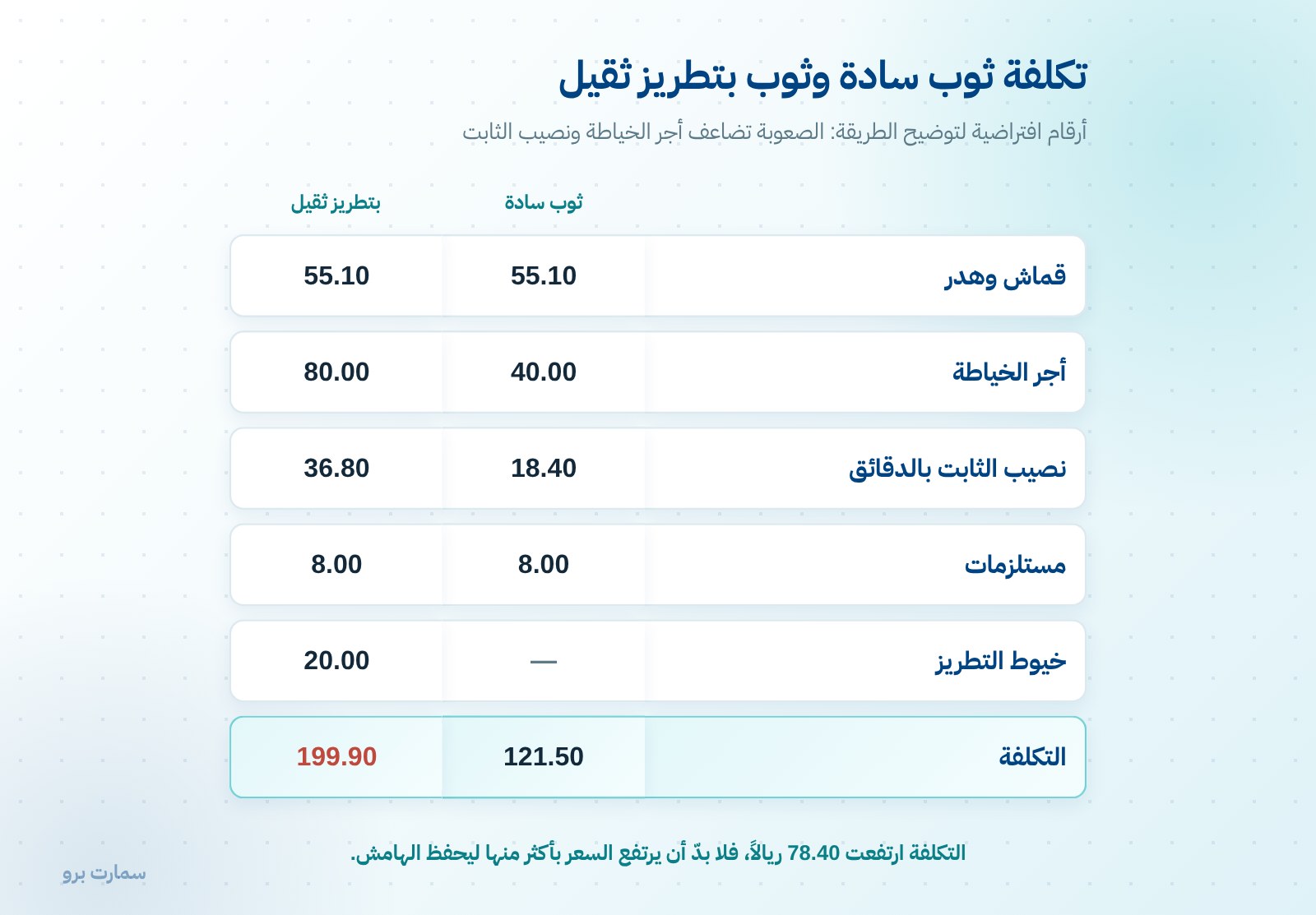
The multiplier changes your cost, so it has to change your price. The following figures are hypothetical, to illustrate the method, and do not represent prevailing market prices.
| Item (SAR) | Plain thobe | Heavily embroidered thobe |
|---|---|---|
| Fabric and waste | 55.10 | 55.10 |
| Sewing wage | 40.00 | 80.00 |
| Share of fixed costs by minutes | 18.40 | 36.80 |
| Trims and supplies | 8.00 | 8.00 |
| Embroidery thread | — | 20.00 |
| Cost | 121.50 | 199.90 |
Cost rose by SAR 78.40, and the price must rise by more than that to protect the margin. If the margin stays at 50%, as in tailoring margin per garment, the required price before VAT is SAR 400, or SAR 460 including 15% VAT.
A workshop that prices the heavily embroidered thobe at SAR 340 including VAT collects SAR 295.65 before VAT. Its profit is SAR 95.75, a 32% margin rather than 50%. The piece is not loss-making, but it takes up twice the capacity of a plain thobe for less than twice the profit.
This is the side that gets overlooked: a difficulty table is not just a raise for the tailor, it is a correction to your price list, as explained in the tailoring price list.
Four mistakes in difficulty tables
- Too many levels, so nobody remembers them and assignment goes back to guesswork.
- A multiplier with no written definition, so the workshop and the tailor disagree over what "light embroidery" means on every piece.
- Mixing families in one table, so the abaya wage moves whenever the thobe wage is updated.
- Forgetting to re-measure, so the minutes grow while the multiplier stays put, and the unfairness returns through another door.
A fifth mistake can be added: not handling rework inside the table. A piece redone because of the tailor's error is not paid twice, while a piece redone because the customer changed the request is new work paid at its multiplier. How to tell the two apart is covered in the rework policy.
The official reference
Rules on wage arrangements and contracting are published by the Ministry of Human Resources and Social Development, which is the reference in any dispute. Review its texts before writing the table into an employment contract.
Everything described here can be run in practice in SmartPro's tailoring system: orders, measurements, fabrics and invoicing in one place.
Key takeaway: Measure sewing minutes, set a small table of quarter-rounded multipliers within each garment family, and update one reference wage. Then carry the higher cost of hard pieces into your price list.
To see how orders, measurements and pay data fit together, start a free trial.
Read also
Article visuals
Frequently asked questions
How do I build a piece rate by difficulty?
Choose the most frequent garment in each family and give it a multiplier of 1.00. Time each difficulty level on five real pieces and take the median, then divide by the reference minutes and round to the nearest quarter. Keep the table to five or six levels so it is actually memorised and applied.
Why does a single flat rate per piece cause problems?
Because it makes the pay per minute uneven. At SAR 40 per piece, a tailor earns half a riyal per minute on a plain thobe and a quarter of a riyal on a heavily embroidered one. Hard pieces slide to the end of the schedule, higher-value orders run late, and rework rises on the hardest garments. The fix is not raising the flat rate for everyone but a small multiplier table built once and updated with one number.
Should I use the same multiplier for the thobe and the abaya?
No. A multiplier works within a garment family, not across families, because each family has a different base. A multiplier of 1.00 for the thobe equals SAR 40 at 80 minutes, while for the abaya it equals SAR 110 at 220 minutes. Mixing the two means every update to the thobe wage moves the abaya wage for no reason.
Does a difficulty table raise the price for the customer?
For hard pieces, yes, because their cost really has gone up. In the hypothetical example, the cost of a heavily embroidered thobe rises from SAR 121.50 to SAR 199.90, so the price that keeps a 50% margin is SAR 400 before VAT, or SAR 460 including VAT. The price of a plain piece does not change. Pricing the embroidered thobe at SAR 340 including VAT yields a 32% margin instead of 50%, so the piece is not loss-making but takes twice the capacity.