
Tailoring Workshop Payroll: How to Build Mixed Pay and Pay It on Schedule
Tailoring workshop payroll is mixed pay: a fixed base plus a piece rate. How to split the target figure, how to derive piece rates from standard minutes, and how to build the monthly payslip.
Author:سامي الحيدري

Tailoring workshop payroll is harder than payroll in any other business of the same size, for one reason: the pay is mixed. There is a fixed monthly part, a piece-rate part that changes with what each tailor delivers, and on top of both come allowances, advances and deductions. Yet at the end, you still need a regular payroll run on the same date every month.
What usually happens in practice is that piece-rate pay is worked out in a notebook, paid in cash or by transfer, and left at that. There is no payslip, no file that matches what is officially registered, and no record to go back to when a dispute comes up six months later.
This article covers the mechanics only: how mixed pay is built and how it becomes a correct monthly payslip. The regulatory rules (what counts toward the contributory wage, the limits on deductions from pay, and end-of-employment entitlements) are covered in their own articles, and we link to them instead of repeating them.
Tailoring workshop payroll: building mixed pay
The figures below are hypothetical, chosen to illustrate the method; they do not represent typical market rates. We use the same parameters as the rest of this series: five tailors, eight hours a day, 26 working days, which gives 5 × 8 × 60 × 26 = 62,400 available minutes a month, and a sewing wage of SAR 0.50 per productive minute.
Each tailor's share is 62,400 ÷ 5 = 12,480 available minutes. At a realistic 75% utilisation, that becomes 9,360 productive minutes. So the monthly target pay is 9,360 × 0.50 = SAR 4,680.
The step many workshops skip is splitting this figure, rather than paying it all as piece rate or all as a fixed salary:
| Component | Share | Per minute (SAR) | Monthly (SAR) |
|---|---|---|---|
| Fixed monthly base | 40% | 0.20 | 1,872.00 |
| Piece rate | 60% | 0.30 | 2,808.00 |
| Total target | 100% | 0.50 | 4,680.00 |
The base pays for the non-productive time that piece rates never price: setting up machines, waiting between stages, helping with receiving and ironing, and the quiet season. The piece rate pays for the output itself. For a comparison of the two pure models, see piece rate or salary.
Piece rates are derived from standard minutes
A piece rate is not invented or borrowed from the workshop next door; it is calculated. Standard minutes are the time a trained tailor should need to complete an item at a normal pace. The piece rate equals the item's standard minutes × the per-minute rate of the variable component, which is SAR 0.30 in our example.
| Item | Standard minutes | Piece rate (SAR) | Completed | Total (SAR) |
|---|---|---|---|---|
| Plain thobe | 80 | 24.00 | 20 | 480.00 |
| Thobe with custom details | 110 | 33.00 | 8 | 264.00 |
| Plain abaya | 70 | 21.00 | 18 | 378.00 |
| Embroidered abaya | 180 | 54.00 | 16 | 864.00 |
| Medium alteration | 20 | 6.00 | 140 | 840.00 |
| Total | 9,420 minutes | 2,826.00 |
Notice that the total standard minutes completed (9,420) came out close to the assumed productive minutes (9,360). That is the point: the piece-rate table is calibrated to capacity. It is not set above capacity, which would make it impossible to reach, nor below it, which would mean paying for capacity that is not used.
If the gap is large month after month, the error lies in the standard times, not in the tailor. How to derive them is explained in tailor productivity, and how to vary rates by difficulty in difficulty-based piece rates.
Why does piece-rate pay need a monthly payslip?
Piece rate is a way of calculating pay, not a substitute for the payroll run. A tailor paid by the piece needs a document showing how the figure was reached. Otherwise every month becomes an occasion for argument, and every dispute has no reference point to settle it.
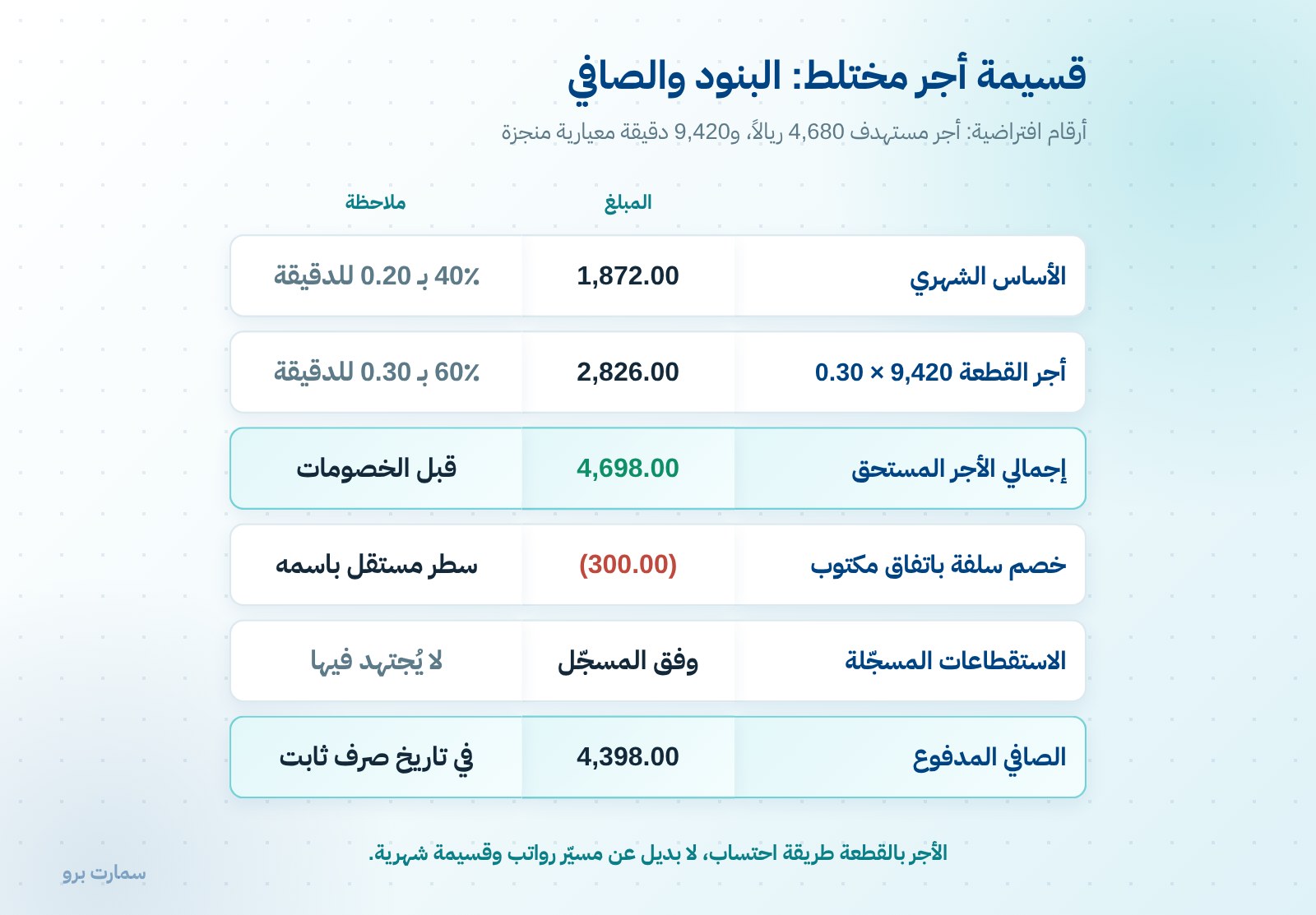
Here is the month's payslip in our example:
| Item | Amount (SAR) |
|---|---|
| Monthly base | 1,872.00 |
| Piece-rate pay (9,420 × 0.30) | 2,826.00 |
| Gross pay due | 4,698.00 |
| Advance deduction under written agreement | (300.00) |
| Registered deductions | As registered |
| Net paid | 4,398.00 |
Make sure every item in the deductions column is backed by a written, dated document shared with the tailor before payday, and shown as a separate line under its own name, not quietly subtracted from the gross. The limits and conditions for deductions from pay are published by the Ministry of Human Resources and Social Development, and they are not a matter for habit or guesswork.
The weak month and the strong month
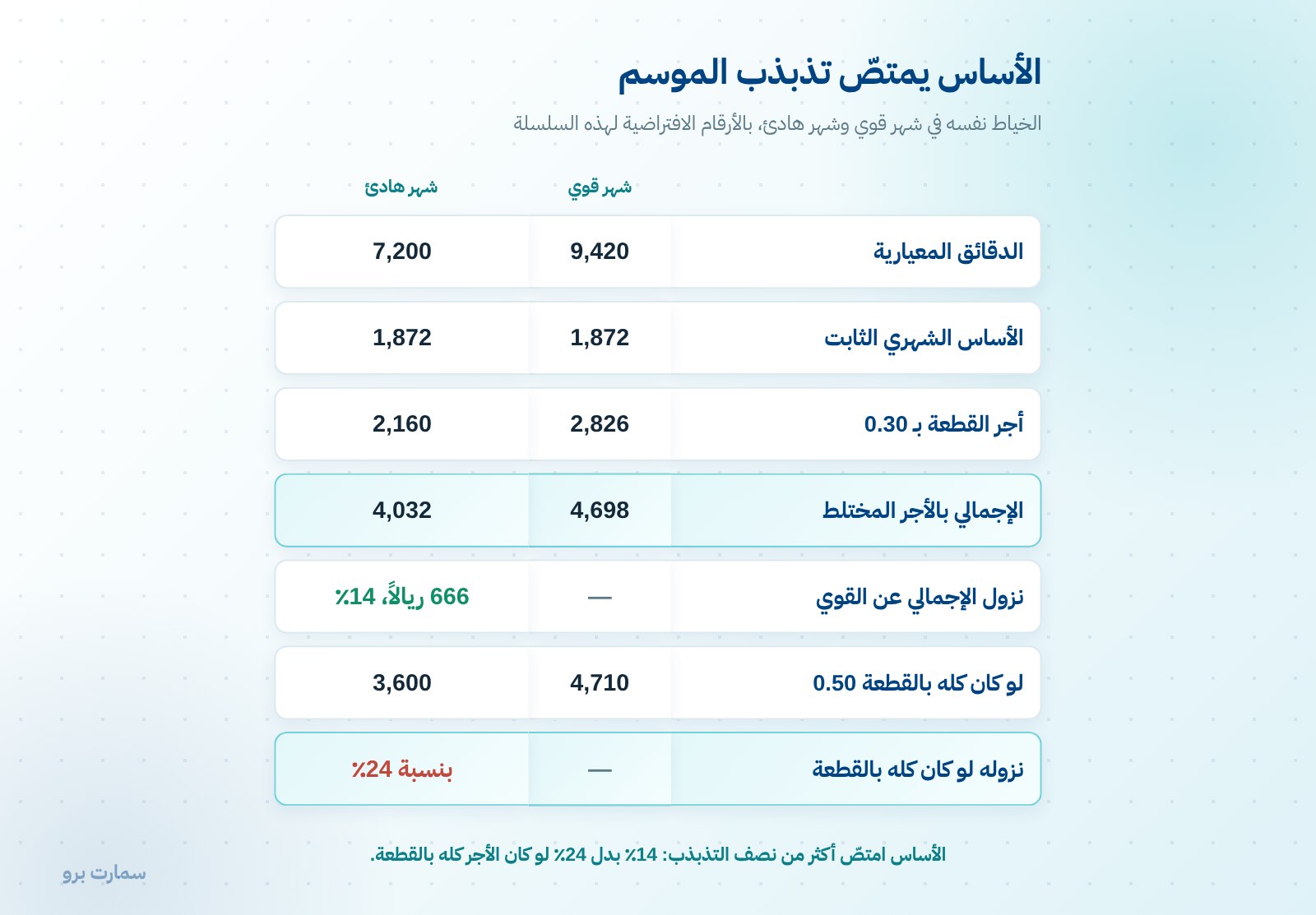
In a quiet month, the same tailor might reach only 7,200 standard minutes. Piece-rate pay then becomes 7,200 × 0.30 = SAR 2,160, and total pay 1,872 + 2,160 = SAR 4,032. That is SAR 666 less than the strong month, a drop of 14%.
If all pay were piece rate at SAR 0.50 per minute, it would fall from 9,420 × 0.50 = SAR 4,710 to 7,200 × 0.50 = SAR 3,600, a drop of 24%. The base absorbed more than half of the swing.
That is its purpose. It is not generosity: a workshop that makes tailors carry the full seasonal swing pays for it next season when it has to search for replacements. The cost of that search is worked out in hiring tailors.
The file must match what is registered
The most common flaw in tailoring workshops is that the internal notebook says one thing and the official registration says another. The wage in the employee file is one figure, what is actually paid is another, and the wage on which contributions are calculated is a third. At the first review or dispute, there is no single figure you can defend.
This is not fixed by a year-end reconciliation, but by three monthly habits:
- One name and one number for each tailor in the employee file, the payroll and the piece-rate log, so the three can be matched in a minute, not a day.
- Pay components named, not lumped together. The base, the piece rate and each allowance get their own line, because a single combined figure cannot be reconciled with anything.
- A fixed payday that does not move with cash flow, because a one-day delay costs more in trust than it saves in cash.
What counts toward the contributory wage and how the rates are calculated is covered in GOSI contribution rates, the full monthly cycle in the payroll run guide, and what is due when employment ends in end-of-service benefit calculation. Those three references are where the rules live; this article is where the arithmetic lives.
Where do the piece counts on the payslip come from?
The biggest practical gap is not the calculation but getting the completed piece counts into payroll without errors. The method that works is for the number to come from the order workflow itself, not from a parallel notebook.
- The tailor is assigned to the order when it enters the sewing stage, not at month-end from memory.
- The piece is credited to the tailor when the order moves to the "Ready" stage, so no piece is counted that has not passed quality inspection.
- Rework is excluded from the count when it is caused by the tailor's own mistake, under a written policy set in advance rather than a decision made afterwards, as described in rework policy.
- The log is closed on a set date two days before payday; anything delivered after that is counted in the following month.
Linking the count to the order stages (Received → Cutting → Sewing → Ironing → Ready → Delivered) is what makes the payslip auditable line by line, and what ends the monthly argument over counts.
Pay is not the full cost
The SAR 0.50 per minute used to cost items throughout this series is the wage due to the tailor, not everything the tailor costs. On top of it sit the employer's burdens: contributions, housing where provided, tickets, insurance and renewals.
Anyone who prices on SAR 0.50 alone is pricing on an incomplete figure. The fix is not to change the wage rate but to add a burden rate on top of it, calculated by dividing total annual burdens by total annual wages. How to build it is explained in the true cost of an employee.
An even bigger mistake is costing a thobe on the piece rate alone: SAR 24 in our example instead of SAR 40, which is the full wage for 80 minutes at SAR 0.50. The thobe then looks SAR 16 cheaper in the books than it really is, and the selling price is built on that shortfall, as detailed in the true cost of tailoring a thobe.
The official reference
Labour regulations, pay components and deductions from pay are published by the Ministry of Human Resources and Social Development, which is the reference in case of any disagreement.
Putting all this into practice is easier when orders, fabrics and invoices live in one system: a tailoring workshop management system.
Read also
Article visuals
Frequently asked questions
How should I split a tailor's pay between the base and the piece rate?
Calculate the target pay first from productive minutes, then split it. In the hypothetical example, 9,360 minutes at SAR 0.50 gives SAR 4,680, split 40% as a fixed base and 60% as piece rate, which is SAR 0.20 and SAR 0.30 per minute respectively. The base covers non-productive time, and the piece rate covers the output itself.
How do I calculate the piece rate for each item?
Multiply the item's standard minutes by the per-minute rate of the variable component. At SAR 0.30, a plain thobe of 80 minutes pays SAR 24 and an embroidered abaya of 180 minutes pays SAR 54. The total minutes completed should come out close to the available productive minutes.
Does a tailor paid by the piece need a payslip?
Yes. Piece rate is a way of calculating pay, not a substitute for the payroll run. The payslip shows the base, the piece-rate pay, the piece counts and the deductions as named lines, which makes it auditable and ends the monthly argument over counts. The piece log should be closed on a set date two days before payday.
Why is a tailor's pay different from what the tailor costs the workshop?
Because the SAR 0.50 per minute rate is the wage due and nothing more. On top of it come the employer's burdens: contributions, housing, tickets, insurance and renewals. You add a burden rate calculated by dividing total annual burdens by total annual wages, without changing the wage rate itself.