
Hiring Tailors: How to Find Skilled Ones and Keep Them
Hiring tailors is usually handled as an emergency, so it costs more than it should. What keeps skilled tailors, what a leaver costs in numbers, a measured trial period and a training ladder for beginners.
Author:سامي الحيدري
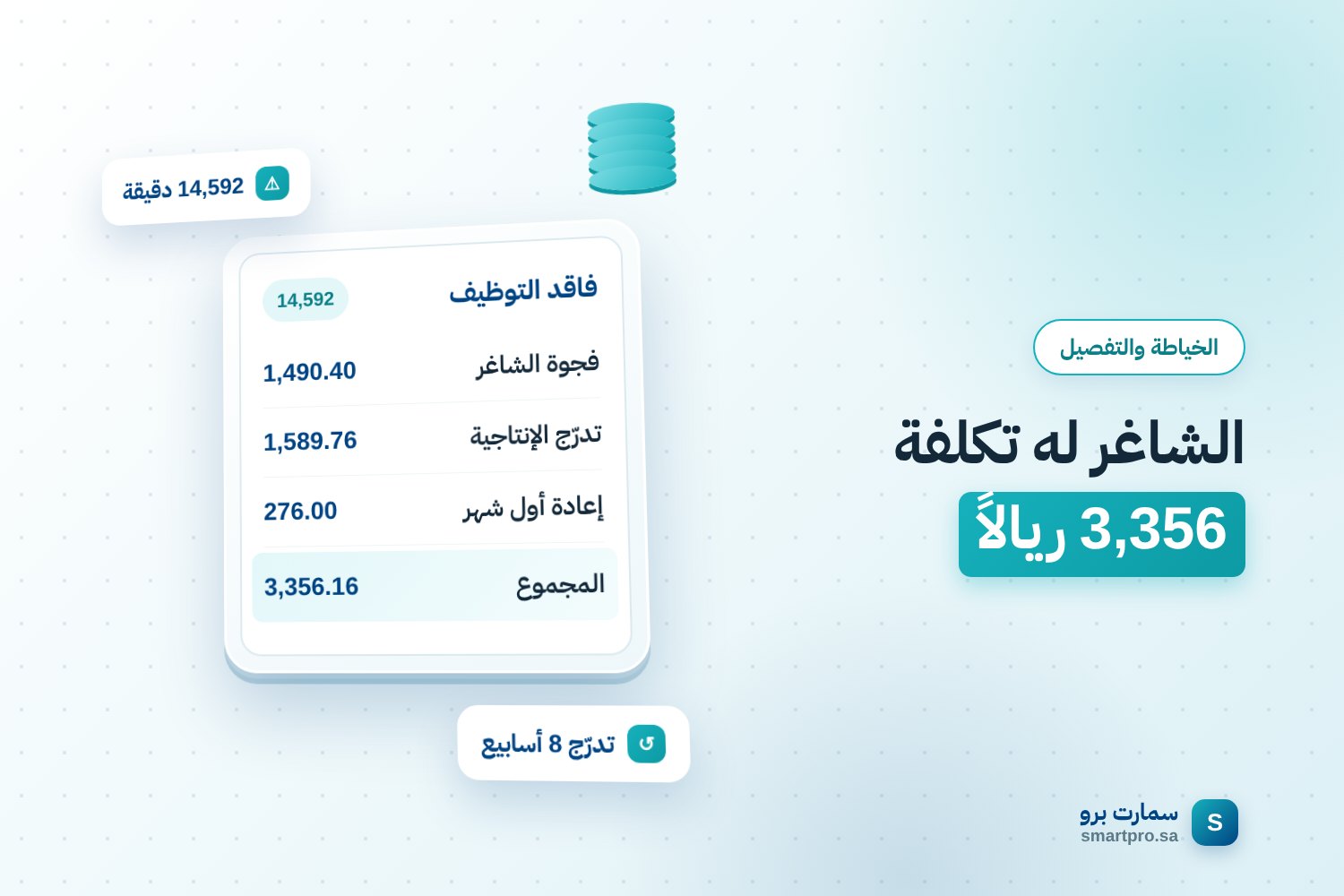
Hiring tailors is the hardest operational decision in a tailoring workshop, and the one most often made in a hurry. A tailor leaves mid-season, a replacement is brought in from the first available offer, and two months later it turns out his output is half that of the man before him and rework has doubled.
The reason is that the workshop treats hiring as an emergency, not as a process with steps, standards and numbers. This article sets out those steps and numbers, starting with the question that comes before all of them: why does a skilled tailor stay?
Why does a skilled tailor stay?
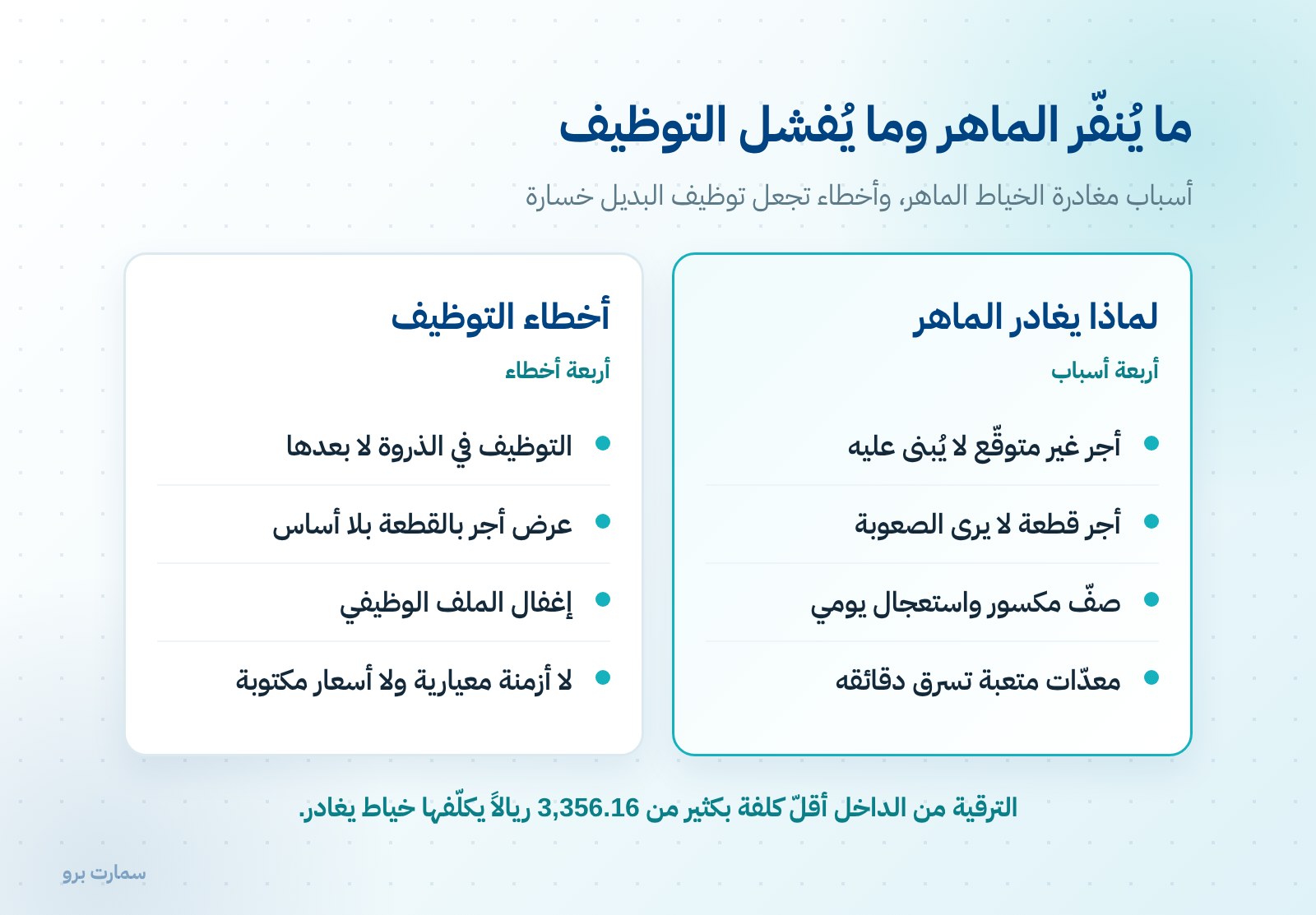
A skilled tailor does not leave because the workshop next door pays a little more per piece. He leaves for four reasons that repeat in every workshop.
Unpredictable pay. If pay is by the piece alone, his income swings from month to month depending on how much work reaches him, and he controls neither the queue nor the items assigned to him. A tailor is not asking for higher pay so much as pay he can plan his rent and commitments around.
A piece rate that ignores difficulty. One rate for a plain thobe and a thobe with special details means the tailor loses every time he is given the harder one. So he avoids it, rushes it in a way that hurts quality, or leaves for someone who pays the difference. How to differentiate is explained in difficulty-based piece rates.
A broken queue. When work is accepted beyond capacity, the tailor receives pressure he did not create: orders that are late before they start, daily rushing, and one order jumping ahead of another without logic. Nothing wears out a skilled tailor faster. The link between capacity and the queue is covered in calculating workshop capacity.
Tiring equipment. A machine that needs adjusting every hour, a weak iron, a short cutting table — each one steals minutes from his piece-rate earnings. A piece-rate tailor pays for bad equipment out of his own pocket, and he knows it and counts it.
Hiring tailors: what a departing tailor costs
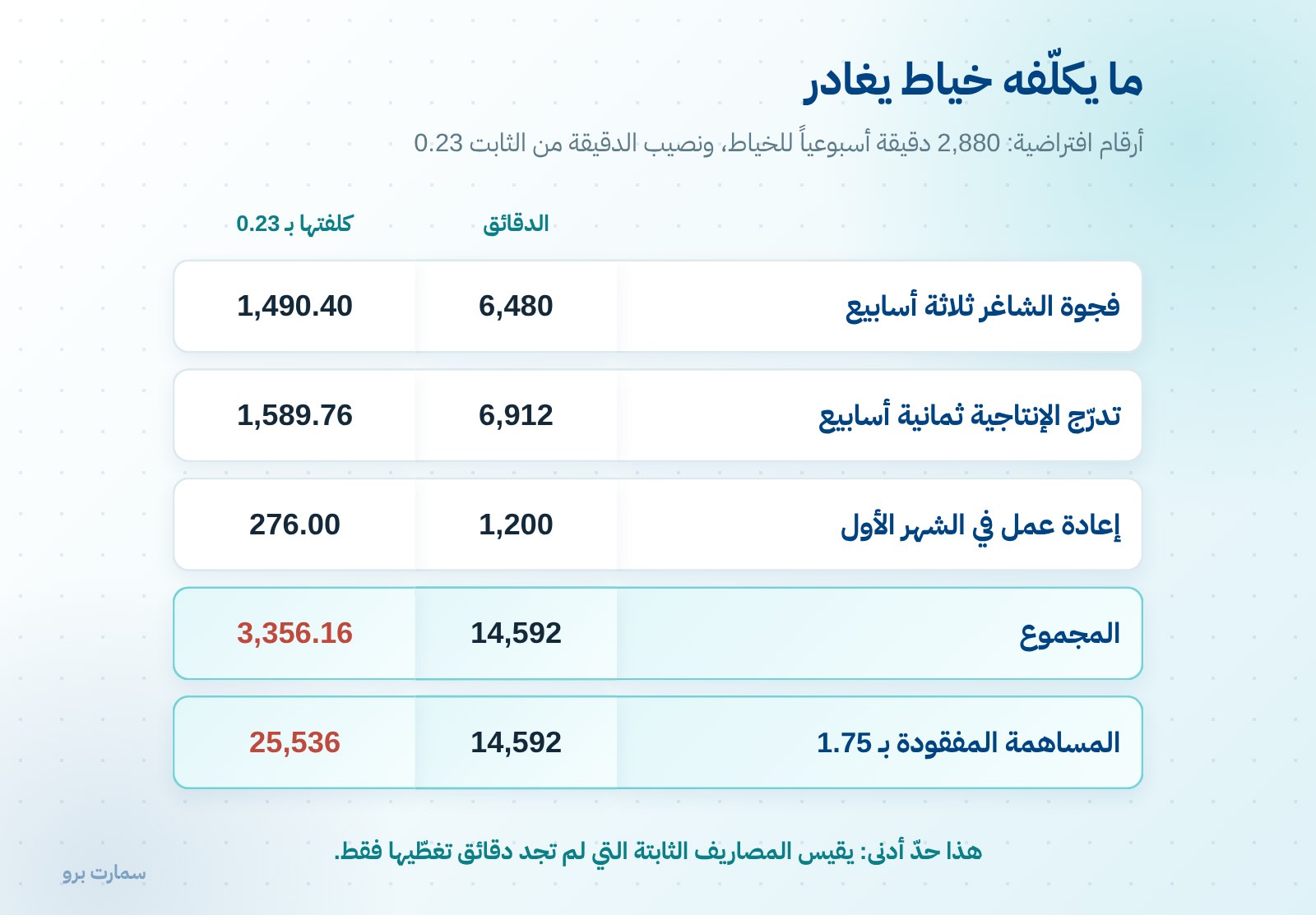
The figures below are hypothetical, to illustrate the method, and do not represent prevailing market rates. Take the reference workshop used in this series: five tailors, eight hours a day, 26 working days, which gives 5 × 8 × 60 × 26 = 62,400 available minutes a month. Fixed costs are SAR 14,400, so each minute carries 14,400 ÷ 62,400 = SAR 0.23 of fixed cost.
One tailor's share of available minutes is 62,400 ÷ 5 = 12,480 minutes a month, or 2,880 minutes a week. At a realistic 75% utilisation, his effective minutes come to 9,360 a month.
| Loss item | Calculation | Minutes | Cost at SAR 0.23 |
|---|---|---|---|
| Three-week vacancy gap | 3 × 2,880 × 75% | 6,480 | 1,490.40 |
| Eight-week ramp-up at 60% productivity | 8 × 2,880 × 75% × 40% | 6,912 | 1,589.76 |
| Rework in the first month | Estimate | 1,200 | 276.00 |
| Total | 14,592 | 3,356.16 |
This is the minimum, because it only measures fixed costs that found no minutes to cover them. If orders were actually available and turned away, every one of these minutes carries a contribution margin of about SAR 1.75 in the thobe example published in the true cost of tailoring a thobe — that is 14,592 × 1.75 = SAR 25,536 of lost contribution.
The right comparison is not one cost against another, but this figure against what it would have cost to keep the tailor: a piece-rate review, a new machine, or a monthly base that stabilises his income.
The trial period: three weeks, three outputs
What most often ruins a trial period is leaving it unmeasured, so it ends with a general impression: "his work is good" or "it didn't work out". An impression cannot be compared, reviewed or used to set pay.
Make it three stages, each with a written output:
- Week one — measurement: easy items only; the goal is to learn his actual time, not his top speed. Time five pieces of each item and take the average.
- Week two — quality under time: medium items with a real delivery date, measuring the share of work that comes back from quality inspection.
- Week three — the difficult item: one piece of the hardest thing you produce, under supervision, followed by a joint review of what it showed.
Record the result in three numbers and no more: average minutes per item, rework rate and on-time rate. These are the same numbers you use to measure your existing tailors, as in tailor productivity. If the trial standards differ from the working standards, the trial measures nothing.
From beginner to producer: a four-step ladder
A shortage of skilled tailors is not solved by competing for the limited number available, but by developing the replacement. A beginner reaches production if he is placed on a clear ladder, not if he is left to watch and called on when needed.
| Step | What he is assigned | Criterion to move up |
|---|---|---|
| First | Ironing, finishing and attaching buttons | Completes the day's quota with no rework |
| Second | Straight seams and assembling cut pieces | Time within 130% of standard |
| Third | A complete plain piece under supervision | Time within 110% and rework below 5% |
| Fourth | Cutting and difficult items | Time within standard and reviews others' work |
Cutting is the last thing taught, not the first, because a cutting mistake cannot be fixed with a stitch. A beginner on the first step lowers your cost immediately, because every minute of ironing and finishing he does is a minute handed back to the skilled tailor to spend sewing.
That is why a beginner's effect on capacity comes faster than his effect on headcount: if he frees twenty minutes a day from each tailor's time, that is 5 × 20 × 26 = 2,600 minutes a month returned to sewing, equivalent to about 32 thobes at 80 minutes per thobe.
Documenting the craft: so a leaver doesn't take the workshop with him
In many workshops, knowledge lives in one person's head: he knows the old customer's measurements, his collar preference, which fabric shrinks and how a striped cloth is cut. When he leaves, all of that leaves with him, and the workshop starts from zero with every returning customer.
Documentation is not a big project, just four files built up gradually:
- A measurement record under the customer's name and number, updated with every change, as in measurement records.
- A worksheet for every order carrying the measurements, notes and item, so any tailor can read it, not only its author. Details are in the tailor worksheet.
- Standard times for each item, since they are the basis of the piece rate and of capacity calculation, and should not live in anyone's memory.
- Fabric notes: what shrinks, what needs extra metres at layout, and what cannot take a hot iron.
The easiest way to build these files is to fill them in as things happen, inside the order flow itself — received → cut → sewn → ironed → ready → delivered — rather than collecting them later in a documentation session that never happens.
Where do you find candidates?
The first route is internal promotion. Whoever is on the second step today is your skilled tailor a year from now, and promoting him costs far less than the figure in the table above.
The second route is local hiring, which in women's workshops involves specific considerations around administrative and technical occupations. These are gathered in batch production, and the authority on them is the Ministry of Human Resources and Social Development.
The third route is referrals from your current tailors. It is the most successful and least costly route, because a tailor will not refer someone who would embarrass him in front of you.
On every route, the premises themselves limit how many people you can actually employ: the sewing area, the number of cutting tables and the fitting room. These are gathered in tailoring shop requirements and should be reviewed before any decision to add headcount.
Four mistakes that turn hiring into a loss
- Hiring at peak season. A beginner who joins mid-season is not trained; he is used up and then leaves. The right time is after the season, not during it.
- Offering piece rate with no base. A new tailor does not know your queue or your items, so piece rate alone in the first two months means income he cannot rely on. The two models are compared in piece rate or salary.
- Neglecting the employment file. Setting up pay components and running the monthly payroll are explained in workshop payroll and the payroll run guide.
- Writing nothing down. No standard times, no written piece rates, no quality standards. Every later dispute then becomes a dispute about what was said verbally months ago.
The official reference
Matters of labour regulations, contracts and Saudisation are published by the Ministry of Human Resources and Social Development, which is the reference in any disagreement.
Everything described here is run in practice in SmartPro's tailoring system: orders, measurements, fabrics and invoicing in one place.
Read also
Article visuals
Frequently asked questions
Why does a skilled tailor leave one workshop and stay in another?
For four recurring reasons: fluctuating pay he cannot plan around, a piece rate that does not distinguish easy from difficult work, a queue accepted beyond capacity that reaches him as daily pressure, and tiring equipment that steals minutes from his piece-rate earnings. Higher pay alone fixes none of the four.
How much does a departing tailor cost the workshop?
In the hypothetical example, a three-week vacancy gap, an eight-week productivity ramp-up and first-month rework add up to 14,592 lost effective minutes. At SAR 0.23 of fixed cost per minute, the cost is SAR 3,356.16, and that is the minimum before counting lost contribution margin.
How do I build a useful trial period for a new tailor?
Use three weeks with three outputs: one week to measure his actual time on easy items, one week for his quality under a real delivery date, and one week on the difficult item under supervision. Record the result in three numbers: average minutes, rework rate and on-time rate.
How do I train an inexperienced tailor until he becomes productive?
Put him on a four-step ladder with a written criterion for moving up: ironing and finishing, then straight seams, then a complete plain piece under supervision, then cutting and difficult items. Cutting is taught last because its mistakes cannot be fixed, and the first step frees minutes for skilled tailors immediately.