
How to Choose CRM Software and Connect It to Your Accounting
A practical guide to choosing CRM software in Saudi Arabia: the chain from lead to invoice, why a quotation is not a tax invoice, and the criteria to compare systems on.
Author:سامي الحيدري
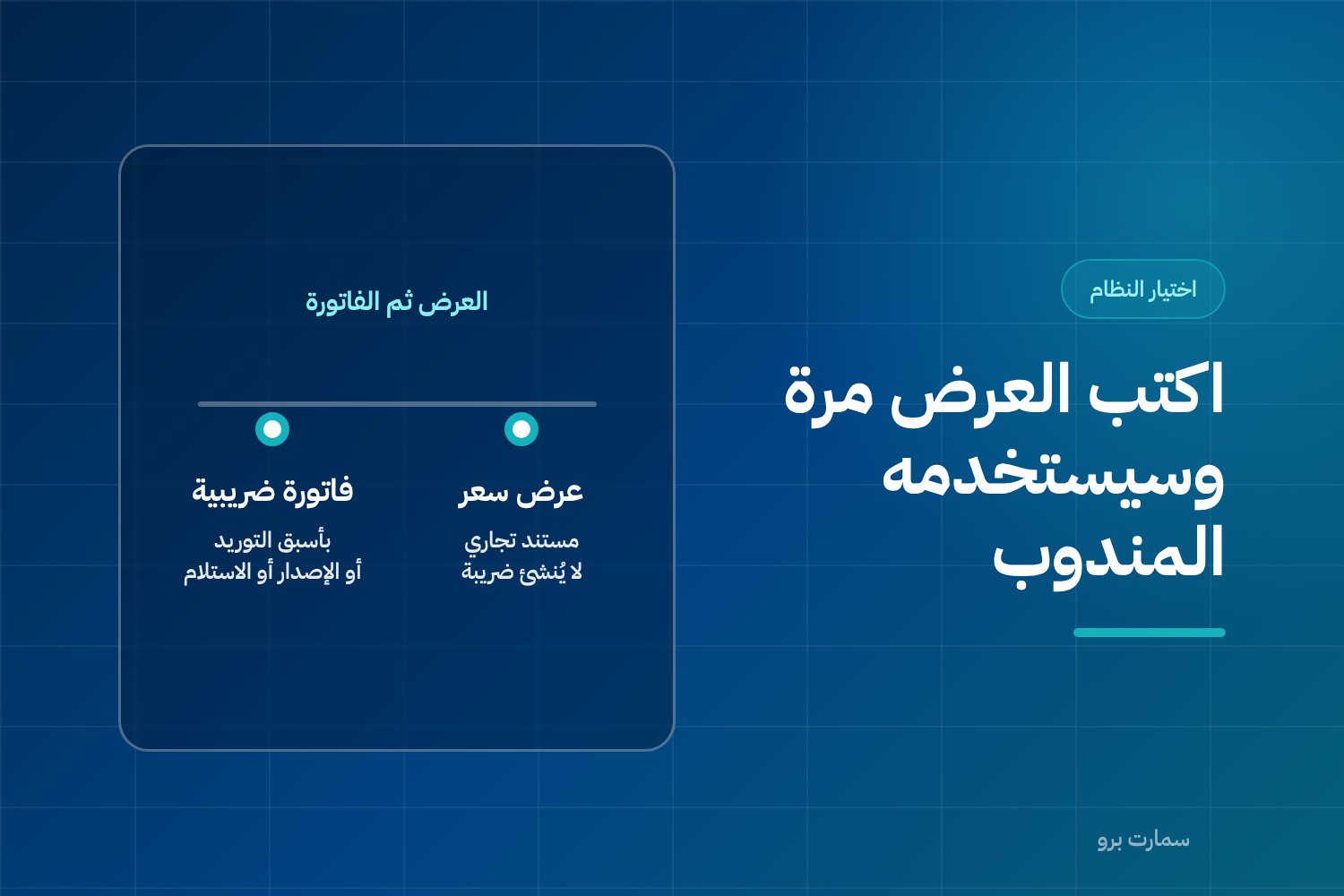
Choose CRM software that saves your sales reps time on the same day they use it, and that carries one deal from lead to quotation, sales order and tax invoice without retyping. A CRM is a system for tracking customers, deals and follow-ups. If it is not connected to accounting and inventory, its pipeline figures cannot be trusted.
In most companies, CRM software does not fail for technical reasons. It fails because sales reps get nothing back for the time they put in. If the system is just a reporting tool for the manager, it gets filled in during the first week, less in the second month, and becomes an empty database after three months. The manager sees the numbers fall and assumes sales have dropped, when in fact it is data entry that has stopped.
The test we suggest is simple: does the system save the rep time on the same day they use it? If they write the quotation once instead of twice, see their contact history with the customer before picking up the phone, and receive reminders instead of having to remember them, they will use it without anyone pushing. If not, no internal policy will make them use it.
Why does CRM software die after three months?
The causes repeat, and you can spot them before you buy:
- Double entry. The rep records the opportunity in the CRM, writes the quotation in a separate file, then asks accounts to issue the invoice from a third system. The same data is typed three times.
- Too many fields with no visible benefit. Twenty mandatory fields to log one call, of which the manager uses only two in their report.
- Nothing comes back to the rep. No follow-up reminder, no organised contact history, no way to know whether the customer has paid their last invoice.
- No mobile access. Field visits happen outside the office. If logging them means sitting at a computer, it will only happen at the end of the week, from incomplete memory.
How should a deal move from lead to invoice?
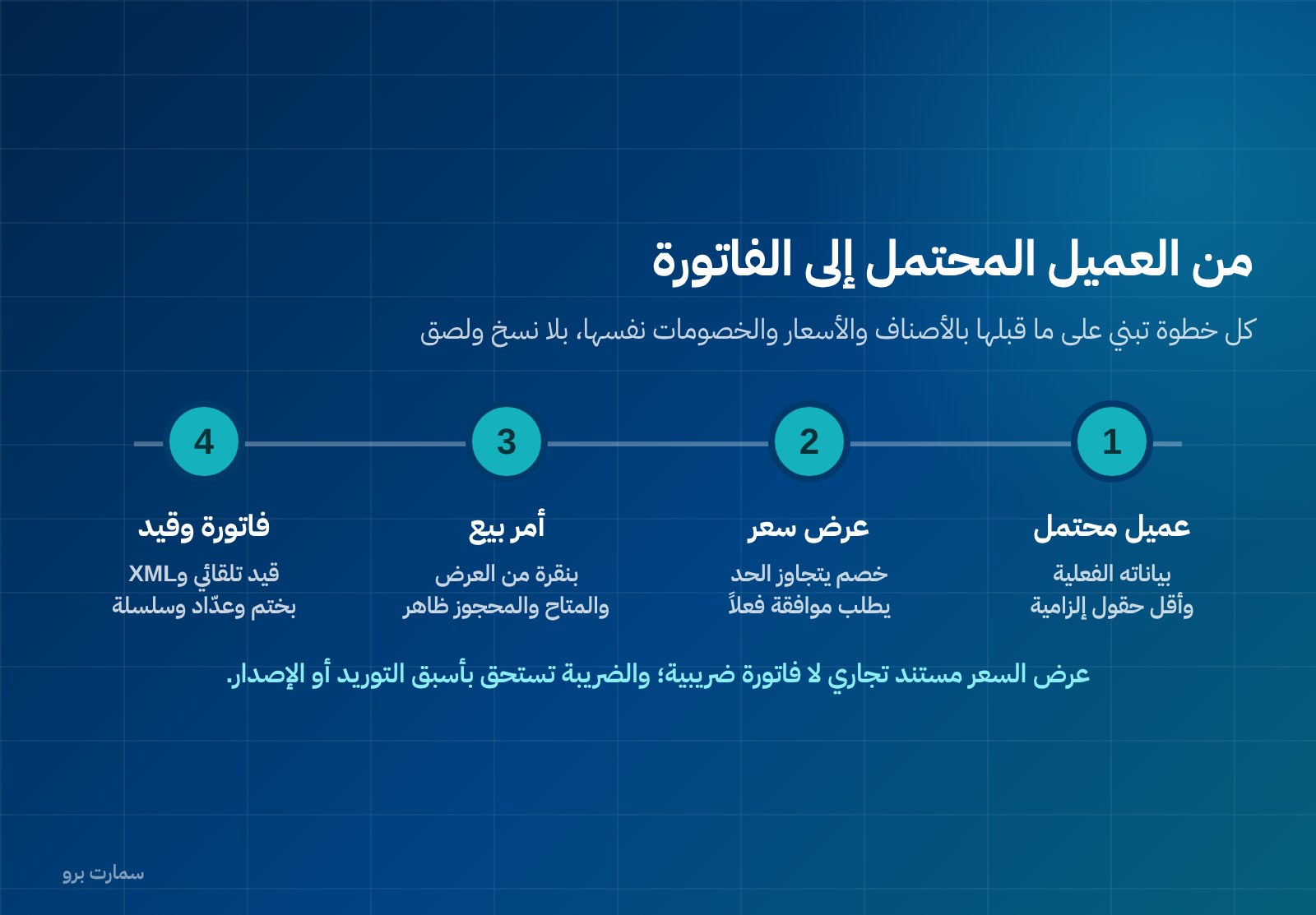
The chain that must run without breaks is: lead → quotation → sales order → invoice.
Each step must build on the one before it. The quotation becomes a sales order in one click, and the sales order becomes an invoice with the same items, prices and discounts. No retyping, no copy and paste.
If the quotation is written in one system and the invoice in another, two problems appear. First, the numbers don't match: the discount the rep gave in the quotation doesn't reach the invoice, or arrives at a different rate. Second, and more serious for management, nobody can say with confidence what the pipeline is worth, because open quotations sit in one place and issued invoices in another, with no saved link between them. The pipeline is simply the total of open deals at each stage.
Linking CRM to accounting is not a technical luxury; it is the condition for the figures to mean anything. If you are weighing a standalone accounting program against an integrated system, this exact difference is explained in our comparison of accounting software and ERP.
Is a quotation a tax invoice?
No, and sales teams get this wrong often, with a direct accounting impact.
A quotation is a commercial document, not a tax invoice. Issuing it does not, by itself, create any VAT liability. Under Saudi VAT, the tax becomes due on the earliest of three dates: the date the goods or services are supplied, the date the invoice is issued, or the date payment (consideration) is received.
That is why the distinction matters in practice. Suppose a customer accepts a quotation and transfers an advance payment. The quotation did not create a liability, but receiving the money did, because receipt of consideration is one of the three dates. If the system treats the quotation as a silent piece of paper and does not link the payment received to any tax document, the payment will sit in the bank account with no VAT treatment until someone discovers it later.
Good software does two things here: it keeps the quotation as a quotation, and it opens a clear path to issue the tax document when the payment is received or when supply happens, whichever comes first.
Remember also that a standard tax invoice is required when the customer is a VAT-registered business, and it must show the buyer's name, address and VAT registration number. For the mandatory fields and how Phase 2 e-invoicing works on the Fatoora platform, see our ZATCA e-invoicing guide. A pro forma invoice, like a quotation, is a preliminary document and not a tax invoice.
What criteria should you compare CRM systems on?
Compare on criteria, not slogans. This table works as a worksheet in front of the vendor:
| Criterion | What to ask exactly | Red flag |
|---|---|---|
| Stages and how editable they are | Can I change the names and number of stages myself, without development? | Stages are fixed and imposed by the system |
| Quotations converting to sales orders | Does the quotation become a sales order and then an invoice with the same data? | Items retyped at every stage |
| Pricing, discounts and approvals | Are there discount limits and an approval chain when they are exceeded? | Any user can give any discount |
| Follow-ups and reminders | Does the system create a reminder automatically at each stage? | Reminders are fully manual |
| Contact history | Can I see every call, message and visit on one screen? | History scattered across users' files |
| Link to accounting and inventory | Do the invoice, the journal entry and the quantity all update from one source? | Export and import through files |
| Pipeline reports | Can I see value, count and average time to close for each stage? | One fixed report that can't be filtered |
| Mobile use | Can a rep log a visit on site within a minute? | A view-only app with no data entry |
Add a ninth, non-technical criterion: who will train the team, and how long will the first complete sales cycle inside the system take?
Why must the CRM show stock before a rep promises a date?
The mistake that most often causes friction between sales and operations is promising a customer a delivery date without looking at stock.
The rep wants to close the deal, so they say two weeks. The warehouse then finds the item is out of stock and the supplier lead time is four weeks. The company pays in reputation, the rep gets blamed, and the root cause is that the system did not show the available quantity at the moment they were negotiating.
So the CRM must see inventory: the available quantity, the quantity reserved for other sales orders, and incoming purchase orders with their dates. The rep doesn't need to run the warehouse, just to see one number before naming a date. To see how to assess this kind of integration within a single package, read our practical framework for choosing accounting software in Saudi Arabia.
Should after-sales support and tickets live in the same system?
Customers don't distinguish between the sales department and the support department. They see one company.
If the customer's sales record is separate from their support tickets, the customer has to explain their situation from scratch on every call: what they bought, when, at what price, and what problem they reported last month. That alone is enough reason to lose a contract renewal.
The minimum you need is one customer file, where support can see purchase history, invoices and items, and the rep can see open tickets before trying to sell an add-on. The practical sign that the link works: a support agent can answer "what did this customer buy?" without asking anyone.
How do you calculate the value of your pipeline?
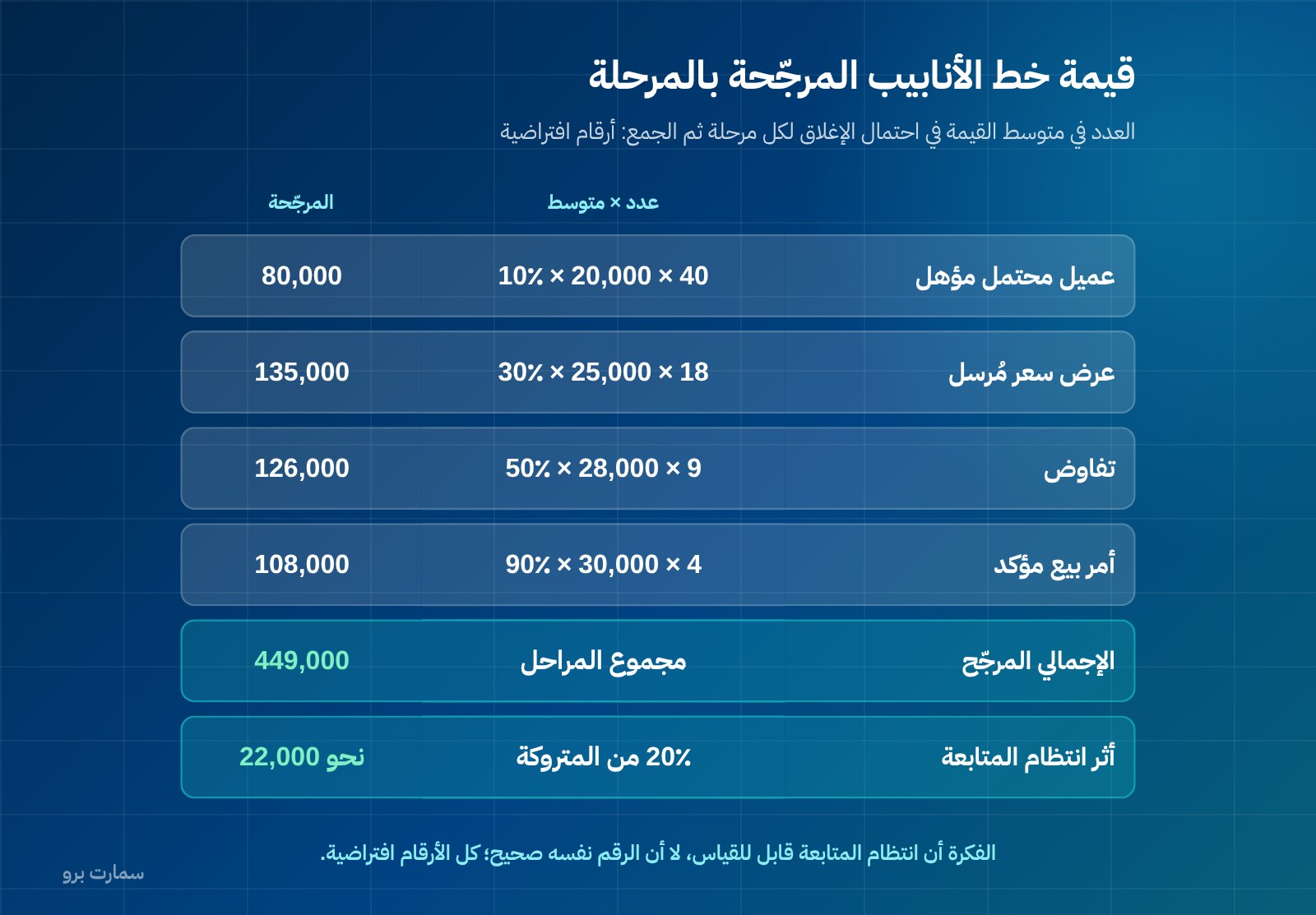
The figures below are hypothetical, to illustrate the method. They are not market data or sector averages.
| Stage | Opportunities | Average value (SAR) | Probability of closing | Weighted value (SAR) |
|---|---|---|---|---|
| Qualified lead | 40 | 20,000 | 10% | 80,000 |
| Quotation sent | 18 | 25,000 | 30% | 135,000 |
| Negotiation | 9 | 28,000 | 50% | 126,000 |
| Confirmed sales order | 4 | 30,000 | 90% | 108,000 |
| Weighted total | — | — | — | 449,000 |
The method is straightforward: for each stage, multiply the number of opportunities by the average value and by the probability of closing, then add the stages together.
Now suppose follow-up discipline improves by 20%, meaning 20% of the opportunities that used to be left without follow-up are now followed up on time and move to the next stage. If four more opportunities move from the quotation stage to negotiation, the weighted value of those four rises from 30% to 50% of their value: 4 × SAR 25,000 × 20 percentage points = about SAR 20,000 in this hypothetical example alone.
The point is not the number. The point is that follow-up discipline is measurable, and a system that creates reminders automatically moves a figure you can see, not just a general feeling that the team has become more active.
What should you test during a trial?
Don't buy on the strength of a presentation. Ask for a trial with one real deal of your own and walk it through the whole chain:
- Enter the lead with its actual details, and note how many fields are mandatory.
- Create a quotation with your items and prices, including a discount above the allowed limit, and check that approval was actually requested.
- Log a follow-up call, and confirm the system created a reminder for the next step without you asking.
- Convert the quotation to a sales order, and compare every line: items, quantities, prices, discount and VAT rate.
- Open the inventory screen from inside the sales order, and check that available and reserved quantities appear.
- Issue the invoice, and check that the buyer's name, address and VAT registration number appear on the standard invoice.
- Confirm the journal entry was created automatically, and that the document is produced as XML in the UBL 2.1 standard, with the cryptographic stamp, the non-resettable counter and the hash chain, as Phase 2 e-invoicing requires.
- Open the same customer's file from the support screen, and check that the invoice and items appear.
- Repeat everything on a mobile phone. If one step breaks, it will break for your team too.
What do the packages cost?
Compare cost on the total you will pay per year, not the price per user. SmartPro packages are Mini at SAR 1,500 a year including VAT, Pro at SAR 4,500 and Max at SAR 20,500; the Customer Management system can be added to any of them at SAR 1,500 a year. To see how stages, quotations and tickets sit in one place, you can explore the SmartPro CRM module before choosing the package that fits the number of your sales reps.
Where is the official reference?
For the official rules on VAT, e-invoicing and Phase 2 requirements, the authoritative source is the Zakat, Tax and Customs Authority (ZATCA) at zatca.gov.sa.
Read also
- Accounting software or ERP? A practical choice for Saudi businesses
- How to choose the best accounting software in Saudi Arabia
- ZATCA e-invoicing guide
Key takeaway: Pick CRM software your reps gain from on day one, where a quotation flows into a sales order and a VAT invoice with the same data, and where stock and accounting update from one source.
To walk one of your own deals through the full chain, start a free trial or book a 30-minute demo.
Article visuals
Frequently asked questions
Does a quotation create a VAT liability?
No. A quotation is a commercial document, not a tax invoice, and issuing it does not by itself create any VAT liability. VAT becomes due on the earliest of three dates: supply, invoice issue, or receipt of payment. If you receive an advance payment against a quotation, the receipt itself is what creates the liability.
When do I need a standard tax invoice rather than a simplified one?
A standard tax invoice is required when the customer is a VAT-registered business. In that case the invoice must include the buyer's name, address and VAT registration number. Your CRM software should therefore keep these details in the customer file from the start, rather than asking for them at the moment of invoicing.
What is the most important criterion when choosing CRM software?
That it saves the sales rep time on the same day they use it. If the system is only a report for the manager, data entry stops within weeks and the figures lose their meaning. The practical sign is that the rep writes the quotation once, and it then becomes a sales order and an invoice with the same data.
Why should a CRM system show inventory?
Because promising a customer a delivery date without seeing available stock is the most common cause of friction between sales and operations. The rep needs to see available and reserved quantities and incoming purchase orders before naming a date. This doesn't mean running the warehouse from the sales screen, just seeing one number while negotiating.