
Arabic Accounting System or Localised Global System: How to Choose
This isn't a language decision. Here's how an Arabic accounting system built for the Saudi market compares with a localised global system, where each one genuinely wins, and who pays when regulations change.
Author:سامي الحيدري
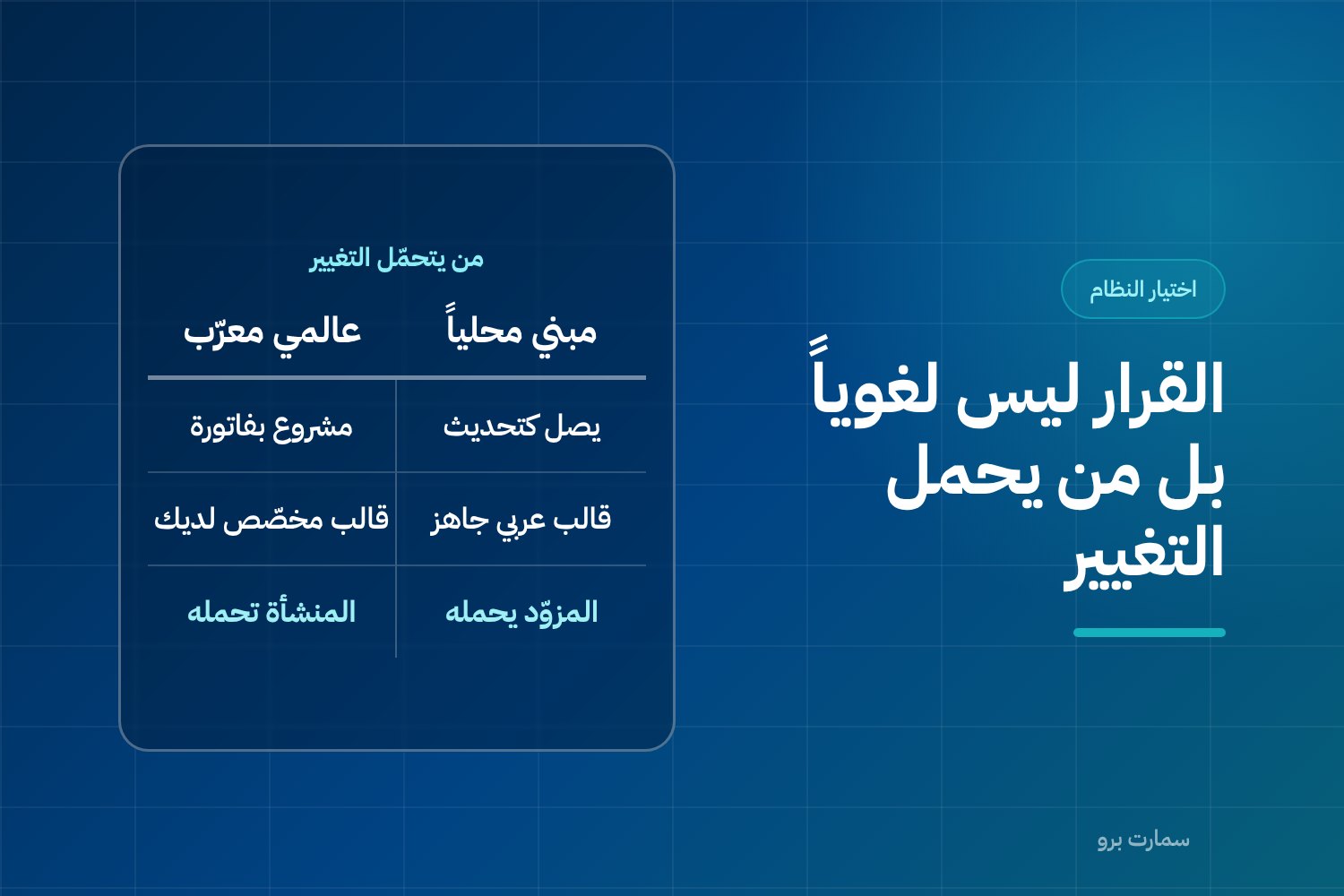
The choice between an Arabic accounting system built for the Saudi market and a localised global system is not about screen language. It is about who carries the cost of regulatory change. A full Arabic interface that produces a non-compliant invoice is worse than an English interface that produces a correct one.
The question usually reaches us like this: do we need an Arabic accounting system built for the local market, or is a localised global system enough? It's a fair question, but the way it's framed pushes the decision to the wrong place. It turns it into a language choice, Arabic screens versus English screens, and that isn't where the risk lies.
The real risk is a fully Arabic interface paired with an invoice that doesn't meet local requirements. Here the Arabic gives you false comfort: everything looks familiar, while the output your business is held accountable for is wrong.
This article compares two categories and two ways of working, not product names. It mentions no specific brand: a system built for the local market versus a localised global system. Each category wins in real places, and anyone who tells you otherwise is selling you something.
Is an Arabic interface the same as real localisation?
The localisation you see in a sales demo is translated menus. The localisation you see in daily operation is something else, and it works on three levels.
The screen level. Genuine right-to-left (RTL) layout, meaning the whole screen is mirrored for Arabic, not Arabic text dropped into a left-to-right design. You notice the difference in the details: where table columns sit, where the Save and Cancel buttons are, how numbers and currencies align, how search fields behave, and the order fields follow when you tab through them. Translated menus alone give you a screen with Arabic words and a Western structure, so data entry slows down and errors repeat.
The data level. Are customer, item and account names stored, sorted and searched correctly in Arabic? Arabic alphabetical sorting, handling of hamza and taa marbuta, and partial search inside a name are all details that surface with the first report requested in alphabetical order, not in the first trial.
The document level. This is the level that decides things. The invoice must be issued in Arabic; a bilingual invoice is allowed, but Arabic is required. Any system that prints an English-only document and leaves you to add the Arabic by hand has shifted the burden onto you, not onto itself. We cover how to build a two-language document, and what must appear on it, in our article on the bilingual invoice.
What is the real decision? Who carries the burden of regulatory change
Set language aside for a moment. Local requirements change: phases are completed, fields are added, the integration method or document details change. The only practical question is this: when that happens, who implements the change, through what route, and at whose expense?
The first category treats regulatory change as part of the product. It arrives as an update, because the local market is the vendor's entire market, so a change the vendor makes once serves every customer. The second category treats it as a market-specific matter: some of the requirements arrive in general updates, while the rest arrive through a local module or an implementation partner, meaning through a project with a scope, a schedule and an invoice.
That is the structural difference. Everything else, such as screens, calendar and date format, are important details but solvable ones. The burden of change can't be solved by customisation; it is a consequence of the product model itself.
How do the two categories compare, criterion by criterion?
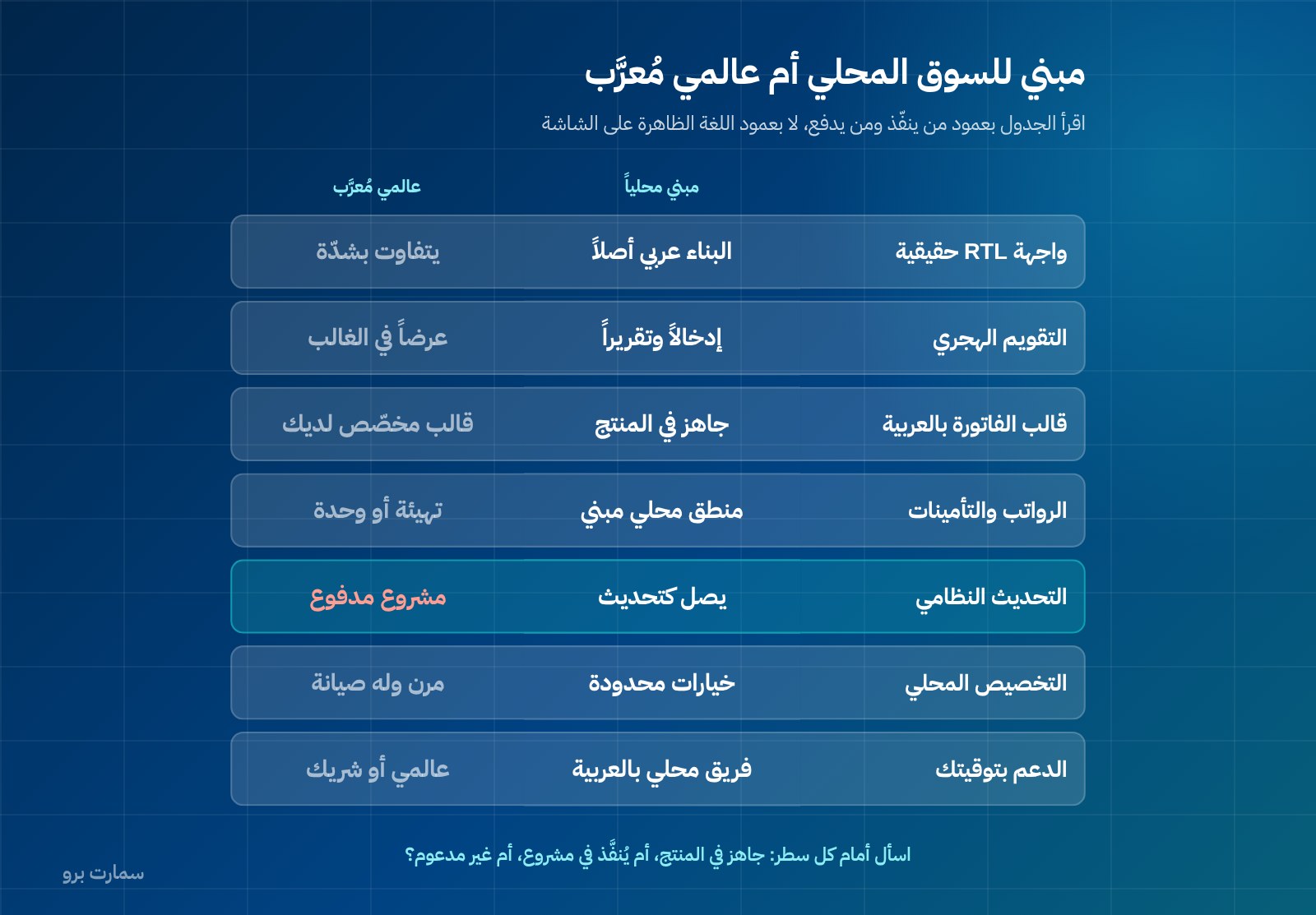
| Criterion | System built for the local market | Localised global system |
|---|---|---|
| Sound Arabic interface (genuine RTL, not translation) | Built in Arabic from the ground up, with English as a second layer | Varies widely: some have mature RTL, some are a translation over a Western layout |
| Hijri calendar | Usually present in both data entry and reports | Sometimes available for display, rarely in period and closing logic |
| Arabic and bilingual invoices | Ready-made Arabic template, bilingual as an option | Usually needs a custom template built and maintained on your side |
| Integration requirements | Delivered as part of the product | Sometimes an official module, sometimes through a partner or integration middleware |
| Local payroll and social insurance | Local logic built into the system | Set up through configuration or a local module, depending on country and version |
| Support in your time zone and language | Local Arabic-speaking team during your working hours | Varies: global support in English, or a local partner depending on the contract |
| Who pays for regulatory updates | The vendor, delivered as an update | Split between vendor and partner, often a paid project |
| Local customisation | Fewer options, but most needs are already covered | Flexible and deep, and that flexibility itself means a project and maintenance |
The table is not a scoreboard. It's a tool for asking the vendor, line by line: is this ready in the product, delivered through a project, or not supported? The third answer is better than a vague one.
Where does the localised global system win?
Let's say it plainly, because ignoring this would cost the article its credibility.
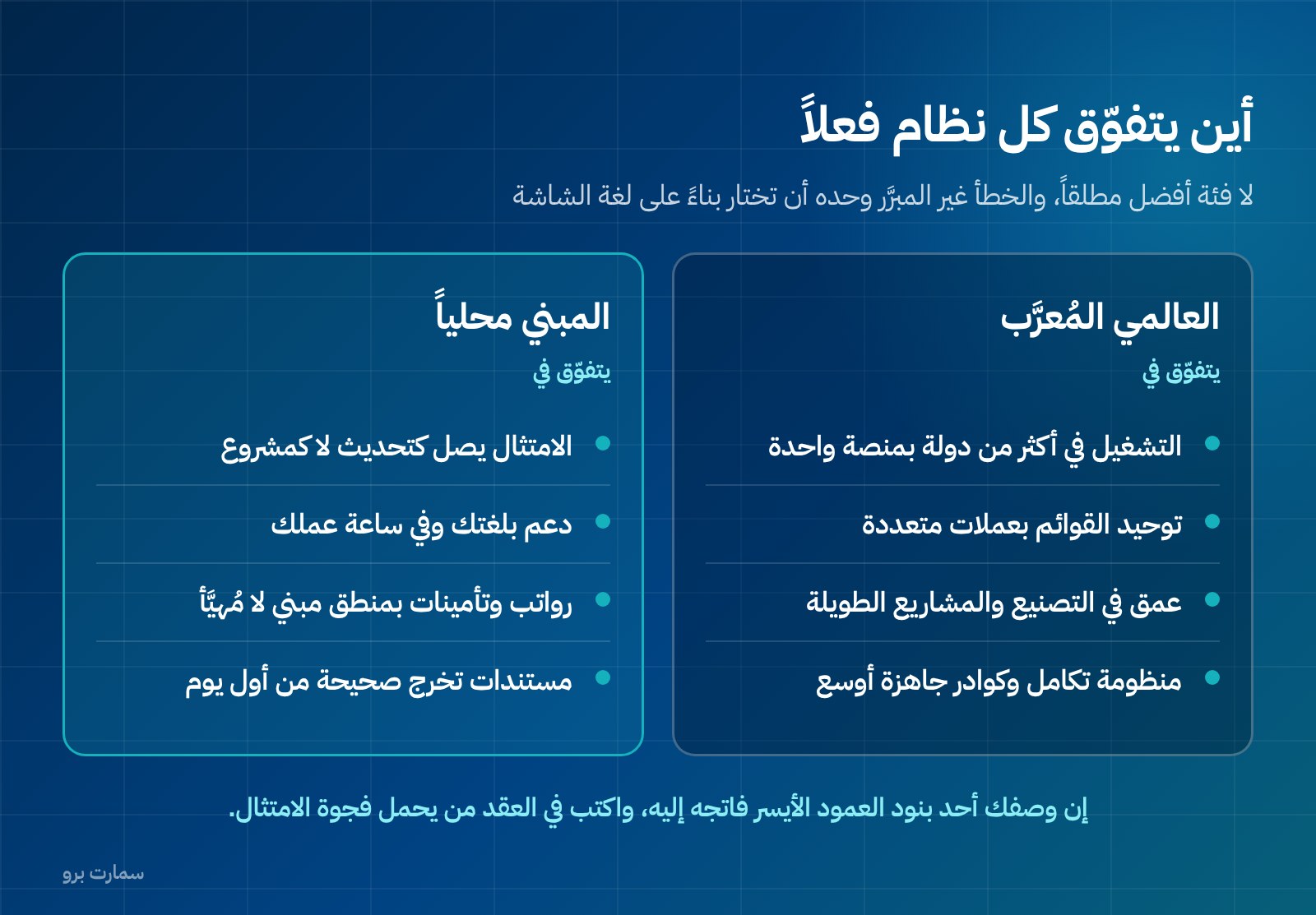
Operating in more than one country. If you have entities in several countries, you need a system that knows all of those markets on one platform. A system built for a single market won't do that, and isn't meant to.
Multi-currency consolidation. Revaluation, translation differences, and group-level consolidation in a single presentation currency are mature capabilities in global systems; elsewhere they arrive late or incomplete.
Depth in specialised industries. Complex multi-stage manufacturing, long-term projects with percentage-of-completion, heavy assets with maintenance schedules, extended supply chains. That depth comes from years of specialisation, and good localisation can't replace it.
A broad integration ecosystem. More ready-made connectors, and a wider market of implementers, auditors and users who know the system, which makes it easier to find trained staff.
If any of these describes your business, the decision usually favours the global system. Your job then becomes managing the localisation and compliance gap, not denying it.
Where does an Arabic accounting system built for the local market win?
And in return, with the same frankness:
Compliance arrives as an update, not a project. This is the most important point on the list. A regulatory change that reaches you in an update needs no scope of work, no hours estimate, no budget approval, and no waiting on a partner's schedule.
Support in your language and working hours. This isn't a language luxury. When invoice issuing stops on a closing day, the difference between support that understands the local context during your working hour and support that opens a ticket for another time zone is the difference between a one-hour delay and a one-day delay.
Payroll and social insurance with built-in, not configured, local logic. The contributory wage, treatment of Saudi and non-Saudi employees, the Wage Protection file, and the end-of-service provision work by default when they're built into the system. When they're built through configuration, every exception becomes a change request. We go into this point in detail in how to choose the best accounting software in Saudi Arabia.
Documents that match what is actually required. The invoice template, credit and debit notes, and account statements come out correct from day one.
What is the hidden cost of localising through a partner?
The common third route is a global system with a local partner who handles localisation, integration and compliance. It's a legitimate route that works for many businesses, but it carries two costs that don't show up in the quotation.
First: every regulatory change becomes a paid customisation. The local layer built for you isn't part of the global product, so the vendor's updates don't reach it. A product update may break it, and a local change requires modifying it. Each time: scope, estimate, implementation, testing, invoice.
Second: dependence on a single partner. Whoever built the local layer is the only one who knows how it was built. Changing partners means rebuilding whatever wasn't documented, and you negotiate price from a weaker position every year. From the start, require that every customisation is documented and owned by you, and make handover of the code and configuration a condition in the contract, not a later request.
If you're comparing cost routes more broadly, we break them down in what ERP costs in Saudi Arabia, year one and renewal.
What does the cost look like over three years?
The following figures are hypothetical, to illustrate the method. They are not market prices, offers from any vendor, or real localisation costs. Their purpose is to show the shape of the cost, not its size.
| Item | Subscription route with updates included | Licence route with an annual localisation project |
|---|---|---|
| Year one | Annual subscription + initial setup | Licence + implementation + building the local layer |
| Year two | Same subscription, regulatory update included | Annual support fees + compliance project for the changes |
| Year three | Same subscription, regulatory update included | Support fees + compliance project + fixing what the update broke |
| What changes when a regulation changes | Nothing in the cost | New scope of work, estimate and invoice |
| Who carries the timing risk | The vendor | The business |
Read the table by its last column, not by the figures. On the first route your cost is known and surprises are limited. On the second, your core cost is known, but one item is open-ended and tied to events outside your control. If that item is small in your case, the second route makes complete sense; the problem is that many businesses don't estimate it at all when they sign.
For comparison only, our packages are published and flat: Mini at SAR 1,500 a year including VAT, Pro at SAR 4,500, and Max at SAR 20,500. We mention them here because a clearly published price is part of the comparison itself. Details of what SmartPro Finance & Accounting covers across the invoice, journal entry and reporting cycle are on its page.
Which four questions settle the choice?
If you don't have time for a long comparison, these four questions are enough in most cases:
- Do you operate in more than one country, or need multi-currency consolidation? If yes, go for the global system and plan explicitly for the localisation gap. If no, you'd be paying for capability you won't use.
- Does your industry genuinely need specialised depth? Multi-stage manufacturing or long projects with completion percentages: yes. Trading, services or mid-sized contracting: usually not, and the extra depth becomes complexity.
- When a local requirement changes, who implements it and who pays? Get the answer written into the contract, not spoken in the meeting. This question alone sorts the offers.
- Who will answer when invoice issuing stops on a closing day? Ask for the name, the channel, the language, the working hours and the committed response time.
What should you verify in any system, local or global?
This list is neutral between the two categories, and every item is a published requirement:
- Invoices issued in XML format following UBL 2.1 (the international standard structure for electronic business documents), with a cryptographic stamp.
- An invoice counter that never resets, and a hash chain linking each invoice to the one before it.
- A QR code on simplified invoices.
- Simplified invoices reported within 24 hours of issue.
- Invoices issued in Arabic, with the option of being bilingual.
- Corrections made through a credit or debit note, never by editing the original invoice.
One point that comes up often: ZATCA does not approve software. It publishes an indicative list of qualified solution providers, and a compliant taxpayer is compliant even if its provider isn't on that list. Any offer that calls its system "approved" is describing something that doesn't exist. We cover this point specifically in ZATCA-approved accounting software: what the phrase really means.
Where is the official reference?
Requirements, guides and the indicative list of providers are published on the official website of the Zakat, Tax and Customs Authority (ZATCA): zatca.gov.sa. Wherever what you read here, or in any vendor's offer, conflicts with what is published there, the official website is the reference.
The bottom line
The decision isn't between Arabic and English. It's between two models of who carries the burden. If your business is local and your accounting needs are standard, a system built for the local market saves you recurring projects that add no operational value. If you operate across countries or in an industry that needs specialised depth, the global system is the right choice, and your duty is to calculate the localisation and compliance gap and write into the contract who carries it. The only unjustifiable mistake is choosing based on the language of the screen.
Key takeaway: Judge an accounting system by who pays when local regulations change and whether its invoice is compliant from day one, not by whether its screens are in Arabic.
Read also
- How to choose the best accounting software in Saudi Arabia
- ZATCA-approved accounting software: what the phrase really means
- What ERP costs in Saudi Arabia: year one and renewal
To see how an Arabic-first system handles your own invoices and closing, start a free trial or book a demo with our team.
Article visuals
Frequently asked questions
Does an Arabic interface mean a system is genuinely localised?
No. The Arabic interface is only one of three levels: the screen, the data and the document. A system can show its menus in Arabic yet still store and sort names incorrectly, or print an invoice that doesn't meet local requirements. The document is the level you are held accountable for, so start your testing there, not with the screen.
When is a localised global system the better choice?
When you operate in more than one country, need to consolidate financial statements across multiple currencies, or work in an industry that needs specialised depth, such as multi-stage manufacturing or long-term projects. In these cases a system built for a single market won't be enough. You still need to define explicitly who implements local changes and who pays for them.
What is the hidden cost of localising a global system through a local partner?
There are two. First, the local layer built for you isn't part of the product, so the vendor's updates don't reach it, and every regulatory change becomes a paid project with a scope, schedule and invoice. Second, you become dependent on the one partner who knows how it was built. Address this with a contract clause requiring that all customisations are documented, handed over and owned by you.
Are there officially approved accounting systems in Saudi Arabia?
ZATCA does not approve software. What it publishes is an indicative list of qualified solution providers, and a compliant taxpayer is considered compliant even if its provider isn't on that list. Any offer presenting itself as an "approved" system is describing something that doesn't exist. It's better to test the outputs: XML in UBL 2.1 format, the cryptographic stamp, a counter that never resets, the hash chain, and a QR code on simplified invoices.