
Excise Tax on Sweetened Beverages: Bands and Rates After the 2026 Amendments
Since January 2026, excise tax on sweetened beverages is a fixed amount per litre based on sugar content, not a percentage of the price. Here are the four bands, the concentrate rule and the new two-month return.
Author:سامي الحيدري
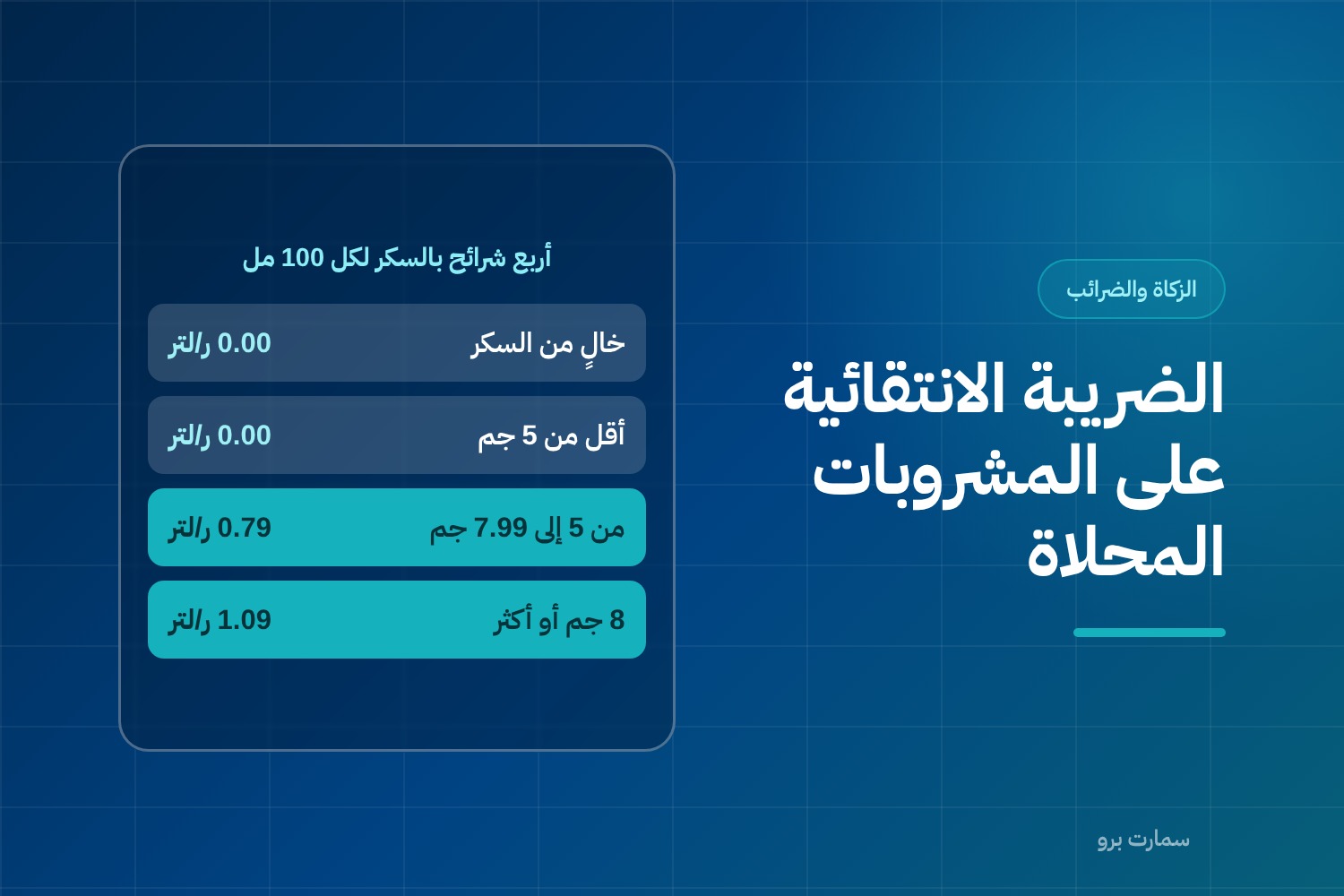
Excise tax on sweetened beverages in Saudi Arabia is no longer a single percentage. Since 1 January 2026, it is a fixed amount in SAR per litre, set by the total sugar in every 100 ml of the ready-to-drink product. Two drinks with the same price and volume can now carry different tax, and the difference sits entirely on the nutrition label.
Excise tax is a tax on specific goods considered harmful to health, such as tobacco, energy drinks and sweetened beverages, charged when they are released for consumption in the Kingdom. The change came through Board of Directors Resolution No. (25-06-06) of the Zakat, Tax and Customs Authority (ZATCA), dated 8/7/1447 AH, which amended the Implementing Regulations of the Excise Tax Law. ZATCA announced that it applies from the start of 2026.
More than the rate changed. The return cycle changed, a product registration obligation was added, and a whole category was removed from the list of excise goods.
The bands of excise tax on sweetened beverages
The tax is no longer a percentage of the retail price. It is a fixed amount per litre:
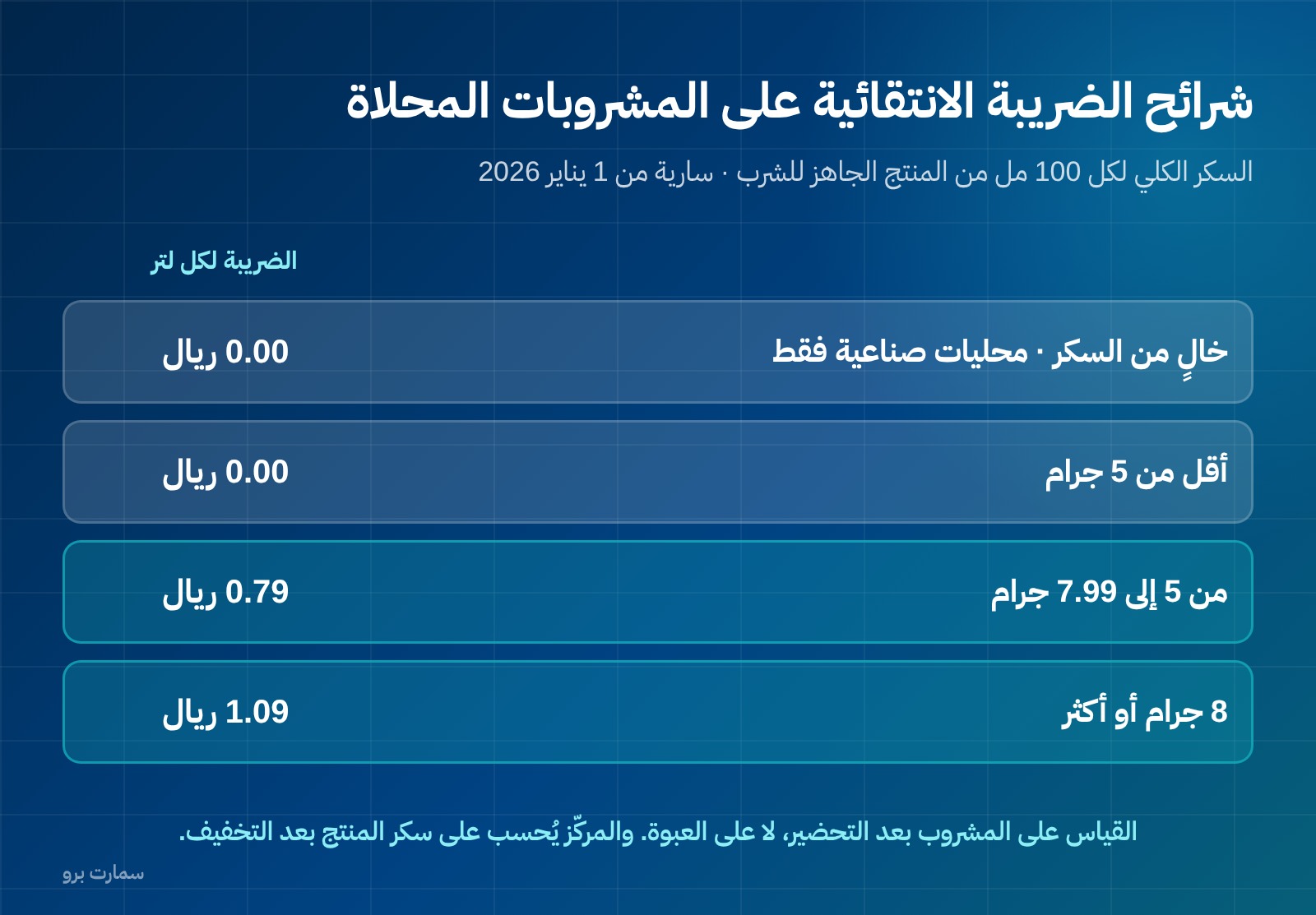
| Band | Total sugar per 100 ml | Tax |
|---|---|---|
| First | Sugar-free, artificial sweeteners only | SAR 0.00/litre |
| Second | Less than 5 g | SAR 0.00/litre |
| Third | 5 g to 7.99 g | SAR 0.79/litre |
| Fourth | 8 g or more | SAR 1.09/litre |
Sugar is measured on the ready-to-drink product, not on the package as sold. That distinction is the subject of the next section.
How are concentrates and powders taxed?
For a concentrate, powder, gel or extract, the tax is not based on the sugar in the product itself but on the sugar in the drink after dilution. The dilution ratio is the volume of the prepared drink divided by the volume of concentrate used, following the preparation instructions printed on the package. From this ratio and the nutrition label you work out the sugar per 100 ml, and that sets the band.
One provision deserves close attention. If the package has no preparation instructions or nutrition information, or if they prove inaccurate, ZATCA may accept other evidence or apply an alternative dilution ratio based on similar products.
If the information is still incomplete, ZATCA applies a conversion factor of no less than 6:1 and classifies the drink in the fourth band, the highest amount. A package with missing data means a tax assumption that works against you.
Are soft drinks now exempt from excise tax?
After the amendment, the list of excise goods is: tobacco and tobacco products, energy drinks, sweetened beverages in their four bands, electronic smoking devices, and their liquids. Carbonated drinks were removed as a separate category from Articles 2, 3, 9 and 26.
That is not an exemption. A sweetened carbonated drink now falls under the tiered amount according to its sugar, like any other sweetened beverage, and a sugar-free carbonated drink lands in the first band at SAR 0. The category was not abolished; it was reclassified within the sugar-based system.
A clear caveat is needed here. At the time of writing, ZATCA's explanatory page on excise goods still mentions a 50% rate for sweetened beverages and lists carbonated drinks as a separate item, with an update date later than the start of the bands. The authoritative reference is the text of the updated Implementing Regulations published on the ZATCA website, not the explanatory page. If you need a written official position, the proper route is to ask ZATCA directly.
What changed in excise returns and product registration?
The amendments went beyond the rate. Two operational structures changed:
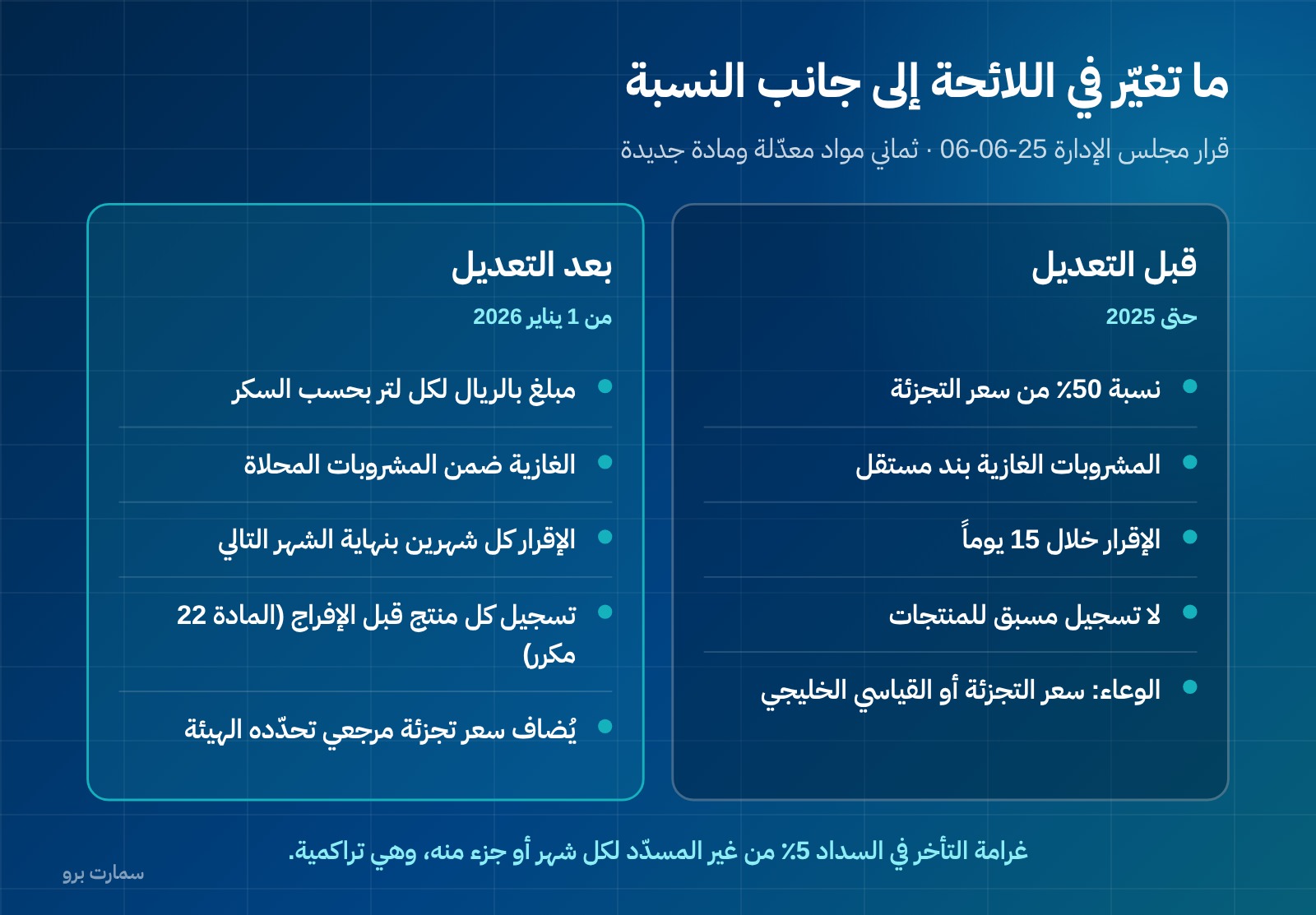
- Article 16 — returns: the licensee files a return for each tax period of two months, due by the end of the month following the end of the period. Before the amendment, the registrant filed within 15 days.
- Article 18 — payment: due before the end of the month following the period.
- Article 22 bis (new) — product registration: importers, producers and other suppliers must register each product with ZATCA before release for consumption, with the data needed to calculate the tax and the supporting documents, and notify ZATCA of any change before the next release date. If the data is incorrect or doubtful, ZATCA may apply the highest rate or request accredited laboratory reports or samples.
- Article 17 — corrections: the licensee must correct the return within 15 days of discovering the error.
- Articles 1 and 8 — tax base: the base is now the highest of the declared retail price, a reference retail price set by ZATCA, or the GCC standard price. The reference retail price is a new item.
- Article 60 — existing stock: goods held on the date a rate or base increases are subject to the new rules; the commercial-quantity threshold is where the resulting tax reaches SAR 20,000; and a refund request when the tax is reduced must be made within 90 days.
Release for consumption means the point at which goods leave a tax suspension situation, such as import or leaving a production facility, and the tax becomes due. A licensee is the person registered with ZATCA for excise tax.
What does this mean for your accounting system?
Moving from a percentage to an amount per litre is not a one-field change. The item card needs three pieces of data that were not required before:
- Sugar per 100 ml of the ready-to-drink product
- Volume in litres
- Dilution ratio, for concentrates
The tax is then calculated by multiplying the band amount by the number of litres released for consumption, not by the invoice value. For example, 1,000 litres of a fourth-band drink carry SAR 1,090 in excise tax, whatever their selling price.
This is fundamentally different from value added tax (VAT, 15% in Saudi Arabia), which is calculated on value. Excise tax here is calculated on quantity and is recorded as a cost built into the selling price before VAT is calculated. Keep both figures in one field and you end up with two wrong returns, not one. A system with automated journal entries and a one-click VAT report helps keep the two taxes in separate accounts from the start.
On timing, the two-month period means your compliance calendar now has two different deadlines: the VAT deadline and the excise deadline, and they do not necessarily coincide. It helps to put both in a zakat and tax compliance calendar rather than tracking them from memory.
What are the penalties for late filing and payment?
The penalty for filing the return late is no less than 5% and no more than 25% of the tax that should have been declared. The penalty for late payment is 5% of the unpaid tax for each month or part of a month of delay.
The late-payment penalty accumulates, so a four-month delay costs four times as much as a one-month delay. If you already have outstanding arrears, check first whether ZATCA has a penalty waiver initiative in force before paying the penalty itself.
Five practical steps
- Obtain from each supplier or laboratory the sugar per 100 ml of the ready-to-drink product, not of the package.
- Classify every item into one of the four bands, and record the band on the item card, not in a separate file.
- Review concentrates in particular: calculate the dilution ratio from the package instructions, and confirm that the instructions and nutrition information are actually printed.
- Register every product with ZATCA before release, and make registration a mandatory step when onboarding a new item.
- Reset your return cycle to a two-month period, and link it to the payment deadline at the end of the following month.
A handful of items in the wrong band in a mid-sized warehouse can produce a tax difference larger than the cost of the system that would have calculated it for you.
Key takeaway: Since January 2026, excise tax on sweetened beverages is SAR 0, 0.79 or 1.09 per litre depending on sugar in the ready-to-drink product, filed every two months. Get sugar data onto every item card and register products before release.
To see how SmartPro keeps item data, stock and accounts connected in one system, start a free trial.
Article visuals
Frequently asked questions
What are the excise tax bands for sweetened beverages in Saudi Arabia?
There are four bands based on total sugar per 100 ml of the ready-to-drink product: sugar-free at SAR 0.00 per litre, less than 5 g at SAR 0.00 per litre, 5 g to 7.99 g at SAR 0.79 per litre, and 8 g or more at SAR 1.09 per litre. The measurement is taken on the drink after preparation, not on the package.
Has the excise tax on carbonated drinks been cancelled?
No. Carbonated drinks were removed as a separate item from the list of excise goods, and sweetened carbonated drinks now fall under the sweetened beverage bands according to their sugar. A sugar-free carbonated drink falls in the first band at SAR 0.00 per litre, which is a reclassification, not an exemption.
How is excise tax calculated on concentrates and powders?
It is based on the sugar in the drink after dilution. The dilution ratio is the volume of the ready drink divided by the volume of concentrate used, following the package instructions, and the sugar per 100 ml is worked out from it. If preparation instructions or nutrition data are missing, ZATCA may apply a conversion factor of no less than 6:1 and place the product in the fourth band.
When is the excise tax return filed now?
The tax period is now two months, and the licensee files the return and pays by the end of the month following the end of the period. Before the amendment, the registrant filed the return within 15 days. The late payment penalty is 5% of the unpaid tax for each month or part of a month.
What is the new product registration obligation for excise goods?
The amendments added Article 22 bis, which requires importers, producers and other suppliers to register every product with ZATCA before release for consumption, with the data needed to calculate the tax. ZATCA must be notified of any change before the next release date. If the data is doubtful, ZATCA may request accredited laboratory reports or samples.