
Penalty Waiver Initiative: What Remains Until 31 December 2026, and the Cut-Off Many People Miss
The initiative ends on 31 December 2026, but it only covers returns due by 30 June 2026. This guide covers the three conditions, what is excluded and the order of steps.
Author:سامي الحيدري
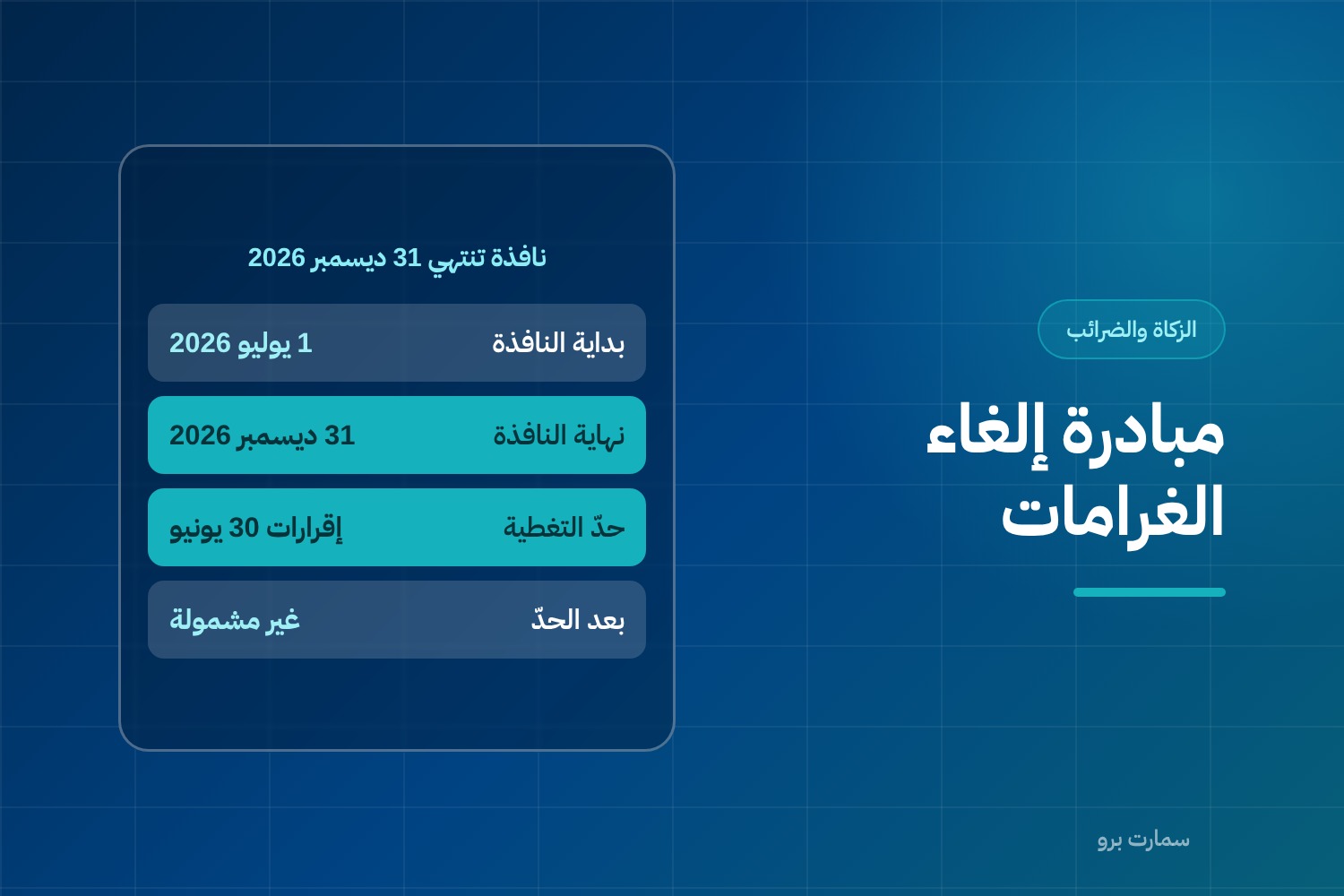
ZATCA's penalty waiver initiative ends on 31 December 2026. It cancels late registration, late payment, late filing and VAT correction penalties if you are registered, file every outstanding return and pay the full tax principal or apply for instalments. The catch is that it only covers returns that fell due on or before 30 June 2026.
If you have an unfiled return or overdue tax, this is the last announced window to have the penalty dropped in exchange for paying the principal. One time condition in particular changes the whole calculation, and many readers miss it.
The Minister of Finance extended the initiative by a decision announced on 29 June 2026. The extension runs for six months, from 1 July 2026 to 31 December 2026. This is not a general amnesty with no strings attached. It is a conditional arrangement that cancels the penalty once the principal is paid.
What does the penalty waiver initiative cover?
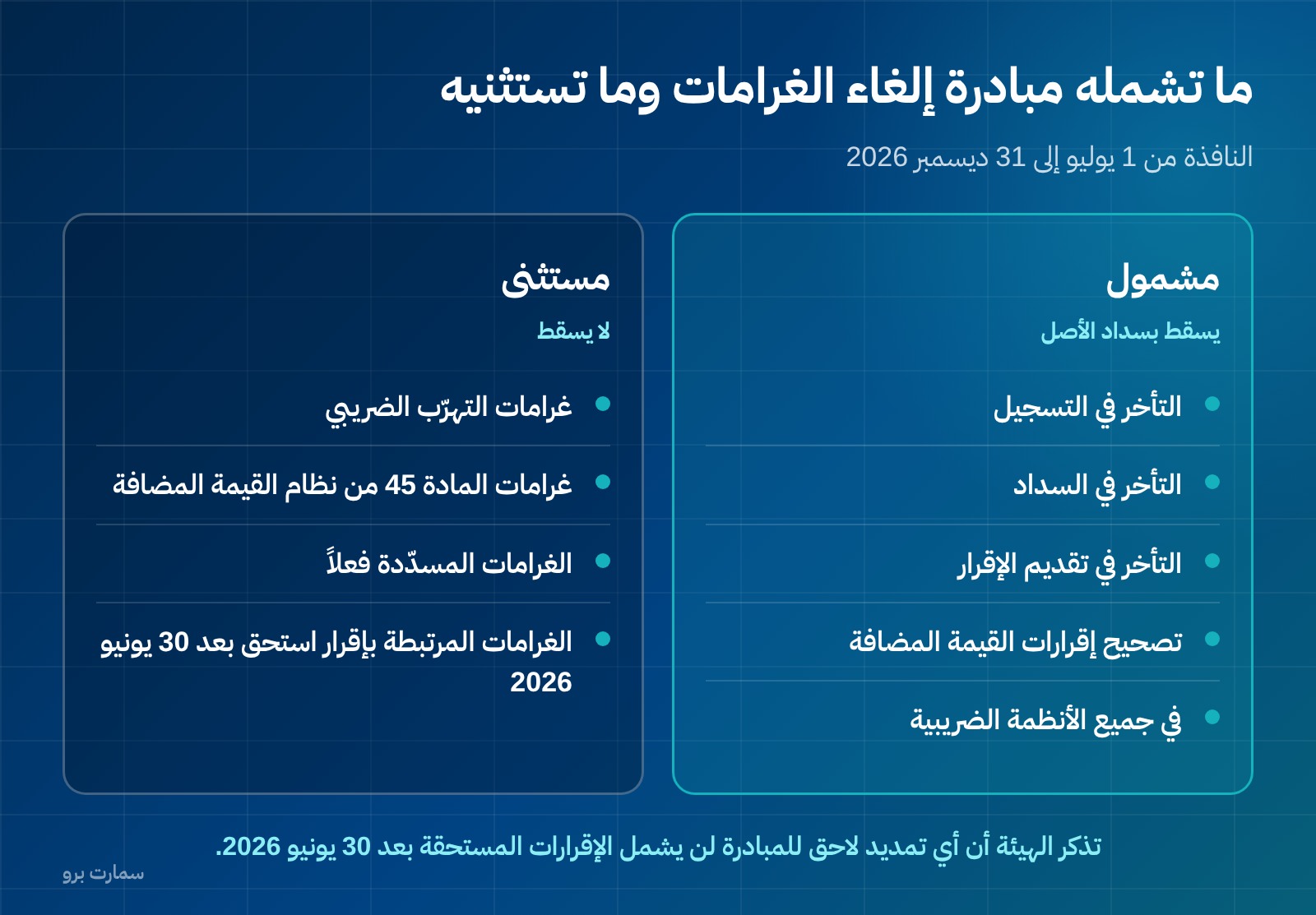
The waiver covers:
- Late registration penalties, under all tax laws.
- Late payment penalties.
- Late filing penalties.
- Penalties for correcting VAT returns.
The phrase "all tax laws" matters. The initiative is not limited to VAT (value added tax, charged at 15% in Saudi Arabia).
The exclusions are just as explicit:
- Tax evasion penalties.
- Penalties imposed under Article 45 of the VAT Law.
- Penalties already paid before the initiative.
If you paid a penalty yesterday, the initiative will not refund it. That alone is a good reason to review any open claim before you pay the penalty, not after.
Which returns fall outside the cut-off date?
This is where most people who skim the initiative go wrong:
Penalties linked to any return that fell due after 30 June 2026 are not covered. ZATCA states that any later extension of the initiative will not cover these returns either.
In practice, the initiative stays open until the end of December 2026, but its coverage stops at 30 June 2026. Your monthly return for May 2026, due in June, is covered. The June 2026 return, due in July, is not. The Q3 return due on 31 October 2026 is not covered either.
This splits your arrears into two layers, not one. Older arrears are handled through the initiative. Recent arrears are handled through normal payment, penalty included. Anyone who submits one request for all their arrears is wrongly assuming there is a single window.
What are the three conditions to benefit?
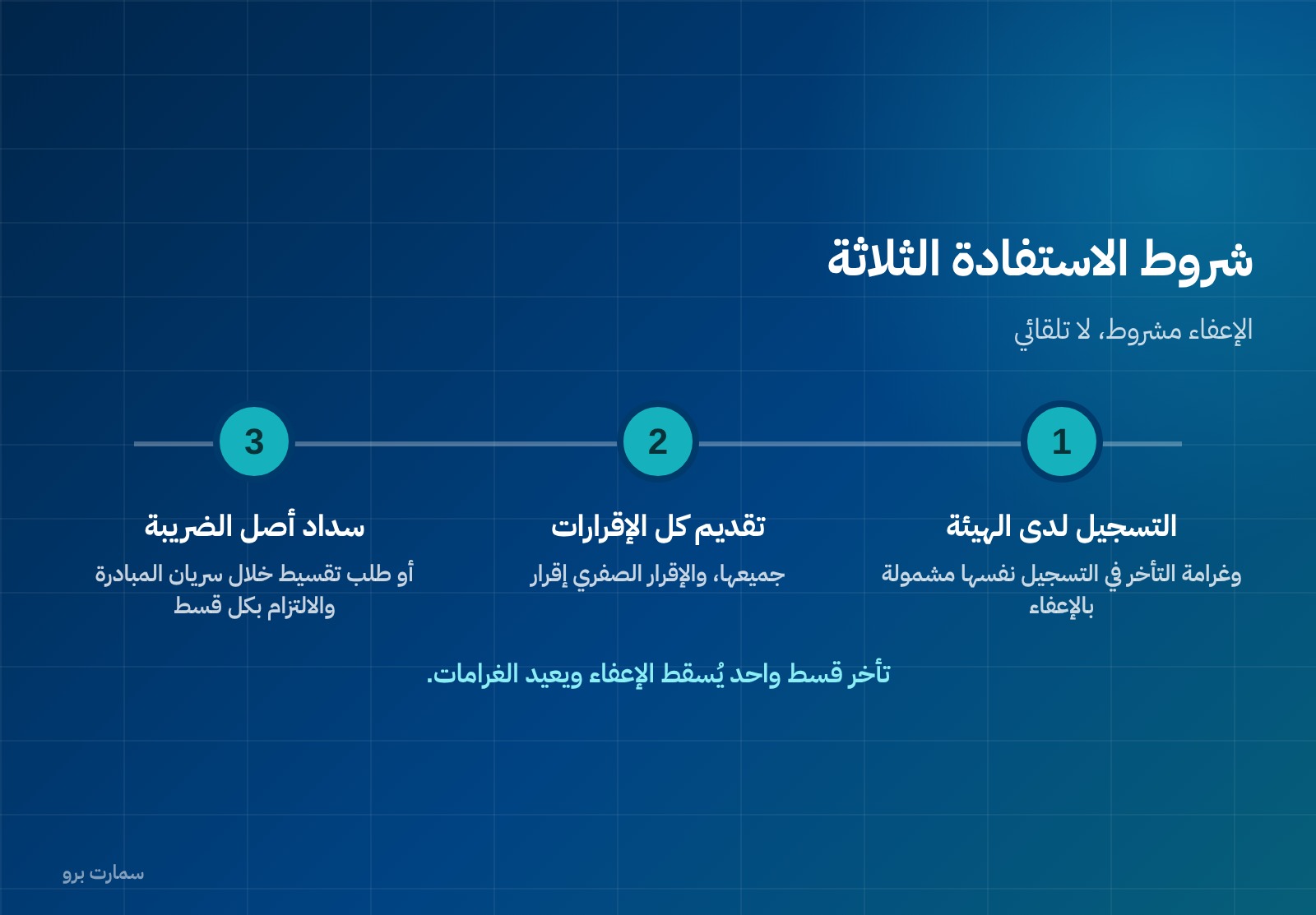
The waiver is not automatic. You must meet three conditions:
- Be registered with ZATCA. If you are not yet registered, register first. The late registration penalty itself is covered by the waiver, so registering late does not punish those who act now.
- File all unfiled returns. All of them, not just the ones you have the money to pay. A nil return is still a return.
- Pay the full tax principal on those returns, or apply for an instalment plan while the initiative is running and pay every instalment on time.
The third condition is the way out for businesses short on cash. Instalments are available, but only if the request is submitted while the initiative is in force, meaning before 31 December 2026, and every instalment is paid on its due date. A single late instalment cancels the waiver.
In what order should you handle a backlog of returns?
Order matters. Filing a return with wrong figures and then correcting it creates a new correction penalty.
- Gather the invoices first, both output (sales) and input (purchases), and calculate the net VAT for each period separately. Filing a return based on estimates is worse than filing it a week late.
- Separate everything before 30 June 2026 from everything after it. The first group is where the initiative applies. The second is paid with its penalty.
- Review deductible input VAT before you calculate the principal. Input VAT is the tax you paid on purchases that you can offset against the tax you collected. An invoice that does not qualify for deduction inflates the principal you will actually pay, so check it against the input VAT deduction rules.
- File the returns in date order, not newest first.
- Pay the principal or apply for instalments before 31 December 2026.
- Keep the filing and payment confirmations. The waiver is conditional, and proving you met the conditions is your responsibility.
The filing process itself and the structure of the VAT penalties the initiative cancels are covered in our other guides. If your invoices are scattered, an accounting system that issues ZATCA Phase 2 (Fatoora) e-invoices and produces the VAT report from posted entries makes step 1 much faster. See how SmartPro Finance & Accounting handles the VAT report, and read our ZATCA e-invoicing guide for the invoicing side.
How much can the waiver save? A rough calculation
The following figures are hypothetical, to illustrate the method. They are not from a real case.
A business failed to file four quarterly returns between 2024 and 2025. The tax principal is SAR 60,000, split equally at SAR 15,000 per return. The late payment penalty is 5% of the unpaid amount for each month or part of a month, and it accumulates.
So a return that is 18 months late with a principal of SAR 15,000 attracts a late payment penalty of 18 × 5% = 90%, or SAR 13,500. On top of that comes the late filing penalty, which is at least 5% and at most 25% of the tax due.
In this case, the initiative reduces an inflated claim to the tax principal alone. The amount you need is SAR 60,000, or an instalment plan for it, not the principal plus penalties.
What happens after 31 December?
ZATCA has not announced an extension. The previous round of the initiative ran from 1 January to 30 June 2026 and was in fact extended, so an extension has precedent, but it is not a promise. And even if there is another extension, the 30 June 2026 cut-off is stated explicitly: an extension will not bring in returns that fell due after it.
Waiting for an extension means waiting for something that will not widen your coverage, while losing six weeks of preparation time. What is worth doing this week, not next month: pull the list of unfiled returns from your ZATCA account, sort them by due date and draw a line at 30 June 2026. Everything above the line goes through the initiative. Everything below it is handled as it stands. Then put the upcoming deadlines in a zakat and tax compliance calendar so the cycle does not repeat.
The initiative's details and conditions are published on the Zakat, Tax and Customs Authority website. Some situations are more complicated, such as alleged evasion, a claim under objection or penalties under Article 45. Those cases are outside the scope of this article and need professional advice based on your documents.
Key takeaway: The penalty waiver initiative is open until 31 December 2026, but it only cancels penalties on returns due by 30 June 2026. File every outstanding return, then pay the principal or apply for instalments before the deadline.
To keep future returns accurate and on time, start a free SmartPro trial or book a demo with our team.
Article visuals
Frequently asked questions
What is the penalty waiver initiative and when does it end?
It is a waiver of financial penalties extended by a decision of the Minister of Finance, announced on 29 June 2026, running from 1 July 2026 to 31 December 2026. It waives late registration, late payment and late filing penalties under all tax laws, as well as VAT return correction penalties, in exchange for paying the principal tax.
Are all late returns covered by the initiative?
No. Penalties linked to any return that fell due after 30 June 2026 are not covered, and ZATCA states that any later extension will not cover them either. So the Q3 return due on 31 October 2026 is outside the coverage, while the May 2026 return due in June is inside it.
What are the conditions to benefit from the penalty waiver initiative?
There are three: you must be registered with ZATCA, you must file all unfiled returns, and you must pay the full principal tax linked to them or apply for instalments while the initiative is in force and pay every instalment on time. A late instalment cancels the waiver.
Which penalties are excluded from the initiative?
Tax evasion penalties, penalties imposed under Article 45 of the VAT Law, and penalties already paid before the initiative are excluded. Anyone who has already paid a penalty will not get it back, so review your position before paying, not after.
Can I benefit if I do not have the cash to pay the principal?
Yes, through instalments. The condition is that the instalment request is submitted while the initiative is in force, meaning before 31 December 2026, and that every instalment is paid on its due date. Missing a single instalment cancels the waiver and brings the penalties back.