
Zakat and Tax Calendar: Every Deadline in One Place
Every statutory deadline on one page: zakat within 120 days, VAT, withholding tax, excise tax, GOSI contributions and wage protection.
Author:سامي الحيدري

Most penalties Saudi businesses pay are not for calculation errors but for missed deadlines. These deadlines are spread across different authorities and platforms, so one easily slips through in a busy month. This zakat and tax calendar puts them in one place: zakat, VAT, withholding tax, excise tax, e-invoicing, GOSI, wage protection and real estate transaction tax.
When are zakat and income tax due?
The statutory deadline is within 120 days of the end of the financial year, and it applies to filing and payment together, not filing alone.
ZATCA's own published example: a financial year ending 31 December 2025 → the last day to file and pay is 30 April.
If you file your return but do not pay within that period, the amounts due become final and payable. Filing on its own protects you from nothing. See how to calculate zakat and filing the income tax return.
When is the VAT return due?
Value Added Tax (VAT) is the 15% tax charged on most supplies of goods and services, and your filing frequency depends on your annual taxable supplies.
| Annual supplies | Tax period | Deadline |
|---|---|---|
| Up to SAR 40 million | Quarterly | Last day of the month following the end of the period |
| Over SAR 40 million | Monthly | Last day of the following month |
So the second quarter, which ends on 30 June, is due by 31 July. See filing the VAT return.
When must withholding tax be paid?
Withholding tax is the tax a Saudi payer deducts from amounts paid to a non-resident beneficiary and pays to ZATCA. It must be remitted within the first 10 days of the month following the month in which the payment was made to the non-resident.
This is the shortest deadline on the whole list, and the easiest to miss because it is triggered by an event, not a cycle. See withholding tax in Saudi Arabia.
When is excise tax due?
The tax period is two calendar months, and filing and payment are due within 15 days of the end of the period.
It applies to anyone who imports or produces tobacco and tobacco products, energy drinks, electronic smoking devices and their liquids, and carbonated and sweetened drinks.
What are the e-invoicing deadlines?
E-invoicing has no monthly window; it is immediate:
- Tax invoice (standard): must go through clearance with ZATCA before it is shared with the buyer.
- Simplified invoice: must be reported to the platform within 24 hours of issue.
- Credit and debit notes: follow the same path as their original invoice. See credit and debit notes under VAT.
For the full picture of Fatoora and Phase 2 e-invoicing, read our ZATCA e-invoicing guide.
When are GOSI contributions due?
Contributions to the General Organization for Social Insurance (GOSI) must be paid within the first 15 days of the following month. The late-payment penalty is 2% of the contribution due for each month or part of a month. See GOSI contribution rates.
What is the wage protection deadline?
The Wage Protection System requires employers to upload their payroll file through the Mudad platform. The deadline is 30 days, effective from 1 March 2025, down from the previous 60 days. See the Wage Protection System.
When is real estate transaction tax due?
It has no cycle: it must be paid before or at the time of title transfer. Exempt transactions must also be registered with ZATCA before the transfer. See real estate transaction tax.
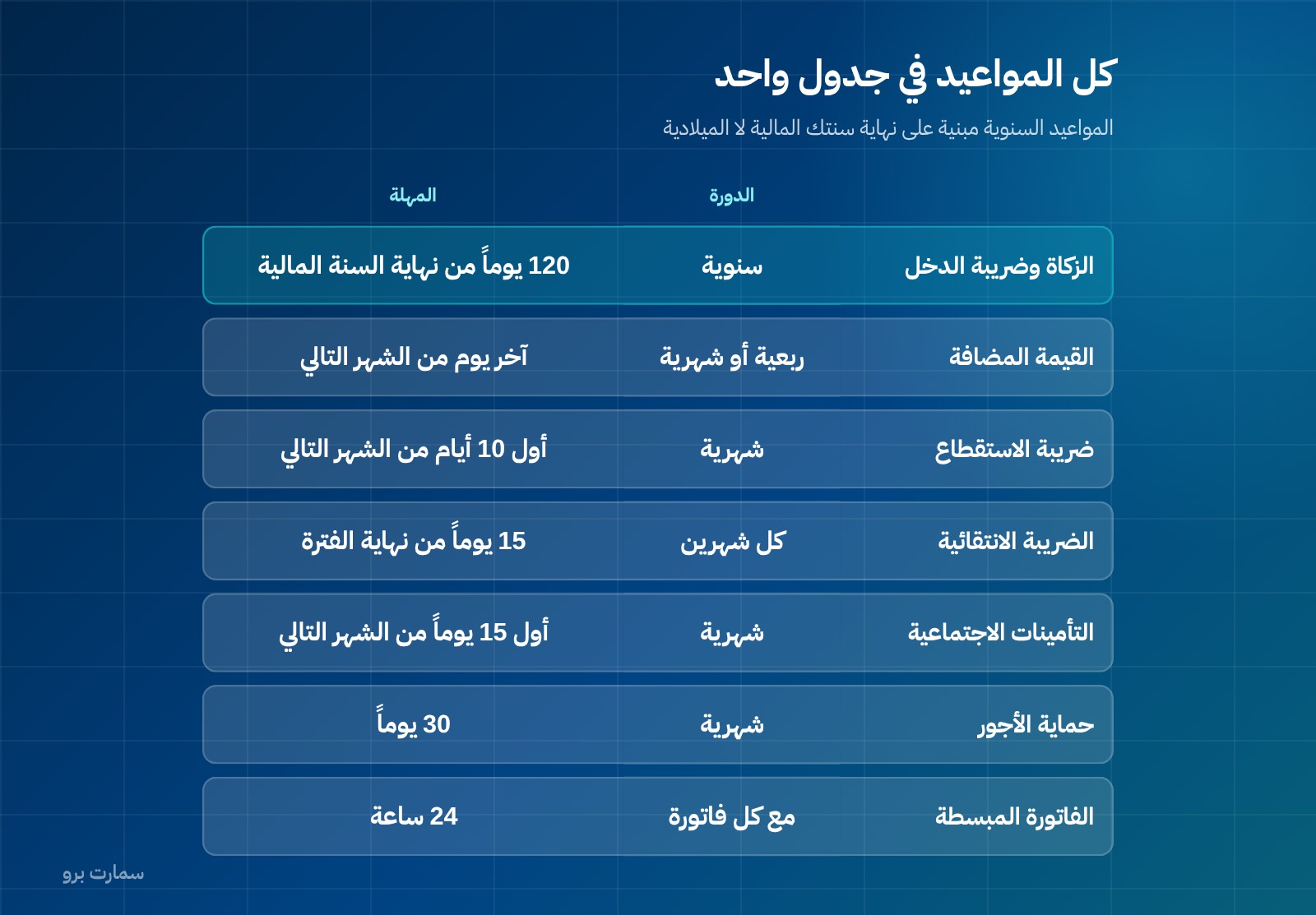
The zakat and tax calendar in one table
| Obligation | Cycle | Deadline |
|---|---|---|
| Zakat and income tax | Annual | 120 days from the end of the financial year |
| VAT | Quarterly or monthly | Last day of the following month |
| Withholding tax | Monthly | First 10 days of the following month |
| Excise tax | Every two months | 15 days from the end of the period |
| GOSI contributions | Monthly | First 15 days of the following month |
| Wage protection | Monthly | 30 days |
| Simplified invoice | With every invoice | 24 hours |
| Real estate transactions | With every deal | Before title transfer |
What penalties apply if you are late?
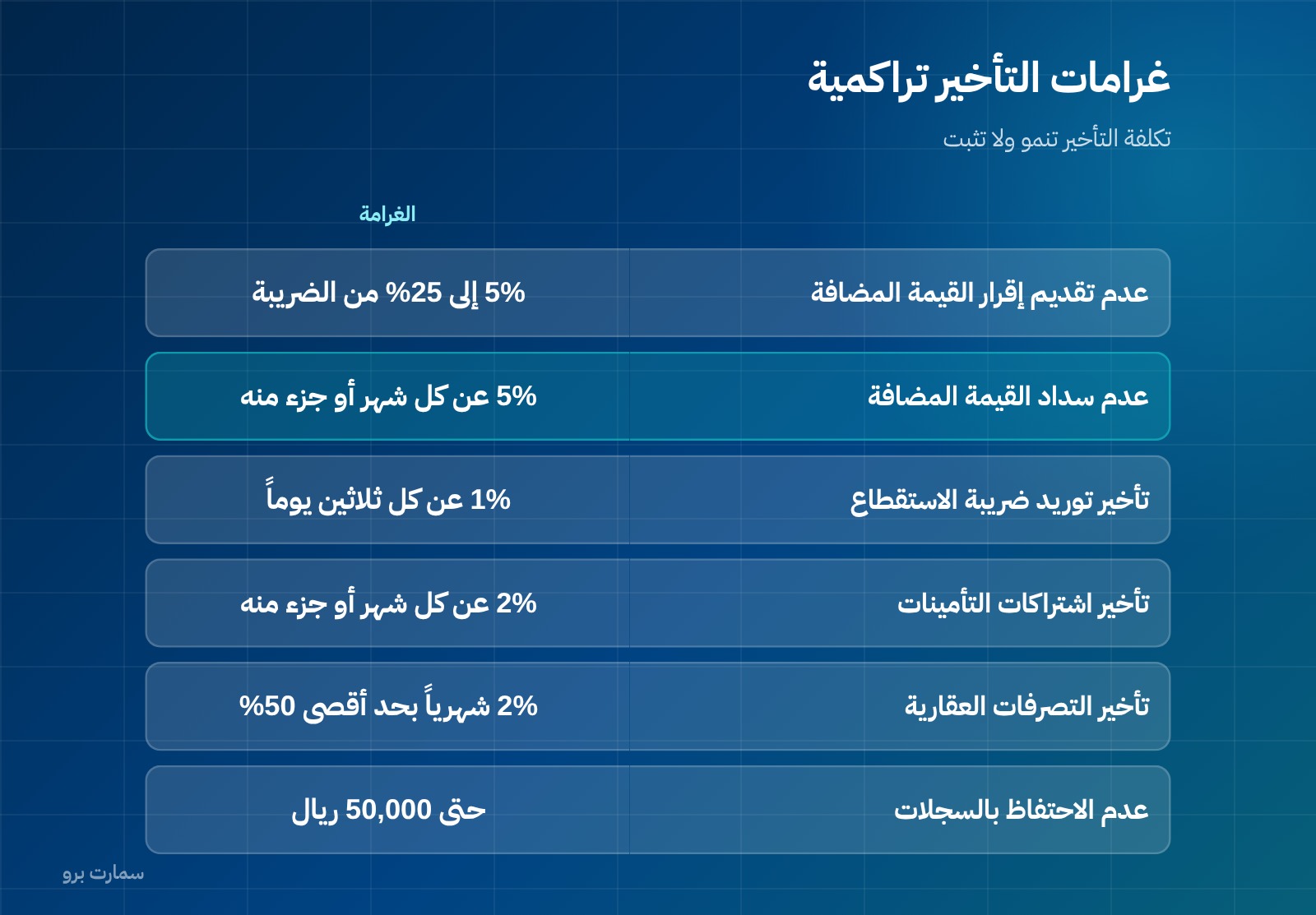
Being late is more than a warning. These are the officially stated penalties:
| Violation | Penalty |
|---|---|
| Failing to file the VAT return | 5% to 25% of the tax that should have been declared |
| Failing to pay VAT | 5% of the unpaid amount for each month or part of a month |
| Late payment of withholding tax | 1% for every 30 days of delay |
| Late GOSI contributions | 2% for each month or part of a month |
| Late real estate transaction tax | 2% per month, capped at 50% |
| Failing to keep invoices and records | Up to SAR 50,000 |
Notice that most of them accumulate monthly, so the cost of delay keeps growing rather than staying fixed. A single violation left for six months costs several times what it would have cost if fixed in its first month.
How do you turn this into a system, not a memory test?
A list on its own does not prevent late filing. Three habits do:
- Close the month on a fixed date, not when you happen to need the numbers. A late close drags everything after it.
- Set a reminder one week before each deadline, not on the due date. The deadline is for submitting, not for preparing.
- Separate responsibility for filing from responsibility for paying. Most delays happen when the accountant assumes finance has paid, and finance assumes the accountant has.
An accounting system with automatic journal entries and a one-click VAT report, such as SmartPro Finance & Accounting, shortens the gap between closing the month and having filing-ready numbers.
What mistake actually causes late filing?
The most common cause of delay is not forgetting; it is numbers that are not ready. The deadline arrives while the books are still open, so an estimated return is filed and then amended, or filing is postponed until the data is complete and the deadline is missed.
The fix lies elsewhere: a disciplined monthly close, not the filing window. If you close each month within the first week of the next, your numbers are ready whenever a deadline comes.
Do annual deadlines follow the calendar year?
All annual deadlines are based on the end of your financial year, not the end of the calendar year. If your year ends on 30 June, your deadline is around 28 October, not 30 April. Changing your financial year changes the whole calendar, so review it whenever the year end changes.
Sources: Zakat, Tax and Customs Authority (ZATCA) · General Organization for Social Insurance (GOSI) · Ministry of Human Resources and Social Development.
Key takeaway: Saudi deadlines run from 24 hours for simplified invoices to 120 days for zakat, and most late penalties grow every month. A fixed monthly close and reminders a week ahead keep you on time.
To see how connected accounting keeps your numbers ready before every deadline, start a free SmartPro trial.
Article visuals
Frequently asked questions
What is the deadline for filing the zakat return in Saudi Arabia?
The zakat return must be filed and paid within 120 days of the end of the financial year; the deadline covers both filing and payment. For a financial year ending 31 December 2025, the last day is 30 April.
When is the VAT return due in Saudi Arabia?
The VAT return is due on the last day of the month following the end of the tax period. The period is quarterly for businesses with annual supplies up to SAR 40 million and monthly for those above that threshold.
What is the deadline for paying withholding tax?
Withholding tax must be paid within the first 10 days of the month following the month in which the amount was paid to the non-resident beneficiary. It is the shortest deadline in the Saudi tax calendar.
When are GOSI contributions due?
GOSI contributions must be paid within the first 15 days of the following month. The late-payment penalty is 2% of the contribution due for each month or part of a month.
Are annual zakat and tax deadlines based on the calendar year?
No. All annual deadlines are based on the end of the business's financial year. A business whose year ends on 30 June has a different calendar from one whose year ends on 31 December, with its zakat deadline falling around 28 October.