
The VAT Return in Saudi Arabia: Deadlines, Fields and Filing Steps
When to file your VAT return monthly and when quarterly, which fields you complete, how to prepare the figures from your books, and the late-filing penalties according to the official schedule.
Author:سامي الحيدري

A VAT return is not a form you fill in from memory on the last day. It is the result of entries recorded over three months, or one. Businesses that struggle to file rarely struggle with the form itself, which is simple and has few fields. They struggle because their books don't give them the required figures ready, so they start collecting invoices by hand under deadline pressure. This guide explains the statutory deadlines, what goes in each field, and where each figure comes from in a well-organised accounting system.
When is the VAT return due: monthly or quarterly?
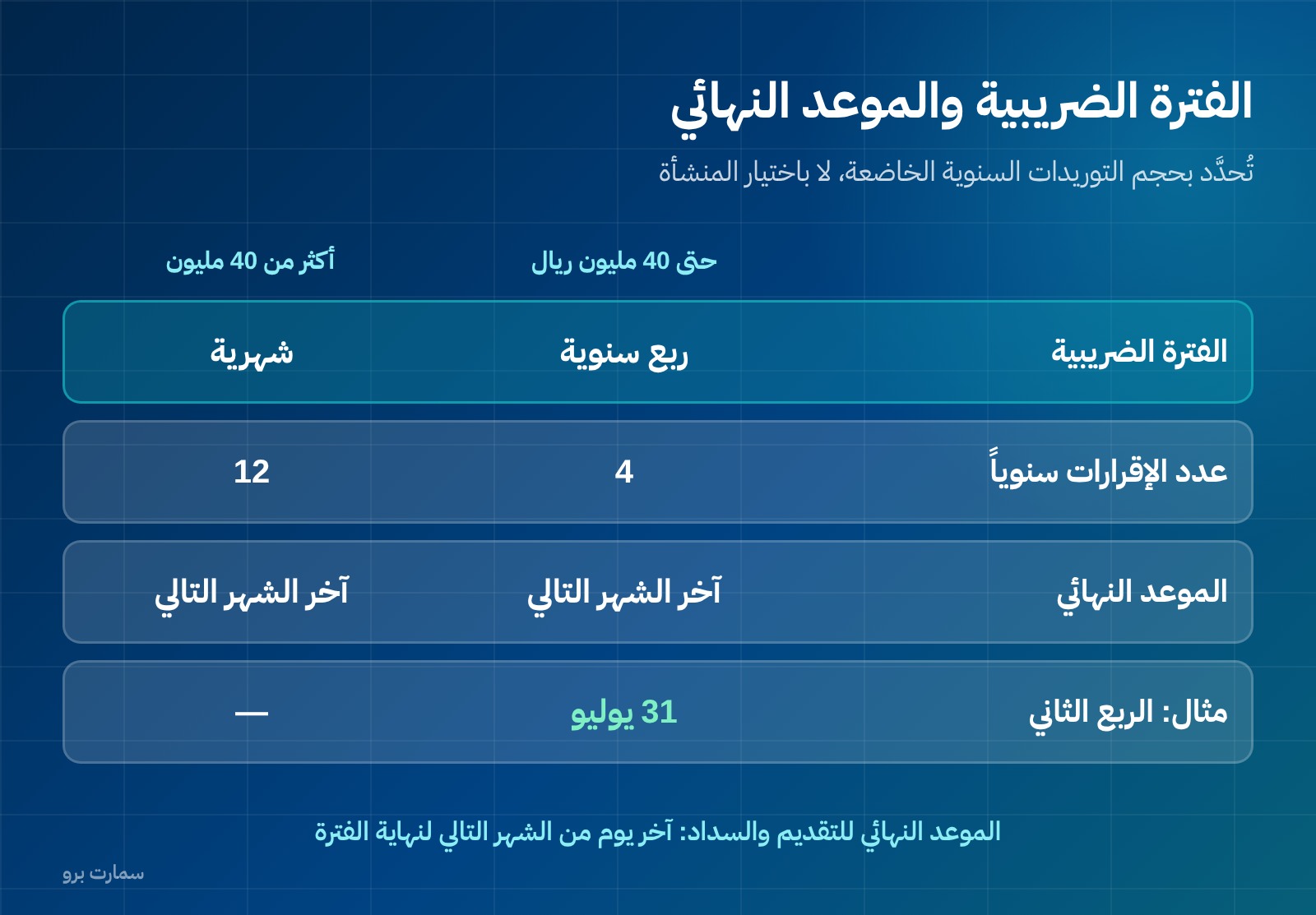
Your tax period is set by the size of your annual taxable supplies, not by your choice:
| Annual supplies | Tax period |
|---|---|
| Up to SAR 40 million | Quarterly |
| More than SAR 40 million | Monthly |
The deadline for filing and payment is the last day of the month following the end of the period. So the second quarter of the year (April–June) is due on 31 July, and June for a monthly filer is also due on 31 July. This means you have a full month after the period closes, and that month is for reviewing, not for collecting.
A practical note: a business approaching the SAR 40 million threshold should watch it before crossing it. Moving to monthly filing means twelve closing cycles a year instead of four, which changes how your accounting works, not just your filing date.
What do you actually fill in on the form?
The form is built on one principle: output tax minus input tax. Output tax is the VAT you charge on your sales; input tax is the VAT you pay on your purchases. The main fields are:
- Sales subject to the standard rate and the VAT on them at 15%.
- Zero-rated sales (the value is reported and the VAT is zero).
- Exempt sales, if any.
- Purchases subject to the standard rate and the deductible input tax.
- Taxable imports, including VAT paid at customs or through the reverse charge mechanism.
- The corrections section for adjusting a previous period.
ZATCA itself notes that small businesses with simple operations usually only need to complete two fields on the form. This is an important point: the complexity of a VAT return is not in the form, but in the quality of the data that feeds it.
Where does each figure come from in your books?
If your chart of accounts is built properly, a correct return comes from just three balances: output VAT payable, deductible input VAT, and the difference between them. Every sales invoice creates an entry that records the VAT as a liability, and every purchase invoice creates an entry that records it as a deductible asset. At the end of the period, the balances of these two accounts are your return.
If you are pulling figures from an Excel file and adding up invoices by hand, the problem isn't the return, it's your accounting structure. See how to build a chart of accounts from scratch and the accounting cycle from invoice to financial statements to understand where these balances should sit.
Three issues usually break the reconciliation:
Invoices dated outside the period. An invoice belongs to the period in which the tax became due, not the period in which it was entered in the system. Recording a June invoice late in July means you reported it in the wrong quarter.
Input tax on non-deductible purchases. Including it inflates your deduction and creates a difference that shows up on audit.
Credit and debit notes that were never recorded. A return that was adjusted on paper but not recorded with a note leaves output tax declared on a sale that never happened. The treatment is explained in detail in credit and debit notes.
What are the penalties for a late VAT return?
The official penalty schedule separates late filing from late payment, and the distinction matters:
| Violation | Penalty |
|---|---|
| Failure to file the return | 5% to 25% of the tax that should have been declared |
| Failure to pay the tax due | 5% of the unpaid tax for each month or part of a month |
| Incorrect return, or an amendment that reduces the amount due | 50% of the difference between the calculated tax and the tax due |
Note the third item: correcting a return in a way that lowers the amount due carries a penalty equal to half the difference. That is why filing a correct return the first time is always cheaper than filing an approximate one and amending it later. And if the same violation is repeated within three years of ZATCA's final decision, the penalty may be doubled.
What should you check before pressing "Submit"?
- The period is closed in the system and no pending invoices are dated within it.
- The output VAT balance in the trial balance equals the total VAT on the period's sales invoices.
- The input VAT balance equals the total VAT on deductible purchase invoices.
- Every credit or debit note for the period is recorded and linked to its original invoice.
- Imports and the VAT paid on them are included.
- Zero-rated and exempt sales are kept separate from standard-rated sales.
- Any correction to a previous period is entered in the corrections section, not slipped into the current period's figures.
- A copy of the return and its balances is saved with the period file for reference during an audit.
The difference between a business that files its return in ten minutes and one that spends a week on it is that the first built its entries day by day. The trial balance is the test: if it gives you the VAT balances ready, you're prepared; if it doesn't, the return will remain a manual collection exercise every period.
Where is the official reference?
The Zakat, Tax and Customs Authority (ZATCA) publishes the deadlines, rates and penalties on its website: zatca.gov.sa. The information above is taken from the official guidelines and penalties page, and any later amendment should be checked against the same source.
Further reading
Key takeaway: Your VAT return is due on the last day of the month after the period ends, and a correct return comes straight from the output and input VAT balances in your trial balance. Build those entries daily and filing becomes a review, not a scramble.
To see sales and purchase invoices post their VAT entries automatically, start a SmartPro free trial.
Article visuals

Frequently asked questions
Do I file my VAT return monthly or quarterly?
The period is set by the size of your annual taxable supplies: quarterly if your supplies are up to SAR 40 million, and monthly if they exceed SAR 40 million. It is not the business's choice. In both cases the deadline is the last day of the month following the end of the period, so the second quarter is due on 31 July.
What is the penalty for filing the VAT return late?
The penalty for failing to file the return ranges from 5% to 25% of the tax that should have been declared. A separate penalty for non-payment is charged at 5% of the unpaid tax for each month or part of a month. Late filing and late payment are two independent violations.
Can I amend a VAT return I have already filed?
Yes, the form includes a corrections section where you disclose an adjustment to a previous period. However, if the amendment reduces the amount due, the statutory penalty is 50% of the difference between the calculated tax and the tax due. That is why getting the return right the first time costs less.
Where do I get the figures for my VAT return?
From the output VAT and input VAT balances in your trial balance when the period closes, provided every sales and purchase invoice created its entry automatically. If you are collecting invoices by hand in Excel, the problem lies in your accounting structure, not in the form.