
Hyperinflation: Restating Financial Statements Under IAS 29
When an economy counts as hyperinflationary, how financial statements are restated in the current measuring unit, and how monetary and non-monetary items are treated differently.
Author:سامي الحيدري
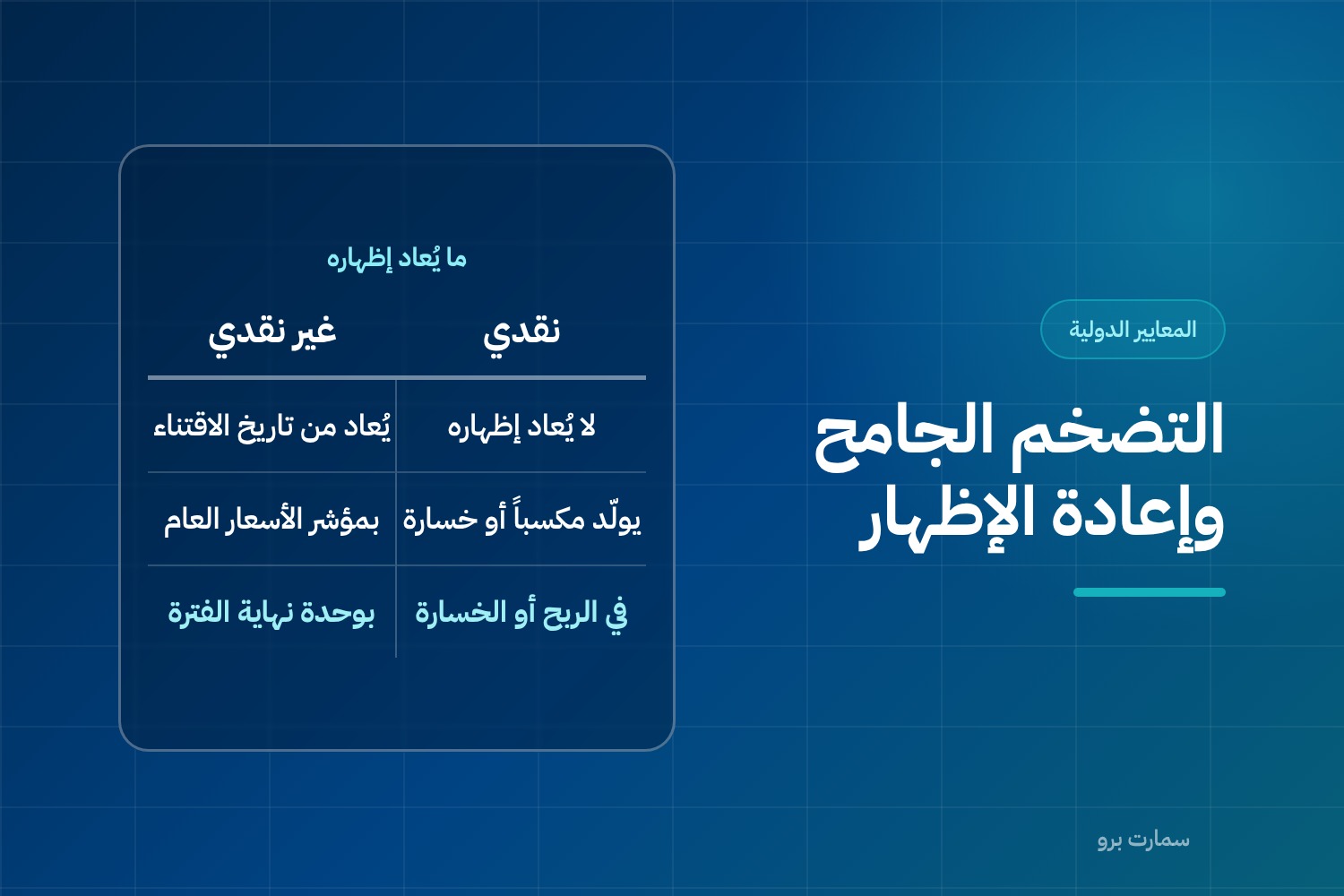
When a currency loses its purchasing power quickly, the numbers in the financial statements stop meaning much. An amount recorded in January is not worth the same in December, so adding the two together gives a misleading figure. IAS 29 deals with this, and it applies when an entity's functional currency is the currency of an economy with hyperinflation.
What it requires is a restatement of the financial statements so that they are expressed in the measuring unit current at the end of the reporting period.
When is an economy considered hyperinflationary?
The standard does not set an absolute rate at which an economy becomes hyperinflationary. It is a matter of professional judgement, guided by these indicators:
- The general population prefers to keep its wealth in non-monetary assets or in a relatively stable foreign currency.
- Prices are quoted in a relatively stable foreign currency.
- Credit sales and purchases take place at prices that compensate for the expected loss of purchasing power during the credit period.
- Interest rates, wages and prices are linked to a price index.
- The cumulative inflation rate over three years is approaching or exceeds 100%.
The fifth indicator is the best known, but it is not the only condition and does not replace an assessment of the others.
It is preferable for all entities reporting in the currency of the same economy to apply the standard from the same date.
The rule: a general price index
All amounts in the statement of financial position that are not already expressed in the measuring unit current at the end of the period are restated by applying a general price index. The prior-period statements, the comparative figures and any information for earlier periods are all expressed in the end-of-period measuring unit.
One decisive point: presenting the unrestated statements as a supplement is not allowed, and presenting them separately is discouraged. The restated statements are the financial statements, not a parallel version.
Monetary and non-monetary items
This is where the practical work happens:
| Type | Definition | Treatment |
|---|---|---|
| Monetary | Money held, and items to be received or paid in money | Not restated |
| Non-monetary | Everything else | Restated from their dates of acquisition |
There are exceptions. Items linked by agreement to price changes, such as index-linked bonds and loans, are adjusted in line with the agreement. Items already carried at end-of-period amounts, such as net realisable value or fair value, are not restated. Items carried at revalued amounts are restated from the date of the revaluation.
Where acquisition records are not available, an independent professional valuation or an estimate may be used.
For equity, each component is restated from the dates the amounts were contributed. Any revaluation surplus from earlier periods is eliminated on first application, and restated retained earnings are derived as the balancing figure.
The gain or loss on the net monetary position
This is a figure the standard produces that exists nowhere else:
- Holding net monetary assets during inflation produces a loss of purchasing power.
- Net monetary liabilities produce a gain.
It is calculated either as the difference arising from the restatements, or by an estimate that applies the change in the index to the weighted average of the net monetary position. It is included in profit or loss and disclosed separately.
The economic meaning is simple: whoever holds cash loses, and whoever owes debt gains. The standard shows this effect explicitly instead of letting it disappear into the numbers.
The income statement and consolidation
All items in the statement of comprehensive income are restated from the dates the income and expense items were first recorded.
On consolidation, the statements of a subsidiary in a hyperinflationary economy are restated using the general price index of its own country, and then translated at closing rates under IAS 21 on foreign exchange. The order matters: restate first, then translate.
When does the standard stop applying?
When the economy ceases to be hyperinflationary, the amounts expressed in the measuring unit current at the end of the previous reporting period become the basis for the carrying amounts in later statements. There is no going back to the original figures.
A worked example
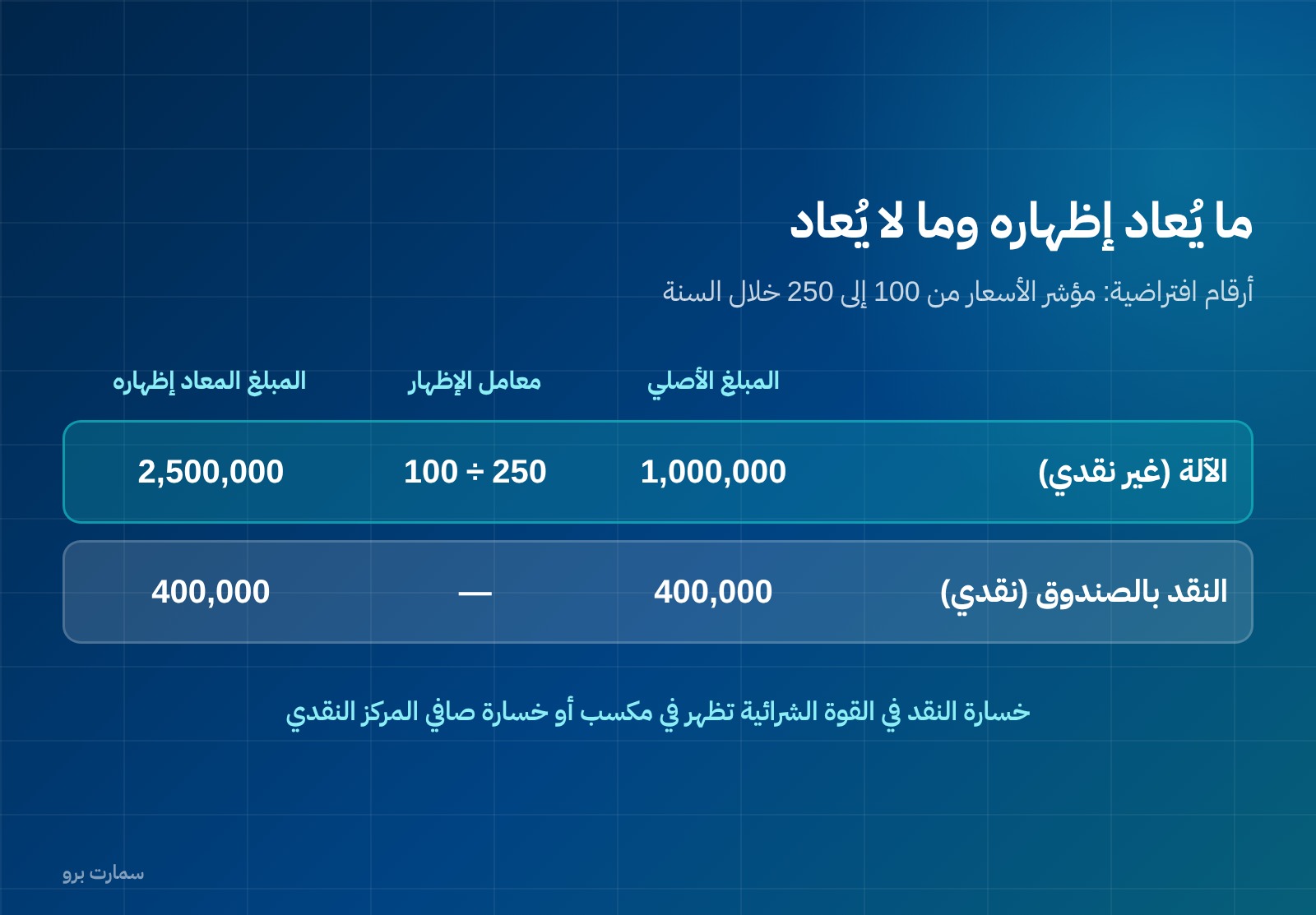
The following figures are hypothetical, to illustrate the method, and do not relate to any particular economy. An entity bought a machine for 1,000,000 currency units at the start of the year, when the general price index stood at 100. By the end of the year the index had reached 250:
| Item | Original amount | Restatement factor | Restated amount |
|---|---|---|---|
| Machine (non-monetary) | 1,000,000 | 250 ÷ 100 | 2,500,000 |
| Cash on hand (monetary) | 400,000 | — | 400,000 |
The machine has not changed, but the measuring unit has, so its value expressed in end-of-year units becomes 2,500,000. The cash stays as it is, and its loss of purchasing power is what shows up in the gain or loss on the net monetary position.
What must be disclosed?
The entity discloses: that the financial statements and the comparative figures for prior periods have been restated for changes in general purchasing power and are expressed in the current measuring unit; whether the statements are based on historical cost or current cost; and the identity and level of the price index at the end of the reporting period, together with its movement during the current and previous period.
Does this matter to a Saudi business?
The riyal is pegged to the US dollar, and inflation in the Kingdom is far from the thresholds of this standard. It becomes directly relevant in two cases: a business with a subsidiary or branch in a hyperinflationary economy, which must restate before consolidating; or a business that trades with such markets and needs to read its counterparties' statements. See also consolidated financial statements and our guide to IFRS in Saudi Arabia.
The official text is on ifrs.org.
What is the official name adopted in Saudi Arabia?
The approved Arabic title of this standard is «المعيار الدولي للمحاسبة 29: التقرير المالي في الاقتصادات ذات التضخم الجامح» (IAS 29: Financial Reporting in Hyperinflationary Economies). SOCPA adopted it without any modification for application in the Kingdom.
Reference: Saudi Organization for Chartered and Professional Accountants (SOCPA), the document endorsing IFRS for application in the Kingdom, updated on 04/07/1447 AH.
Key takeaway: Under IAS 29, non-monetary items are restated with a general price index while monetary items are not, and the resulting purchasing-power effect appears as a separate gain or loss on the net monetary position. For a group, restate first, then translate.
If you want your chart of accounts, cost centres and financial statements kept in one connected system, book a demo of SmartPro's Finance & Accounting.
Article visuals

Frequently asked questions
When is an economy considered hyperinflationary?
IAS 29 does not set a fixed rate. It leaves the decision to professional judgement, guided by indicators. The best known is cumulative inflation over three years approaching or exceeding 100%.
Which items are not restated under IAS 29?
Monetary items are not restated: money held, and items to be received or paid in money. Items already carried at end-of-period amounts, such as net realisable value or fair value, are not restated either.
What is the gain or loss on the net monetary position?
It is the effect of holding monetary items during inflation. Net monetary assets produce a loss of purchasing power, while net monetary liabilities produce a gain. It is included in profit or loss and disclosed separately.
In what order do you consolidate a subsidiary in a hyperinflationary economy?
First restate the subsidiary's statements using the general price index of its own country. Then translate them at closing rates under IAS 21, The Effects of Changes in Foreign Exchange Rates.
What happens when an economy stops being hyperinflationary?
The amounts expressed in the measuring unit current at the end of the previous reporting period become the basis for carrying amounts in later statements. There is no return to the original figures.