
Consolidated Financial Statements: When and How to Prepare Them
When you must prepare consolidated financial statements, the three elements of control in IFRS 10, and when a parent is exempt from consolidation.
Author:سامي الحيدري
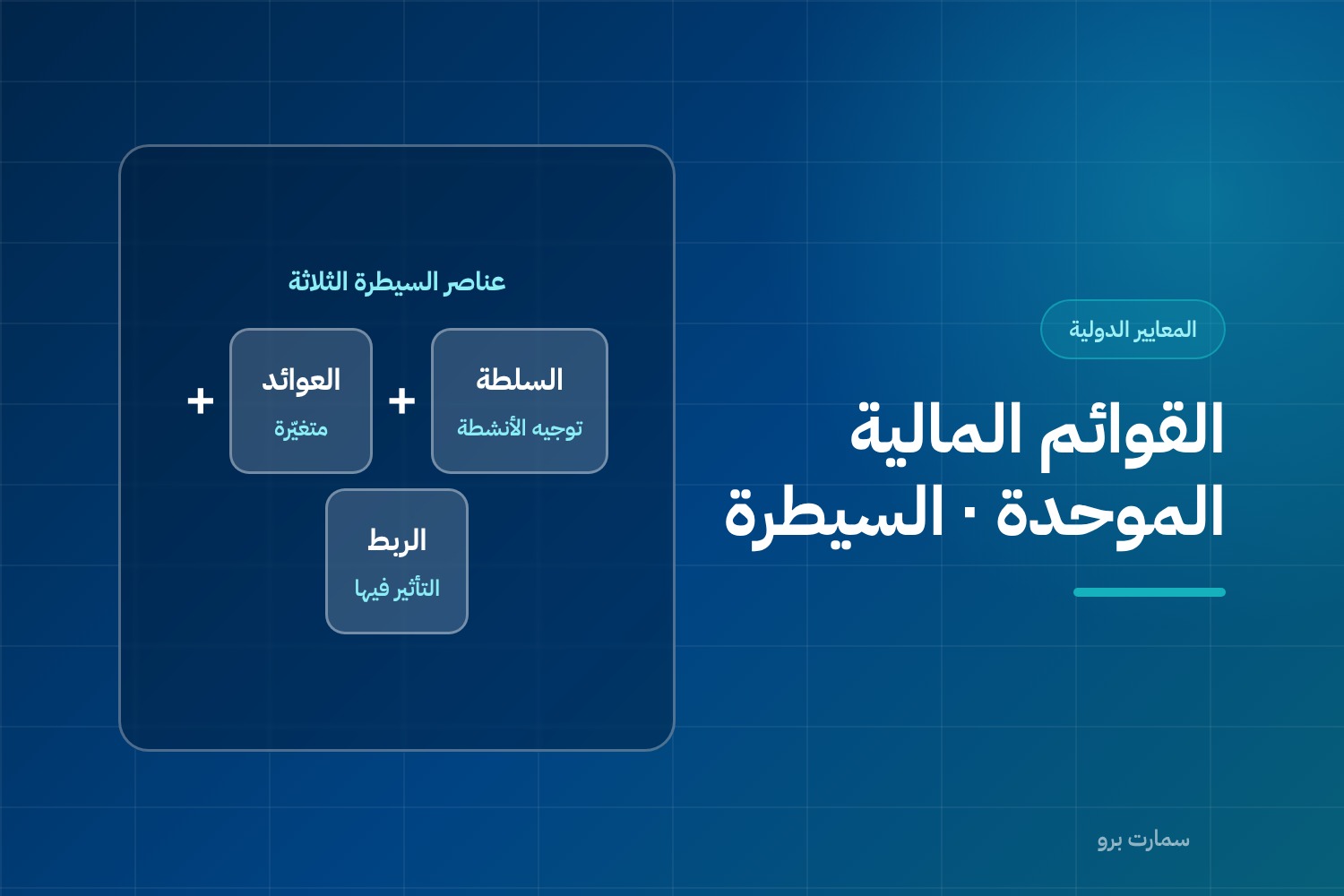
If you hold stakes in more than one entity, the first question is not "How much do I own?" but "Do I control it?". That answer decides whether you must prepare consolidated financial statements. It is not a percentage test, as many people assume.
IFRS 10 sets the principles for presenting and preparing consolidated financial statements when an entity controls one or more other entities. It defines the principle of control and makes control the basis for consolidation. It does not cover accounting for business combinations or goodwill, which are the subject of IFRS 3.
What are the three elements of control?
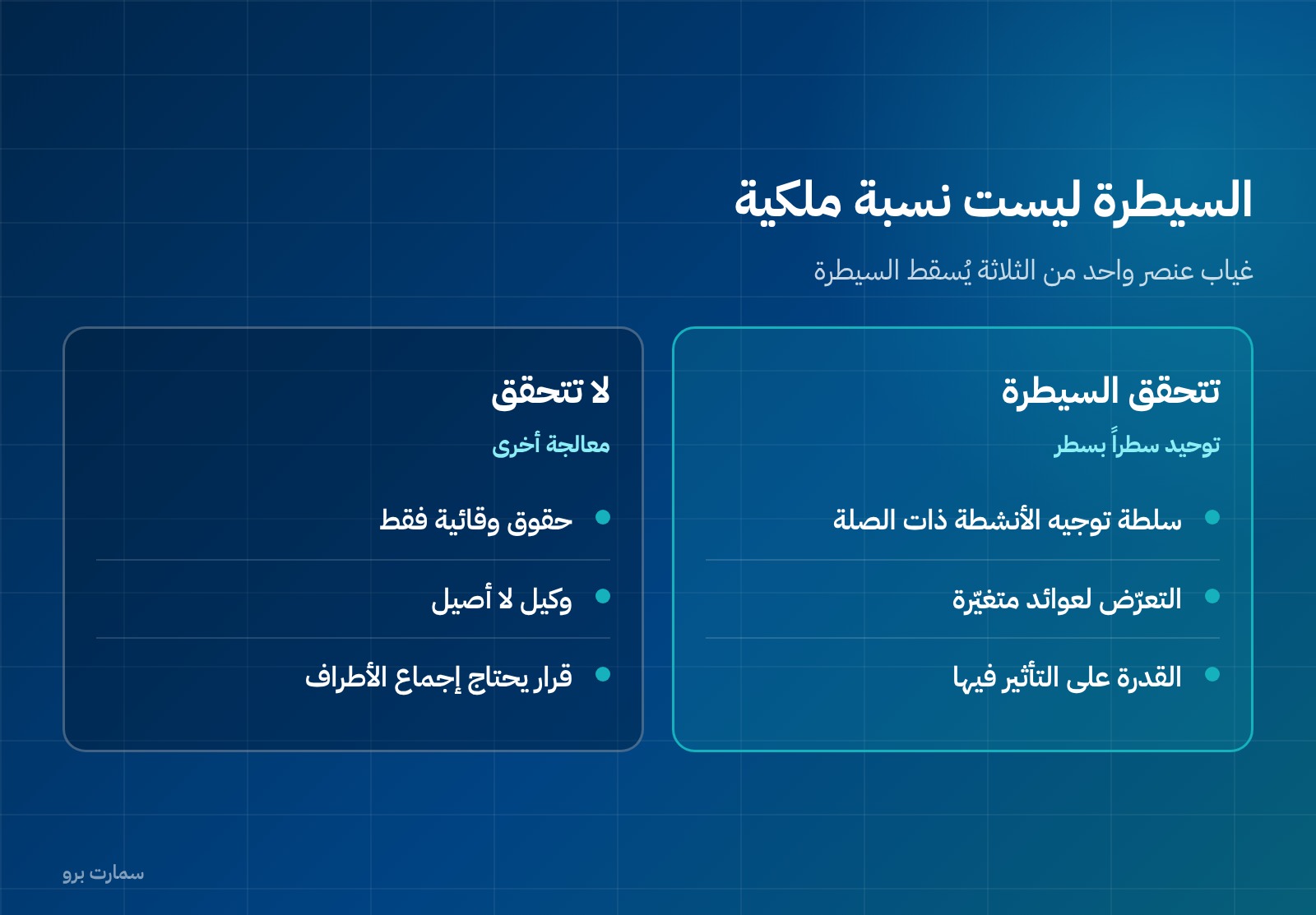
An investor controls an investee if, and only if, it has all three of the following elements together:
- Power over the investee.
- Exposure, or rights, to variable returns from its involvement with the investee.
- The ability to use its power to affect the amount of those returns.
If one element is missing, there is no control. An investor with a large stake that receives variable returns but cannot direct the relevant activities does not control. Control is reassessed whenever facts and circumstances indicate a change in any of the three elements.
What does power mean?
Power comes from existing rights that give the current ability to direct the "relevant activities". These are the activities that significantly affect the investee's returns. Three fine points matter:
- Power exists even if the rights are not exercised. Abstaining from a vote does not remove control.
- When different investors direct different activities, the one that directs the activities that most significantly affect returns has power.
- Protective rights alone do not give power. A right to veto the investee's liquidation or a fundamental change to its business is protective, and an investor holding only such rights does not control.
When two or more investors must act together to direct the relevant activities, control is collective and none of them controls alone.
Is the decision-maker a principal or an agent?
A decision-maker must assess whether it is a principal acting on its own behalf, or an agent exercising delegated rights on behalf of others. An agent does not control, however broad its authority. This point is often overlooked in fund and portfolio management structures.
When are you exempt from preparing consolidated financial statements?
A parent does not need to present consolidated financial statements if all four conditions are met:
| # | Condition |
|---|---|
| 1 | It is a wholly-owned or partially-owned subsidiary, and its other owners have been informed and do not object to it not consolidating |
| 2 | Its debt or equity instruments are not traded in a public market |
| 3 | It has not filed, and is not in the process of filing, its financial statements with a regulator for the purpose of issuing instruments in a public market |
| 4 | Its ultimate parent or any intermediate parent produces consolidated financial statements that are available for public use and comply with IFRS |
If any single condition fails, the requirement applies again. Post-employment benefit plans covered by IAS 19 are also excluded.
What are the practical rules of consolidation?
- Uniform accounting policies for like transactions and events in similar circumstances.
- Consolidation starts when control is obtained and stops when control is lost.
- Non-controlling interests are presented within equity, separately from the equity of the parent's owners. This is a frequent error: they are neither a liability nor a mezzanine item.
- A change in the parent's ownership interest without loss of control is accounted for as an equity transaction, not as a gain or loss in profit. Selling 10% while keeping control does not create a profit in the income statement.
- On loss of control, the subsidiary's assets and liabilities are derecognised, any retained interest is recognised and remeasured, and the resulting gain or loss is recognised.
What is the investment entity exception?
An investment entity is one that obtains funds from investors to provide them with investment management services, commits to those investors that its business purpose is to invest for returns from capital appreciation, investment income or both, and measures and evaluates the performance of substantially all its investments on a fair value basis. Such an entity does not consolidate its subsidiaries. Instead, it measures them at fair value through profit or loss.
This exception has its own exception: a subsidiary that is not itself an investment entity and whose main purpose is to provide services related to the investment activities is consolidated.
How does consolidation differ from the equity method?
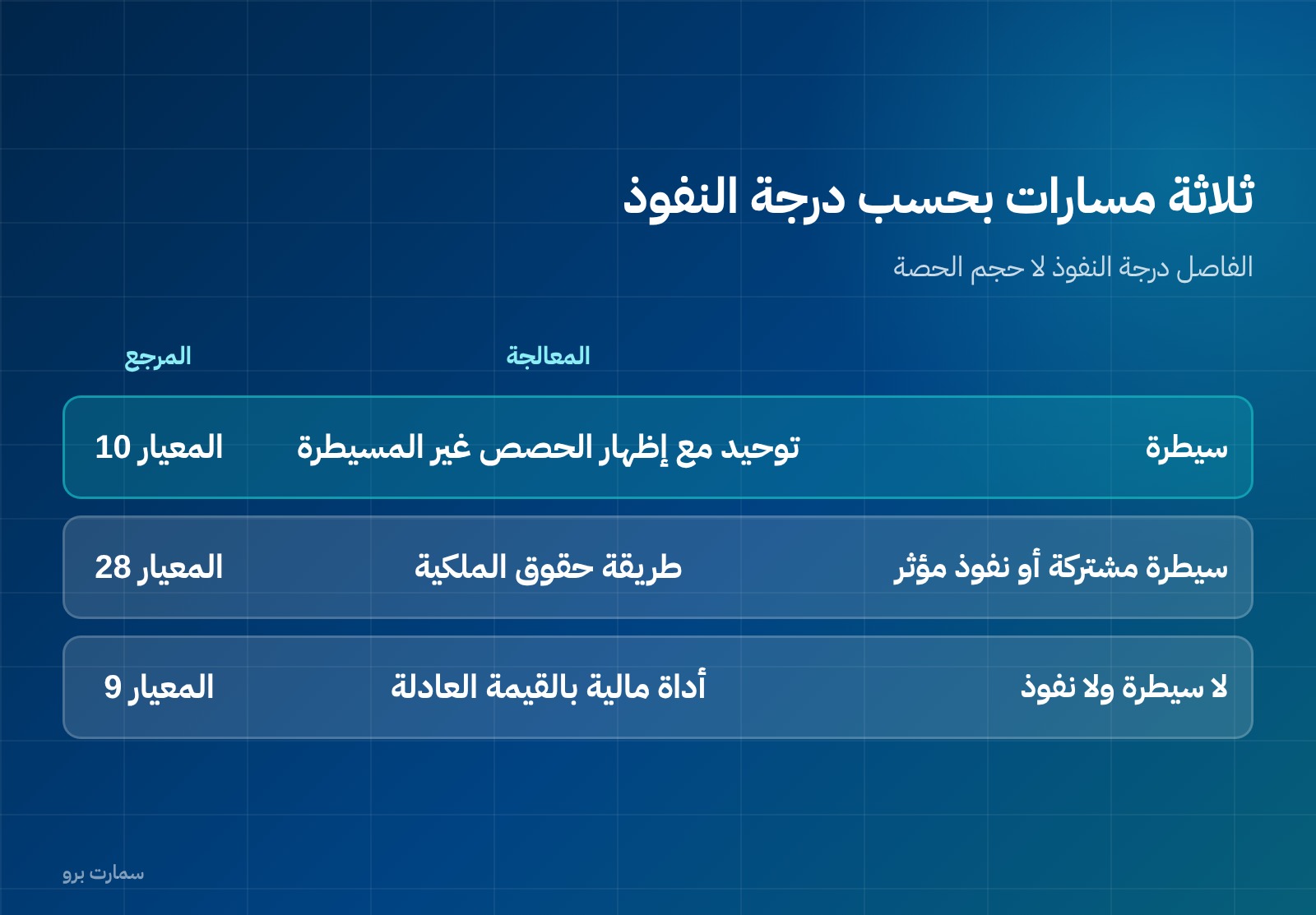
Mixing up these two routes is one of the most common ways financial statements go wrong. What separates them is the degree of influence, not the size of the stake:
| Situation | Treatment | Standard |
|---|---|---|
| Control | Line-by-line consolidation, showing non-controlling interests | IFRS 10 |
| Joint control or significant influence | Equity method | IAS 28 |
| Neither control nor significant influence | Financial instrument at fair value | IFRS 9 |
On consolidation, transactions between group companies are eliminated in full: intercompany sales, intercompany receivables and payables, and unrealised profit in inventory transferred between companies. If you sell goods to your subsidiary at a profit and they have not yet been sold to an outside party, the group has not earned a profit.
What does this mean for your accounting system?
Consolidation is not a report pieced together by hand at year end. Your system needs three things:
- A common chart of accounts across companies. A chart of accounts is the structured list of accounts every transaction is posted to.
- A tag on every transaction between group companies, so it can be eliminated automatically.
- A single presentation currency, with the balances of foreign companies translated under IAS 21.
Without these three, the consolidated close turns into weeks of work across separate spreadsheets. In SmartPro, Finance & Accounting includes the chart of accounts and cost centres, with multiple currencies available as a paid option; how far your group's consolidation can be automated is something to confirm against your structure.
A common misconception about one amendment
The amendments "Sale or Contribution of Assets between an Investor and its Associate or Joint Venture", issued in September 2014, had their mandatory effective date deferred indefinitely in December 2015, and that is still the position. Many secondary sources treat them as if they were in force, so be careful.
The standard has been effective since 1 January 2013. Its official text is on ifrs.org.
What is the official title adopted in Saudi Arabia?
The approved Arabic title of this standard is «المعيار الدولي للتقرير المالي 10: القوائم المالية الموحدة» (IFRS 10: Consolidated Financial Statements). SOCPA adopted it without any modification for application in the Kingdom.
Source: Saudi Organization for Chartered and Professional Accountants (SOCPA), document on the endorsement of IFRS for application in the Kingdom, updated 1447/07/04 AH.
Key takeaway: Consolidation depends on control, meaning power, variable returns and the link between them, not on a shareholding percentage. Once you control, consolidate line by line, show non-controlling interests within equity and eliminate intercompany transactions in full.
To see how SmartPro's accounting handles your group's chart of accounts and intercompany postings, book a demo with a product expert.
Article visuals
Frequently asked questions
When must consolidated financial statements be prepared?
When an entity controls one or more other entities. Under IFRS 10, control exists when three elements are present together: power over the investee, exposure to variable returns, and the ability to use that power to affect those returns.
Is owning more than 50% enough to prove control?
The percentage is an indicator, not a rule. IFRS 10 bases control on the three elements, so you may control with less than half of the shares and may not control with more than half if you cannot direct the relevant activities.
When is a parent company exempt from consolidation?
When four conditions are all met: it is a subsidiary whose other owners do not object, its instruments are not traded in a public market, it is not in the process of issuing instruments publicly, and its parent publishes IFRS-compliant consolidated financial statements available for public use. If any one condition fails, consolidation is required.
Where are non-controlling interests presented?
Within equity in the consolidated statement of financial position, separately from the equity of the parent's owners. They are neither a liability nor a mezzanine item between liabilities and equity.
What happens when a stake is sold but control is kept?
The change is accounted for as an equity transaction, and no gain or loss is recognised in profit or loss. Only when control is lost are the subsidiary's assets and liabilities derecognised, any retained interest remeasured, and a gain or loss recognised.