
Employee Benefits and the End-of-Service Provision: The Accounting Treatment
How the end-of-service liability is measured for accounting purposes, the difference between defined contribution and defined benefit plans, and why a rough calculation based on current employees is not enough.
Author:سامي الحيدري
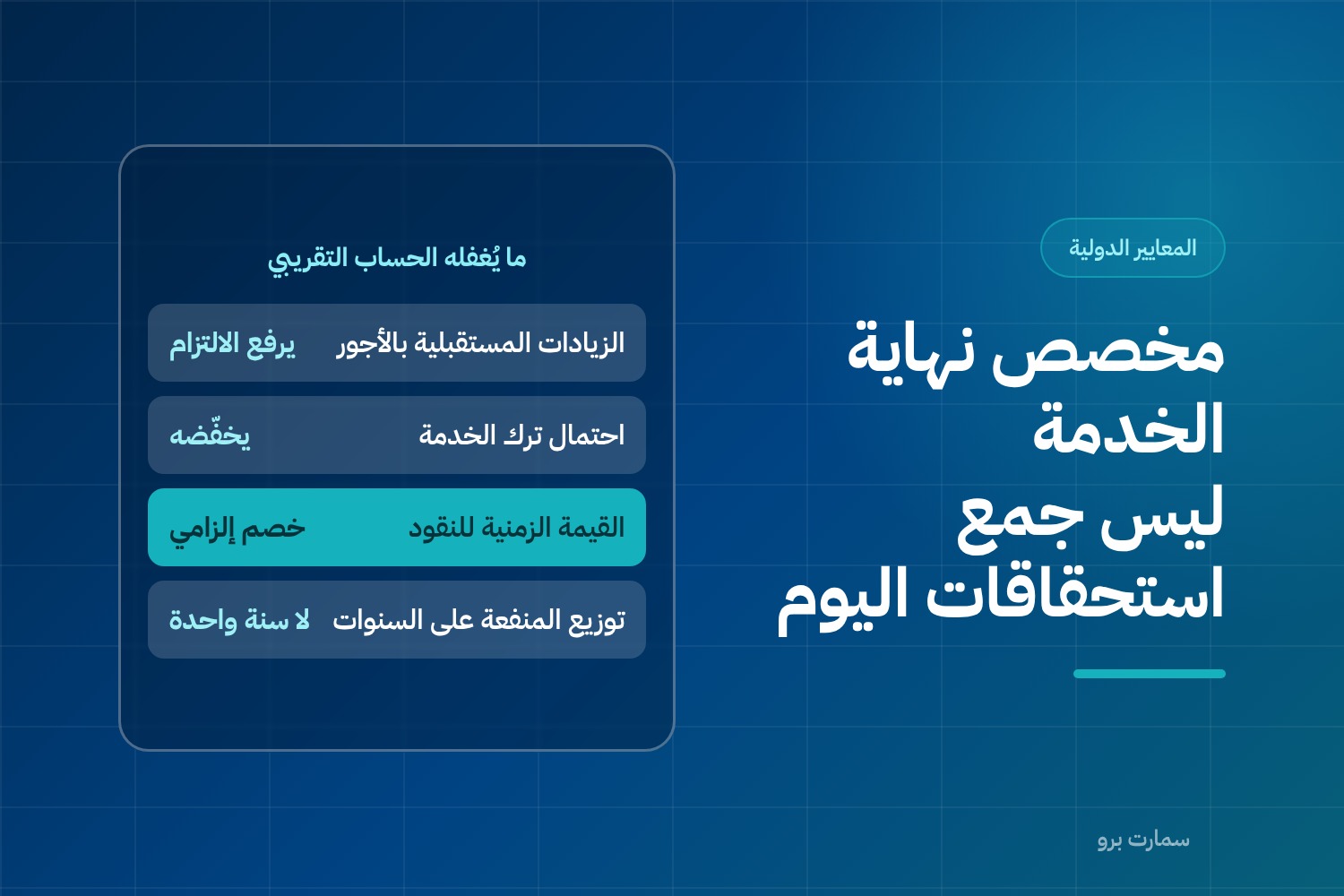
The most common error in Saudi businesses' financial statements is calculating end-of-service employee benefits by adding up what current staff would receive if they left today and booking the total as a provision. That is not sound measurement. The liability is based on what will actually be paid in future, discounted to present value, after allowing for staff turnover and salary increases.
Employee benefits: what are the two types of plan?
Defined contribution plans: the business pays a fixed contribution to an independent body, and its obligation ends once it pays. The treatment is simple: the contribution is expensed in the period in which the employee provided the service, and no long-term liability arises.
Defined benefit plans: the business commits to a benefit calculated by a formula based on salary and length of service, and it carries the actuarial and investment risks. This is where the complexity starts, because the final amount is not known today. An actuarial risk is the risk that assumptions about salaries, turnover or timing turn out differently than expected.
The end-of-service award under the Saudi Labour Law is treated for accounting purposes as a defined benefit plan, because the benefit is calculated by a formula on salary and service and does not end with a contribution paid to an independent body. Social insurance (GOSI) contributions, on the other hand, are treated according to their nature, depending on what the business is actually obliged to pay.
Why isn't a rough calculation enough?
The common method, "what everyone would be owed if they left today", ignores four factors that change the figure materially:
Future salary increases. The benefit is calculated on the final salary, not the current one. Ignoring expected increases understates the liability.
The likelihood of leaving. Not every employee will stay until full entitlement, and some will leave in circumstances that reduce the benefit. Ignoring this overstates the liability.
The time value of money. An amount paid in ten years is not worth the same amount today. Discounting to present value is essential for long-term liabilities.
Timing of entitlement. The benefit should be spread over the years of service that earned it, not charged in full to a single year.
This is why businesses with a meaningful number of employees need an actuarial valuation: a calculation by an actuary that combines these factors into a single, defensible figure.
Where do the cost components appear in the financial statements?
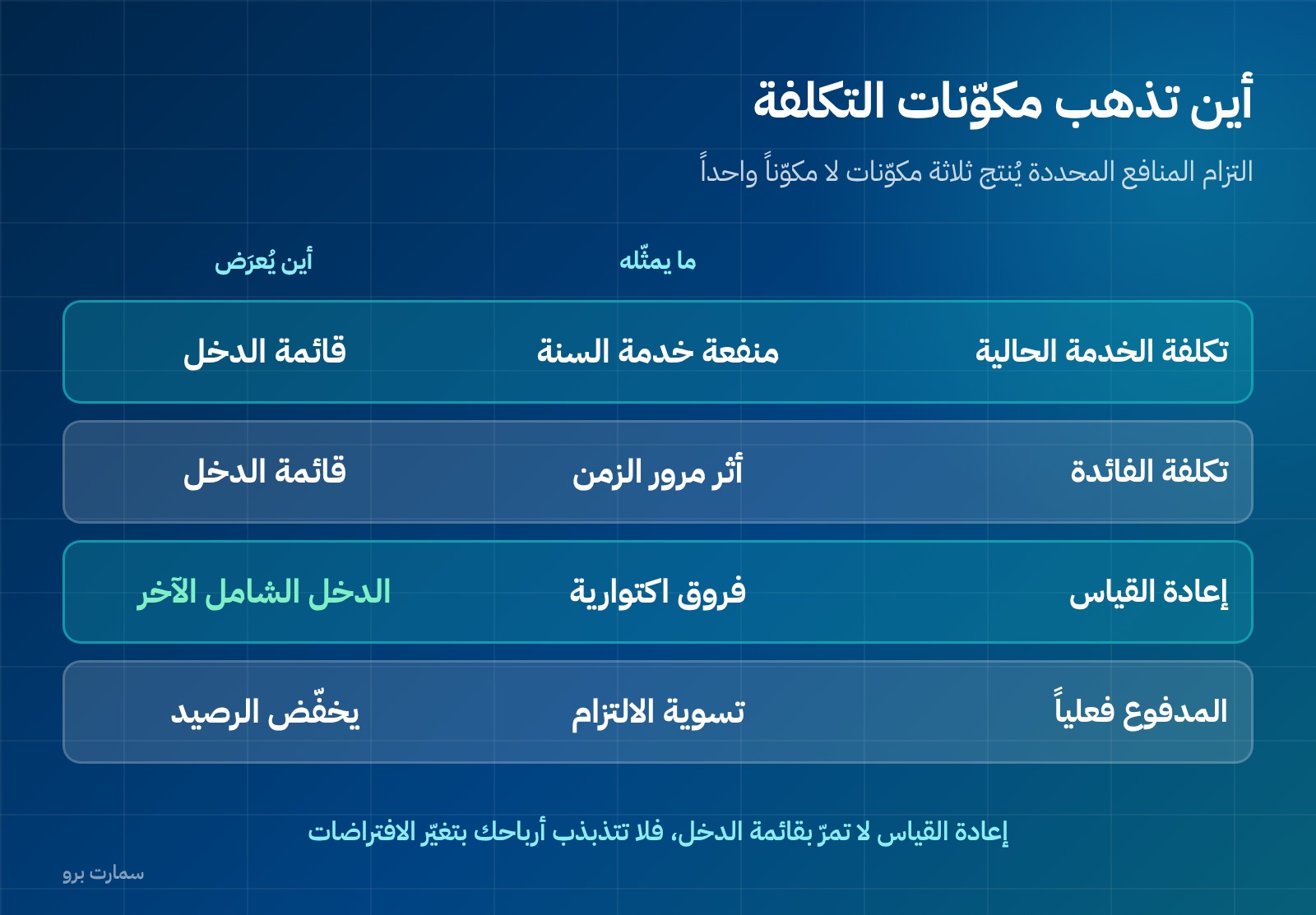
A defined benefit obligation produces three components that go to different places:
| Component | What it represents | Where it is presented |
|---|---|---|
| Current service cost | The benefit earned for this year's service | Income statement |
| Interest cost | The effect of the passage of time on the discounted liability | Income statement |
| Remeasurement | Actuarial differences and changes in assumptions | Other comprehensive income |
That last split matters: remeasurement does not go through the income statement, so your profit does not swing when actuarial assumptions change. It also explains why the liability on the balance sheet can move without a matching effect on profit.
Which assumptions drive the number?
The discount rate is the assumption with the greatest effect. A lower rate noticeably increases the present value of long-term liabilities.
The salary growth rate increases the expected benefit.
Staff turnover rates reduce the liability, and they differ materially from one sector to another and between job grades.
The expected remaining service period determines how far the amounts are discounted.
These assumptions are reviewed at every close and disclosed by the business, because they are a significant source of estimation uncertainty, as covered in notes to the financial statements.
How does the accounting liability differ from the legal entitlement?
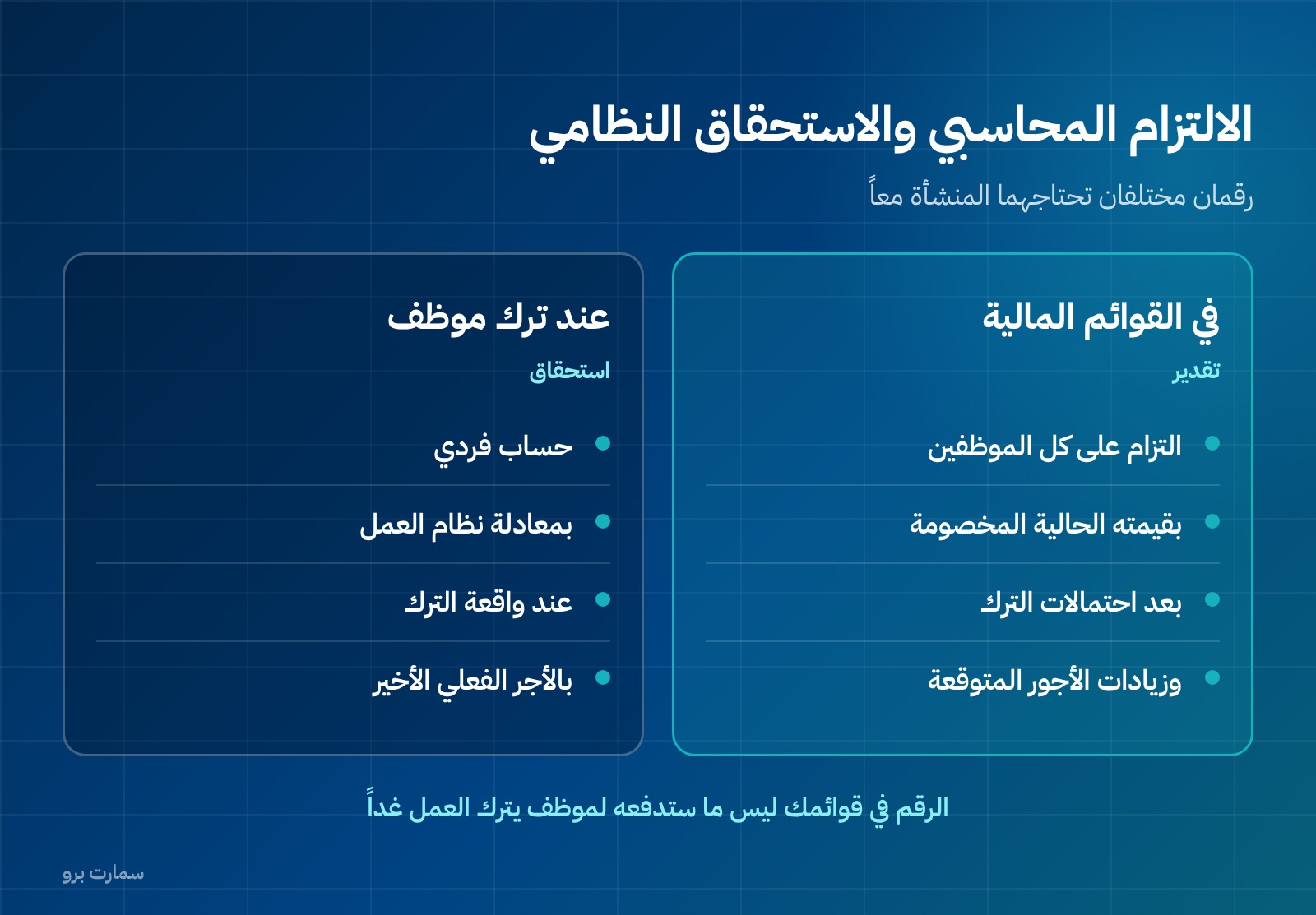
This point confuses many people: the figure in your financial statements is not the amount you will pay an employee who leaves tomorrow. The first is an overall estimate, at present value, of a future obligation to all employees. The second is an individual entitlement calculated using the Labour Law formula when the employee actually leaves.
A business needs both: the accounting estimate for the financial statements, and the individual calculation for each case. The practical detail of the individual calculation is in calculating the end-of-service award and the end-of-service provision.
What errors keep showing up in the books?
Expensing only what is paid. Recording only what was actually paid to leavers, without building a liability for everyone else, produces an erratic expense and a missing liability.
Closing the provision every year and rebuilding it. The provision is a cumulative balance that moves through a movement schedule, not an entry reversed each year.
Not separating payments from new charges. The movement schedule must show: opening balance, service cost, interest cost, payments during the year, remeasurement and closing balance. Without the schedule, the balance is a number nobody can explain.
Ignoring employees on probation or temporary contracts. Entitlement follows the law and the contract, and automatically excluding an entire category without a basis understates the liability.
What is the zakat and tax effect?
A provision built for accounting purposes may not be fully accepted for tax, because the tax treatment usually looks at actual payment rather than the build-up of the provision. This is one of the items in the reconciliation from accounting profit to the tax base; see the income tax return in Saudi Arabia. The resulting timing differences give rise to deferred tax, as explained in deferred tax.
What should a year-end checklist include?
- Your benefit plans are classified as either defined contribution or defined benefit.
- The end-of-service liability is measured on a discounted basis, not by adding up today's entitlements.
- The actuarial assumptions are documented and reviewed this year.
- Service cost and interest are in the income statement, and remeasurement is in other comprehensive income.
- The liability movement schedule is prepared: opening balance, service cost, interest, payments, remeasurement, closing balance.
- The effect of the estimate on the tax base is identified in the reconciliation schedule.
- The balance agrees with the trial balance.
Where are the official references?
The international standards as endorsed in the Kingdom are published by the Saudi Organization for Chartered and Professional Accountants (SOCPA) on its website: socpa.org.sa, and the full texts of the standards are available from the IFRS Foundation at ifrs.org. The legal provisions on the end-of-service award are set out in the Labour Law, available from the Ministry of Human Resources and Social Development at hrsd.gov.sa.
Read also
- The end-of-service provision: how it is built
- Deferred tax: where it comes from
- Provisions and contingent liabilities
Key takeaway: The end-of-service liability is a discounted estimate of future payments, not the sum of today's entitlements. Keep a movement schedule and send remeasurement to other comprehensive income, not profit.
If you want employee files and payroll kept in one system connected to your accounts, you can start a free SmartPro trial.
Article visuals
Frequently asked questions
What is the difference between defined contribution and defined benefit plans?
In a defined contribution plan, the business pays a fixed contribution to an independent body and its obligation ends once it pays, so the contribution is expensed in the period of service. In a defined benefit plan, the business commits to a benefit calculated by a formula on salary and length of service and carries the actuarial risks. This creates a long-term liability that must be measured on a discounted basis.
Why isn't adding up current employees' entitlements enough?
Because that method ignores future salary increases, the likelihood of employees leaving, the time value of money, and the spreading of the benefit over the years of service that earned it. The result is a figure that does not reflect the real liability and cannot be defended in an audit.
Where are the components of defined benefit cost presented?
Current service cost and interest cost are presented in the income statement. Remeasurement arising from actuarial differences and changes in assumptions is presented in other comprehensive income and does not go through the income statement. That is why the liability on the balance sheet can change without a matching effect on profit.
Is the figure in the financial statements what I will pay an employee?
No. The figure in the financial statements is an overall estimate, at present value, of a future obligation to all employees. The amount paid to a specific employee is calculated using the Labour Law formula when they leave. A business needs both: the accounting estimate for the financial statements and the individual calculation for each case.