
Provisions and Contingent Liabilities: When Do You Recognise and When Do You Only Disclose?
The three conditions for recognising a provision, how it differs from a contingent liability and an accrued expense, and how it is measured and reviewed at every close.
Author:سامي الحيدري
In practice, the word "provision" gets used in the books for very different things: an accrued expense whose invoice hasn't arrived, a possible legal liability, or an estimate of a fall in an asset's value. Mixing them up produces statements that are either weighed down by liabilities that don't exist or missing liabilities that do. Provisions and contingent liabilities have specific conditions that settle which one you are looking at.
What are the three conditions for recognising a provision?
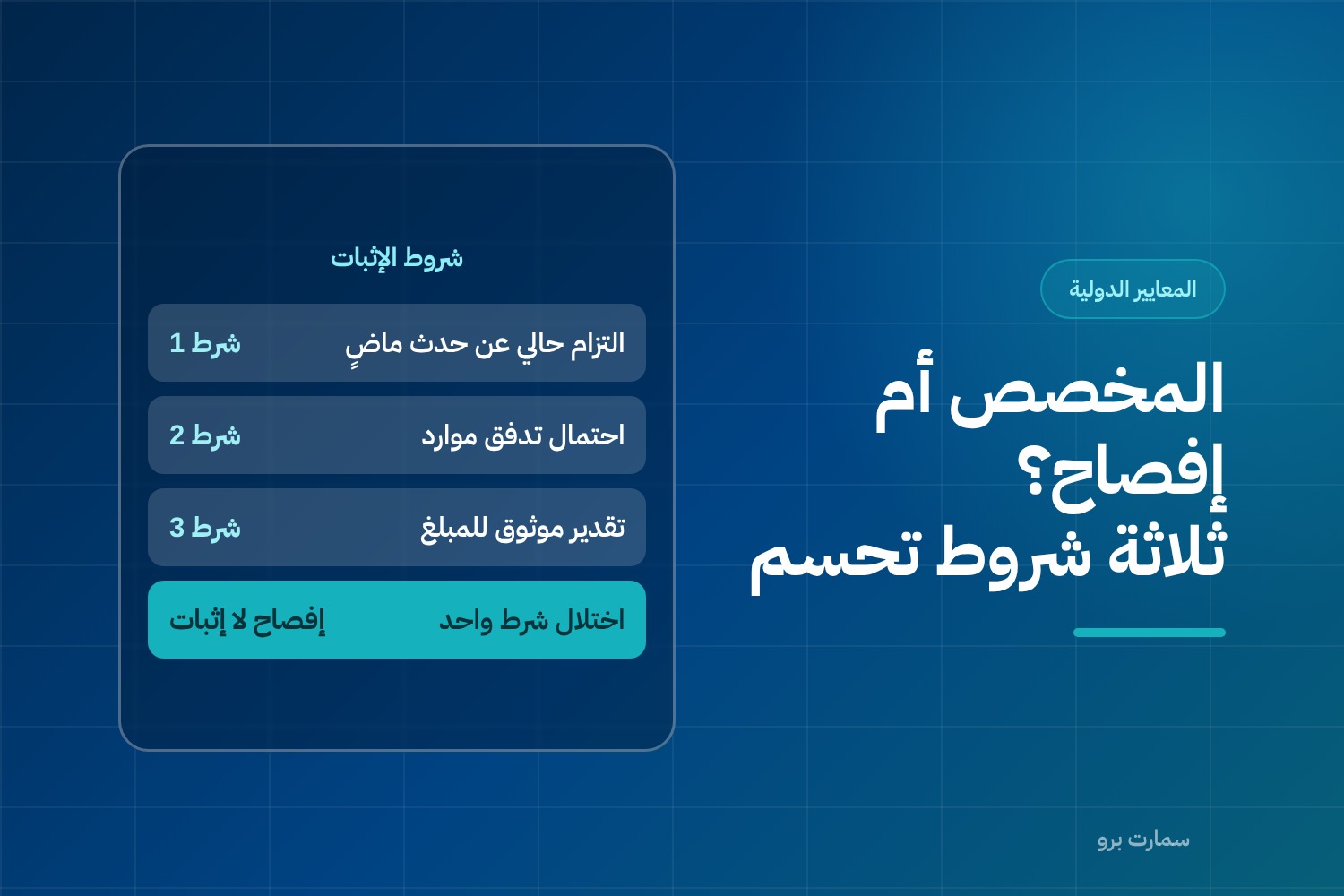
A provision is recognised only when three conditions are met together:
- A present obligation, legal or constructive, arising from a past event.
- It is probable that an outflow of resources will be required to settle the obligation.
- The amount can be estimated reliably.
If even one condition fails, no provision is recognised. An obligation that cannot be estimated reliably is disclosed, not recognised.
The constructive obligation deserves a closer look: not every obligation is written into a contract. A constructive obligation is one created by a business's established practice rather than a written term. A business that routinely replaces products within a certain period, even without a contractual clause, and has thereby created a valid expectation among its customers, has a constructive obligation.
Provisions, contingent liabilities and accrued expenses: what's the difference?
| Item | Description | Treatment |
|---|---|---|
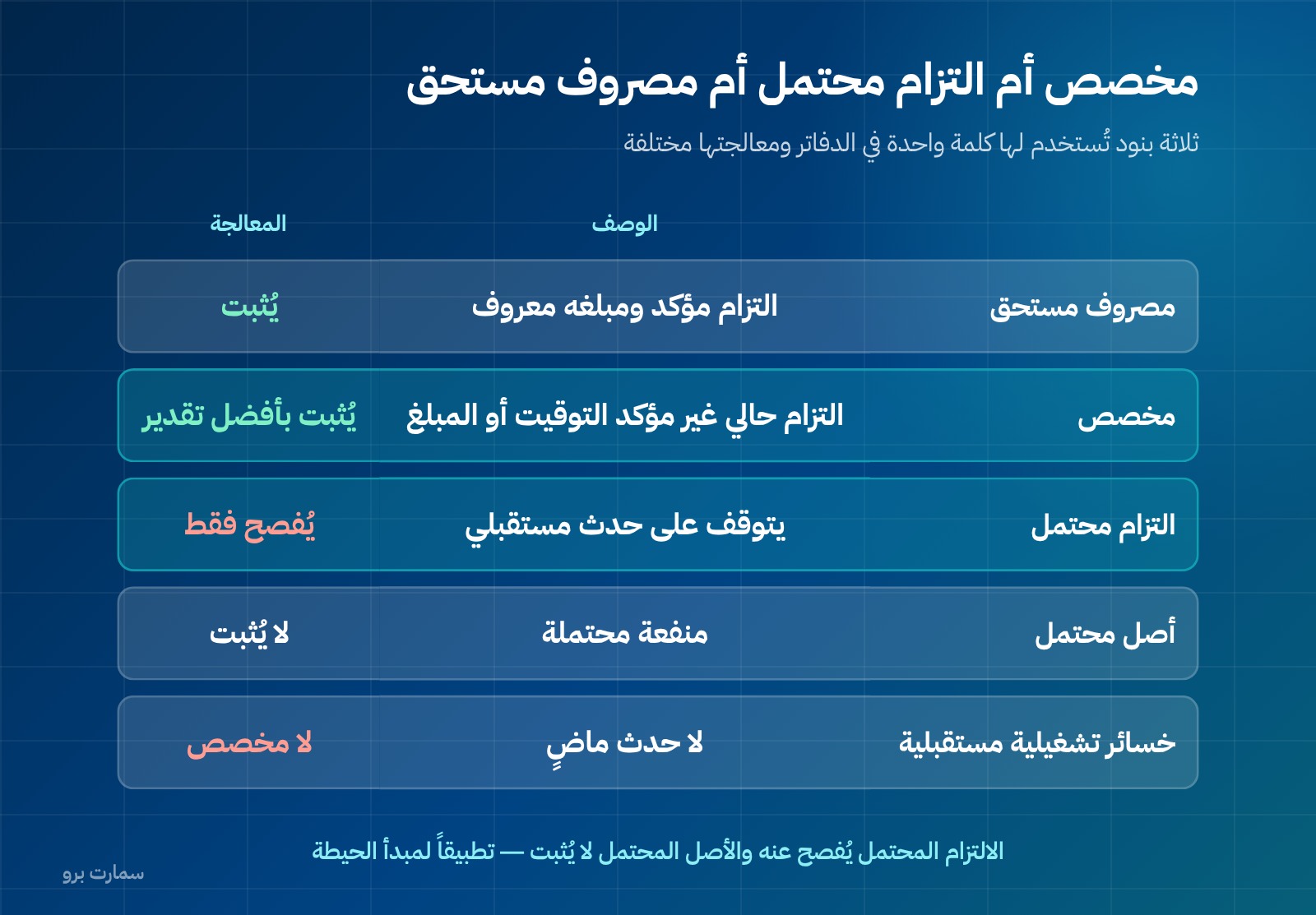
| Accrued expense | A certain obligation whose amount is known or nearly known, but whose invoice hasn't arrived | Recognised within current liabilities |
| Provision | A present obligation whose timing or amount is uncertain | Recognised at the best estimate |
| Contingent liability | A possible obligation that depends on a future event, or a present one where the outflow is not probable or cannot be estimated | Disclosed but not recognised |
| Contingent asset | A possible benefit, such as an expected compensation | Not recognised; disclosed if the inflow is probable |
Note the asymmetry: a contingent liability is disclosed, while a contingent asset is not recognised and is disclosed only under narrower conditions. This is the prudence principle in action.
What do provisions look like in practice?
A lawsuit. If legal counsel considers a loss likely and the amount can be estimated, a provision is recognised. If the likelihood is low or the amount cannot be estimated, it is disclosed as a contingent liability.
Product warranty. A constructive or contractual obligation arising from a sale that has already taken place. It is measured using historical experience of repair and replacement rates.
Restoring a site. The obligation to remove fit-out works at the end of a lease is recognised as a provision, and the matching amount is added to the cost of the right-of-use asset. See lease contracts under IFRS 16.
Restructuring. A provision is not recognised merely because management has made a decision. It is recognised when there is a detailed formal plan and a valid expectation has been created among those affected.
Future operating losses. No provision is ever recognised for them, because they do not arise from a past event.
How is a provision measured?
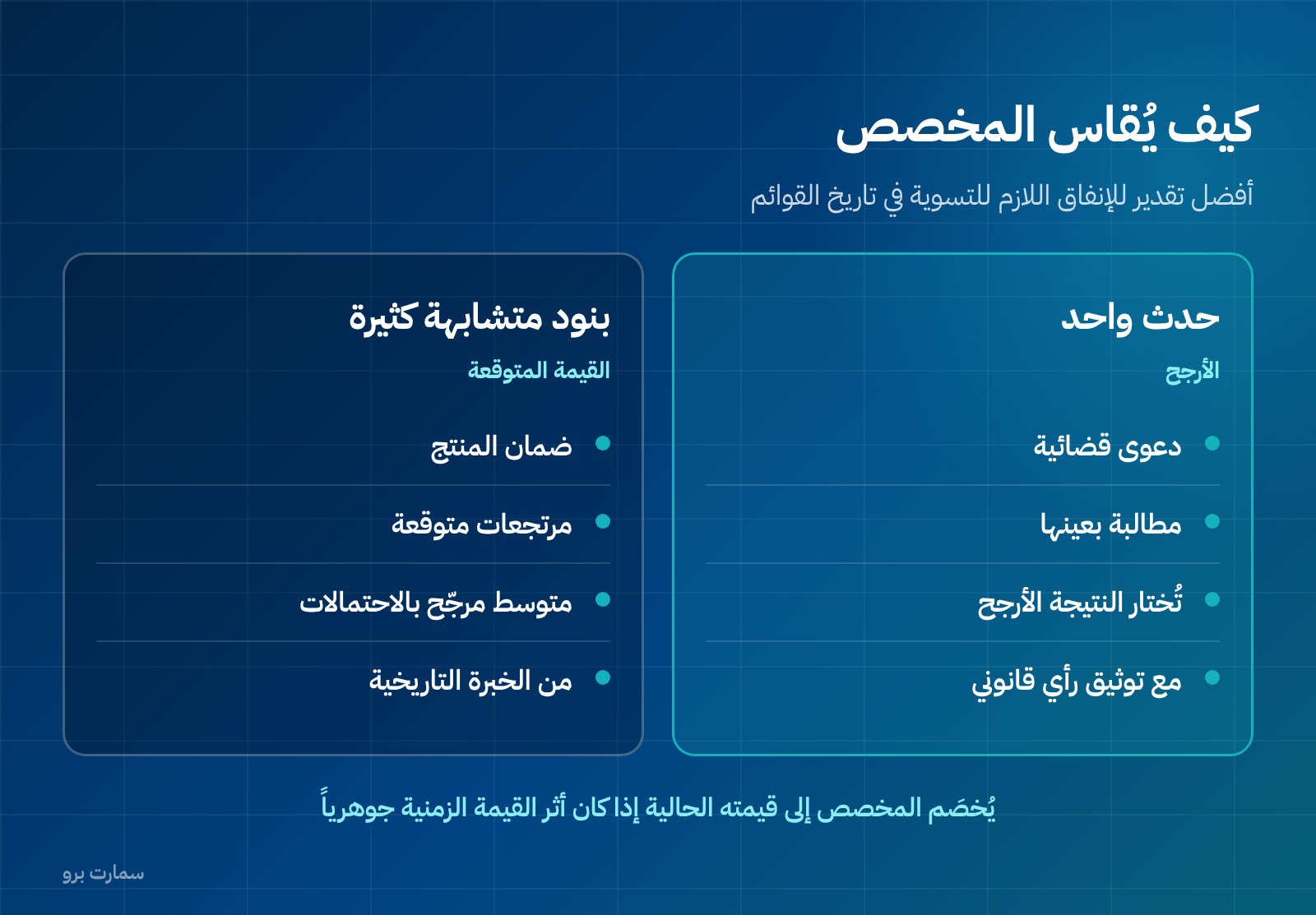
At the best estimate of the expenditure required to settle the obligation at the reporting date. The estimation method depends on the situation:
- A single obligation: the most likely outcome among the possible results.
- A large population of similar items, such as product warranties: the expected value, meaning the probability-weighted average.
If the time value of money is material, for example an obligation settled several years from now, the amount is discounted to its present value. The increase caused by the passage of time is then recognised as a finance cost.
Any expected reimbursement from another party is not deducted from the provision. Instead, the reimbursement is recognised as a separate asset when its receipt is virtually certain, and it cannot exceed the amount of the provision.
How should provisions be reviewed at each close?
A provision is not a number you set up and forget. It is reviewed at the end of every period and adjusted to reflect the current best estimate. If an outflow of resources is no longer probable, the provision is reversed.
A provision is used only for the purpose it was created for. Using a warranty provision to cover a regulatory fine hides the true cost of both.
A movement schedule is effectively mandatory: opening balance, amounts provided, amounts used, amounts reversed, unwinding of the discount, and closing balance, as covered in notes to the financial statements.
Where do people go wrong in practice?
Calling everything a provision. An electricity bill that hasn't arrived yet is not a provision but an accrued expense, because the obligation is certain and the amount is nearly known. The wrong label takes away the reader's ability to tell what is certain from what is an estimate.
Creating provisions to smooth results. Building up a provision in a good year to release it in a weak one is a practice the standard does not accept, because a provision is measured at the best estimate of the obligation, not at whatever suits the result.
Not updating the estimate. A lawsuit provision set up three years ago and never reviewed as the case developed is no longer the best estimate.
Offsetting the expected reimbursement. Reducing a provision by an expected insurance recovery hides the size of the obligation. The correct treatment is to recognise the reimbursement as a separate asset when its receipt is virtually certain.
Overlooking constructive obligations. A customary returns policy with no written terms creates a real constructive obligation.
What is the tax effect of provisions?
Provisions are among the most frequently disputed items in a tax audit, because the tax treatment usually looks at actual realisation rather than at the creation of the provision. A provision that has been set up is therefore a recurring item in the reconciliation from accounting profit to the tax base; see the income tax return in Saudi Arabia. The resulting timing difference gives rise to a deferred tax asset, as explained in deferred tax.
Provisions checklist before closing
- Every provision meets the three conditions, with the reason documented.
- Contingent liabilities are identified and disclosed, not recognised.
- The basis of estimation is written down: most likely outcome or expected value.
- Discounting is applied wherever the time value of money is material.
- Expected reimbursements are shown as separate assets, not offset.
- There is a movement schedule for each type of provision.
- There is no provision for future operating losses.
- Legal advice on pending lawsuits is documented before the close.
Where is the official reference?
The international standards as endorsed in the Kingdom are published by the Saudi Organization for Chartered and Professional Accountants (SOCPA) on its website: socpa.org.sa. The texts and summaries of the standards are available from the IFRS Foundation at ifrs.org.
Read also
- Employee benefits and the end-of-service provision
- The bad debt provision and expected credit losses
- Events after the reporting period
Key takeaway: Recognise a provision only when a present obligation, a probable outflow and a reliable estimate all exist together; otherwise disclose it as a contingent liability, and review every provision at each close.
If you want your journal entries, period close and reports in one connected system, you can start a free SmartPro trial.
Article visuals
Frequently asked questions
What are the conditions for recognising a provision?
Three conditions must be met together: a present legal or constructive obligation arising from a past event, a probable outflow of resources to settle it, and the ability to estimate the amount reliably. If any one condition fails, the provision cannot be recognised, and the obligation is disclosed instead.
What is the difference between a provision and a contingent liability?
A provision is a present obligation that is uncertain in timing or amount, and it is recognised at the best estimate. A contingent liability depends on a future event, or is a present obligation where the outflow is not probable or cannot be estimated reliably. It is disclosed in the notes but not recognised in the statements.
Can a provision be recognised for future operating losses?
No. Future operating losses never give rise to a provision because they do not result from a past event, so the condition of a present obligation from a past event is not met. Likewise, a restructuring decision on its own is not enough until there is a detailed formal plan and a valid expectation has been created among those affected.
How is a provision measured?
It is measured at the best estimate of the expenditure needed to settle the obligation at the reporting date. For a single obligation this is the most likely outcome, and for a large group of similar items such as product warranties it is the expected value, a probability-weighted average. The amount is discounted to present value if the time value of money is material.