
Deferred Tax: Where It Comes From and How It's Calculated
Why deferred tax arises, the difference between temporary and permanent differences, how deferred tax assets and liabilities are calculated, and how they affect the zakat base.
Author:سامي الحيدري

If the tax expense in your income statement exactly equals what you paid to ZATCA, your statements probably don't recognise deferred tax. The gap between accounting profit and the tax base isn't an error to fix. It arises because accounting standards and tax law measure for different purposes. Some differences reverse over time, and those are exactly what create deferred tax.
Deferred tax arises from temporary differences, not permanent ones
A permanent difference never reverses. It is an expense that tax law never accepts, or income that is never taxable. It affects the current year only and creates no deferred tax.
A temporary difference reverses in a later year. The item is recognised under both accounting and tax, but at different times. This is the source of deferred tax.
The precise definition: a temporary difference is the difference between the carrying amount of an asset or liability in the financial statements and its tax base.
What are common examples in Saudi businesses?
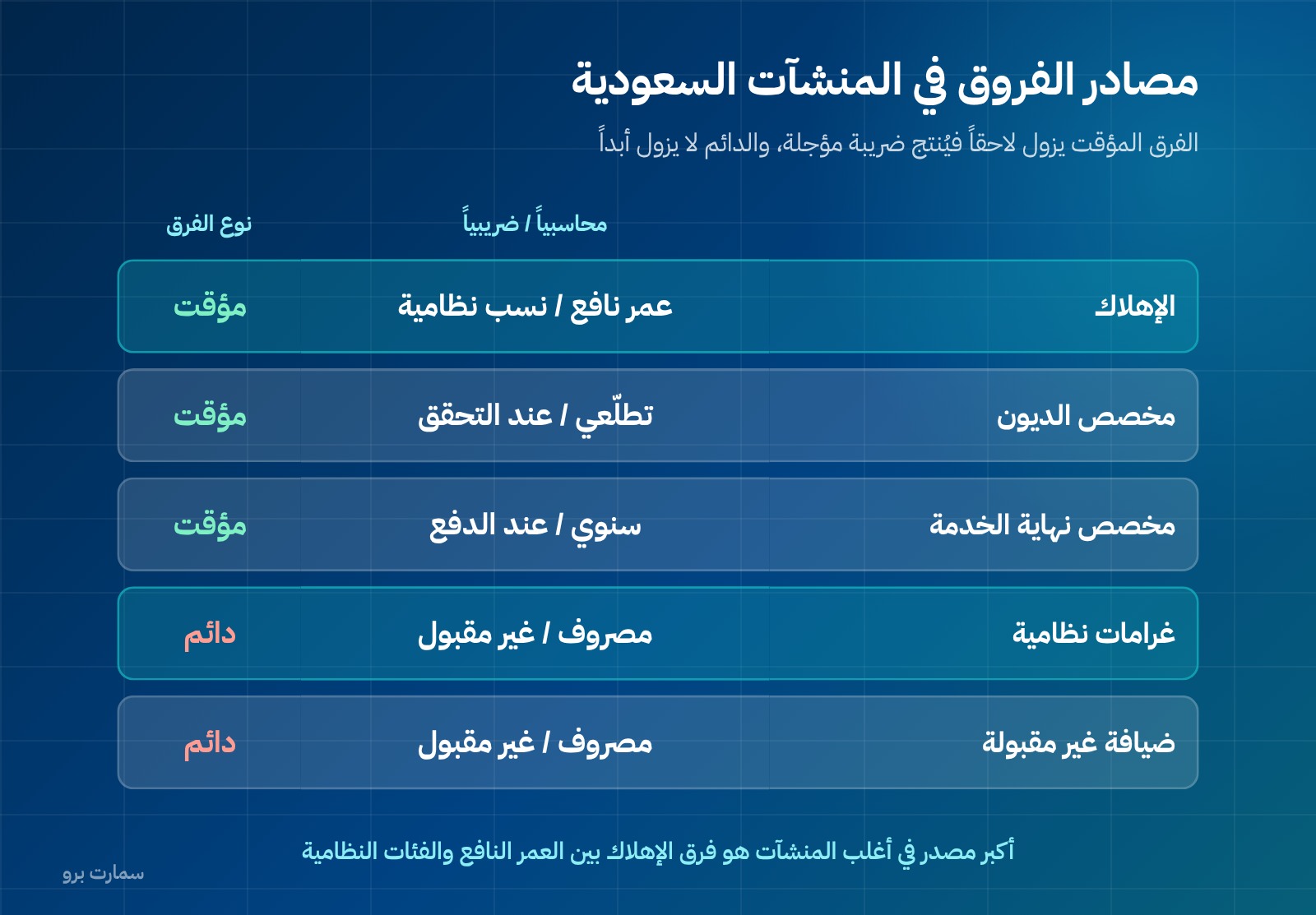
| Item | Accounting | Tax | Type of difference |
|---|---|---|---|
| Depreciation | Estimated useful life | Statutory classes and rates | Temporary |
| Doubtful debts provision | Recognised on a forward-looking basis | Usually when realised | Temporary |
| End-of-service provision | Recognised annually | Usually when paid | Temporary |
| Slow-moving inventory provision | When net realisable value falls | On sale or write-off | Temporary |
| Statutory fines | Expense | Not deductible | Permanent |
| Non-deductible hospitality | Expense | Not deductible | Permanent |
In most businesses the largest source is the depreciation difference, because Class 3 in the tax rules is depreciated at a high rate that exceeds many accounting useful lives. The details are in accounting depreciation vs tax depreciation.
What is a deferred tax asset and a deferred tax liability?
A deferred tax liability arises when you pay less tax today and will pay more later. The typical example is tax depreciation that runs faster than accounting depreciation: it lowers the tax base today and raises it in later years.
A deferred tax asset arises in the opposite case: you pay more tax today and will pay less later. The typical example is a provision recognised in the accounts that is not deductible for tax until it is realised.
The governing rule for the asset: it is recognised only to the extent that future taxable profit is probable against which it can be used. A business expecting losses does not record a deferred tax asset without support.
How is deferred tax calculated?
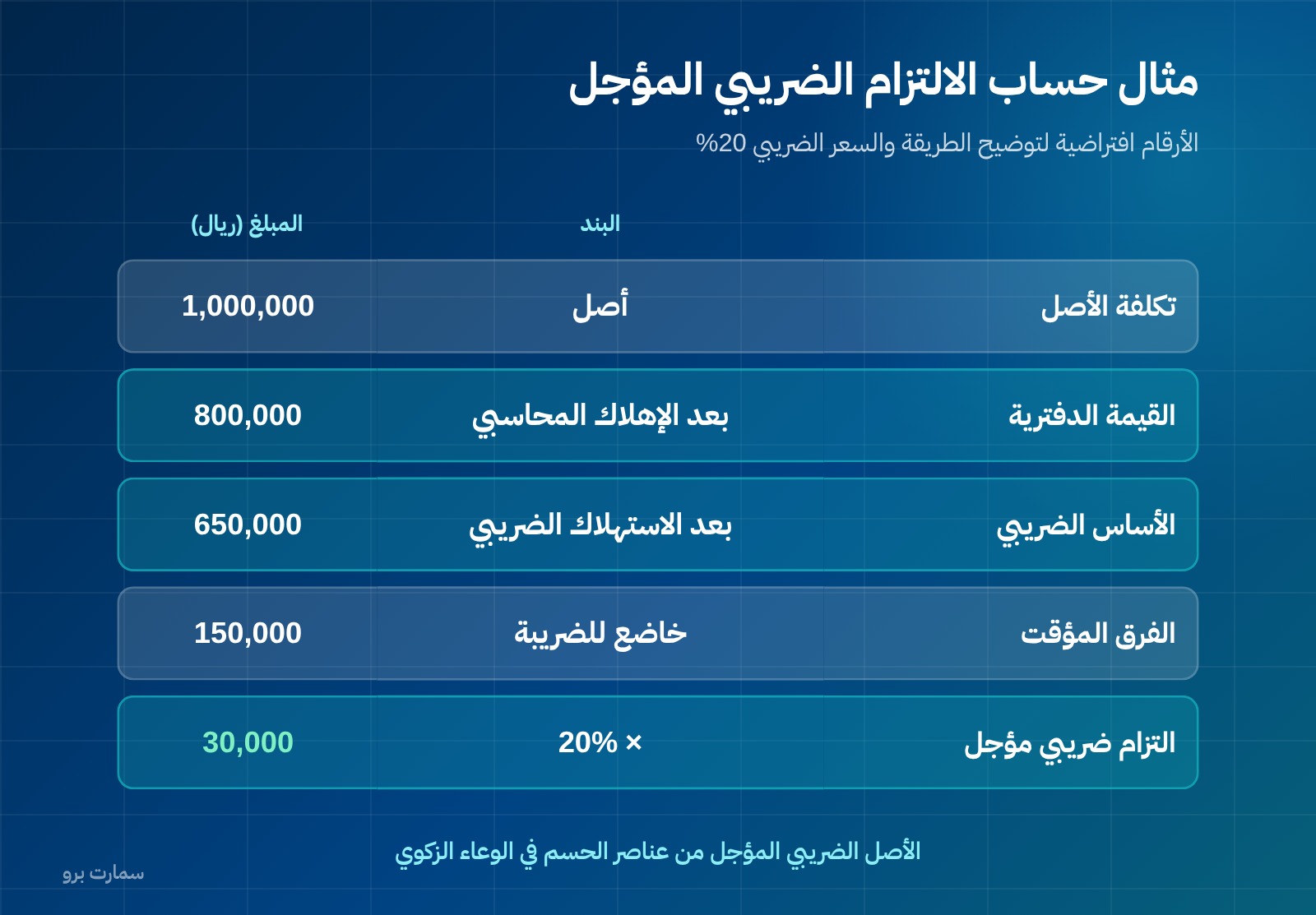
The figures below are hypothetical, to illustrate the method: an asset costing SAR 1,000,000, with accumulated accounting depreciation of 200,000, accumulated tax depreciation of 350,000, and a tax rate of 20%.
| Item | Amount (SAR) |
|---|---|
| Carrying amount | 800,000 |
| Tax base | 650,000 |
| Taxable temporary difference | 150,000 |
| Deferred tax liability (× 20%) | 30,000 |
The general formula: temporary difference × the tax rate expected when the difference reverses.
It is measured at the rate expected to apply when the difference is realised, not the current rate, if a change has been enacted.
Can deferred tax assets and liabilities be offset?
Deferred tax assets and liabilities are not presented net automatically. Offsetting requires a legally enforceable right to set off current tax assets and liabilities, and the deferred taxes must relate to the same tax authority and the same taxable entity.
In practice, a group of companies cannot offset a deferred tax asset in one company against a deferred tax liability in another simply because both appear in the same consolidated statements.
Where is deferred tax presented?
A deferred tax liability or asset is presented under non-current items in the statement of financial position, never under current items, however short the expected reversal period. The movement for the period is presented within tax expense in the income statement, except where it relates to items recognised in other comprehensive income, in which case it follows them there.
How does deferred tax affect zakat?
A point specific to Saudi Arabia: the deferred tax asset is a deductible item in the zakat base under the Implementing Regulations for Zakat Collection. So recognising it or not directly affects your zakat liability, not just your financial statements. The details are in zakat calculation.
In a mixed-ownership company it gets more precise, because zakat and income tax are calculated together by ownership share. See zakat and income tax.
What mistakes come up most often?
Ignoring deferred tax entirely. Common in medium-sized businesses, and the result is a tax expense that doesn't reflect the true liability.
Treating a permanent difference as temporary. A statutory fine will never be deductible, so it creates no deferred asset however long you wait.
Recognising an asset with no probable future profit. This is an artificial improvement to the result.
Not preparing a tax base schedule. You cannot calculate a temporary difference without knowing the tax base of every asset and liability.
Review checklist
- A schedule comparing the carrying amount with the tax base for every material item.
- Differences clearly classified as temporary or permanent.
- An asset register with two depreciation columns: accounting and tax.
- The deferred tax asset recognised only to the extent future taxable profit is probable.
- The rate used is the one expected when the difference reverses.
- Presentation under non-current items.
- The effect of the deferred tax asset reflected in the zakat deduction.
Official references
International standards as endorsed in the Kingdom are published by the Saudi Organization for Chartered and Professional Accountants (SOCPA) at socpa.org.sa, and the standards' texts are with the IFRS Foundation at ifrs.org. Tax depreciation rules and the zakat treatment of the deferred tax asset are published by the Zakat, Tax and Customs Authority (ZATCA) at zatca.gov.sa.
Key takeaway: Deferred tax comes only from temporary differences between carrying amounts and tax bases, measured at the rate expected on reversal. In Saudi Arabia, the deferred tax asset also reduces your zakat base, so getting it right matters beyond the statements.
Further reading
- Accounting depreciation vs tax depreciation
- Income tax return: deadline and tax base
- Zakat calculation: the zakat base step by step
To keep accounting and tax figures organised in one connected system, start a free SmartPro trial.
Article visuals
Frequently asked questions
What is the difference between a temporary and a permanent difference?
A permanent difference never reverses, such as an expense that is never tax-deductible or income that is never taxable, so it affects the current year only and creates no deferred tax. A temporary difference is the difference between the carrying amount of an asset or liability and its tax base, and it reverses in a later year. Temporary differences are the source of deferred tax.
How is deferred tax calculated?
Multiply the temporary difference by the tax rate expected to apply when the difference reverses. For example, if an asset's carrying amount is 800,000, its tax base is 650,000 and the rate is 20%, the temporary difference is 150,000. That creates a deferred tax liability of SAR 30,000.
When is a deferred tax asset recognised?
Only to the extent that future taxable profit is probable against which the asset can be used. A business expecting losses does not record a deferred tax asset without support. Doing so would artificially improve the result rather than recognise a real entitlement.
How does deferred tax relate to zakat in Saudi Arabia?
The deferred tax asset is a deductible item in the zakat base under the Implementing Regulations for Zakat Collection. Recognising it or not therefore directly changes the zakat amount due, not just the financial statements.