
Statement of Financial Position: What It Really Says About Your Business
The components of the statement of financial position, the difference between current and non-current items, the balance sheet equation, and what the balances reveal about your business's liquidity and how it is financed.
Author:سامي الحيدري
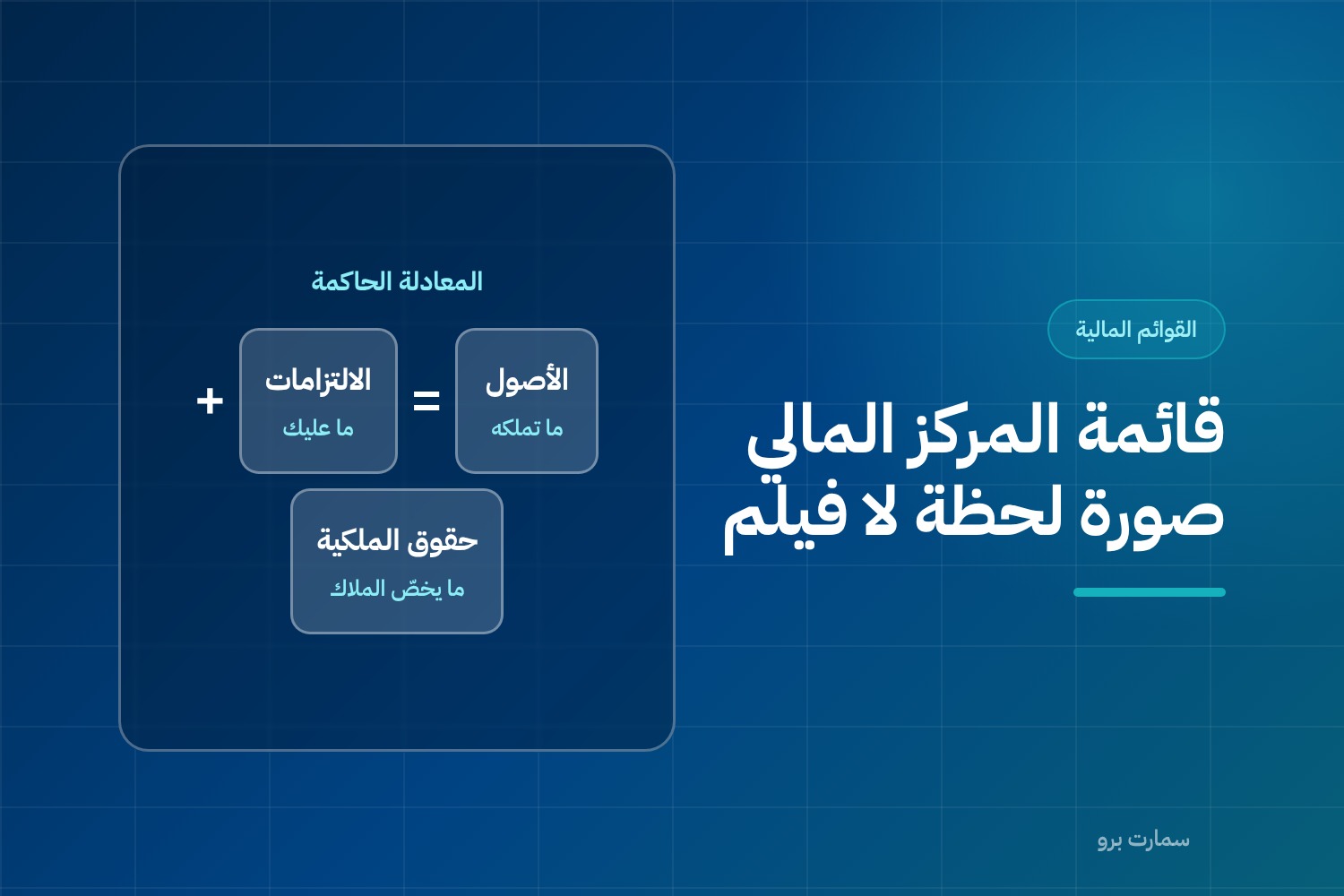
If the income statement is a film about a period, the statement of financial position is a photograph of a single moment: the end of closing day. It tells you what you own, what you owe, and what belongs to the owners once everything is paid. It is the statement your zakat base is built from, the one banks measure their covenants against, and the one that shows whether your business can withstand pressure or is exposed.
What equation governs the statement?
Assets = Liabilities + Equity
This is not a presentation rule but an arithmetic fact: every riyal on the assets side has a source of financing, either a creditor or an owner. The same logic is what keeps the books balanced in the first place, as explained in double-entry bookkeeping.
What are the components of the statement of financial position?
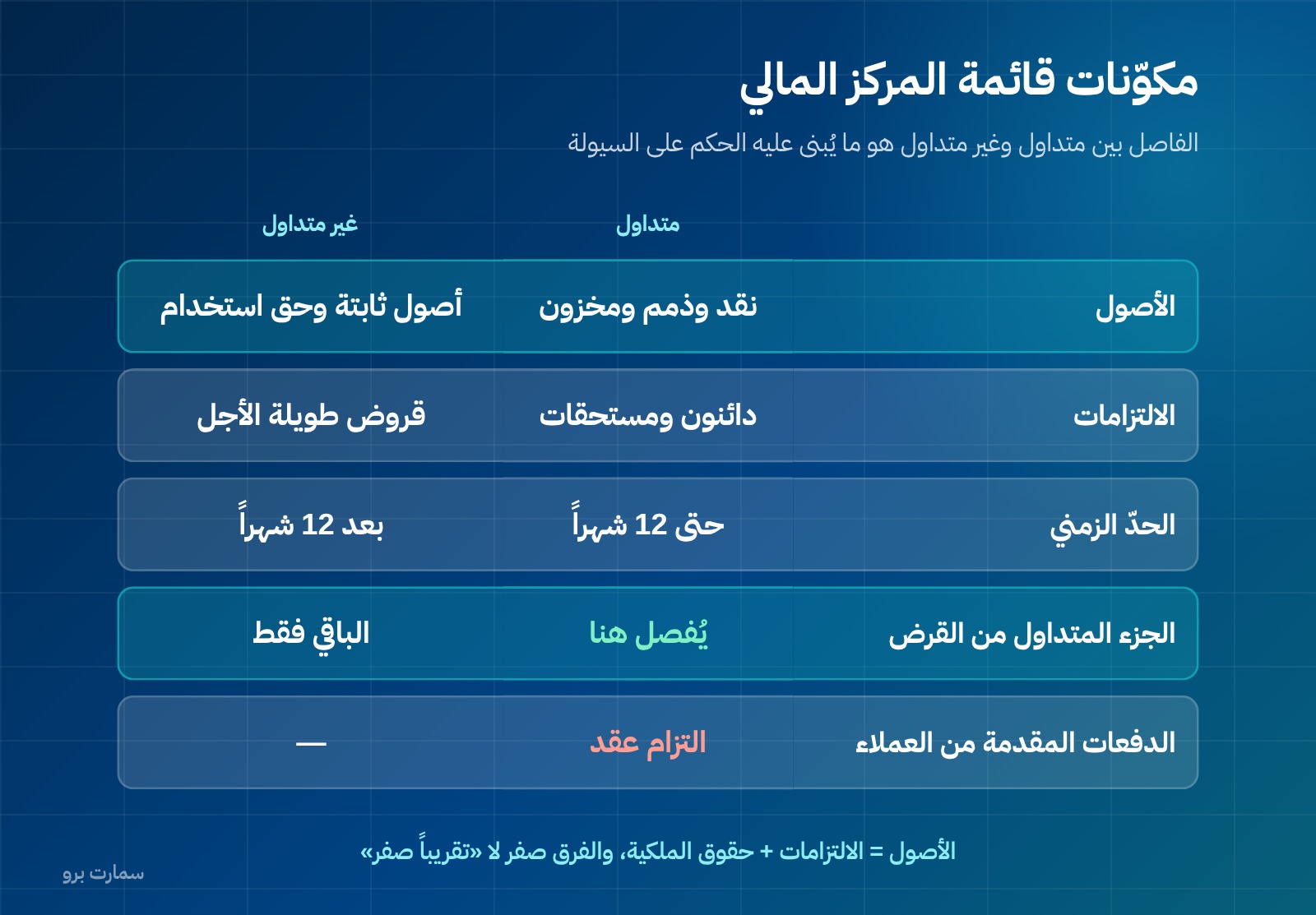
Current assets: items expected to be converted into cash or consumed within the normal operating cycle or twelve months, such as cash and cash equivalents, accounts receivable, inventory and prepaid expenses.
Non-current assets: what you hold for use rather than for sale, such as property, plant and equipment, intangible assets, right-of-use assets arising from leases, and long-term investments.
Current liabilities: what is payable within twelve months, such as accounts payable, the current portion of loans, accrued expenses, VAT payable, zakat and tax payable, and contract liabilities (advance payments from customers).
Non-current liabilities: long-term loans, long-term lease liabilities and the end-of-service provision.
Equity: share capital, the statutory reserve, retained earnings and any other reserves.
Which classification changes the picture?
The line between current and non-current is not cosmetic: it is the basis for any judgement about liquidity. The most common mistakes are:
- The current portion of a long-term loan must be separated out under current liabilities. Leaving the whole loan as long-term shows liquidity that does not exist.
- Advance payments from customers are a liability, not revenue, as covered in revenue recognition.
- Lease liabilities now appear on the balance sheet under IFRS 16 and are likewise split between current and non-current. The details are in leases.
- Slow-moving inventory stays within current assets even though, in practice, it cannot be turned into cash. That is why it is measured at net realisable value, as explained in inventory valuation.
What can you read from the statement?
Current ratio = current assets ÷ current liabilities. It measures your ability to meet next year's obligations from next year's resources.
Quick ratio = (current assets − inventory) ÷ current liabilities. It is stricter, because it assumes inventory may not sell quickly.
Debt-to-equity ratio = total liabilities ÷ equity. It measures how much you rely on external financing compared with the owners' funds.
Working capital = current assets − current liabilities. This is the figure that tells you whether you can run your operations without strain.
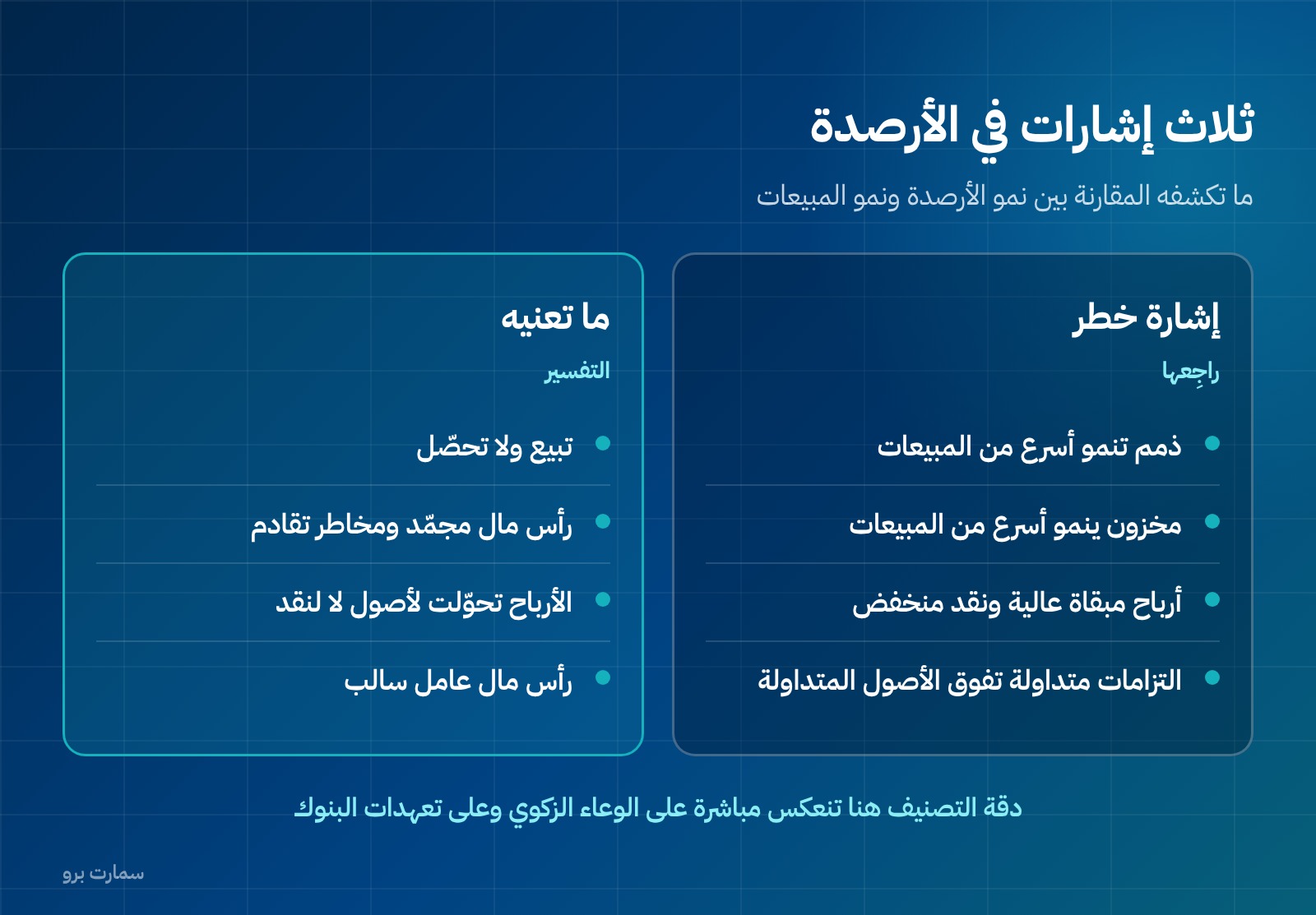
Warning signs worth watching for when you read it:
Receivables growing faster than sales means you are selling but not collecting: growth on paper only.
Inventory growing faster than sales means frozen capital and a risk of obsolescence.
High retained earnings with low cash means the profits have gone into inventory, receivables and assets rather than into the bank account. Tracking this gap is the job of the cash flow statement.
Current liabilities larger than current assets means negative working capital: next year's obligations exceed the resources available to settle them. A business that sells for cash and buys on credit may be able to live with this, but it is a danger for a business that sells on credit.
How is the statement presented: by liquidity or by classification?
There are two ways to order the line items, and the choice follows whichever gives more relevant and reliable information:
Classification into current and non-current is the most common approach for trading and industrial businesses, because it separates what moves within the year from what is long-term.
Ordering by liquidity is used when it is more relevant, as in financial institutions that do not have a clearly identifiable operating cycle, so items are listed from the most liquid to the least liquid.
Whichever approach is used, the amounts expected to be recovered or settled after more than twelve months must be disclosed, because the reader needs this information regardless of the presentation order.
How does it relate to zakat and tax?
The zakat base is built from this statement specifically: equity and its equivalents, together with specified liabilities within the limits of the deductible assets, are added, while net fixed assets and intangible assets are deducted. That is why the accuracy of classification here feeds directly into your zakat liability. The details are in zakat calculation.
Unlike the income statement, IFRS 18 does not fundamentally change the structure of this statement, because it focuses on how performance is presented. It does, however, change related disclosures and the basis of preparation, as explained in IFRS 18.
What should you check before approving the statement?
- Assets = Liabilities + Equity, and the difference is zero, not "almost zero".
- The current portion of loans and leases is shown separately.
- Receivables are stated after the allowance for doubtful debts.
- Inventory is measured at the lower of cost and net realisable value.
- Net fixed assets agree with the fixed asset register.
- Zakat, income tax and VAT payable are recorded as liabilities.
- Net profit for the period is correctly transferred to retained earnings.
- Every balance in the statement has a breakdown that can be drawn from the trial balance.
Where is the official reference?
International standards as endorsed in the Kingdom are published by the Saudi Organization for Chartered and Professional Accountants (SOCPA) on its website: socpa.org.sa, and the full texts of the standards are available from the IFRS Foundation at ifrs.org.
Read also
Article visuals
Frequently asked questions
What is the difference between current and non-current assets?
Current assets are expected to be converted into cash or consumed within the normal operating cycle or twelve months, such as cash, accounts receivable and inventory. Non-current assets are held for use rather than for sale, such as property, plant and equipment, right-of-use assets and long-term investments.
Why must the current portion of a loan be shown separately?
Because keeping the whole loan under non-current liabilities shows liquidity that does not exist. Instalments due within twelve months are a current liability, and leaving them out inflates the current ratio and working capital in a way that misleads both the bank and your own management.
What do high retained earnings with low cash mean?
It means the profits were genuinely earned but went into inventory, receivables and fixed assets instead of staying as cash. This is not necessarily a mistake, but it calls for a review of the collection cycle and inventory levels before any decision to distribute profits or expand.
Does IFRS 18 change the format of the statement of financial position?
It does not fundamentally change its structure, because it focuses on how performance is presented, meaning the income statement and its related disclosures. It does, however, affect the basis of preparation and some related disclosures, and it requires a review of the cross-references in your accounting policies document.