
IFRS 18: Your Financial Statements Are About to Change Significantly
SOCPA has endorsed IFRS 18 to replace IAS 1. Here is what changes in the income statement and when the standard becomes mandatory.
Author:سامي الحيدري
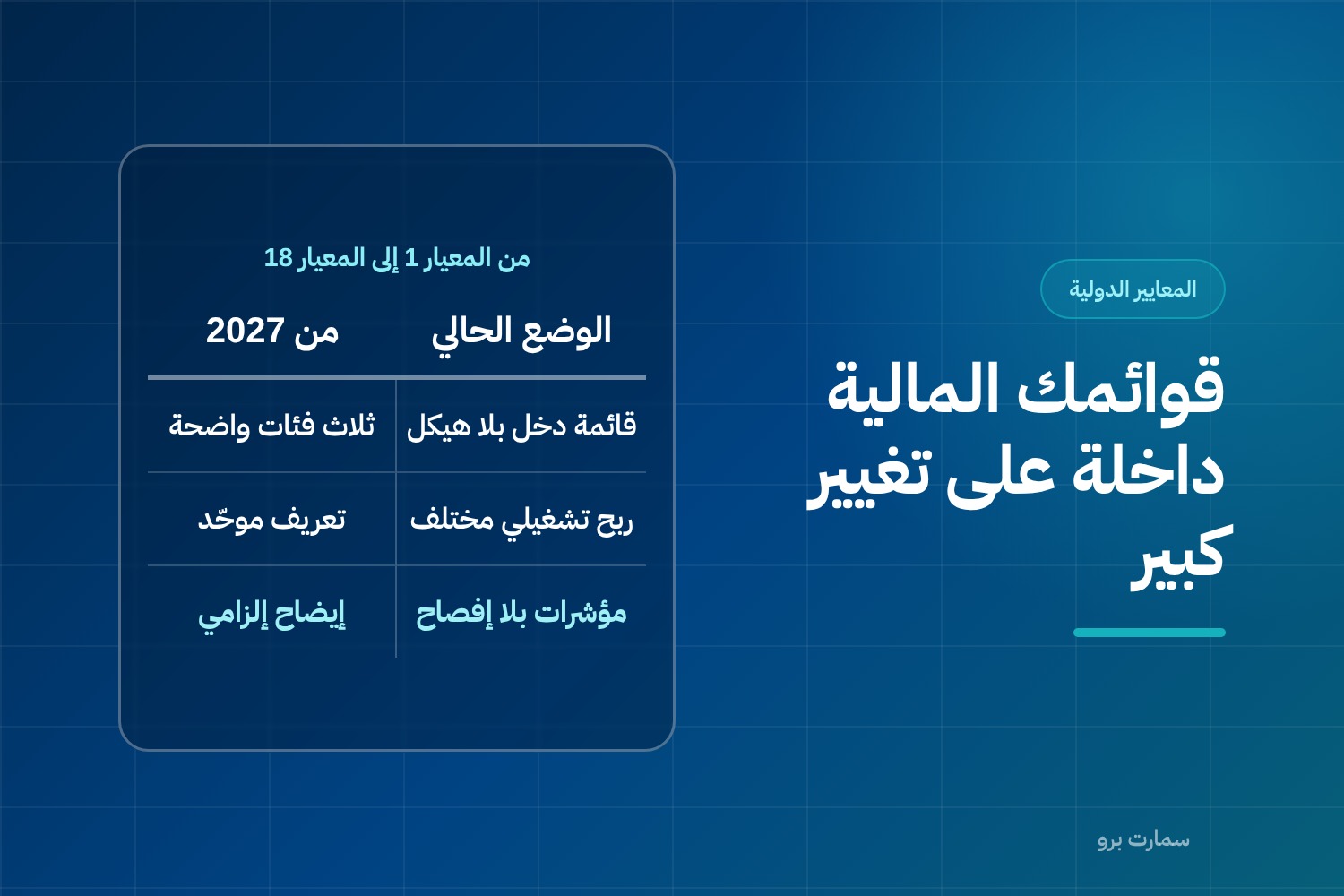
The Saudi Organization for Auditors and Accountants (SOCPA) has endorsed IFRS 18 Presentation and Disclosure in Financial Statements to replace IAS 1, by board resolution dated 25-06-1446 AH (26 December 2024), with early application permitted. This is not a cosmetic reshuffle of line items. The shape of the income statement itself changes, with two new mandatory subtotals. Entities in the Kingdom that apply full IFRS need to start preparing now.
What did SOCPA endorse in IFRS 18?
The board resolution covered three things:
- Endorsing IFRS 18 together with the related amendments to other standards, after reviewing and developing parts of it.
- Permitting early application before the mandatory effective date.
- Moving the additional disclosures that SOCPA previously required under IAS 1 into IFRS 18, after aligning them with the new standard's paragraphs. The rest of IAS 1's requirements moved to other standards, including IAS 8, which has been renamed "Basis of Preparation of Financial Statements".
The mandatory effective date is annual periods beginning on or after 1 January 2027, with early application available for earlier periods.
What should be clear from the start?
IFRS 18 is a presentation and disclosure standard, not a recognition and measurement standard. It does not change when you recognise revenue, how you measure an asset or a liability, or your net profit figure as such. What changes is how these figures are presented and explained. Even so, the practical impact is large, because many readers look at your statements through specific subtotals.
Change one: how is the income statement classified into categories?
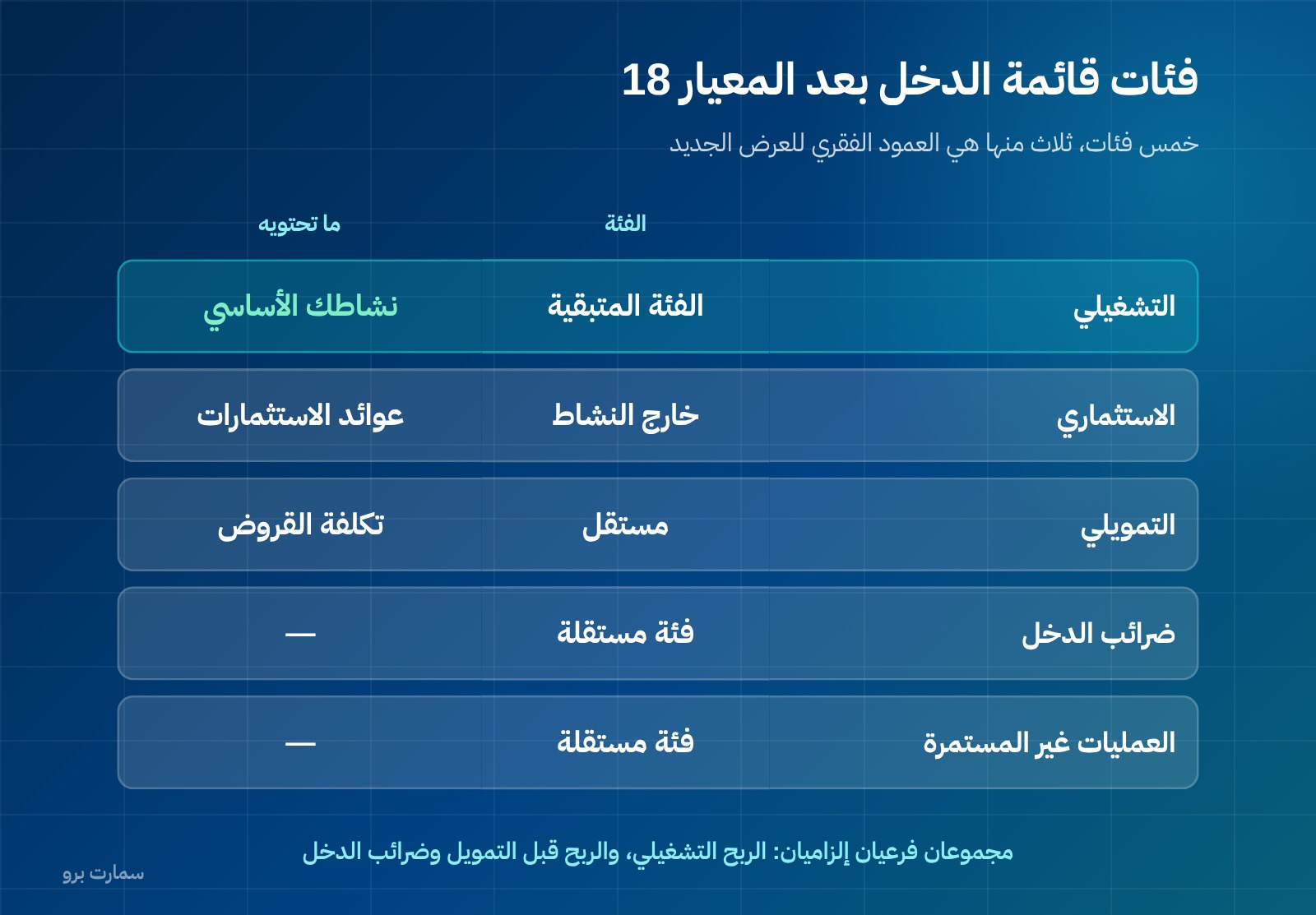
Instead of an open format that varies from one entity to the next, the standard requires income and expenses to be classified into five categories, three of which form the backbone of the new presentation:
| Category | What it contains |
|---|---|
| Operating | Your main business activity, the one you earn from every day |
| Investing | Returns on your investments and assets outside the main activity |
| Financing | The cost of your funding and borrowings, shown separately |
| Income taxes | A separate category |
| Discontinued operations | A separate category |
The operating category is the residual category: anything that does not fall into investing, financing, income taxes or discontinued operations is classified as operating. That is what gives "operating profit" a uniform definition for the first time, rather than each entity defining it its own way.
One important detail: classification depends on the entity's main business activity. An entity whose main activity is investing in assets, or providing finance to customers, classifies some items as operating that a manufacturer would classify as investing or financing. In other words, the table above is a general rule, not a single template for every sector.
Change two: which subtotals become mandatory?
The standard requires two subtotals on the face of the income statement:
- Operating profit
- Profit before financing and income taxes
The effect is direct for anyone who compares your business with others. A bank whose facility agreement sets a ratio based on "operating profit", and an investor comparing your operating margin with your competitors', were both working with a figure whose definition varied from one entity to another. After IFRS 18, the definition is the same. It also means your operating figure may change from what you used to publish, not because your performance changed but because the classification rule did.
Change three: what must you disclose about management performance measures?
Many businesses publish their own measures outside the financial statements, in investor presentations, press releases and the board of directors' report. IFRS 18 calls these "management-defined performance measures" and requires them to be disclosed in a single note that includes:
- A reconciliation of the measure to the most directly comparable subtotal or total specified by IFRS, showing the income tax effect and the effect on non-controlling interests for each reconciling item.
- A description of how the measure reflects management's view and how it is calculated.
- An explanation of any change to the measure or to how it is calculated.
- A statement that the measure reflects management's view and may not be comparable with similarly named measures used by other entities.
The standard also sets limits on what counts as such a measure. Measures that are not subtotals of income and expenses, such as free cash flow, fall outside the definition. And what is said orally, recorded in minutes or posted on social media does not count as the public communication that triggers the disclosure.
Change four: what are the aggregation and disaggregation rules?
The standard sets clearer principles for what goes into a single line and what is broken out:
- Items that share characteristics are aggregated; items with different characteristics are disaggregated.
- Aggregation must not obscure material information or reduce understandability.
- Information is split between the primary statements and the notes so that each plays its complementary role.
There is also a practical requirement that weighs heavily on systems. An entity that presents expenses by function must disclose in the notes the depreciation, amortisation, employee benefits, impairment losses and inventory write-downs included in each operating line item. In other words, you need a by-nature breakdown inside each function, and that cannot be extracted from a one-dimensional chart of accounts.
What effect do many people miss? The statement of cash flows
The consequential amendments also reach IAS 7:
- An entity using the indirect method starts its operating cash flow calculation from the operating profit subtotal, not from any other figure.
- Most of the presentation choices for interest and dividends paid and received have been removed.
The result is that the statement of cash flows becomes tied to the new income statement structure, so neither can be dealt with in isolation from the other.
What does this mean in practice for your business?
Chart of accounts. The operating, investing and financing classification has to live in the account structure itself, not in an Excel sheet prepared at closing. If you present expenses by function, you need an extra dimension that carries the nature of each expense. Start with building a chart of accounts from scratch.
System reports. The income statement template in your accounting system will need adjusting to show the two mandatory subtotals. This is a practical criterion to ask about explicitly when evaluating systems, as covered in questions before buying accounting software.
Comparative figures. Applying the standard requires restating the prior period's figures under the new classification. That means 2026 will be shown twice: as published, then restated for comparison. This assumes your detailed data for that year can be reclassified, which is a real test of the quality of your accounting cycle.
Agreements and covenants. Review financing agreements and incentive plans linked to "operating profit": is the definition written in them the new standard's definition or your old one? This is a legal and financial review that is better done before adoption than after it.
Investor communication. Every measure you publish outside the statements now needs a documented reconciliation. Build the reconciliation file directly from the books, not from a previous presentation.
Zakat and tax. The standard does not in itself change the zakat base or the tax base, but the financial statements are the source both are built from. Rearranging the presentation means checking that your zakat calculation and income tax return schedules still pull the right items after the change.
Who does IFRS 18 apply to?
The standard applies to entities that apply full IFRS as endorsed by SOCPA. Small and medium-sized entities that apply the IFRS for SMEs standard have their own framework, and IFRS 18 in this form does not apply to them. If you are not sure which framework applies to your business, settle that first before any preparatory work.
What is a practical readiness plan?
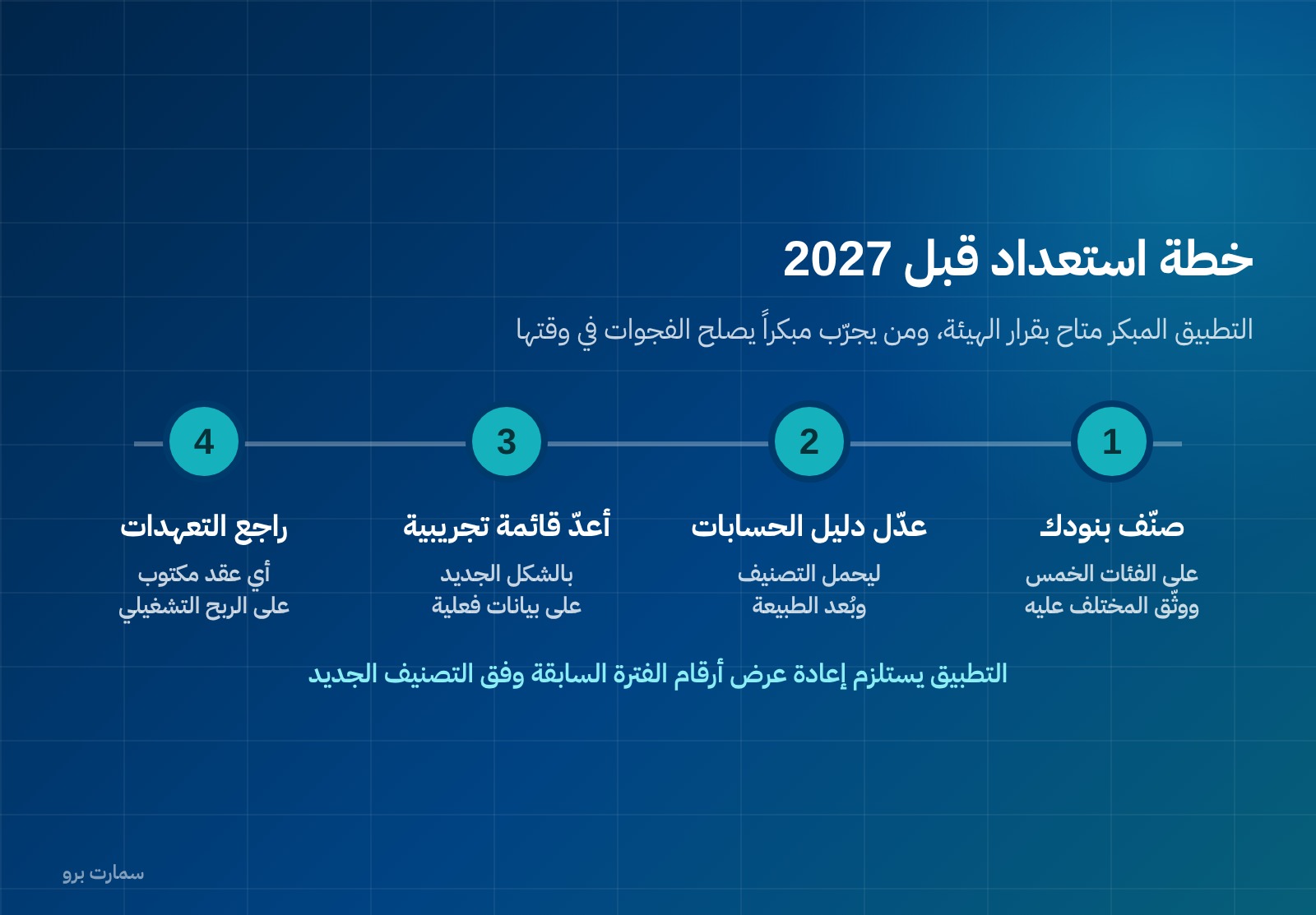
- Identify the accounting framework that applies to your business and your financial year dates.
- Map your current income statement lines to the five categories, and log the items in dispute.
- Settle the classification of items that depend on your main business activity, and document the basis for the judgement.
- Update the chart of accounts to carry the classification, and add a nature dimension if you present by function.
- Prepare a trial income statement in the new format on actual data, and compare it with the current format.
- List every measure you publish outside the statements, and build a reconciliation table for each.
- Review financing agreements and incentive plans linked to operating profit.
- Prepare the prior-period comparative figures under the new classification.
- Agree the classification bases with your external auditor early, before closing rather than after.
- Decide whether early application is in your interest; SOCPA's resolution makes it available.
Early application is not for show. An entity that runs the new format over a full year before it becomes mandatory finds the gaps in its chart of accounts and system reports while there is still time to fix them. An entity that waits for the first mandatory close finds them under deadline pressure.
Where is the official reference?
SOCPA publishes the endorsement resolution and the text of the standard on its website: socpa.org.sa. The original standard and its summaries are available from the IFRS Foundation at ifrs.org. The above is based on SOCPA's official announcement and the IFRS Foundation's summary of the standard; for any sector-specific detail, refer to the text of the standard itself.
Read also
Article visuals
Frequently asked questions
When does IFRS 18 become mandatory in Saudi Arabia?
It applies to annual periods beginning on or after 1 January 2027, with early application available for earlier periods. SOCPA endorsed it by board resolution dated 25-06-1446 AH (26 December 2024), permitting early application.
What does IFRS 18 replace?
It replaces IAS 1. The additional disclosures SOCPA previously required under IAS 1 moved into IFRS 18 after being aligned with its paragraphs, while the rest of IAS 1's requirements moved to other standards, including IAS 8, which was renamed "Basis of Preparation of Financial Statements".
What are the new categories in the income statement?
There are five: operating, investing, financing, income taxes and discontinued operations. Operating is the residual category that captures everything not falling into the others. The standard also requires two mandatory subtotals: operating profit, and profit before financing and income taxes.
Does IFRS 18 change a company's profit?
No. It is a presentation and disclosure standard, not a recognition and measurement standard, so it does not change when you recognise revenue or how you measure assets and liabilities. However, the operating profit figure you present may differ from what you used to publish, because its classification rule is now uniform for all entities.
What are management-defined performance measures?
They are subtotals of income and expenses that management uses in public communications outside the financial statements to convey its view of performance. They must be disclosed in a single note that reconciles them to the most comparable IFRS subtotal with the tax and non-controlling interest effects, describes how they are calculated, and states that they may not be comparable with other entities' measures.
Is the presentation of cash flows affected?
Yes. The consequential amendments to IAS 7 require entities using the indirect method to start from the operating profit subtotal, and they removed most presentation choices for interest and dividends. The statement of cash flows is therefore tied to the new income statement structure.