
Zakat Calculation for Businesses: The Zakat Base Step by Step
How the zakat base is built from additions and deductions under the Implementing Regulations, how the rate works for Hijri and Gregorian years, and a complete worked example step by step.
Author:سامي الحيدري
Zakat calculation for a business is not like personal zakat. You do not take your bank balance and pay 2.5%. You build a zakat base from your statement of financial position, using the specific additions and deductions set out in the Implementing Regulations for Zakat Collection, then apply 2.5% for a Hijri year or a day-adjusted rate for a Gregorian year.
A profitable business can have a small zakat base, and a modestly profitable one can have a large base. The reason lies in the structure of the balance sheet, not in the profits. This guide walks through the method in the order the regulations set it out.
What is the zakat rate for Hijri and Gregorian years?
Article 15 of the Implementing Regulations for Zakat Collection states that the zakat rate is two and a half per cent (2.5%) of the zakat base for a Hijri year.
If the taxpayer's zakat year differs from the Hijri year, as it does for most businesses that use the Gregorian calendar, the calculation is made on actual days:
Rate = (2.5% ÷ number of days in the Hijri year) × actual number of days in the taxpayer's financial year
This point is often missed. A business with a Gregorian financial year (365 days) does not apply 2.5% directly, because the Hijri year is shorter. The result is a rate slightly above 2.5%, calculated with the formula above rather than by rounding.
How is the zakat base structured?
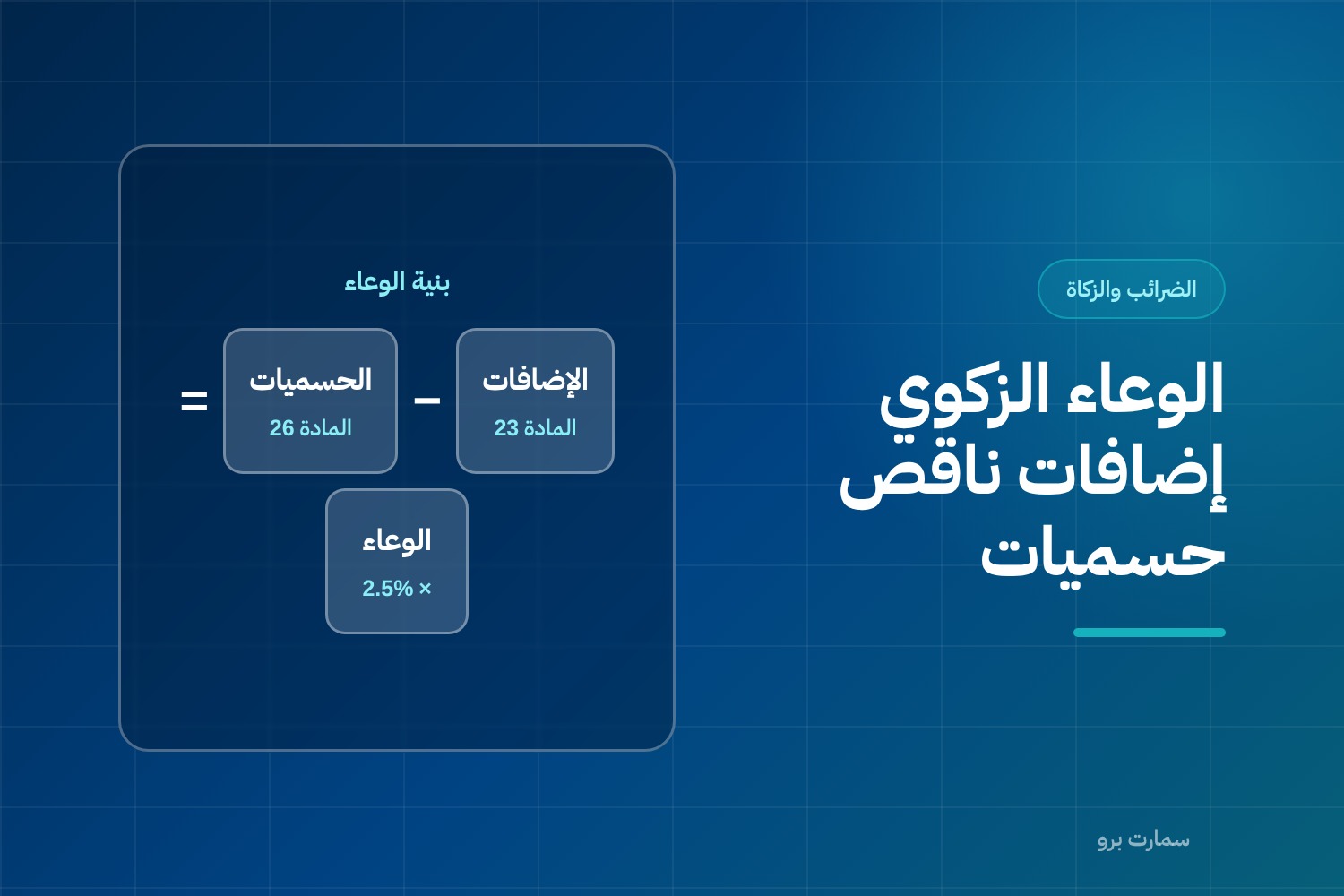
Article 21 sets out the formula clearly: the zakat base is calculated by adding the items listed in Article 23, then deducting the items listed in Article 26.
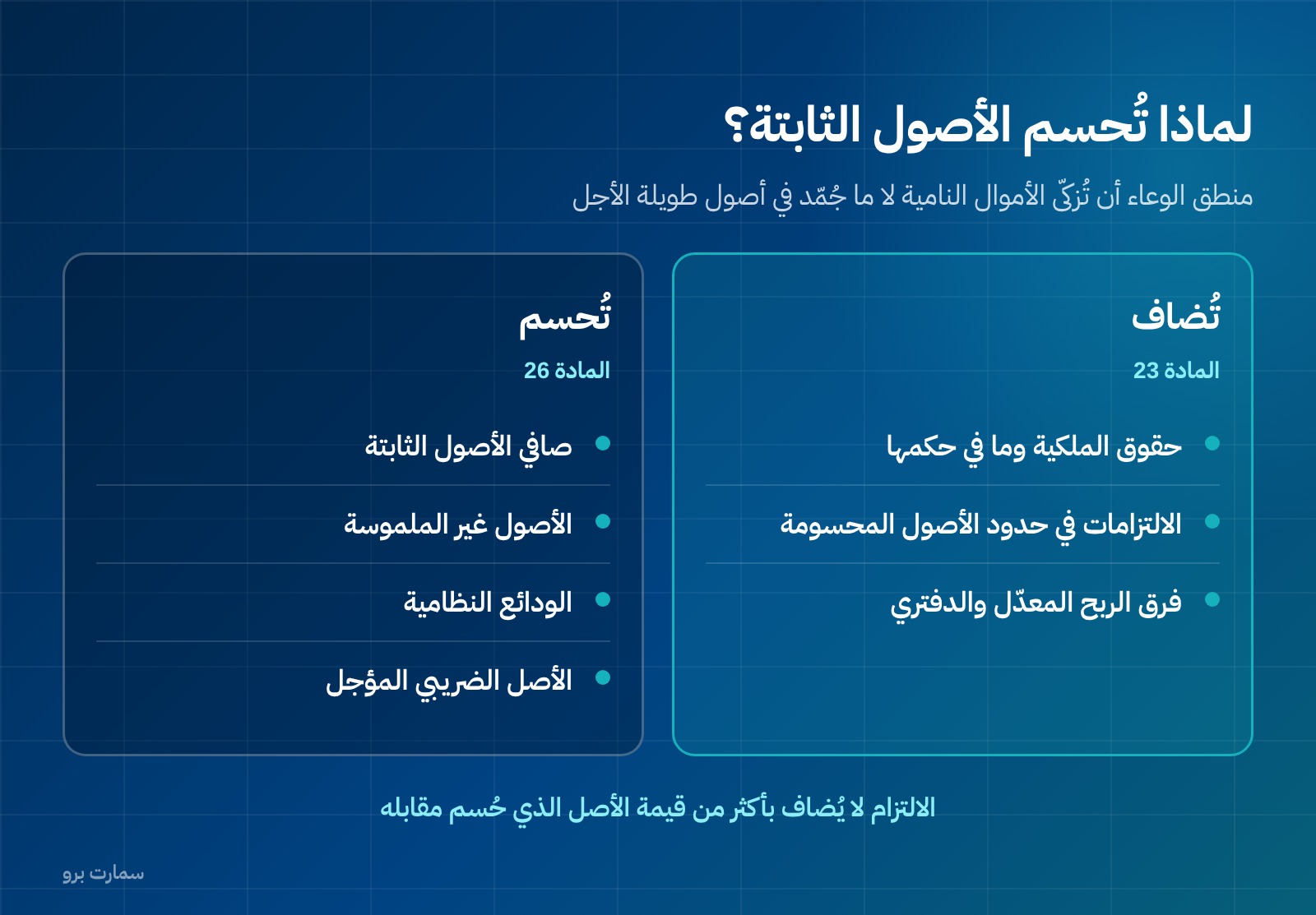
Additions (Article 23):
- Equity and items treated as equity.
- The liabilities listed in Article 29, up to the value of the deducted assets.
- The difference between adjusted and book net profit or loss, after zakat and tax, in accordance with Part Six.
Deductions (Article 26): a number of items are deducted from the base, including:
- Net fixed assets (Articles 49 and 51).
- Intangible assets (Article 50).
- Statutory deposits (Article 56).
- Deferred tax asset.
The logic behind this structure: zakat is due on growing wealth, not on wealth tied up in long-term assets. That is why equity and long-term financing are added, and fixed and intangible assets are then deducted. The limit "up to the value of the deducted assets" matters: a liability cannot be added for more than the value of the asset deducted against it.
What does a worked zakat calculation look like?
The figures below are hypothetical, used only to illustrate the method. They are not an estimate for any particular business:
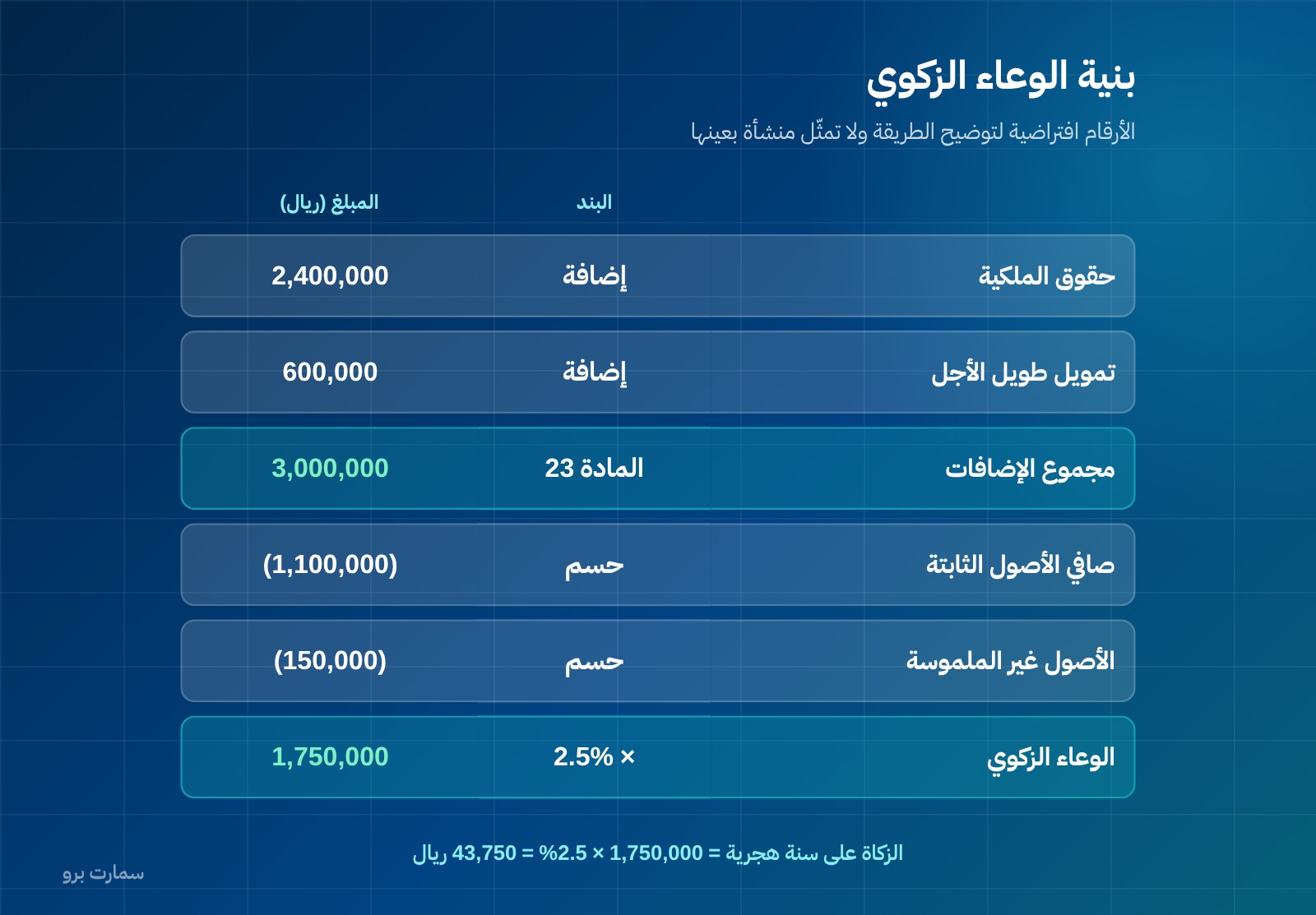
| Item | Amount (SAR) |
|---|---|
| Equity (capital + reserves + retained earnings) | 2,400,000 |
| Long-term financing (up to the value of deducted assets) | 600,000 |
| Total additions | 3,000,000 |
| Net fixed assets | (1,100,000) |
| Intangible assets | (150,000) |
| Total deductions | (1,250,000) |
| Zakat base | 1,750,000 |
For a Hijri year: zakat = 1,750,000 × 2.5% = SAR 43,750.
Note that net profit did not enter this simplified example as a separate line. Its effect shows up through retained earnings within equity, and through the line for the difference between adjusted and book profit when adjustments exist.
What makes a zakat calculation right or wrong?
Zakat is calculated from the financial statements, so the quality of the calculation equals the quality of the books. Four points make the difference:
Accurate classification of liabilities. Mixing long-term and short-term financing, or adding a liability beyond the value of the deducted assets, inflates the base without support. Classification starts with building your chart of accounts.
An organised fixed asset register. The deduction is made at net book value, meaning cost less accumulated depreciation. A business without an up-to-date asset register deducts a figure it cannot prove. The treatment is covered in accounting depreciation versus tax depreciation.
A proper year-end close. The base is built on balances at the end of the zakat year. Adjusting entries that were never recorded produce a wrong base. See year-end adjusting entries and the steps of the accounting cycle.
Separating zakat from income tax. A company partly owned by non-Saudis is subject to zakat on the Saudi share and to income tax on the non-Saudi share. The details are in zakat and income tax: who is subject to which.
Who is subject to zakat?
Article 3 defines who is subject to the regulations. It starts with a resident Saudi person carrying out a licensed activity in the Kingdom, and covers establishments and companies owned by Saudis, certain government companies, and investment funds licensed by the Capital Market Authority. Residency is defined in Article 4.
One statutory deadline is often confused with the filing deadline. Article 7 allows 120 days from the end of the zakat year to submit a request for annual exemption from zakat collection. This is the deadline for the exemption request, not for filing the zakat return; the return deadline is set by ZATCA and should be checked on its portal.
What should you check before calculating zakat?
- The year is closed and all adjusting entries are recorded.
- Equity is broken down: capital, reserves, retained earnings.
- Liabilities are clearly classified as long-term or short-term.
- The fixed asset register is up to date and net book value matches the books.
- Intangible assets are recognised and measured separately.
- The actual number of days in the financial year is set, to calculate the rate if the year is Gregorian.
- Saudi and non-Saudi ownership shares are documented if the company is mixed.
Where is the official reference?
The Implementing Regulations for Zakat Collection and the text of their articles are published by the Zakat, Tax and Customs Authority (ZATCA) on its website: zatca.gov.sa. The articles cited above (15, 21, 23, 26, 3 and 7) are taken from the regulations themselves. Sector-specific treatments and exceptions have their own guides, which are the reference wherever they differ.
Key takeaway: A business's zakat is 2.5% of a zakat base built from equity and qualifying liabilities less fixed and intangible assets, adjusted by actual days for a Gregorian year. Clean books, a current asset register and a proper year-end close are what make the figure defensible.
Read also
- Zakat and income tax: who is subject to which
- The trial balance: what it reveals and what it hides
- Year-end adjusting entries that correct your profit
To keep the books your zakat base depends on in order, explore SmartPro Finance & Accounting and start a free trial.
Article visuals
Frequently asked questions
What is the zakat rate for businesses?
The rate is 2.5% of the zakat base for a Hijri year, under Article 15 of the Implementing Regulations for Zakat Collection. If the taxpayer's zakat year differs from the Hijri year, the calculation is made on actual days: (2.5% ÷ days in the Hijri year) × actual days in the financial year. This produces a slightly higher rate for a Gregorian year.
How is the zakat base calculated?
You add the items listed in Article 23: equity and items treated as equity, the specified liabilities up to the value of the deducted assets, and the difference between adjusted and book profit. You then deduct the items listed in Article 26, including net fixed assets, intangible assets, statutory deposits and the deferred tax asset.
Why are fixed assets deducted from the zakat base?
Because the logic of the base is that zakat is due on growing wealth, not on wealth tied up in long-term assets. Equity and long-term financing are therefore added, and fixed and intangible assets are then deducted. An important limit applies: a liability cannot be added for more than the value of the asset deducted against it.
Is the 120-day period the deadline for filing the zakat return?
No. The 120 days from the end of the zakat year in Article 7 is the deadline for submitting a request for annual exemption from zakat collection. The deadline for filing the zakat return is set by ZATCA and should be checked on its official portal, and the two should not be confused.