
Accounting Depreciation vs Tax Depreciation: Classes, Rates and Differences
The tax depreciation classes and rates set out in the Saudi Income Tax Law, why they differ from accounting depreciation, and how to build a fixed asset register that serves both.
Author:سامي الحيدري

One asset, two numbers. Accounting depreciation spreads an asset's cost over its estimated useful life under accounting standards, while tax depreciation is calculated using classes and rates set by the Income Tax Law. This isn't a conflict that needs resolving. It's two systems measuring for two different purposes. A business that keeps only one number ends up building a schedule from scratch at filing time, with nothing to back it up during an audit.
What are the tax depreciation classes and rates in Saudi Arabia?
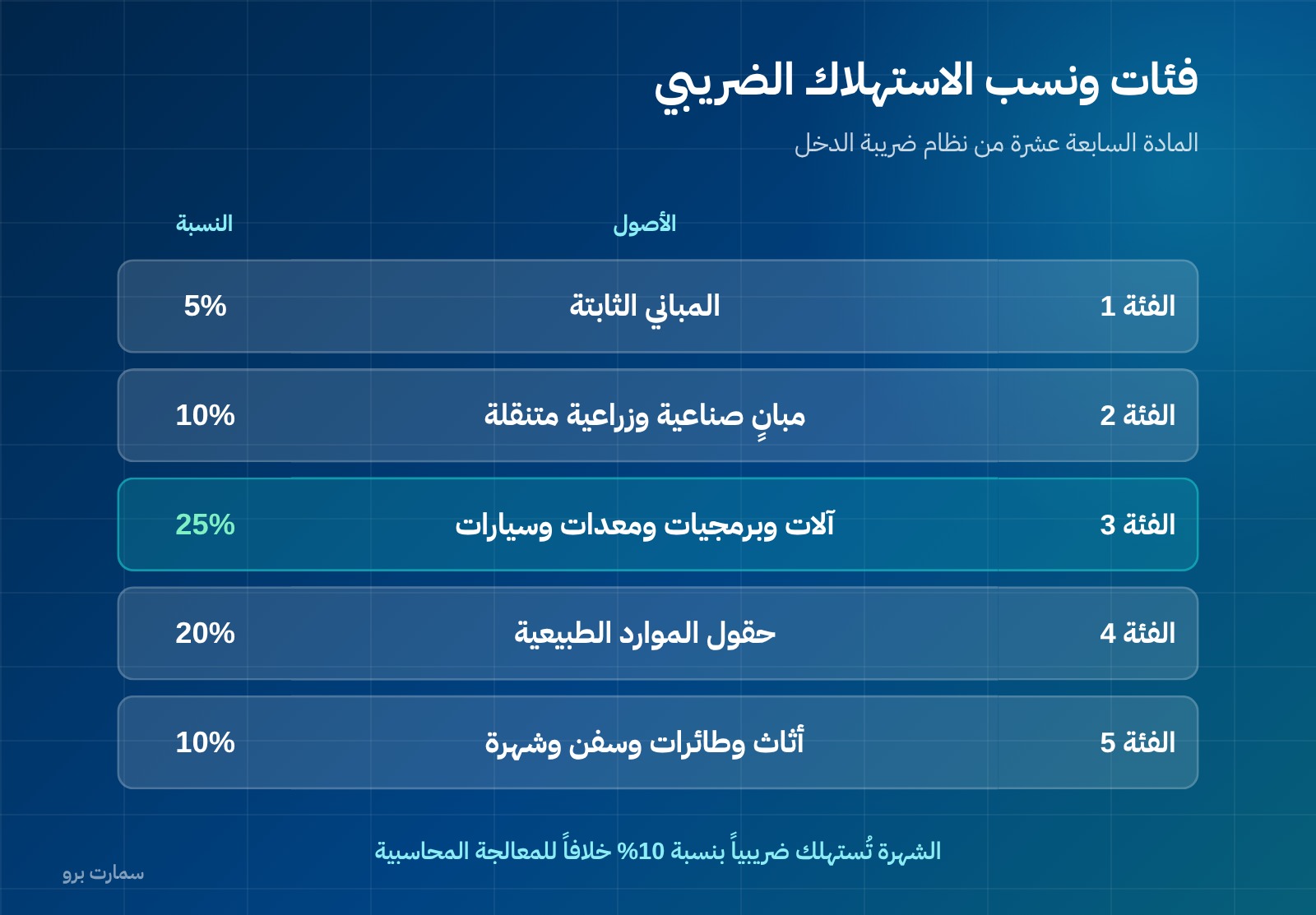
Article 17 of the Income Tax Law sets out the classes and their rates:
| Class | Assets | Rate |
|---|---|---|
| 1 | Fixed buildings | 5% |
| 2 | Movable industrial and agricultural buildings | 10% |
| 3 | Factories, machinery, equipment, software and devices, including passenger cars and cargo vehicles | 25% |
| 4 | Geological survey, drilling, exploration and natural resource field development expenses | 20% |
| 5 | All other depreciable assets, such as furniture, aircraft, ships, trains and goodwill | 10% |
Three points about the table:
Class 3 is broad and carries a high rate. Software, devices, cars and machinery all fall under 25%. That's faster than many typical accounting useful lives, which means tax depreciation in the early years is larger than accounting depreciation for these assets.
Goodwill sits in Class 5. Goodwill is listed among other depreciable assets at 10%. This differs from the accounting treatment, which doesn't depreciate goodwill but tests it for impairment instead.
Fixed buildings are at 5%. That means twenty years for tax purposes, which may be shorter or longer than the accounting estimate depending on the type of building.
Why do the two numbers differ?
The difference isn't an error in either system. It comes from their different purposes:
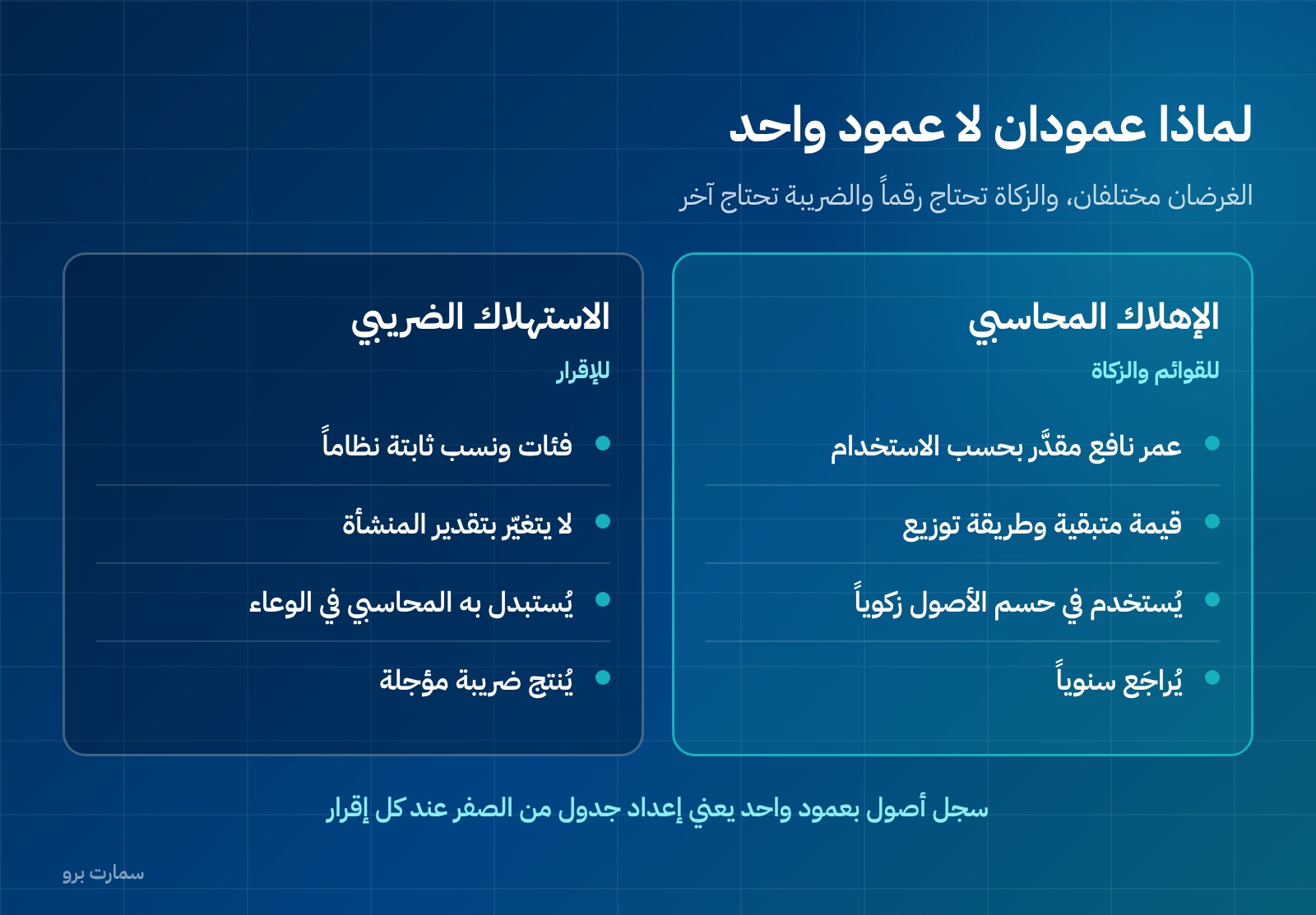
- Accounting depreciation aims to faithfully represent how an asset's economic benefit is used up in the financial statements. Useful life and residual value are estimated based on the business's circumstances and actual use, and the allocation method may be straight-line or another method.
- Tax depreciation aims for a uniform rule that can be applied to and audited across all taxpayers. It is fixed by classes and rates that don't change with the business's own estimates.
The result is an annual difference that accumulates. An asset you depreciate over ten years in your books but depreciate at 25% for tax gives you a larger tax expense in the early years and a smaller one later. The total over the asset's life converges, but the timing differs. This difference is the source of the deferred tax asset or deferred tax liability in the financial statements. Deferred tax is the future tax effect of timing differences between accounting profit and taxable profit.
How does the difference affect the income tax return and zakat?
On the income tax return: the tax base is built from accounting profit with adjustments, and one of the largest is replacing accounting depreciation with tax depreciation. Details are in the income tax return guide.
On zakat: the zakat base deducts net fixed assets, meaning cost minus accumulated accounting depreciation according to the books. So the figure used for the zakat deduction is not the tax figure. The deferred tax asset itself is one of the deductible items under Article 26 of the Zakat Regulations. Details are in how to calculate zakat.
This explains why a single column isn't enough: zakat needs the accounting figure, income tax needs the tax figure, and the financial statements need both to show deferred tax.
What should a fixed asset register that serves both include?
A proper register holds, for each asset:
- Asset number, description, location and who uses it.
- Purchase date, acquisition cost and any qualifying costs added to it.
- Accounting useful life, method and residual value.
- Tax class and its rate under Article 17.
- Accumulated accounting depreciation and net book value.
- Accumulated tax depreciation and remaining tax value.
- Disposal or sale date and its effect.
Two columns, not one. You don't need a separate spreadsheet if the system supports both; it's a practical criterion to ask about before you buy, as covered in questions before buying accounting software.
What are the most common depreciation mistakes?
Depreciating from the invoice date rather than the date of use. An asset starts depreciating when it is ready for its intended use, not when it is paid for.
Capitalising an expense or expensing an asset. Routine maintenance is an expense; an improvement that increases the asset's benefit is capitalised. Mixing them up distorts profit and both bases at once. The accounting rule is in writing a journal entry step by step.
Forgetting disposed assets. An asset that was sold or scrapped but stays in the register generates depreciation expense on something that no longer exists, and a zakat deduction with no support.
Depreciating an asset below its residual value. Net book value doesn't fall below the estimated residual value. A fully depreciated asset stays in the register at its residual value with no further expense charged.
Not recording a physical count of assets. A fixed asset count is an annual procedure, not an optional one; without it, the register is just an old file.
What should the annual review checklist cover?
- The asset register is up to date and every asset has an assigned tax class.
- Accumulated accounting depreciation in the register matches its balance in the trial balance.
- The tax depreciation schedule is prepared at the statutory rates and kept separate from the accounting one.
- Assets disposed of during the year have been written off and the effect of disposal recorded.
- A physical asset count was carried out and reconciled with the register.
- Expenses capitalised during the year have supporting evidence showing they are not maintenance.
- The difference between the two depreciation figures is documented for preparing deferred tax.
Where is the official reference?
The Zakat, Tax and Customs Authority (ZATCA) publishes the depreciation classes and rates in the Income Tax Law and its Implementing Regulations on its website: zatca.gov.sa. The table above is taken from Article 17 of the Law, and the rules for deducting fixed assets in the Zakat Collection Regulations are the reference on the zakat side.
Read also
- Income tax return: who files it and how the tax base is built
- Calculating zakat: the zakat base step by step
- Adjusting entries that correct your profit
Key takeaway: Keep two depreciation figures for every asset: the accounting figure for the books and zakat, and the tax figure at Article 17 rates for the income tax return. The difference between them drives deferred tax.
To see how SmartPro's connected accounting handles your asset records, start a free trial or book a demo.
Article visuals
Frequently asked questions
What are the tax depreciation rates in Saudi Arabia?
Under Article 17 of the Income Tax Law: fixed buildings 5%; movable industrial and agricultural buildings 10%; factories, machinery, equipment, software and devices, including passenger cars and cargo vehicles, 25%; geological survey, drilling, exploration and natural resource field development expenses 20%; and all other assets, such as furniture, aircraft, ships and goodwill, 10%.
Why does tax depreciation differ from accounting depreciation?
Because they serve different purposes. Accounting depreciation represents how an asset's economic benefit is used up, so it is estimated from useful life and residual value based on the business's circumstances. Tax depreciation is fixed by uniform classes and rates that can be applied to and audited across all taxpayers. The difference accumulates each year and gives rise to a deferred tax asset or liability.
Which figure is used to deduct fixed assets from the zakat base?
The accounting figure, meaning net book value according to the books: cost minus accumulated accounting depreciation. Accumulated tax depreciation is not used for the zakat deduction. That is why you need a two-column asset register, since zakat needs the accounting figure and income tax needs the tax figure.
When does an asset start depreciating?
When it is ready for its intended use, not from the invoice date or the payment date. This is one of the most common mistakes: an asset delivered in December but not installed until February starts depreciating from when it was ready for use, not from its purchase date.