
Zakat and Income Tax: Who Is Subject to Which, and How a Mixed-Ownership Company Is Treated
How zakat and income tax differ in who is subject, the base and the rate, how a company owned by Saudis and non-Saudis is treated, and the statutory filing deadlines.
Author:سامي الحيدري
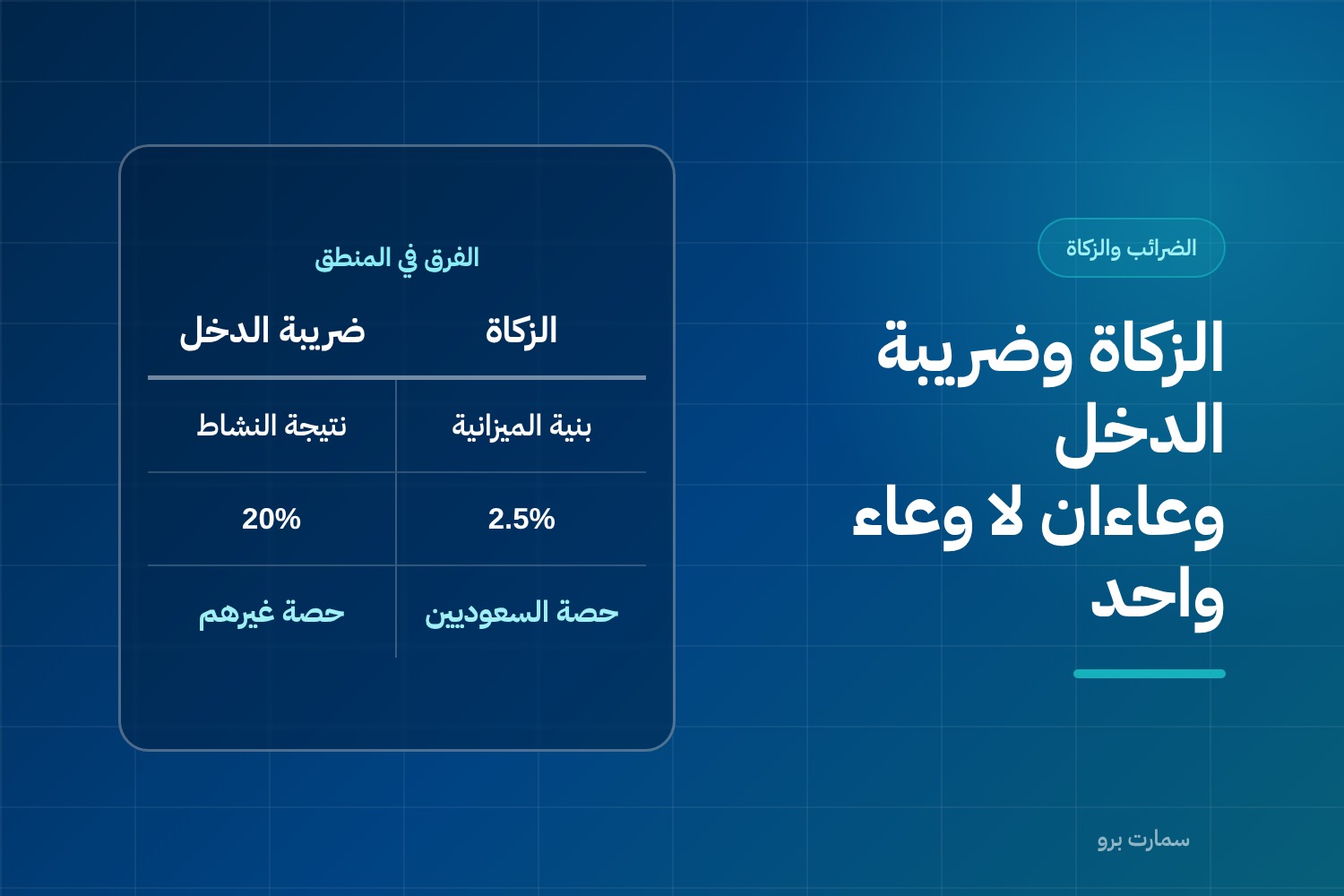
Zakat and income tax are not two names for the same thing. They differ in who is subject to each, in what the obligation is measured on, and in the rate. A company owned by Saudis and non-Saudis does not choose between them; it is subject to both at once, in proportion to ownership. Confusing the two obligations is one of the most common causes of assessment differences with the Zakat, Tax and Customs Authority (ZATCA), because the confusion shows up not only in the return but in how the books are built from the start.
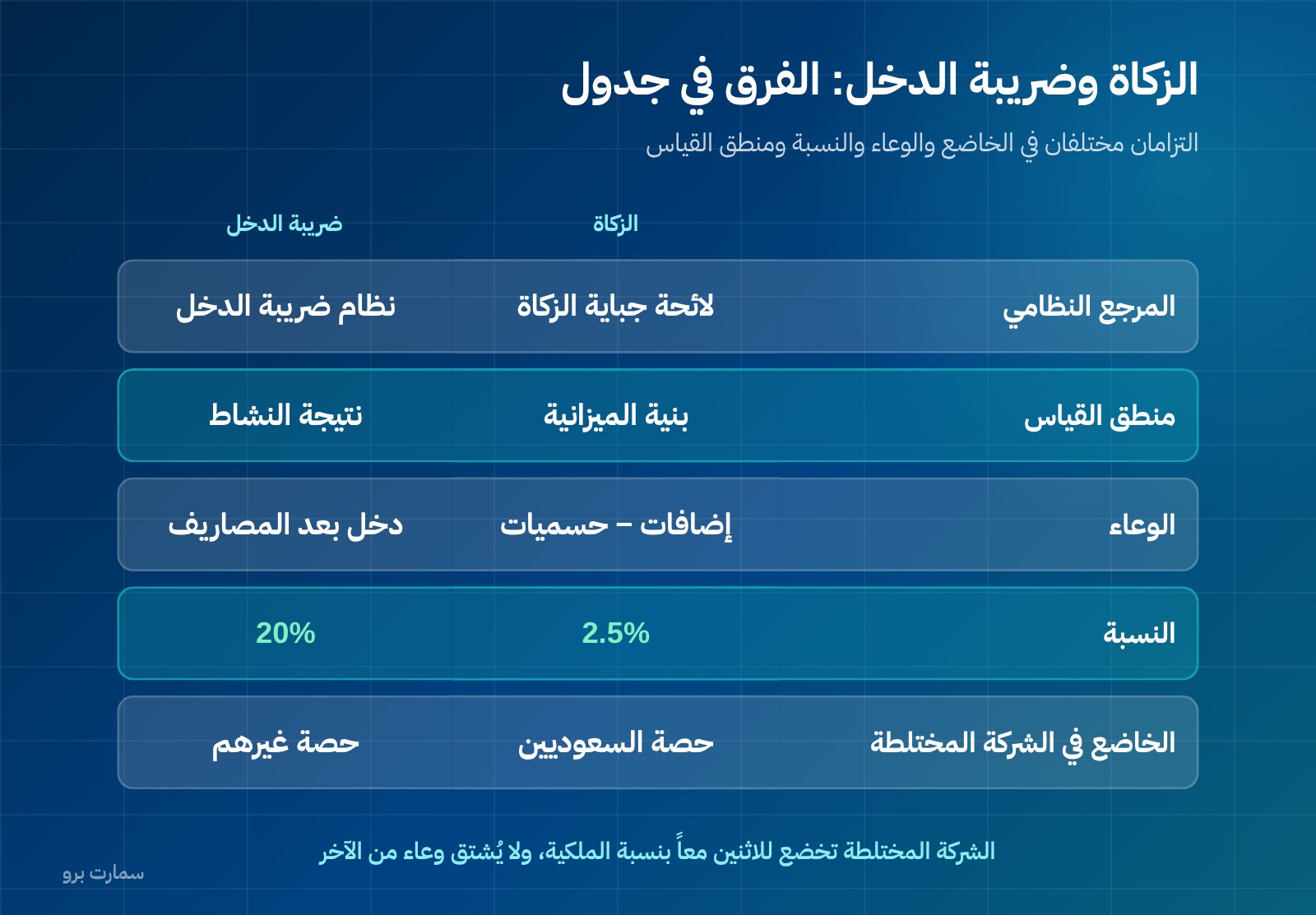
Zakat and income tax: the difference in one table
| Aspect | Zakat | Income tax |
|---|---|---|
| Legal reference | Implementing Regulations for Zakat Collection | Income Tax Law |
| Who is subject | Resident Saudis carrying on a licensed activity, sole establishments and companies owned by Saudis, certain government companies, and licensed financing funds | Resident capital companies on the shares held by non-Saudis, resident non-Saudi individuals carrying on an activity, and non-residents operating through a permanent establishment |
| Base | Zakat base: additions minus deductions from the statement of financial position | Tax base: taxable income after allowable expenses |
| Rate | 2.5% for a Hijri year, pro-rated by actual days if the year differs | 20% of the tax base in the general case |
| Measurement logic | On growing wealth | On profit |
The core difference is not the rate but the logic: zakat is measured on the structure of the balance sheet, while tax is measured on the result of the activity. That is why one business can make no profit and still owe zakat, while another is profitable but has a limited zakat base.
Who is subject to zakat?
Article 3 of the Implementing Regulations for Zakat Collection sets out who its provisions apply to. It starts with the resident Saudi person carrying on a licensed activity in the Kingdom, then covers sole establishments and companies owned by Saudis, certain government companies, and financing funds licensed by the Capital Market Authority. Residency is defined in Article 4. How the base is built is explained in detail in Zakat calculation: the zakat base step by step.
Who is subject to income tax?
Article 2 of the Income Tax Law sets out who is subject. In general terms, they are:
- Resident capital companies, on the shares owned by non-Saudis, with exceptions relating to companies listed on the Saudi stock market.
- Resident non-Saudi individuals carrying on an activity in the Kingdom.
- Non-residents carrying on an activity through a permanent establishment in the Kingdom.
- Non-residents with taxable income from sources in the Kingdom without a permanent establishment. This is where the withholding mechanism applies, as covered in Withholding tax: rates and deadlines.
- Those working in natural gas investment or in oil and hydrocarbon production.
Article 6 defines the base for each category, such as the non-Saudi partners' shares in a resident capital company, and the taxable income from sources in the Kingdom for a resident non-Saudi individual.
What are the income tax rates?
Article 7 sets the rates:
- 20% is the general rate on the tax base.
- 20% for natural gas investment.
- Oil and hydrocarbon production: brackets that step according to total capital investment in the Kingdom. 50% where investment exceeds SAR 375 billion, 65% where it exceeds SAR 300 billion up to SAR 375 billion, 75% where it exceeds SAR 225 billion up to SAR 300 billion, and 85% where investment does not exceed SAR 225 billion.
- Withholding tax rates are set by Article 68.
How is a mixed-ownership company treated in practice?
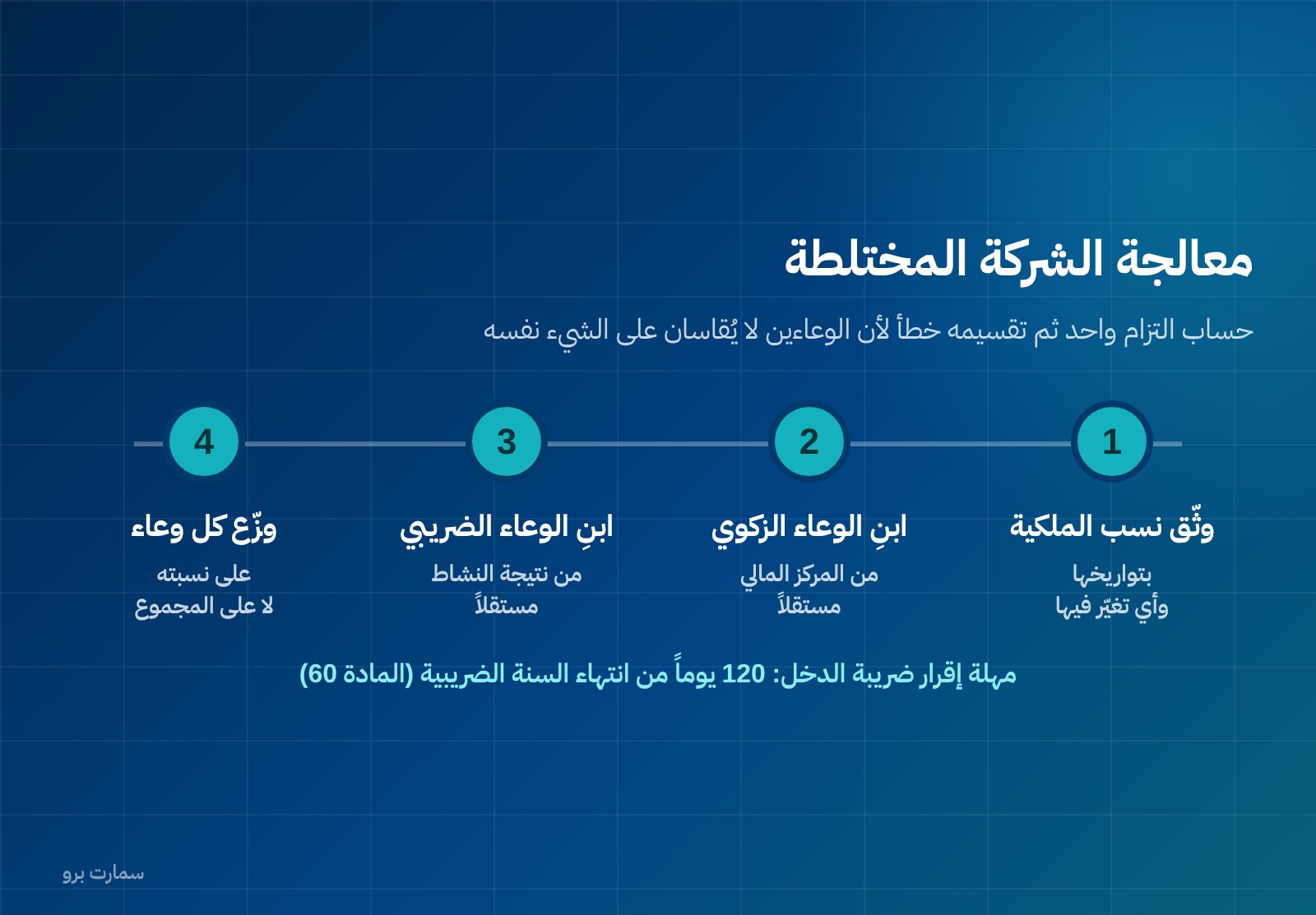
A company owned by Saudis and non-Saudis is subject to zakat on the Saudi ownership share and to income tax on the non-Saudi ownership share. In practice, the treatment takes three steps:
- Document ownership percentages with their dates. Any change in the percentages during the year affects the allocation, and it needs a supporting document, not an estimate.
- Build the two bases independently. The zakat base comes from the statement of financial position; the tax base comes from the result of the activity after allowable expenses. Neither is derived from the other.
- Apply each base to its own share. Zakat applies to the Saudi share of the zakat base, and tax applies to the non-Saudi share of the tax base.
The recurring mistake is calculating one obligation and then splitting it. That produces a figure that rests on neither system, because the two bases are not measured on the same thing.
When are the returns due?
Income tax: Article 60 provides that the return is filed within one hundred and twenty days of the end of the tax year, and payment of the tax due under it is tied to filing the return.
Zakat: the filing deadline is set by ZATCA and should be checked on its portal. Do not confuse it with the 120-day period in Article 7 of the zakat regulations; that is the deadline for requesting the annual exemption from zakat collection, not the filing deadline.
What does your accounting system need to serve both?
Books built to serve one obligation do not automatically serve the other:
- Detailed, classified equity accounts from which the zakat base can be built.
- A fixed asset register with a documented net book value, for the zakat deduction and for calculating tax depreciation alike. The details are in Accounting depreciation vs tax depreciation.
- Allowable and non-allowable expenses separated in the chart of accounts, not in an external spreadsheet.
- A record of ownership percentages and how they change.
- A sound annual close with complete adjusting entries, following the accounting cycle.
Where is the official reference?
The Income Tax Law and the Implementing Regulations for Zakat Collection are published by the Zakat, Tax and Customs Authority on its website: zatca.gov.sa. The articles referred to (2, 6, 7 and 60 of the Income Tax Law, and 3, 4 and 7 of the zakat regulations) are taken from the official texts, and international agreements for the avoidance of double taxation may change the treatment for non-residents.
Read also
Article visuals
Frequently asked questions
Can a business be subject to both zakat and income tax?
Yes, if its ownership is mixed. A company owned by Saudis and non-Saudis is subject to zakat on the Saudi ownership share and to income tax on the non-Saudi share, and the two bases are built independently: the zakat base from the statement of financial position and the tax base from the result of the activity. Calculating one obligation and then splitting it is a common mistake.
What is the income tax rate in Saudi Arabia?
The general rate is 20% of the tax base under Article 7 of the Income Tax Law, and natural gas investment is also taxed at 20%. Oil and hydrocarbon production has brackets ranging from 50% to 85% depending on total capital investment in the Kingdom.
What is the core difference between the zakat base and the tax base?
The zakat base is measured on the structure of the statement of financial position: additions such as equity, then deductions such as net fixed assets. The tax base is measured on the result of the activity, meaning taxable income after allowable expenses. That is why one business can make no profit and still owe zakat, while another is profitable but has a limited zakat base.
When is the income tax return due?
Within one hundred and twenty days of the end of the tax year, under Article 60 of the Income Tax Law, and payment of the tax due is tied to filing the return. The zakat return deadline is set by ZATCA and should be checked on its official portal.