
Revenue Recognition Under IFRS 15: The Five Steps with Practical Examples
The IFRS 15 five-step model for revenue recognition, when revenue is recognised over time and when at a point in time, and the errors that turn up most often in the books.
Author:سامي الحيدري
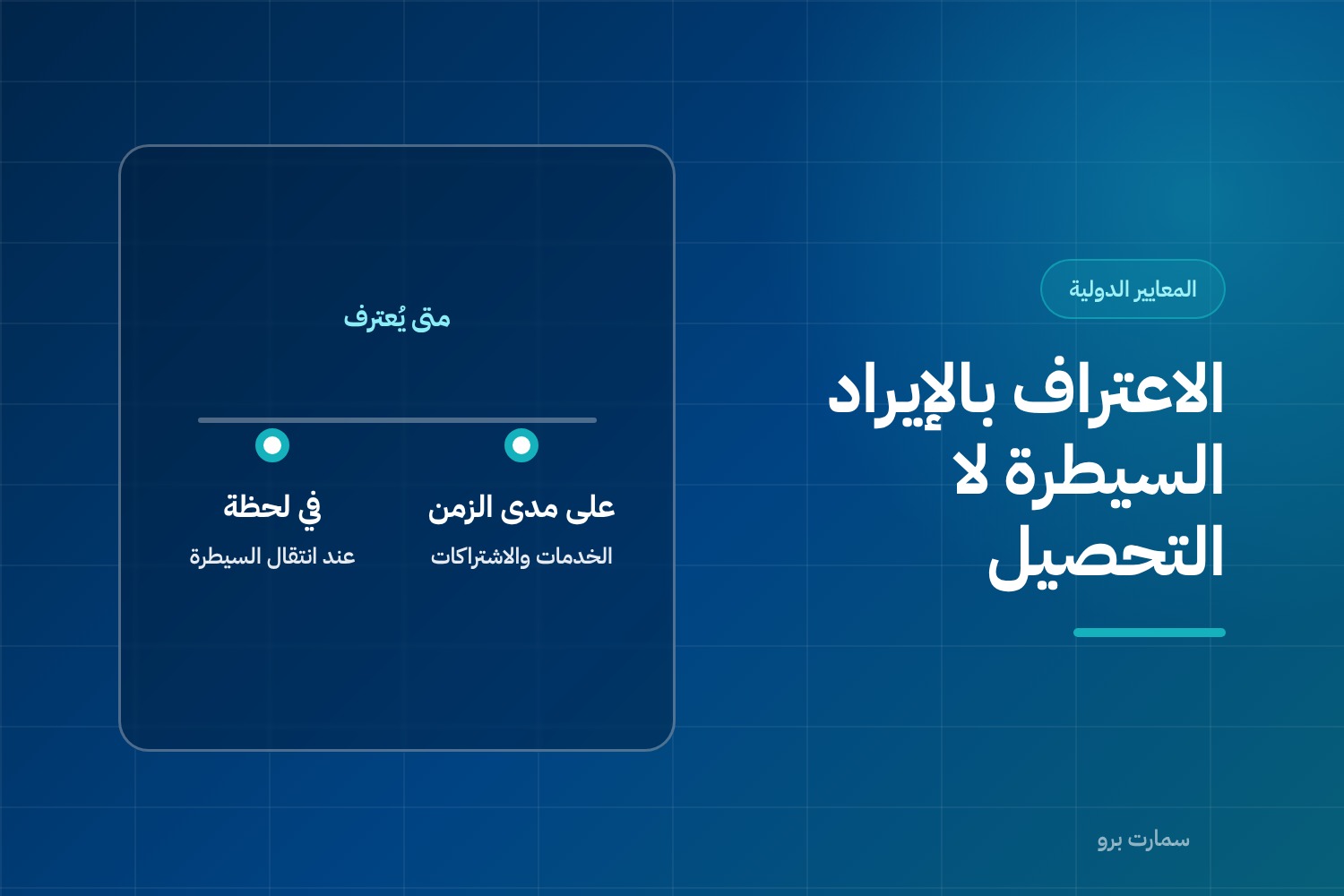
Revenue recognition is the accounting decision that most shapes how your business looks. It sets the period's profit, the tax base and the figure your bank and investors see. The usual mistake is timing, not arithmetic. Businesses record revenue when cash arrives or the contract is signed, rather than when control actually passes to the customer. IFRS 15 settles that timing with a five-step model.
What is the core principle before the steps?
The governing rule is this: revenue is recognised when control transfers of the good or service to the customer, at the amount the business expects to be entitled to in exchange. Control is what matters. Collection, the invoice date and the contract signature do not decide it.
This difference is the heart of moving from the cash basis to the accrual basis. The two are compared in cash basis vs accrual basis.
What are the five steps of revenue recognition?
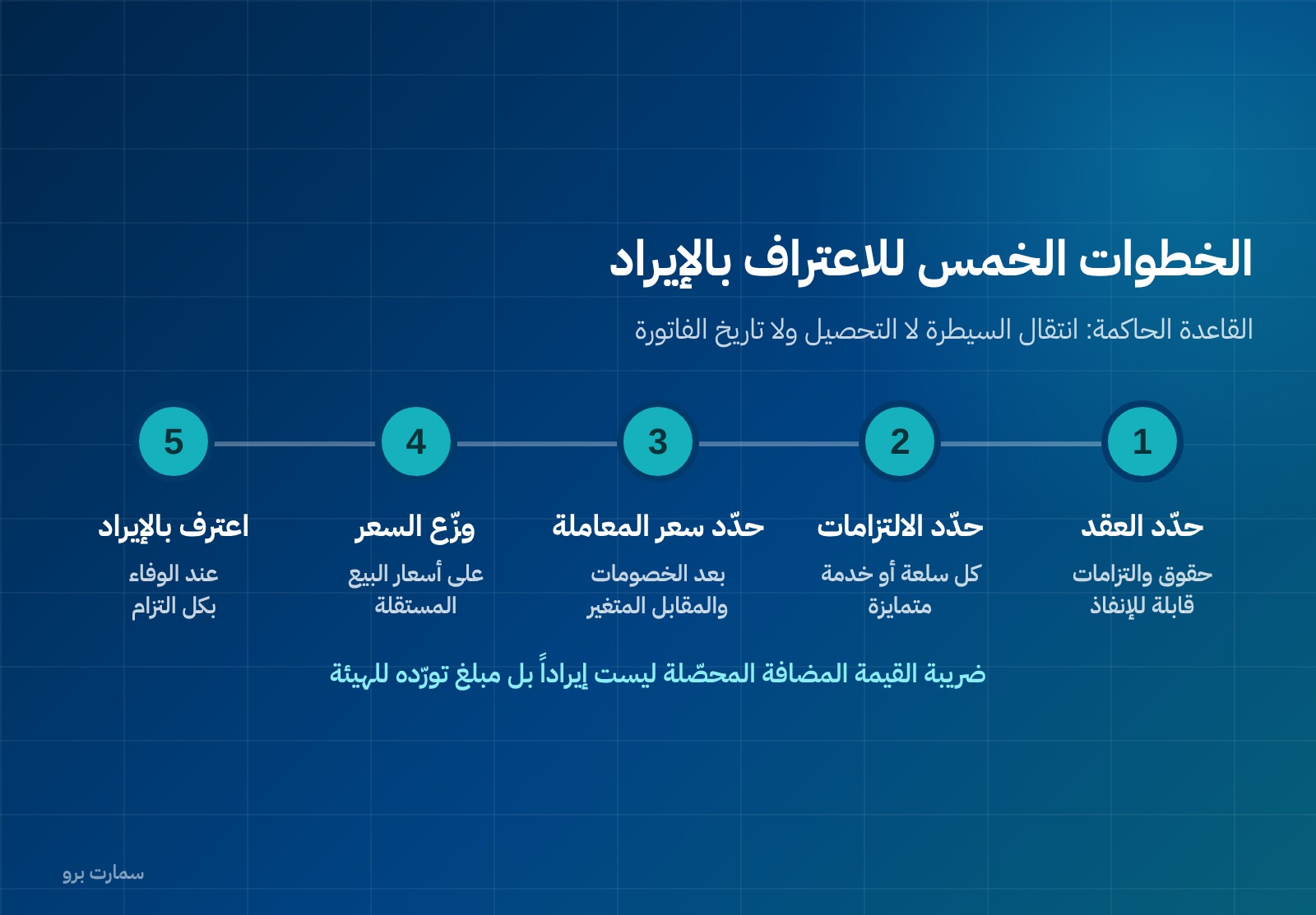
1. Identify the contract with the customer. A contract is an agreement that creates enforceable rights and obligations. It does not have to be written, but the rights, terms and payment method must be defined, and collection must be probable. A verbal purchase order with no quantity or price is not a contract for recognition purposes.
2. Identify the performance obligations in the contract. A performance obligation is a promise to deliver a distinct good or service. One contract can hold several obligations. Selling a device with installation and two years of maintenance is three obligations if each is distinct, not one.
3. Determine the transaction price. This is the amount the business expects to be entitled to, after allowing for discounts, variable consideration such as performance bonuses and penalties, and amounts collected on behalf of third parties. VAT you collect for the Authority is not your revenue; the treatment is covered in detail in tax invoice requirements.
4. Allocate the transaction price to the performance obligations. The price is allocated on the basis of each obligation's standalone selling price, the price at which you would sell that item on its own. If you sell the device, installation and maintenance for a total below the sum of their standalone prices, the discount is spread across the obligations proportionally.
5. Recognise revenue as each obligation is satisfied. This happens either over time or at a point in time.
Is revenue recognised over time or at a point in time?
Revenue is recognised over time if any one of three conditions is met:
- The customer receives and consumes the benefits at the same time as the business performs (ongoing service contracts such as maintenance and subscriptions).
- The business's performance creates an asset the customer controls while it is being built (construction on the customer's land).
- The business's performance does not create an asset with an alternative use to the business, and the business has an enforceable right to payment for work completed to date.
If none of these applies, revenue is recognised at the point in time control transfers. Indicators of transfer include: a present right to payment, transfer of legal title, transfer of physical possession, transfer of the risks and rewards of ownership, and the customer's acceptance of the goods.
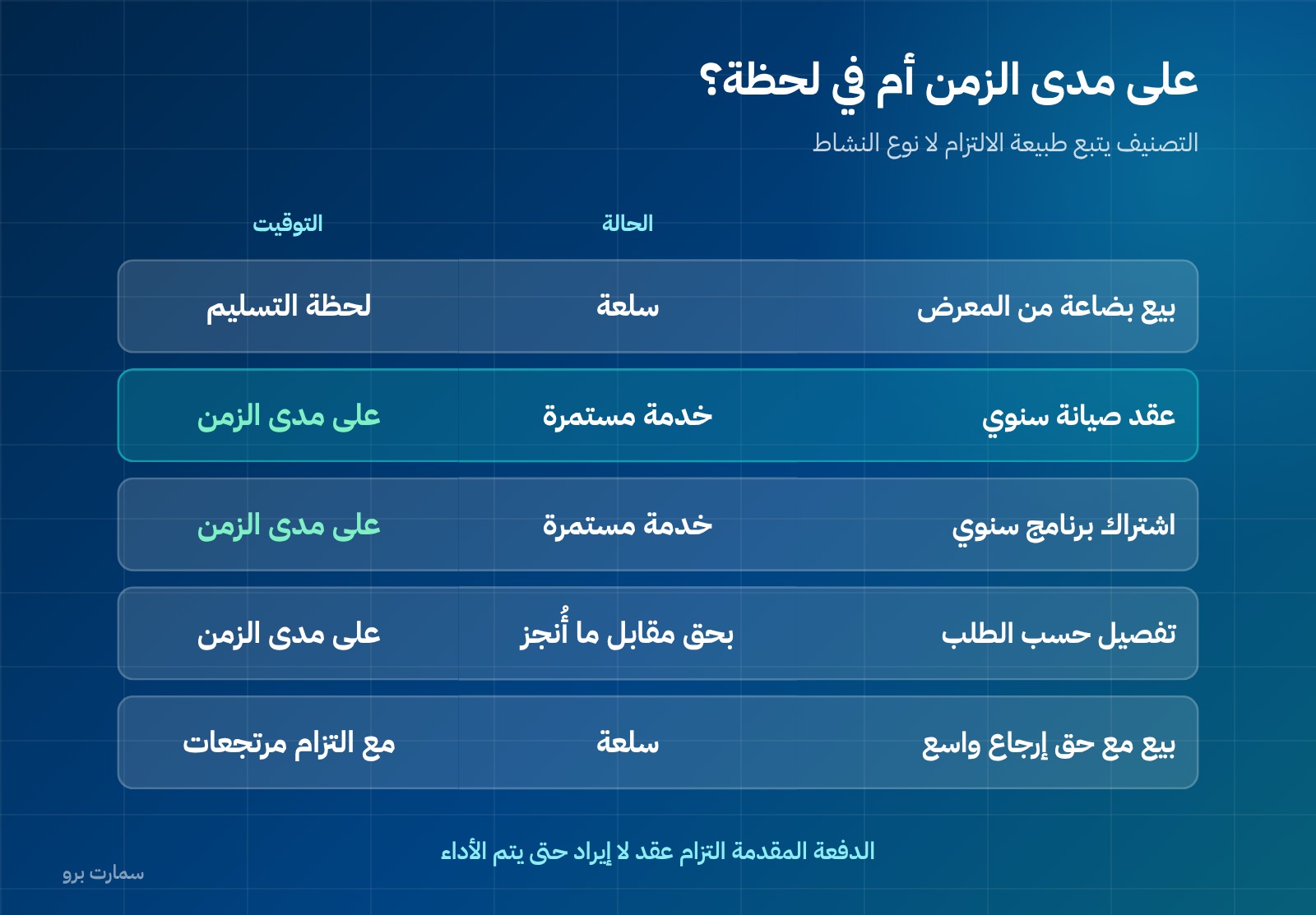
| Situation | Timing |
|---|---|
| Sale of goods from the showroom | On delivery |
| Annual maintenance contract | Over time |
| Annual software subscription | Over time |
| Made-to-order tailoring with a right to payment for work done | Over time |
| Sale with a broad right of return | On delivery, with a liability for expected returns |
What are the most common mistakes?
Recognising revenue on collection. An advance payment is not revenue; it is a contract liability until the work is performed. This is one of the items most often corrected at audit.
Treating a multi-element contract as one obligation. Selling a device with two years of maintenance and booking the whole amount as revenue in the year of sale inflates the first year's profit and empties the next two.
Ignoring variable consideration. A volume discount the customer earns on reaching a threshold must be estimated and deducted from revenue, not left until the customer claims it.
Mixing revenue with amounts collected for others. A business acting as an agent recognises only its commission, not the gross amount. Whether you are principal or agent depends on who controls the good before it passes to the customer.
Not linking revenue to an automatic entry. Sound recognition needs every invoice to generate its journal entry automatically, with revenue and liability accounts kept separate in the chart of accounts.
How does it affect zakat, tax and the financial statements?
Recognised revenue is a core input to the operating result, from which the tax base is built after adjustments, as shown in the income tax return. The timing of recognition also affects retained earnings and therefore the equity that feeds into the zakat calculation.
There is a new effect worth watching: the presentation of the income statement changes under IFRS 18 for periods beginning on or after 1 January 2027. Items are classified into categories and two mandatory subtotals appear. The details are in IFRS 18.
What should a practical review checklist include?
- Every contract type you use has a sheet setting out its performance obligations.
- Advance payments are recorded as contract liabilities, not revenue.
- Standalone selling prices are documented for allocating the transaction price.
- Variable consideration is estimated and reviewed at every close.
- The business's role (principal or agent) is defined and documented for each line of business.
- Expected returns are recognised as a liability, not handled only when they happen.
- Recognised revenue agrees with the account balance in the trial balance.
Where is the official reference?
IFRS as endorsed in the Kingdom is published by the Saudi Organization for Chartered and Professional Accountants (SOCPA) on its website: socpa.org.sa. The original text of the standard and its summaries are available from the IFRS Foundation at ifrs.org. For industry-specific treatments, refer to the text of the standard itself.
Read also
Article visuals
Frequently asked questions
When is revenue recognised?
Revenue is recognised when control of the good or service passes to the customer, at the amount the business expects to be entitled to in exchange. It is not recognised on collection, on signing the contract or by the invoice date. The transfer may happen over time or at a point in time, depending on the nature of the obligation.
What are the five steps in IFRS 15?
Identify the contract with the customer, then identify the distinct performance obligations within it, then determine the transaction price. Next, allocate the price to the obligations based on their standalone selling prices. Finally, recognise revenue as each obligation is satisfied.
Is a customer's advance payment revenue?
No. It is recorded as a contract liability until the work is performed, and revenue is recognised when the obligation is satisfied. Recognising an advance payment as revenue is one of the mistakes most often corrected at audit, and it inflates the period's profit without basis.
What is the difference between a principal and an agent in revenue recognition?
A principal recognises the gross value of the transaction, while an agent recognises only its commission. The deciding factor is who controls the good or service before it passes to the customer. The role should be documented for each line of business, not assumed.