
Lease Contracts Under IFRS 16: The Right-of-Use Asset and the Lease Liability
How IFRS 16 treats lease contracts: the right-of-use asset and lease liability, the permitted exemptions, and the effect on financial ratios and bank covenants.
Author:سامي الحيدري
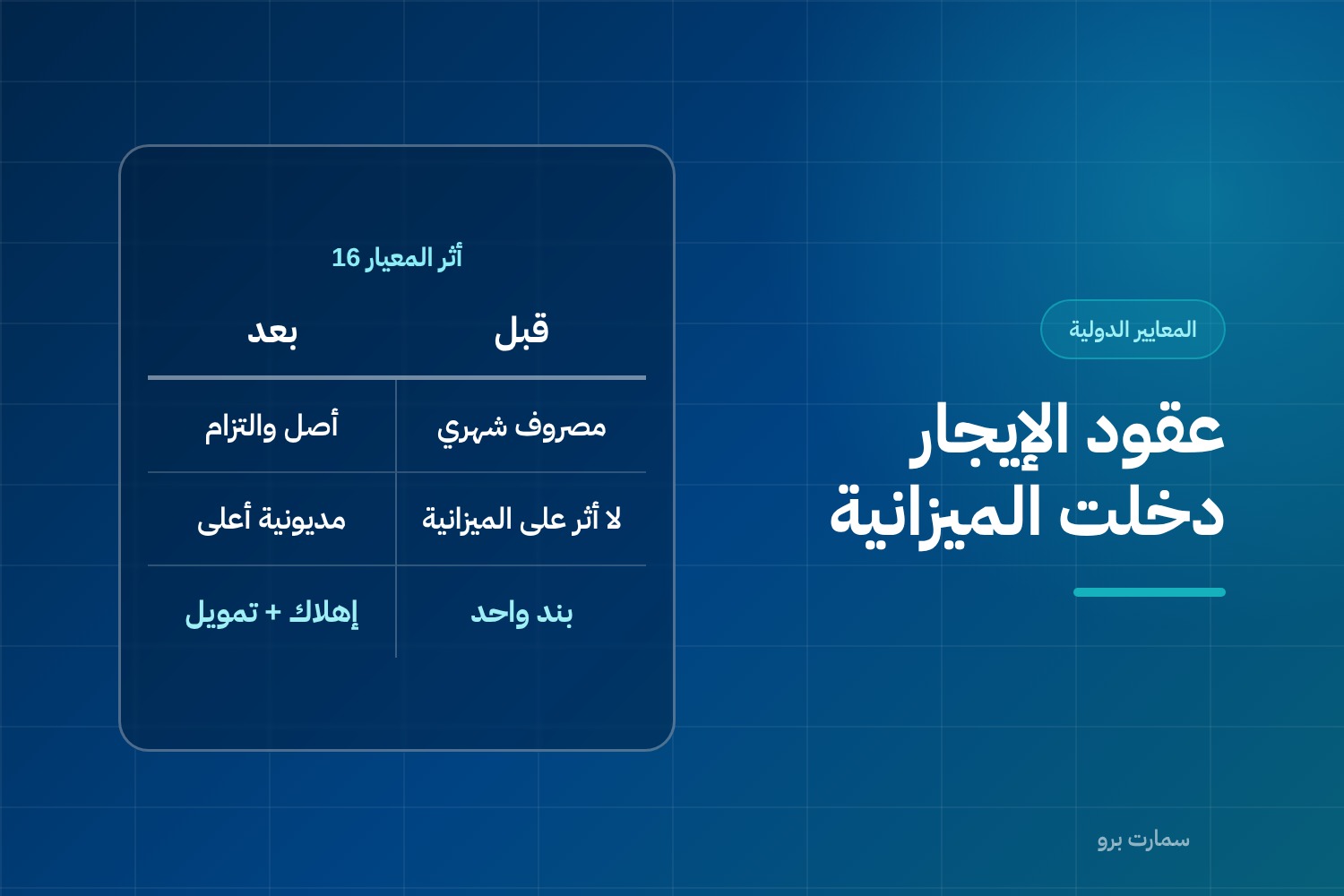
Before IFRS 16, many lease contracts went through the income statement as a monthly expense and never touched the statement of financial position. A business renting ten branches on long contracts could look free of long-term obligations. IFRS 16 ended that: lease contracts now appear on the balance sheet as an asset and a liability. This changes your financial ratios even if nothing in your operations has changed.
What is the core idea of IFRS 16?
At the commencement date of the contract, the lessee recognises two things:
- Right-of-use asset: your right to use the leased asset for the lease term.
- Lease liability: the present value of the lease payments not yet paid, discounted at the interest rate implicit in the lease, or at the lessee's incremental borrowing rate if the implicit rate cannot be determined.
The right-of-use asset is then depreciated over the lease term (or over its useful life if ownership transfers). The lease liability carries a finance charge that falls as payments are made.
What changes in your financial statements?
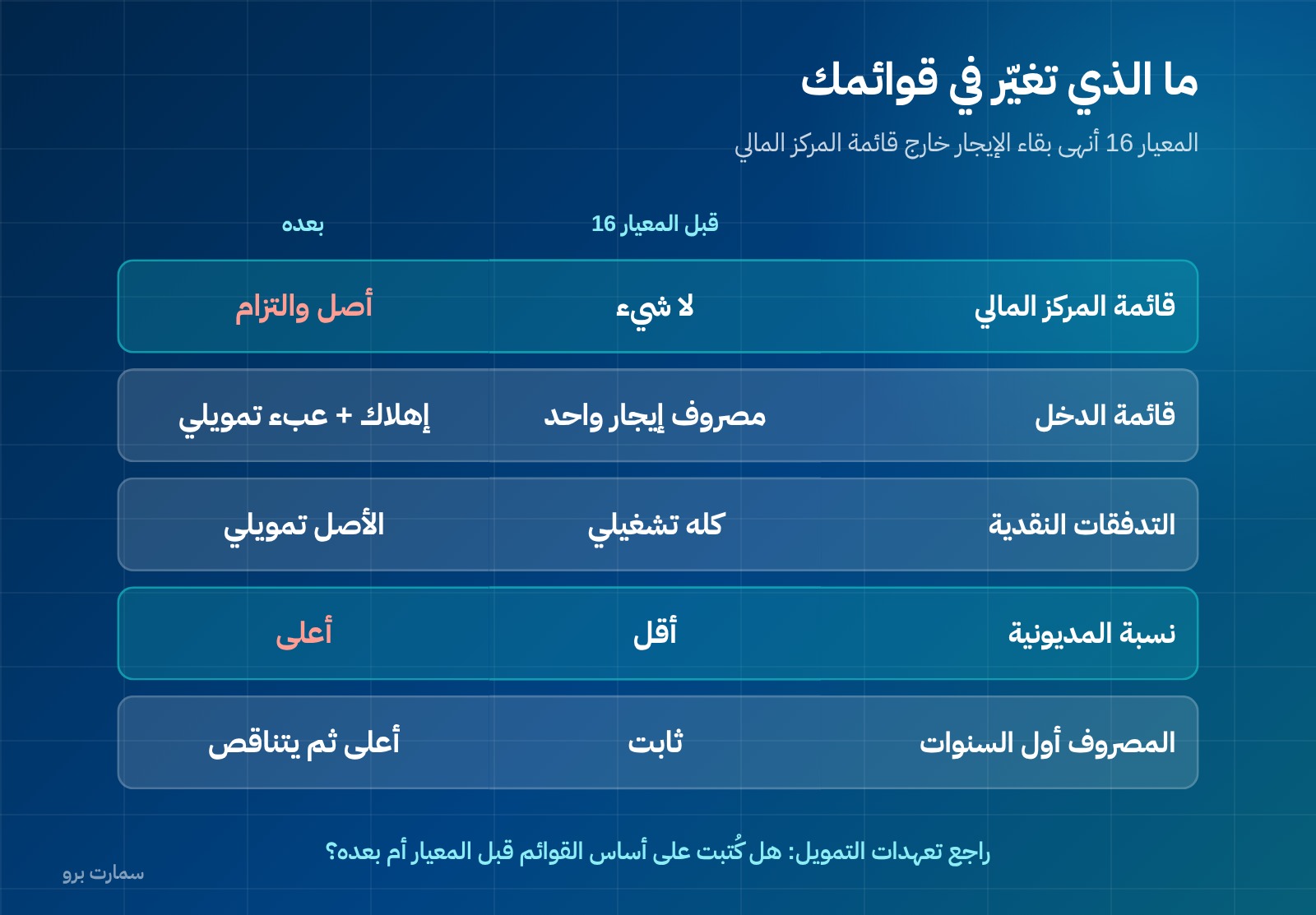
| Statement | Before | After |
|---|---|---|
| Financial position | Nothing | Right-of-use asset + lease liability |
| Income | A single rent expense | Depreciation + finance charge |
| Cash flows | Within operating | Principal portion within financing |
The effect analysts watch for: total expense in the early years is higher than the old flat rent expense. This is because the finance charge is calculated on a larger balance at the start, then declines. The total over the lease term is the same, but the timing is different.
Which leases are exempt?
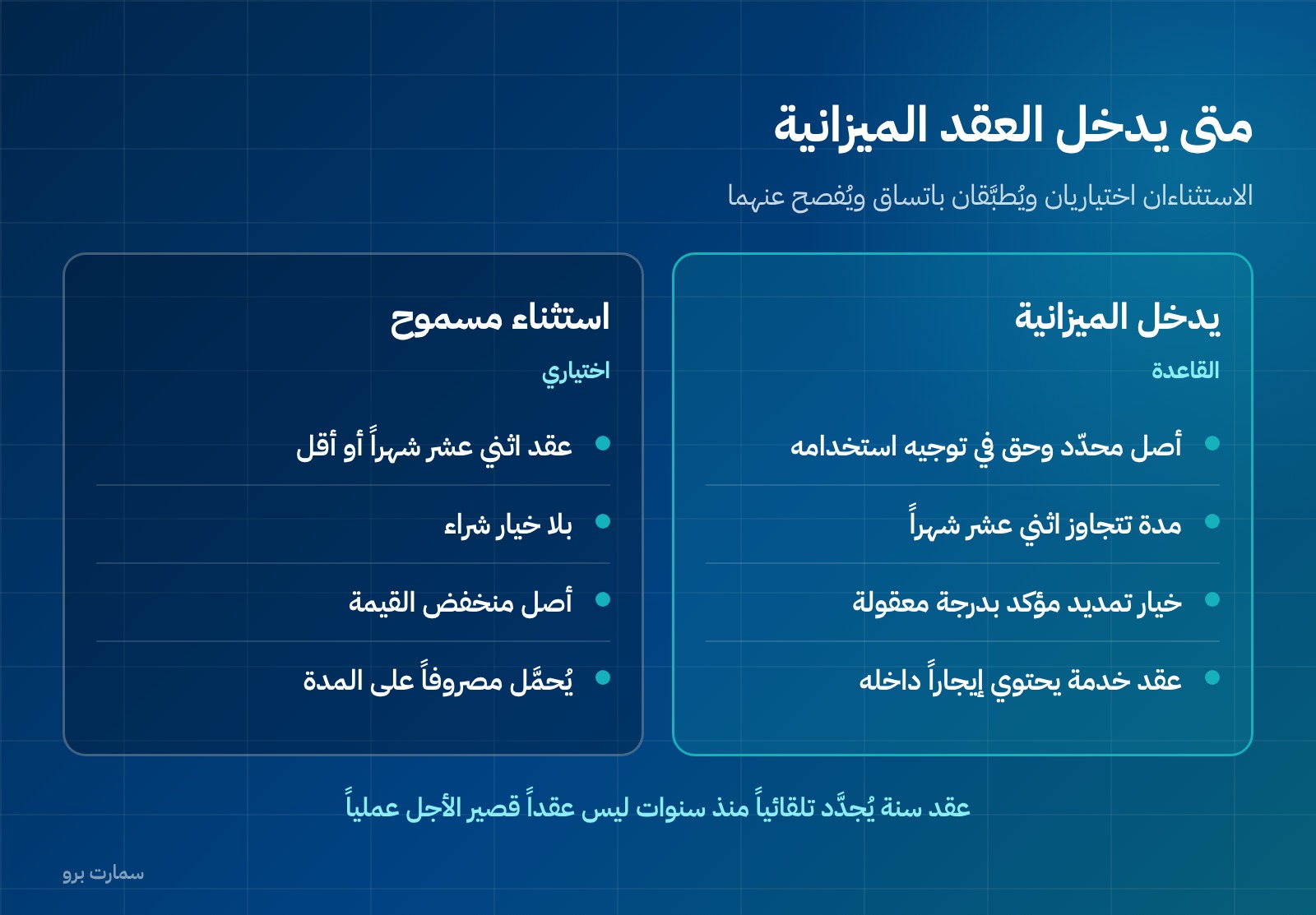
The standard allows the lessee not to recognise the asset and liability in two cases. In these cases, the rent is charged as an expense over the lease term:
- Short-term leases: a term of twelve months or less, with no purchase option.
- Low-value assets: such as small computers and simple office furniture, judged by the value of the asset when new.
Both exemptions are optional. Whichever choice you make must be applied consistently and disclosed.
Which details change the number?
The lease term is not always the one written in the contract. If you have an extension option and you are reasonably certain to exercise it, the extension period counts. A one-year lease that renews automatically, and that you have renewed for five years, is not a short-term lease in practice.
Variable payments. Payments linked to an index or rate are included in the measurement at the rate in effect at commencement. Payments linked to sales or usage are expensed as they occur.
The discount rate. A small change in the discount rate changes the liability noticeably on long leases. Document how you arrived at it.
Remeasurement. A change in the lease term or the payments requires the liability to be remeasured, with a matching adjustment to the asset.
Where do people go wrong in practice?
Treating every lease as short-term. A one-year lease that renews automatically is not exempt if renewal is reasonably certain.
Forgetting contracts not called leases. An equipment hosting agreement, or cars rented under a service contract, may contain a lease if there is an identified asset and a right to control its use.
Ignoring the effect on covenants. The new liability raises your debt-to-equity ratio. Check your financing agreements: is the covenant written on the basis of the financial statements before the standard or after it?
Not building a lease register. You cannot measure what you have not listed. The register is the starting point. Without it, any figure you show on the balance sheet is an estimate you cannot defend in an audit.
Confusing a lease with a service contract. What matters is whether there is an identified asset and a right to direct its use and obtain substantially all of its economic benefits throughout the period of use. A contract giving you unspecified storage space in a supplier's warehouse is not a lease. A contract that assigns you a specific warehouse may be one, even if it is called a logistics services agreement.
Ignoring dismantling and restoration costs. An obligation to restore the site to its original condition when the lease ends is part of the cost of the right-of-use asset. It is often missed in branch and showroom leases.
What goes in a lease register?
For each contract: the lessor, a description of the asset, the commencement date, the contractual term, extension options and the assessment of whether they will be exercised, the payments and their timing, variable payments and their basis, the discount rate and its basis, the present value at commencement, the amortisation schedule, and the date of the last reassessment.
This register should not live in someone's personal spreadsheet. It belongs in the accounting system itself, like the fixed asset register explained in accounting depreciation versus tax depreciation. Setting up the related accounts starts with the chart of accounts guide.
How does IFRS 16 connect to the new presentation of financial statements?
Under IFRS 18, effective for periods beginning on or after 1 January 2027, classifying items as operating, investing or financing becomes mandatory, and an operating profit subtotal appears on the face of the income statement. Because your rent has become depreciation and a finance charge, where each one falls in the new categories directly affects the operating profit you report. The details are in IFRS 18: presentation and disclosure.
IFRS 16 review checklist
- All contracts that may contain a lease have been identified, not only those titled "lease".
- Every extension option has been assessed and the basis of the assessment recorded.
- A discount rate has been set for each contract and its basis documented.
- Fixed payments have been separated from variable payments.
- The exemptions have been applied consistently and disclosed.
- The total of lease liabilities agrees with the account balance in the trial balance.
- Bank covenants have been reviewed after including the new liability.
Where is the official reference?
IFRS as endorsed in Saudi Arabia is published by the Saudi Organization for Chartered and Professional Accountants (SOCPA) on its website: socpa.org.sa. The texts and summaries of the standards are available from the IFRS Foundation at ifrs.org.
Read also
- IFRS 18: presentation and disclosure
- Revenue recognition under IFRS 15
- The accounting cycle from invoice to financial statements
Key takeaway: Under IFRS 16, most lease contracts become a right-of-use asset and a lease liability on your balance sheet. A complete lease register, with documented lease terms and discount rates, is what makes those figures defensible.
Article visuals
Frequently asked questions
What does a lessee recognise under IFRS 16?
A right-of-use asset and a lease liability at the commencement date of the lease. The liability is measured at the present value of unpaid lease payments, discounted at the interest rate implicit in the lease or at the lessee's incremental borrowing rate. The asset is then depreciated over the lease term, and the liability carries a finance charge.
Do all lease contracts go on the balance sheet?
IFRS 16 allows two optional exemptions: short-term leases of twelve months or less with no purchase option, and leases of low-value assets. For these, the rent is charged as an expense over the lease term. The choice must be applied consistently and disclosed.
Is a one-year renewable lease treated as short-term?
Not necessarily. If you are reasonably certain to exercise the extension option, such as a lease you have renewed automatically for years, the extension period is included in the lease term. The lease then no longer qualifies for the short-term exemption.
Why is the expense higher in the early years of a lease under IFRS 16?
The expense is now a fixed depreciation charge plus a finance charge calculated on the lease liability balance, which is largest at the start and then declines. The total over the lease term stays the same. Only its spread across the years differs from the old flat rent expense.