
Income Statement: How to Build It and Read It Correctly
What an income statement contains, the difference between presenting expenses by nature and by function, how to read its margins, and what changes under IFRS 18.
Author:سامي الحيدري
The income statement is the first document a bank opens, the one an investor compares against competitors, and the source of your tax figures. Yet many business owners read it only from the bottom: the net profit figure. That misses what the statement actually tells you: where the profit came from, whether it came from your core business or a one-off event, and whether your margin is improving or eroding.
What does an income statement contain?
The statement shows the business's performance over a period (a month, a quarter or a year), not at a single moment. This is a fundamental difference from the statement of financial position, which captures one specific point in time.
Its traditional structure:
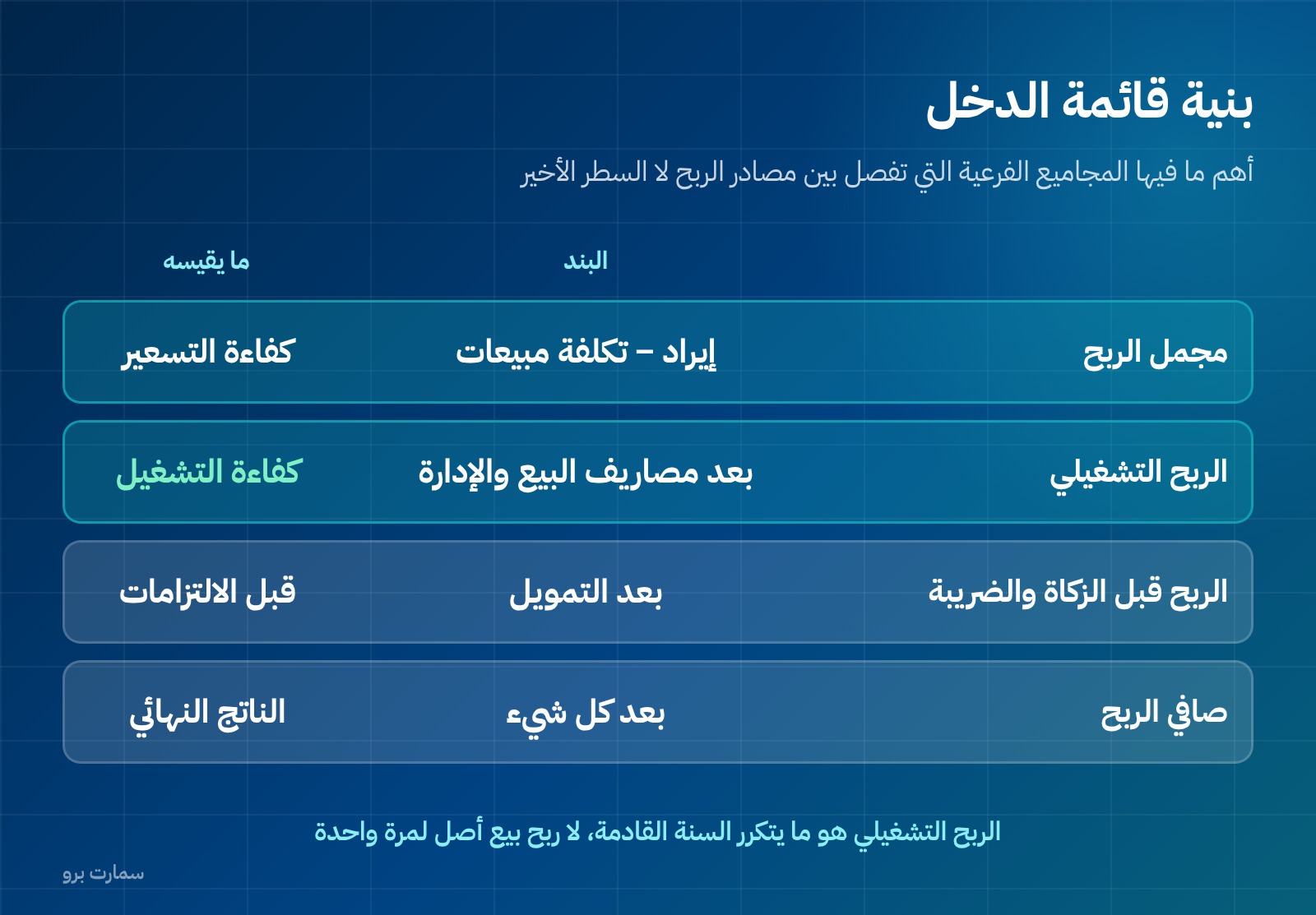
| Line item | What it means |
|---|---|
| Revenue | The value of what you actually delivered to customers during the period |
| Cost of sales | The direct cost of what was delivered |
| Gross profit | Revenue minus cost of sales |
| Selling and distribution expenses | What was spent to generate sales |
| General and administrative expenses | What is spent to run the business |
| Operating profit | The result of the core business |
| Other income and expenses | Items outside the core business |
| Finance costs | The cost of loans and credit facilities |
| Profit before zakat and tax | Before statutory obligations |
| Zakat and income tax | Depending on what the business is subject to |
| Net profit | The final result |
Note that the most important part of the statement is not the last line but the subtotals that separate the sources of profit.
How are expenses presented: by nature or by function?
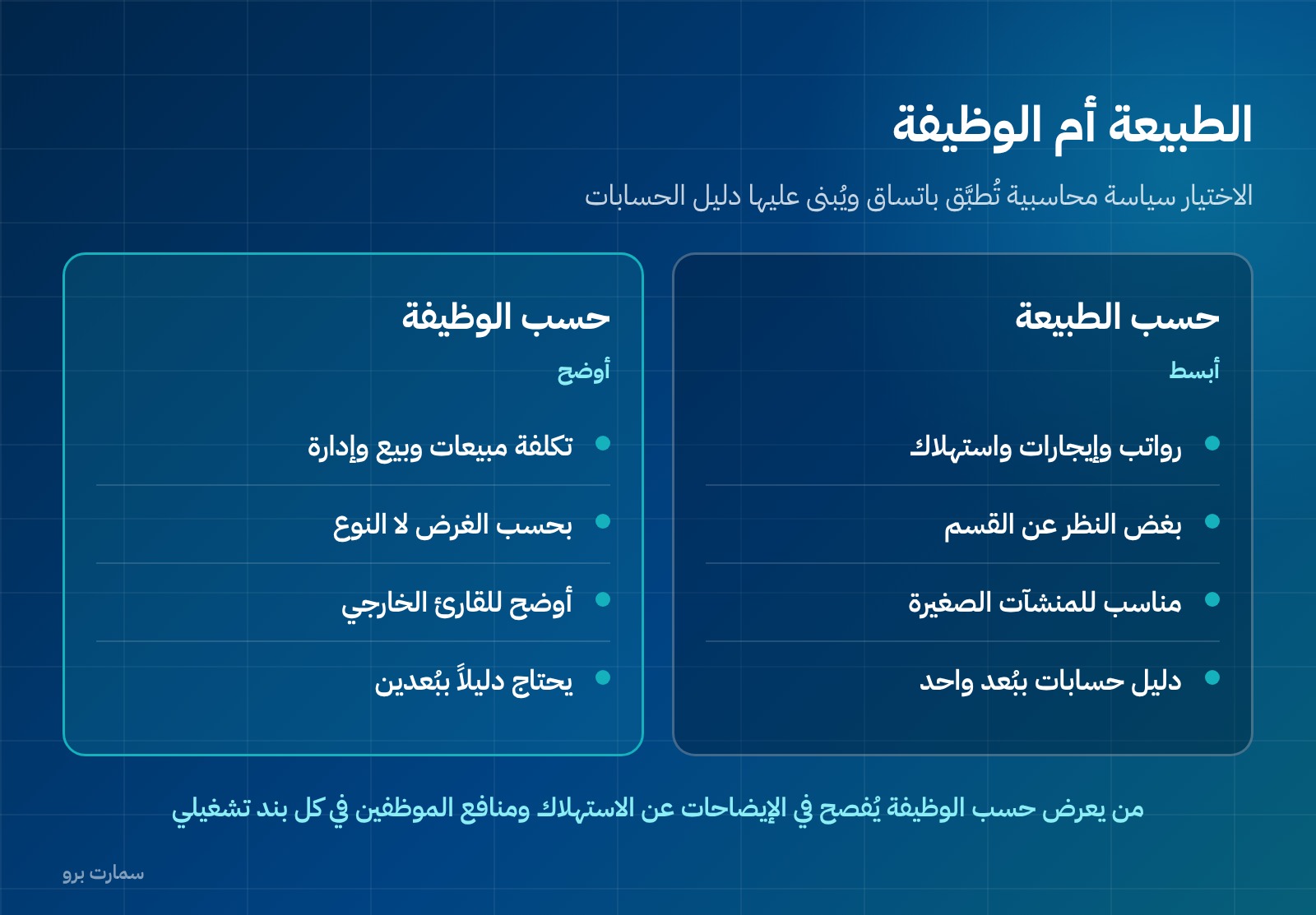
There are two accepted methods, and the choice is an accounting policy that must be applied consistently:
By nature: expenses are shown by type (salaries, rent, depreciation, raw materials, electricity) regardless of which department incurred them. It is simpler to apply and suits small businesses.
By function: expenses are shown by purpose (cost of sales, selling and distribution expenses, administrative expenses). It is clearer for an outside reader but requires allocating a single expense across more than one function.
A business that presents by function needs a chart of accounts with two dimensions: nature and function. This decision is made when building your chart of accounts, not at period close.
What changes under IFRS 18?
The Saudi Organization for Chartered and Professional Accountants (SOCPA) has adopted IFRS 18 to replace IAS 1. It applies to annual periods beginning on or after 1 January 2027, with early application permitted. Its impact on this particular statement is the largest:
- Items are classified into categories: operating, investing and financing, plus income taxes and discontinued operations.
- Two mandatory subtotals appear: operating profit, and profit before financing and income taxes.
- The business discloses its management-defined performance measures in a single note, together with a reconciliation.
In other words, "operating profit" becomes a figure with one standard definition across all businesses, instead of each business defining it its own way. Full details are in IFRS 18.
How do you read an income statement?
Don't start at the bottom. Start with the margins:
- Gross profit margin = gross profit ÷ revenue. It measures the efficiency of your pricing, purchasing and production.
- Operating margin = operating profit ÷ revenue. It measures operating efficiency after indirect expenses.
- Net profit margin = net profit ÷ revenue. The final result after everything.
Then ask three questions:
Is the margin improving or eroding? Revenue rising 20% while the margin falls from 32% to 24% means you are buying growth with price. This does not show up in the net profit figure alone.
Does the profit come from the business or from a one-off event? A gain on selling land or an insurance payout lifts net profit once. Operating profit is what repeats next year.
Are finance costs eating into operations? A business with healthy operating profit but weak net profit has a financing-structure problem, not an operating problem.
Which mistakes make the statement misleading?
Confusing revenue with collection. An advance payment is not revenue; it is a contract liability until the obligation is performed, as explained in revenue recognition under IFRS 15.
Including VAT in revenue. The VAT you collect is not your revenue; it is an amount you remit to ZATCA.
Charging capital expenditure to the period. Buying an asset is capitalised and depreciated, not expensed in one go. The rule is covered in fixed assets.
Closing without adjustments. Unrecorded accrued and prepaid expenses and depreciation make the profit illusory. Details are in adjusting entries.
Recording owner drawings as an expense. An owner's drawing is a distribution from equity, not an operating expense. Including it in expenses lowers profit and distorts the operating margin at the same time.
Comparing a full period with an incomplete one. Comparing a peak-season quarter with an ordinary quarter without flagging it leads to the wrong conclusion. The correct comparison is with the same period of the previous year, or with a moving average that removes the effect of seasonality.
What should you check before approving the statement?
- The period is closed and there are no pending entries dated within it.
- All adjustments are recorded: accruals, prepayments, depreciation and provisions.
- Revenue is recognised on transfer of control, not on collection.
- VAT is excluded from revenue and from deductible expenses.
- Expenses are classified consistently under the chosen method.
- Non-recurring items are separated and clear to the reader.
- The figures agree with the trial balance.
- Net profit is correctly carried to equity in the statement of financial position.
Key takeaway: Read the income statement from its margins and subtotals, not its last line, and make sure revenue, VAT, adjustments and owner drawings are treated correctly before you rely on the result.
Official reference
International standards as adopted in the Kingdom are published by the Saudi Organization for Chartered and Professional Accountants on its website: socpa.org.sa, and the texts and summaries of the standards are available from the IFRS Foundation at ifrs.org.
Read also
- IFRS 18
- The accounting cycle from invoice to financial statements
- Trial balance: what it reveals and what it hides
To see an income statement built from automatic journal entries with a live P&L, try SmartPro free or explore Finance & Accounting.
Article visuals
Frequently asked questions
What is the difference between the income statement and the statement of financial position?
The income statement shows performance over a period, such as a month, a quarter or a year. The statement of financial position captures assets, liabilities and equity at one specific moment, the closing date. The first is a film; the second is a photograph.
What is the difference between presenting expenses by nature and by function?
By nature, expenses are shown by type: salaries, rent, depreciation and materials. By function, they are shown by purpose: cost of sales, selling and distribution expenses and administrative expenses. The function method is clearer for outside readers but requires a chart of accounts with two dimensions.
What changes in the income statement under IFRS 18?
Items are classified into operating, investing and financing categories, plus income taxes and discontinued operations, and two mandatory subtotals appear: operating profit, and profit before financing and income taxes. This applies to periods beginning on or after 1 January 2027, with early application permitted.
Where should I start when reading an income statement?
Start with the margins, not net profit. Gross profit margin measures pricing and purchasing efficiency, operating margin measures operating efficiency, and net profit margin is the final result. Then ask whether the margin is improving and whether the profit comes from the core business or a one-off event.