
Bad Debt Provision and Expected Credit Losses: IFRS 9
How the bad debt provision is built under the expected credit loss model, how the provision matrix works for trade receivables, and why waiting for a customer to default is no longer an option.
Author:سامي الحيدري

Before IFRS 9, a provision was recognised only after evidence appeared that a customer had defaulted. The standard reversed that rule: expected credit losses are recognised from day one, because the risk of non-collection exists from the moment you sell on credit. This is not accounting conservatism. Part of your receivables will not be collected, and finding out late does not change that.
Expected credit losses: what is the core idea?
The old approach was the incurred loss model: wait for evidence, then book the provision. Its weakness was timing. Recognition came late, often after the loss had already happened.
The new model is forward-looking. You estimate what you expect not to collect based on past experience, current conditions and reasonable forecasts of the future. It does not wait for a trigger event.
What is the simplified approach for trade receivables?
IFRS 9 allows a simplified approach for trade receivables that removes the need to track changes in credit risk. You recognise lifetime expected losses on the receivable straight away. The practical tool for this is the provision matrix.
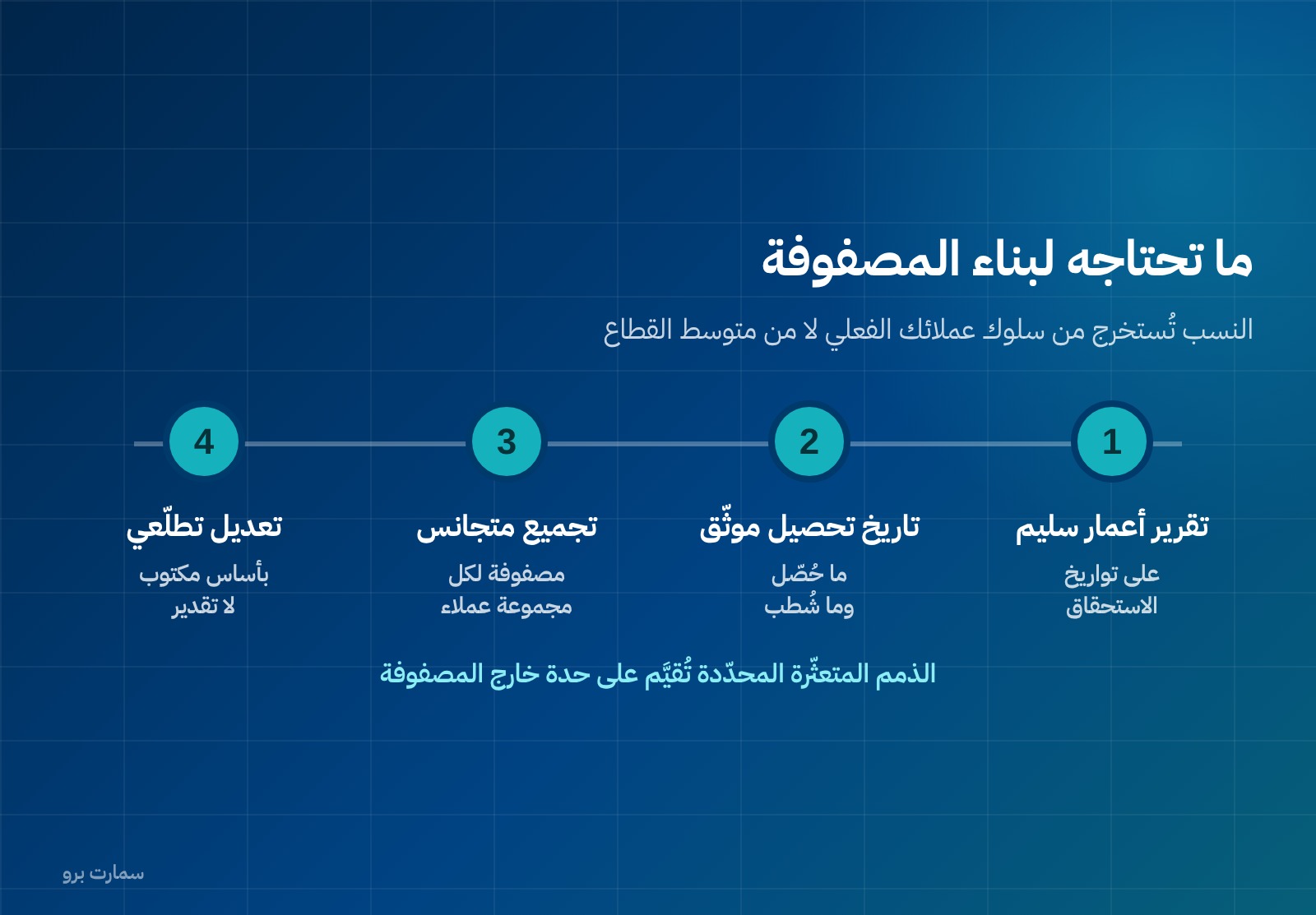
The matrix is built in three steps:
- Group your receivables by age: not yet due, 1–30 days overdue, 31–60, 61–90, and more than 90.
- Calculate a historical loss rate for each bucket from previous years' data: of the receivables that reached this bucket, how much was never collected?
- Adjust the rates for expected future conditions that affect your customers' ability to pay.
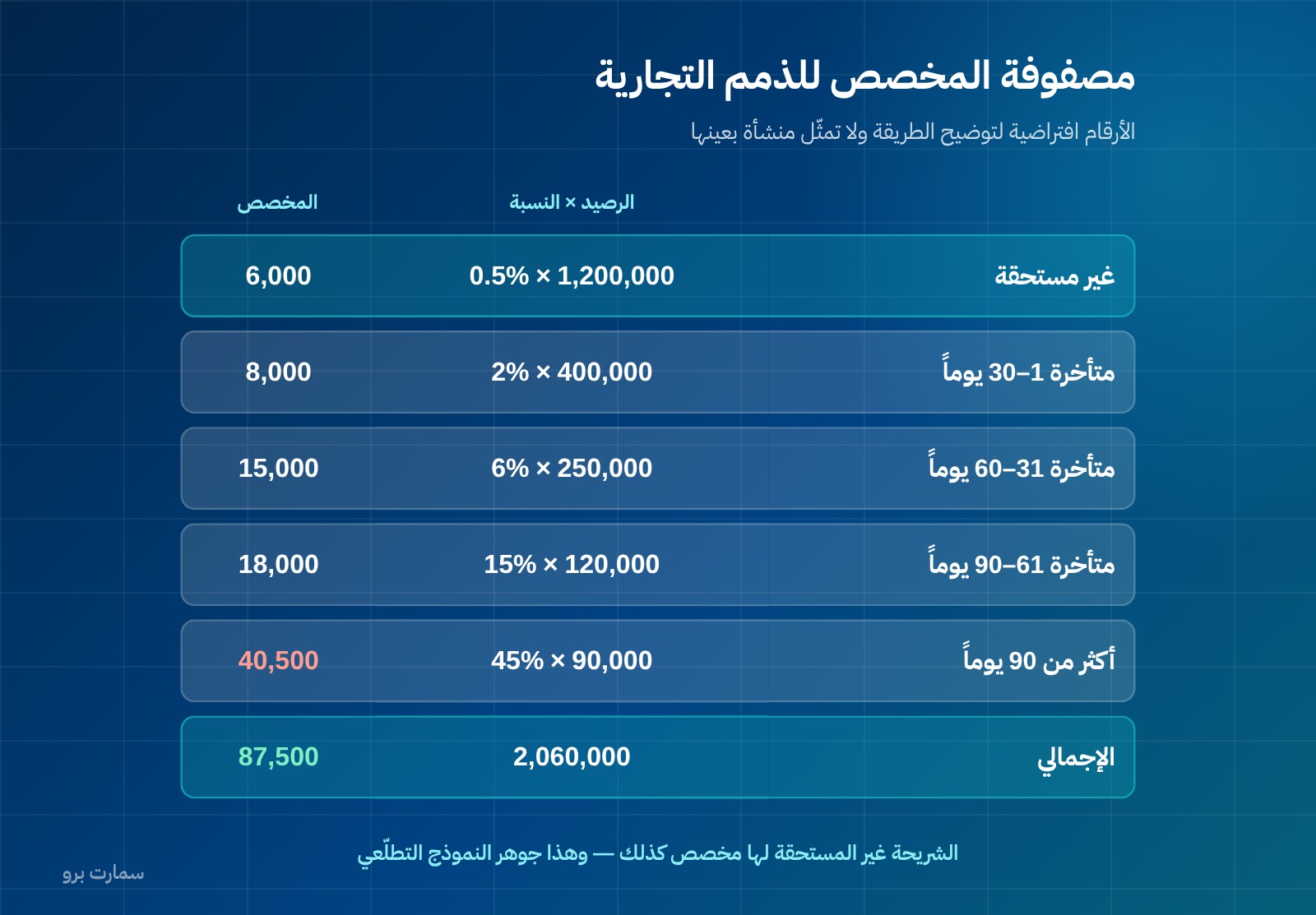
The figures below are hypothetical and only illustrate the method:
| Age bucket | Balance (SAR) | Loss rate | Provision |
|---|---|---|---|
| Not yet due | 1,200,000 | 0.5% | 6,000 |
| 1–30 days | 400,000 | 2% | 8,000 |
| 31–60 days | 250,000 | 6% | 15,000 |
| 61–90 days | 120,000 | 15% | 18,000 |
| More than 90 days | 90,000 | 45% | 40,500 |
| Total | 2,060,000 | 87,500 |
Note that the not-yet-due bucket carries a provision too. That is the essence of the forward-looking model.
What do you need to apply the provision matrix?
A reliable aged receivables report. You cannot build the matrix on a single total balance. The report must be based on due dates, not on invoice dates alone.
A documented collection history. Loss rates are derived from actual past behaviour, not assumed. A business that does not keep a record of what was collected and what was written off has no basis for its rates.
Homogeneous groupings. Government customers, retail customers and export customers behave differently, and combining them in one matrix hides those differences. A separate matrix for each homogeneous group is better.
Excluding specifically identified receivables. A customer who has actually defaulted is assessed individually, not inside the matrix. Including them distorts the rates of the whole bucket and hides the true size of their problem.
Guarantees and credit insurance. If you hold a bank guarantee or insurance on receivables, the expected loss is measured after the effect of that protection, not on the outstanding balance.
When should a debt be written off?
A write-off is not the same as a provision. A debt is written off when the business no longer has a reasonable expectation of recovery: after collection efforts are exhausted, the customer is bankrupt, or the claim is time-barred. The write-off reduces the receivable and the provision together, and does not pass through the income statement if the provision was sufficient.
The common mistake is keeping receivables that are years old on the balance sheet with no provision and no write-off, so current assets appear that do not exist in practice. This distorts the statement of financial position and the liquidity measures covered in financial ratios.
What mistakes come up most often?
A flat rate on total receivables. "2% of the balance" is an estimate with no basis, and it does not hold up in an audit because it does not rest on actual collection behaviour.
Copying another company's rates. Your own customers' behaviour is the basis, not the sector average.
Not updating the rates. The matrix should be reviewed at least once a year, because changes in your customers' sectors change the likelihood of collection.
Mixing receivables with advance payments to suppliers. Supplier advances are not a credit receivable in the same sense, and they are treated differently.
Ignoring related parties. Balances due from sister companies are assessed as well. They are not excluded automatically just because they are "inside the group". See related parties.
How does the provision affect the financial statements and tax?
The provision reduces net receivables on the statement of financial position and is charged as an expense in the income statement. Under IFRS 18, effective for periods beginning on or after 1 January 2027, entities that present expenses by function must disclose the impairment losses included in each operating line item. Details are in IFRS 18.
For tax: the provision is an estimate, and tax treatment usually looks at actual realisation, so the provision booked becomes an item in the reconciliation schedule. See the income tax return. The timing difference gives rise to deferred tax, as explained in deferred tax.
Checklist
- The aged receivables report is based on due dates and reviewed at every close.
- Loss rates are derived from documented, actual collection data.
- A separate matrix exists for each homogeneous customer group.
- Specifically identified defaulted receivables are assessed individually, outside the matrix.
- A provision movement schedule is prepared: opening balance, charge for the period, amounts used, amounts written off, closing balance.
- Receivables with no reasonable expectation of recovery are written off, not carried forward.
- The basis for the forward-looking adjustment to the rates is documented in writing.
- The balance agrees with the trial balance.
Official reference
The international standards as endorsed in the Kingdom are published by the Saudi Organization for Chartered and Professional Accountants (SOCPA) on its website: socpa.org.sa. The texts and summaries of the standards are available from the IFRS Foundation at ifrs.org. The full treatment of financial instruments in the financial sector carries additional requirements, for which you should refer to the text of the standard.
Read also
Article visuals
Frequently asked questions
What is the difference between the old and new provisioning models?
The old approach was the incurred loss model: it waited for evidence of default and only then booked a provision. The new model under IFRS 9 is forward-looking: it estimates what is expected not to be collected based on past experience, current conditions and reasonable forecasts, and recognises it from day one without waiting for a trigger event.
What is a provision matrix?
It is the practical tool for the simplified approach to trade receivables. Receivables are grouped into age buckets, a loss rate is calculated for each bucket from historical collection data, and the rates are then adjusted for expected future conditions. Each bucket's balance is multiplied by its rate, and the results are added up to give the provision.
Do receivables that are not yet due need a provision?
Yes. Under the forward-looking model, the not-yet-due bucket carries a loss rate, even if a small one, because the risk of non-collection exists from the moment of a credit sale. This is exactly what distinguishes the new model from waiting for evidence of default.
When should a debt be written off?
A debt is written off when the business no longer has a reasonable expectation of recovery: after collection efforts are exhausted, the customer goes bankrupt, or the claim becomes time-barred. The write-off reduces the receivable and the provision together. Keeping receivables that are years old with no provision and no write-off shows current assets that do not really exist.