
Financial Ratios: Four Families That Read Your Business
Liquidity, profitability, leverage and activity ratios: how each one is calculated, what it really means, and when it misleads if read on its own without the context of your sector.
Author:سامي الحيدري
Financial ratios are not a separate science. They are a way to make your numbers comparable, both with your own past performance and with businesses larger or smaller than yours. "Profit of SAR 1 million" means little on its own, but "operating margin of 18%, up from 14%" means a lot. The most common mistake is calculating twenty ratios and then making not a single decision based on them.
Family one: liquidity
Liquidity ratios answer one question: can you meet the obligations due over the next year?
| Ratio | Formula | What it measures |
|---|---|---|
| Current ratio | Current assets ÷ Current liabilities | General ability to pay short-term obligations |
| Quick ratio | (Current assets − Inventory) ÷ Current liabilities | Ability to pay without relying on selling stock |
| Cash ratio | Cash and cash equivalents ÷ Current liabilities | The strictest test: cash available immediately |
A current ratio below 1 means negative working capital. That is manageable for a business that sells for cash and buys on credit, such as a restaurant or a retailer, but dangerous for a business that sells on credit. This is why the ratio should never be read without understanding the business model.
Family two: profitability
| Ratio | Formula |
|---|---|
| Gross profit margin | Gross profit ÷ Revenue |
| Operating margin | Operating profit ÷ Revenue |
| Net profit margin | Net profit ÷ Revenue |
| Return on assets | Net profit ÷ Average total assets |
| Return on equity | Net profit ÷ Average equity |
Operating margin is the most important indicator because it measures the core business without the effect of financing and one-off items. With IFRS 18, which applies to periods beginning on or after 1 January 2027, "operating profit" becomes a figure with a single definition across all entities, so this ratio becomes genuinely comparable for the first time. The detail is in IFRS 18 presentation and disclosure, and how to read margins is covered in the income statement guide.
Family three: leverage and solvency
| Ratio | Formula | What it measures |
|---|---|---|
| Debt-to-equity | Total liabilities ÷ Equity | How much you rely on external financing |
| Liabilities-to-assets | Total liabilities ÷ Total assets | How much of your assets is financed by debt |
| Interest coverage | Earnings before financing costs and tax ÷ Finance costs | Whether profits can carry the cost of debt |
An important note since IFRS 16: lease liabilities now appear on the balance sheet, so leverage ratios rose at many businesses with no change at all in their operations. Review your financing covenants in light of this; the detail is in lease accounting under IFRS 16.
Family four: activity and efficiency
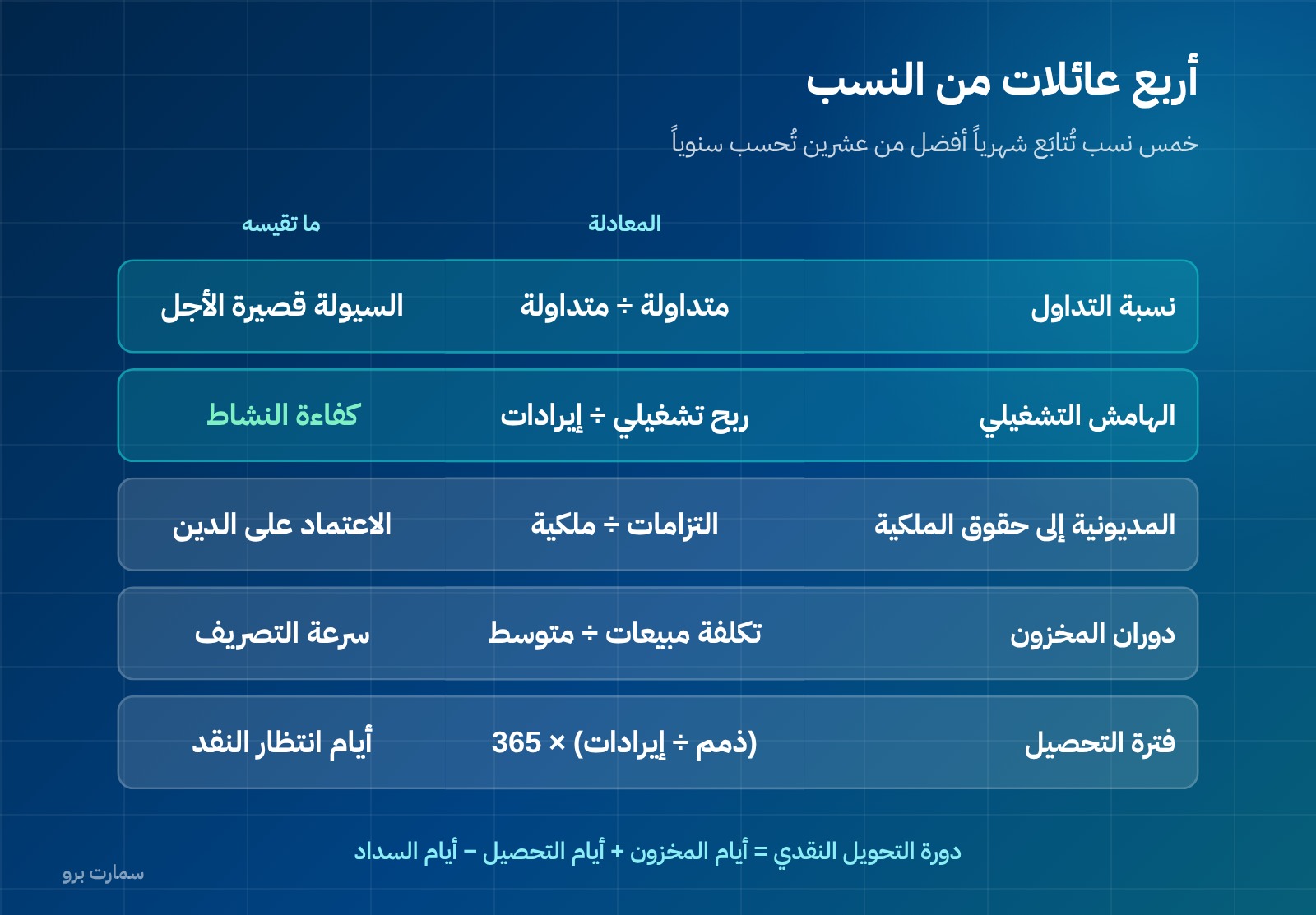
| Ratio | Formula | What it measures |
|---|---|---|
| Inventory turnover | Cost of sales ÷ Average inventory | How fast goods sell through |
| Average collection period | (Average receivables ÷ Revenue) × 365 | How many days you wait for your cash |
| Average payment period | (Average payables ÷ Purchases) × 365 | How many days your suppliers give you |
| Asset turnover | Revenue ÷ Average total assets | How much revenue each riyal of assets generates |
The first three give you the cash conversion cycle: inventory days + collection days − payment days. It is the most important operating figure for a business short of cash, because every day you cut from it comes back as cash in your account without any increase in sales.
When are financial ratios misleading?
When read without the sector. An 8% margin is excellent in wholesale trading and disastrous in software.
When using point-in-time balances. Ratios that combine the income statement (a period) with the balance sheet (a moment) need the average balance, not the closing balance; otherwise seasonality distorts them.
When ignoring the quality of the numbers. Receivables with no allowance for doubtful debts, and slow-moving stock carried at its original value, produce excellent liquidity ratios on paper only.
When looking at one year only. The trend matters more than the level. Three years of the same ratio say more than twenty ratios for a single year.
When ignoring cash. High profit and excellent profitability ratios alongside weak operating cash flow is a warning sign, not a sign of success, and it is exactly what the cash flow statement reveals.
An example that shows the difference
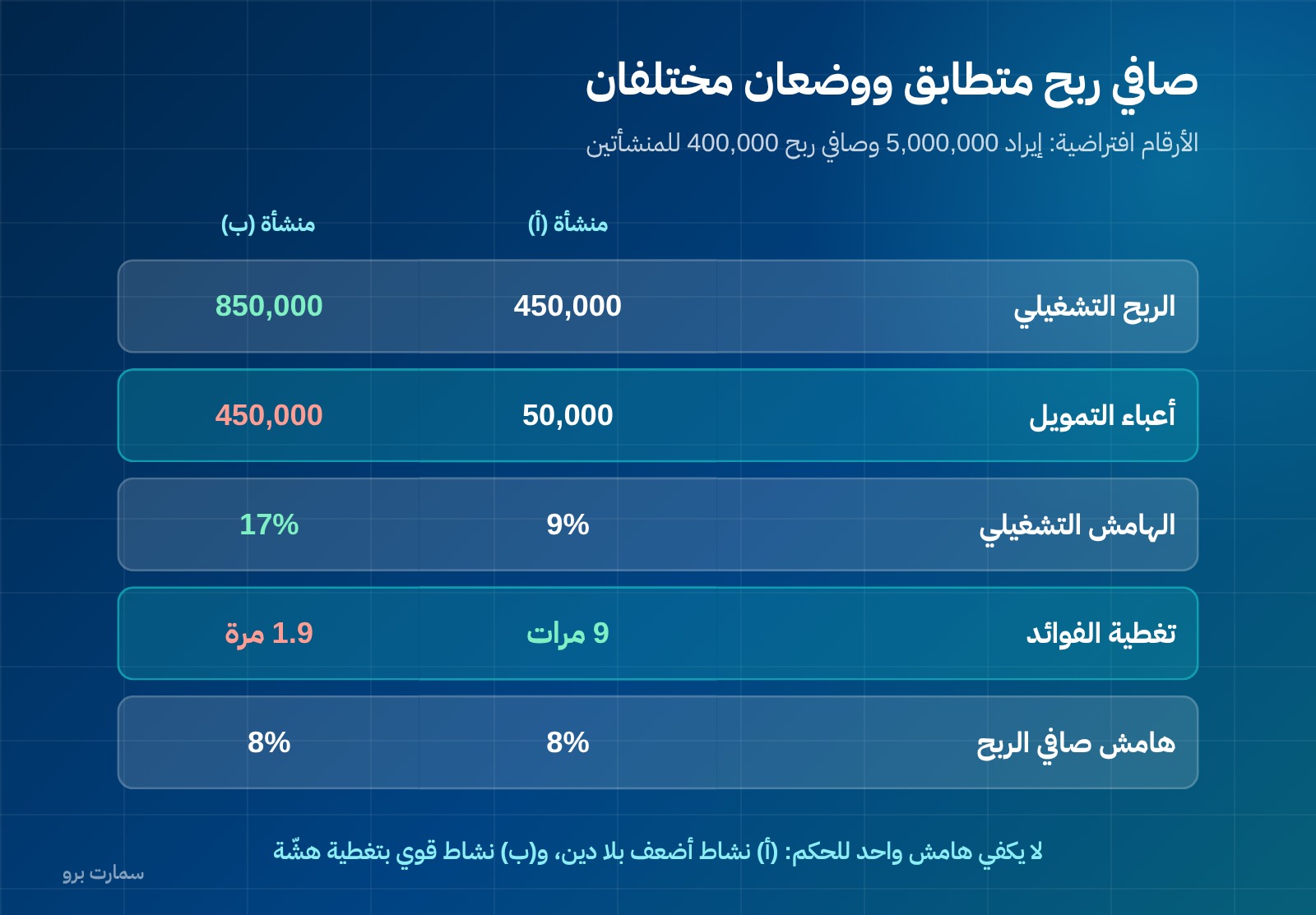
The following figures are hypothetical, to illustrate the method. Two businesses each have revenue of SAR 5,000,000 and net profit of SAR 400,000, so both have a net margin of 8%:
| Item | Business A | Business B |
|---|---|---|
| Operating profit | 450,000 | 850,000 |
| Finance costs | 50,000 | 450,000 |
| Operating margin | 9% | 17% |
| Interest coverage | 9 times | 1.9 times |
Net profit is identical, yet the two positions are completely different. A has a weaker core business but is almost debt-free; B has a strong core business, but its profits go to servicing debt and its interest coverage is fragile. This is why a single margin is never enough to judge a business.
How do you use financial ratios in practice?
- Pick only five ratios that fit your business model and track them monthly.
- Chart their trend over twelve months, not a single point.
- Link each ratio to a decision: who owns it and what action follows when it crosses a threshold.
- If your business is seasonal, compare with the same period last year, not with the previous month.
- Make sure the figures come from closed, reconciled books in the trial balance.
- Review your bank covenants: which of these ratios are written into your financing agreement?
- Document how each ratio is calculated so the formula does not change from one period to the next.
Key takeaway: A ratio only means something against your sector, your business model and its own trend over time. Track a handful, base them on reconciled books, and tie each one to a decision.
Official reference
The international standards as adopted in Saudi Arabia are published by the Saudi Organization for Chartered and Professional Accountants (SOCPA) on its website: socpa.org.sa. The text and summaries of the standards are available from the IFRS Foundation at ifrs.org.
Read also
- The income statement: how it is built and how to read it
- The balance sheet: what it says about your business
- The cash flow statement: why profit is not the same as cash
To see a live trial balance and profit and loss built automatically from your daily transactions, start a SmartPro free trial.
Article visuals
Frequently asked questions
Which financial ratios should I track?
Five are enough if you choose them to fit your business model: the current ratio for liquidity, operating margin for profitability, debt-to-equity for solvency, and inventory turnover and the average collection period for efficiency. The trend over twelve months matters more than the value of a ratio at a single point.
What is the cash conversion cycle?
It is inventory days plus collection days minus payment days. It is the most important operating figure for a business short of cash, because every day cut from it returns cash to your account without any increase in sales.
Does a current ratio below 1 mean danger?
Not always. It means negative working capital, which is manageable for a business that sells for cash and buys on credit, such as restaurants and retail, but dangerous for a business that sells on credit. That is why the ratio should not be read in isolation from the business model and sector.
Why did my leverage ratio rise with no change in my operations?
Usually because of IFRS 16, which brought lease liabilities onto the balance sheet when they had previously been only a monthly expense. This raises total liabilities without any real change in the business, and it calls for a review of financing covenants that were written on the basis of the old statements.