
Related Parties: Who They Are and What You Must Disclose
Who counts as a related party, which transactions, balances and compensation must be disclosed, and why this note is the first thing a tax review opens.
Author:سامي الحيدري
A company rents a building from its owner at above-market rent. A sister company buys goods below cost. A general manager takes an interest-free loan. All of these are transactions with related parties, and all are perfectly legal. Hiding them is not. The related-party note is the first thing opened in a tax examination and in an audit.
Why is disclosure required in the first place?
A relationship can affect profit or loss and financial position even if no transaction takes place. A subsidiary, for example, may stay out of an activity because its parent already carries it out.
Readers of your financial statements need to know that your figures may not reflect what would have happened between two independent parties.
Who counts as a related party?
A relationship exists if the party is one of the following.
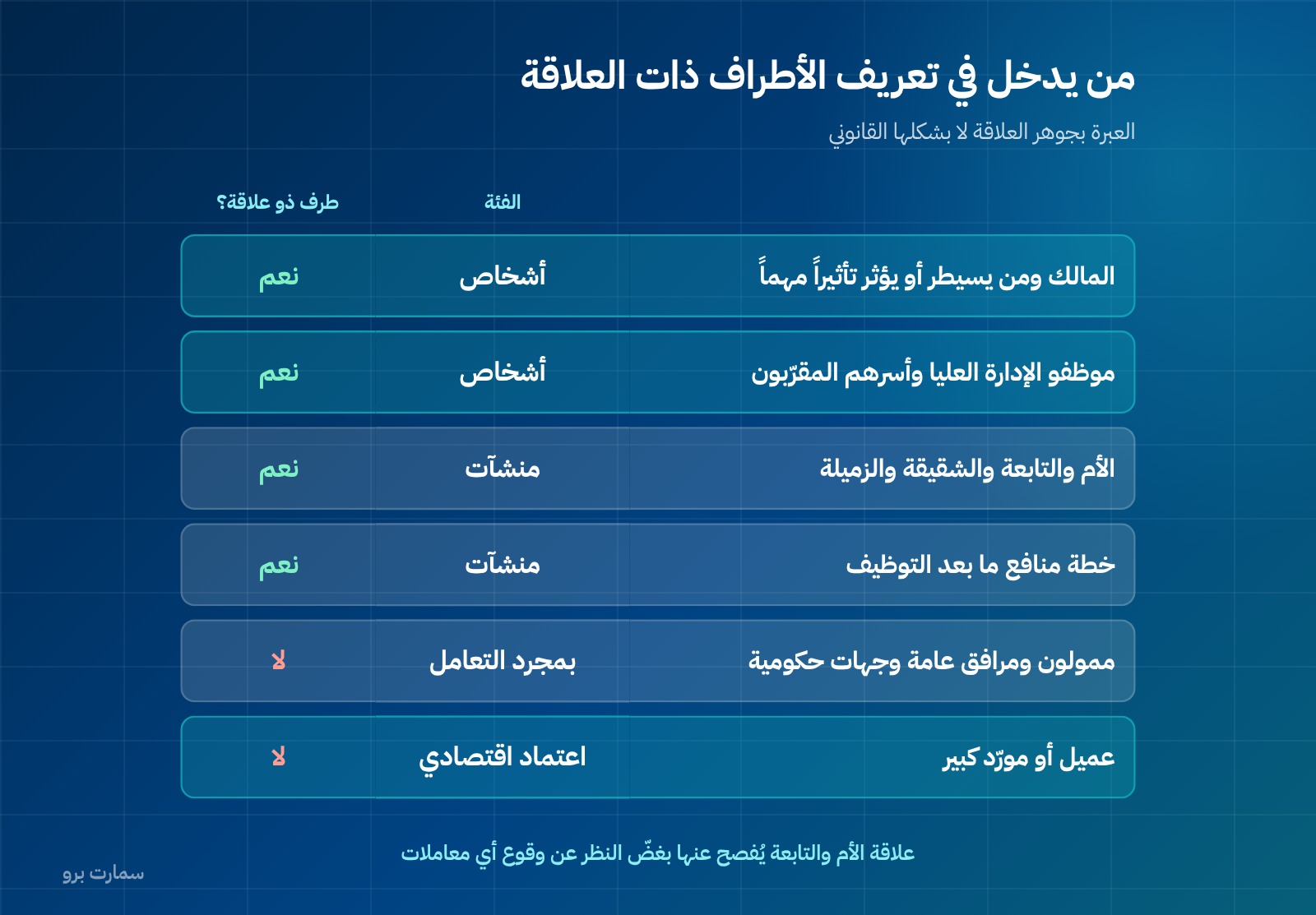
Individuals
- A person who controls the entity, shares control of it, or has significant influence over it.
- A member of the key management personnel of the entity or of its parent. Key management personnel are the people with authority and responsibility for planning, directing and controlling the entity's activities.
- A close member of that person's family: spouse, children and dependants, and anyone expected to influence, or be influenced by, that person in their dealings with the entity.
Entities
- Members of the same group: parent, subsidiary and sister companies.
- An associate or joint venture of any entity in the group.
- A post-employment benefit plan for the entity's employees.
- An entity controlled, or significantly influenced, by any of the individuals listed above.
Who is not a related party simply because you deal with them: providers of finance, trade unions, public utilities, and government bodies that do not control, jointly control or significantly influence the entity. The same applies to a customer or supplier the business depends on heavily. Economic dependence alone does not create a relationship.
The governing rule: look at the substance of the relationship, not its legal form.
What must you disclose?
The relationship itself: a parent–subsidiary relationship is disclosed whether or not any transactions took place, together with the name of the parent and, if different, the name of the ultimate controlling party.
Key management personnel compensation, in total and by category: short-term benefits, post-employment benefits, other long-term benefits, termination benefits, and share-based payment.
Transactions and outstanding balances, where transactions exist, shown separately for each category of related party:
- The amount of the transactions.
- The amount of outstanding balances and their terms, whether they are secured, and the nature of the consideration to be provided on settlement.
- Guarantees given or received.
- Any allowance for doubtful debts relating to those balances, and the expense recognised for them.
You may only state that transactions were made on arm's length terms if you can actually prove it. Arm's length terms are the price and conditions that two independent parties would agree in a normal commercial deal.
Why is this note the first thing a tax review checks?
Related-party transactions are the natural place to shift profit between entities that are treated differently for tax. That is why these transactions need prices and documentation you can defend, not internal entries with agreed-upon numbers.
They are also a recurring item in the reconciliation from accounting profit to the tax base; see our guide to the income tax return in Saudi Arabia. In a mixed-ownership company the issue is even more sensitive because it affects how the zakat and tax bases are split, as explained in zakat and income tax for mixed-ownership companies.
How are government-related entities treated?
Entities that are controlled, jointly controlled or significantly influenced by a government body get a partial exemption from some disclosure requirements for their transactions with that body and with entities related to it, given the volume and number of these transactions.
But the exemption is not a waiver. The entity must still disclose the name of the government body and the nature of the relationship, the nature and amount of each individually significant transaction, and a qualitative or quantitative indication of the extent of the other transactions that are significant collectively.
What are the most common mistakes?
Limiting related parties to companies. The owner, the owner's family and key management personnel are all related parties.
Leaving out current-account balances between partners and the company. A partner's current account is a balance with a related party and must be disclosed with its terms.
Booking owner drawings as an expense. They are a distribution from equity; see the statement of changes in equity.
Not assessing group balances for credit risk. Balances due from sister companies are subject to expected credit loss assessment like any other receivable.
Relying on a generic sentence. "Transactions with related parties were carried out on normal terms" is not a disclosure; it is a shortcut around one.
How do you build the register in practice?
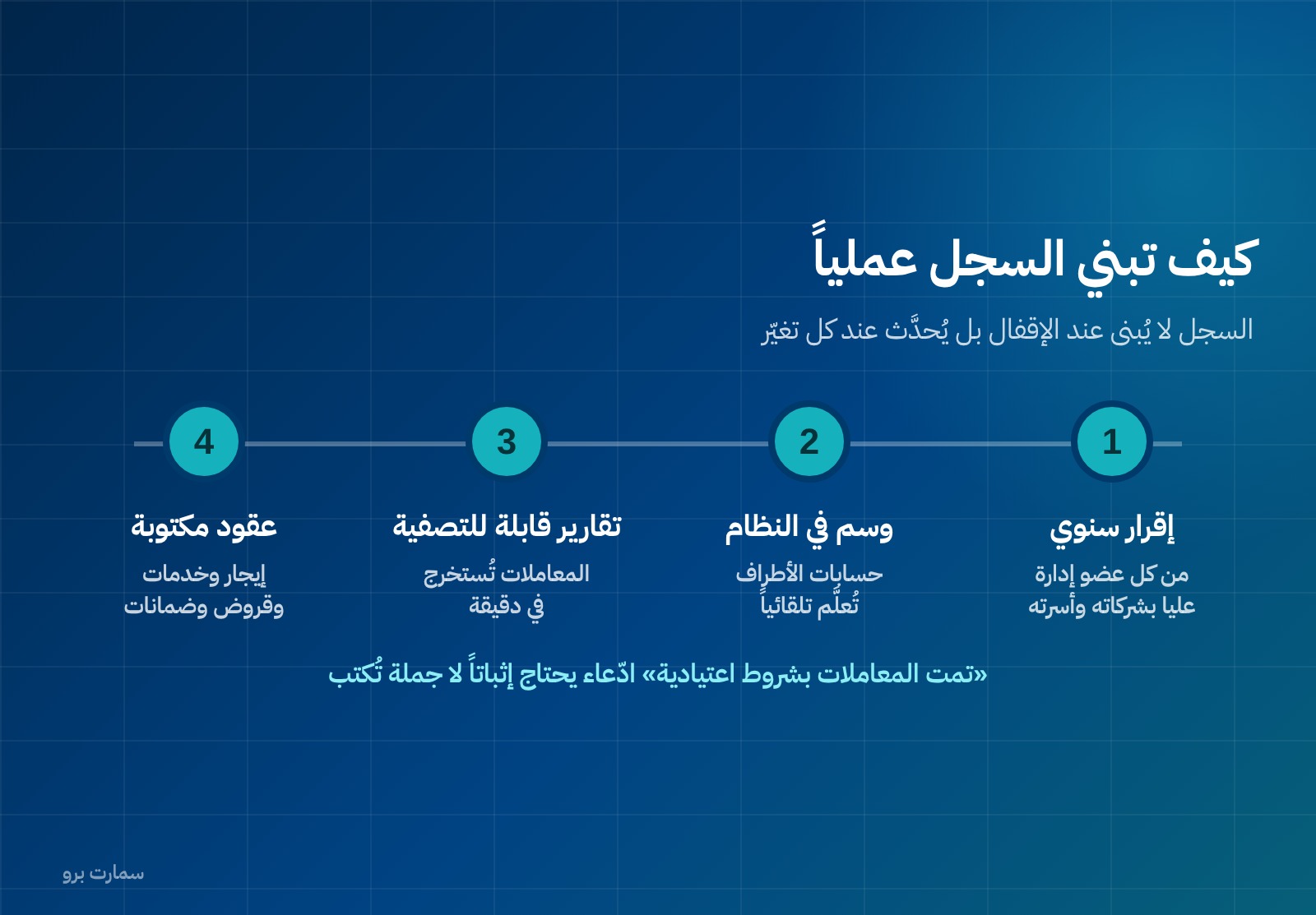
The related-party register is not built at period close. It is updated whenever something changes:
- Ask every member of key management for an annual declaration listing the companies they own or influence, and any close family members connected to an entity that deals with you.
- Link the register to the customer and supplier master data in your system, so related-party accounts are flagged automatically.
- Make sales and purchasing reports filterable by that flag, so the transactions can be pulled in a minute rather than a week.
- Keep written contracts for every recurring transaction: rent, management services, loans and guarantees.
In an integrated system such as SmartPro, where every sale and purchase posts to the accounts automatically through Finance & Accounting, a flagged customer or supplier makes this extraction part of the routine close rather than a separate project.
Checklist
- An up-to-date register of related parties: individuals and entities.
- Close family members of key management personnel are included.
- The parent–subsidiary relationship is disclosed even without transactions.
- Key management compensation is disclosed across the five categories.
- Transactions and balances are broken down for each category of related party.
- Terms of balances and guarantees are documented.
- Related-party contracts are in writing, at prices you can defend.
- No arm's length claims without proof.
Official references
International standards as endorsed in the Kingdom are published by the Saudi Organization for Chartered and Professional Accountants (SOCPA) on its website: socpa.org.sa. The full texts of the standards are available from the IFRS Foundation at ifrs.org. Tax documentation requirements for transactions between related persons are published by the Zakat, Tax and Customs Authority (ZATCA) at zatca.gov.sa.
Read also
- Notes to the financial statements
- Income tax return: deadline and tax base
- Statement of changes in equity
Key takeaway: Related-party transactions are legal, but they must be identified, documented at defensible prices and disclosed in detail. A generic "normal terms" sentence is the first thing a tax reviewer will challenge.
To see how flagged accounts and connected reports work in practice, start a free SmartPro trial.
Article visuals
Frequently asked questions
Who counts as a related party?
Anyone who controls the entity, shares control or has significant influence over it, plus key management personnel of the entity or its parent and their close family members. Group entities (parent, subsidiaries and sister companies), associates and joint ventures, post-employment benefit plans, and any entity controlled or influenced by one of these people are also related parties.
Is a major customer a related party?
No. Economic dependence alone does not create a relationship. Likewise, providers of finance, trade unions, public utilities and government bodies that do not control, jointly control or significantly influence the entity are not related parties simply because you deal with them.
What must be disclosed about related parties?
The parent–subsidiary relationship, whether or not transactions took place, with the names of the parent and the ultimate controlling party. You must also disclose key management compensation by category, and for each category of related party the amounts of transactions and outstanding balances, with their terms, guarantees and any allowances for doubtful debts.
Is it enough to state that related-party transactions were on normal terms?
No, you may only make that statement if you can actually prove it. A generic sentence without evidence is not a disclosure but a shortcut around one. It is among the first things checked in a tax examination, because related-party transactions are a natural place to shift profit.