
Statement of Changes in Equity: What It Shows and Why It Matters
The components of equity and what moves them during the year, the difference between retained earnings and the statutory reserve, and how this statement affects the zakat base.
Author:سامي الحيدري
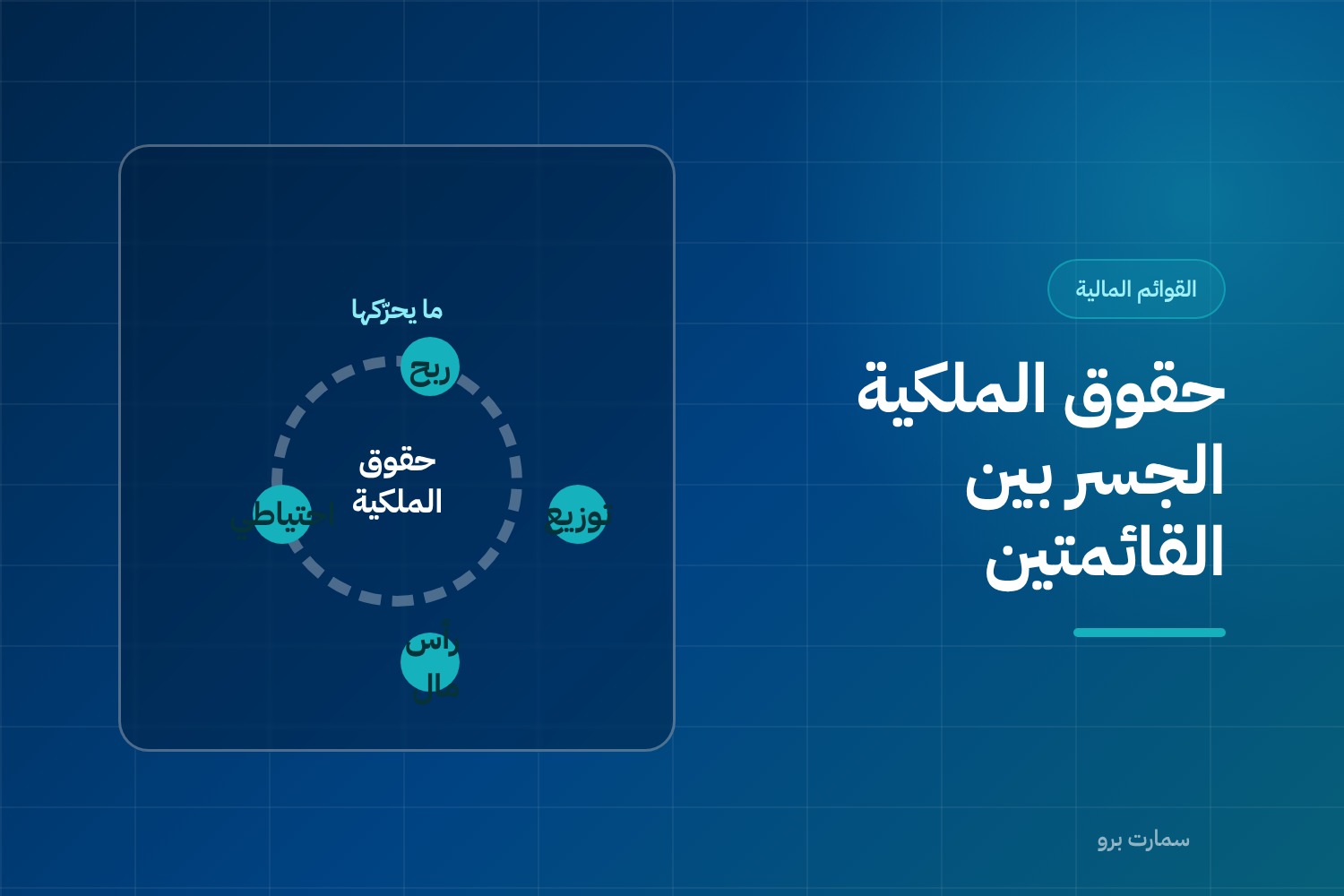
Equity is what remains for the owners after every liability is settled. The statement of changes in equity is the bridge between the income statement and the statement of financial position: it takes the period's net profit and shows where it ended up on the balance sheet, what left as distributions and what was held back as reserves. Of the four financial statements, it is the least read and the most revealing about how owners treat the business.
What are the components of equity?
| Component | What it represents |
|---|---|
| Share capital | What the owners have actually put into the business |
| Share premium | The difference between the issue price of shares and their nominal value |
| Statutory reserve | A portion of profits retained because the law or the articles of association require it |
| Other reserves | Contractual reserves or reserves set aside for specific purposes |
| Retained earnings | Accumulated profits that have been neither distributed nor set aside |
| Accumulated other comprehensive income | Revaluation differences, currency translation differences and similar items |
Read these components together, not one by one. A business with SAR 1 million in capital and SAR 3 million in retained earnings has built itself from its own operations. A business with SAR 4 million in capital and zero retained earnings has lived on cash injected by its owners.
What changes equity during the year?
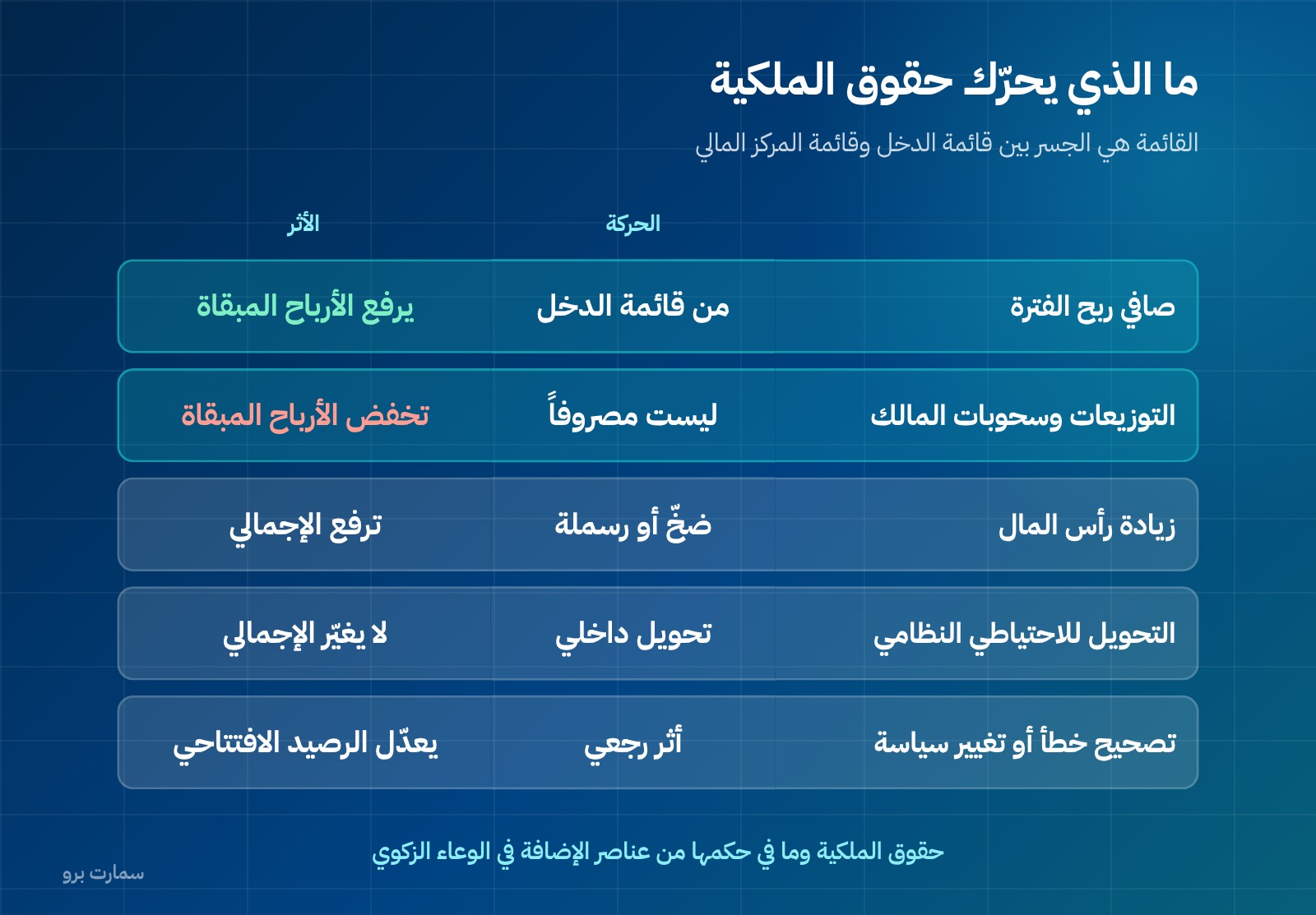
Net profit or loss for the period. It is added to, or deducted from, retained earnings. This is the direct link with the income statement.
Distributions to owners. They are deducted from retained earnings. They are not an expense and never pass through the income statement — a common mistake in sole proprietorships and family businesses.
Increases or reductions in capital. A fresh injection from the owners, capitalising retained earnings, or a reduction to absorb accumulated losses.
Transfers to the statutory reserve. An internal transfer from retained earnings to the reserve. It does not change total equity, but it changes how equity is split and limits what can be distributed.
Other comprehensive income. Gains and losses that do not pass through the income statement, such as an asset revaluation surplus.
Error corrections and changes in accounting policy. Both are applied retrospectively, so the opening balance of equity is adjusted. The details are in accounting policies, estimates and errors.
What is the difference between retained earnings and the statutory reserve?
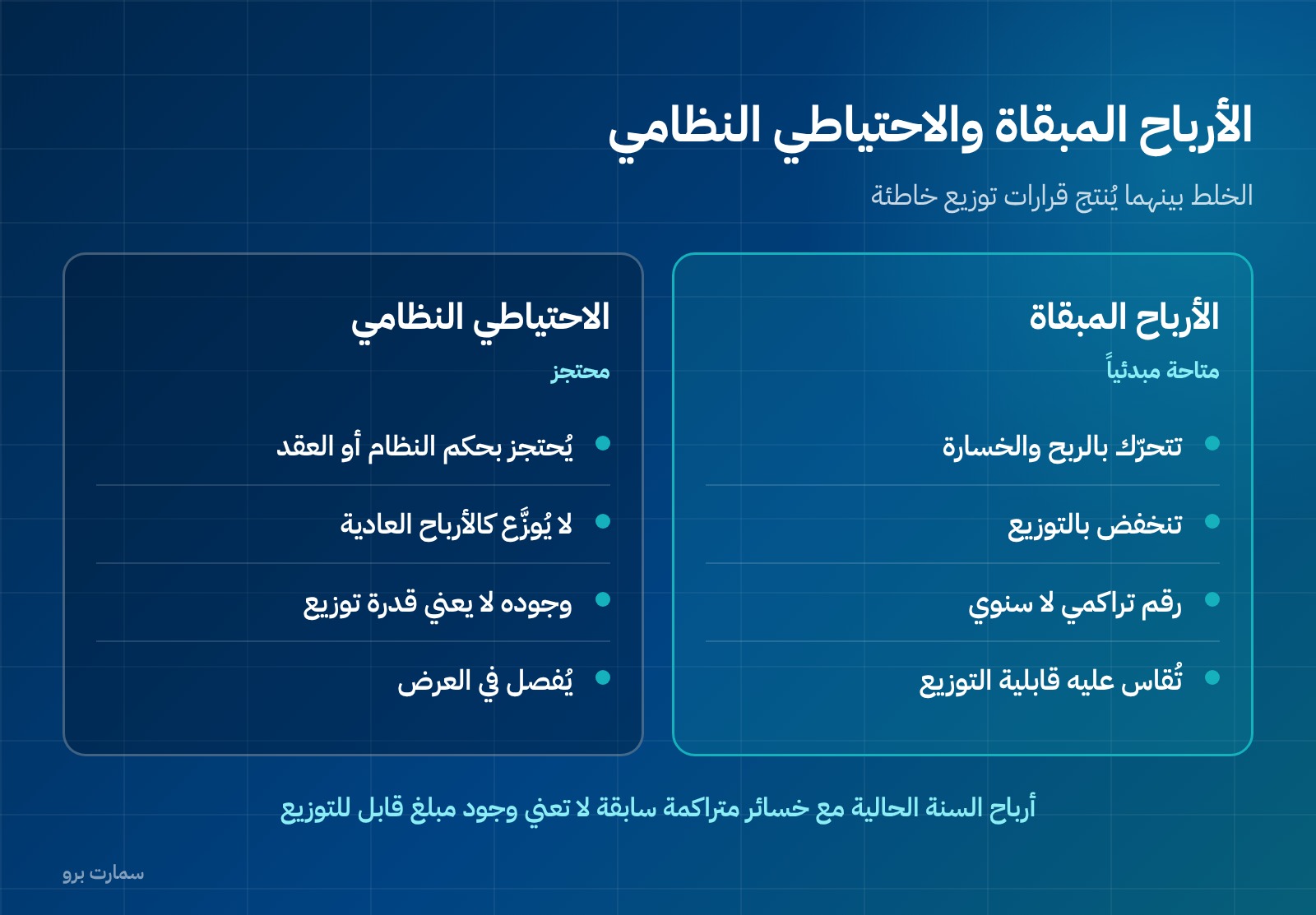
Mixing the two up leads to wrong distribution decisions:
Retained earnings are profits that are, in principle, available for distribution. They rise with profit and fall with losses and distributions.
The statutory reserve is a portion of profits that must be retained under the law or the articles of association, and it is not distributed like ordinary profits. A large reserve does not mean a large capacity to distribute.
The practical test before any distribution decision: what amount is actually distributable after excluding what is legally retained, and taking available cash into account? A business with huge retained earnings and weak cash cannot distribute, as the cash flow statement reveals.
How does equity affect zakat?
In the Saudi context, this statement is not a formality: equity and items treated as equity are additions to the zakat base under the Implementing Regulations for the Collection of Zakat. The zakat base is the amount on which zakat is calculated. Every movement here — profit, distribution, capital increase, transfer to a reserve — is reflected in that base.
That is why the timing of distributions and the accurate classification of equity components are not a presentation issue; they directly affect the zakat liability. The details are in zakat calculation: the zakat base step by step.
What mistakes come up most often?
Recording owner drawings as an expense. In sole proprietorships, the owner's drawings are sometimes booked under administrative expenses. This reduces profit and distorts the operating margin; drawings are in fact a distribution from equity.
Confusing paid-up capital with authorised capital. The statement shows the capital actually paid up, not just the figure on the commercial registration.
Not separating the statutory reserve. Leaving it inside retained earnings suggests a capacity to distribute that does not exist.
Not adjusting the opening balance when correcting errors. Correcting a prior-year error with an entry in the current year hides the error instead of fixing it.
Skipping the statement altogether. Many businesses prepare an income statement and a statement of financial position but ignore this one. The explanation of the difference between opening and closing equity disappears, and any question about where the difference came from has no documented answer.
Distributing before covering accumulated losses. A profit this year alongside accumulated losses from previous years does not mean there is a distributable amount. Retained earnings is a cumulative figure, and distributions are measured against it, not against this year's profit alone.
Overlooking in-kind capital increases. Contributing an asset instead of cash as a capital increase needs a documented valuation of the asset; otherwise the capital shown is larger than it really is.
How is the statement presented?
The statement is presented as a table. The columns are the components of equity (share capital, reserves, retained earnings, total), and the rows are the movements in chronological order: opening balance, then the effect of error corrections or policy changes, then the restated balance, then profit or loss for the period, then other comprehensive income, then distributions, then transfers between components, then the closing balance.
The comparative period is presented in full in the same way, not just its closing balance. Readers need to see the previous year's movements to judge distribution behaviour over time, not in a single year.
Review checklist
- The closing balance of equity in this statement matches the statement of financial position.
- Net profit for the period is carried over from the income statement at the same amount.
- Distributions are deducted from retained earnings, not from expenses.
- Owner drawings are classified as distributions, not expenses.
- The transfer to the statutory reserve is calculated according to the law or the articles of association, and documented.
- Any error correction or policy change is reflected in the opening balance, not the current one.
- Equity components are broken down in a way that supports zakat calculation.
- The figures are consistent with the trial balance.
Official reference
International standards as endorsed in the Kingdom are published by the Saudi Organization for Chartered and Professional Accountants (SOCPA) on its website: socpa.org.sa. The Implementing Regulations for the Collection of Zakat are published by the Zakat, Tax and Customs Authority (ZATCA) at zatca.gov.sa.
Read also
Article visuals
Frequently asked questions
What are the components of equity?
Paid-up share capital, share premium if any, the statutory reserve, other reserves, retained earnings and accumulated other comprehensive income. They should be read together: a business whose retained earnings are large relative to its capital has built itself from its operations, not from owner injections.
Are profit distributions an expense?
No. Distributions are deducted from retained earnings within equity and never pass through the income statement. A common mistake in sole proprietorships is recording the owner's drawings under administrative expenses, which reduces profit and distorts the operating margin.
What is the difference between retained earnings and the statutory reserve?
Retained earnings are, in principle, available for distribution and move with profit, losses and distributions. The statutory reserve is a portion of profits that must be retained under the law or the articles of association and is not distributed like ordinary profits, so having one does not mean you can distribute it.
How is the statement of changes in equity related to zakat?
Directly. Equity and items treated as equity are additions to the zakat base under the Implementing Regulations for the Collection of Zakat. Every movement in the statement — profit, distribution, capital increase or transfer to a reserve — is reflected in the zakat base and in the amount of zakat due.