
Accounting Policies, Estimates and Errors: What's the Difference and How Is Each Treated?
The difference between a change in accounting policy, a change in estimate and a correction of an error, when the effect is retrospective and when it is prospective, and what changed in the name of IAS 8.
Author:سامي الحيدري
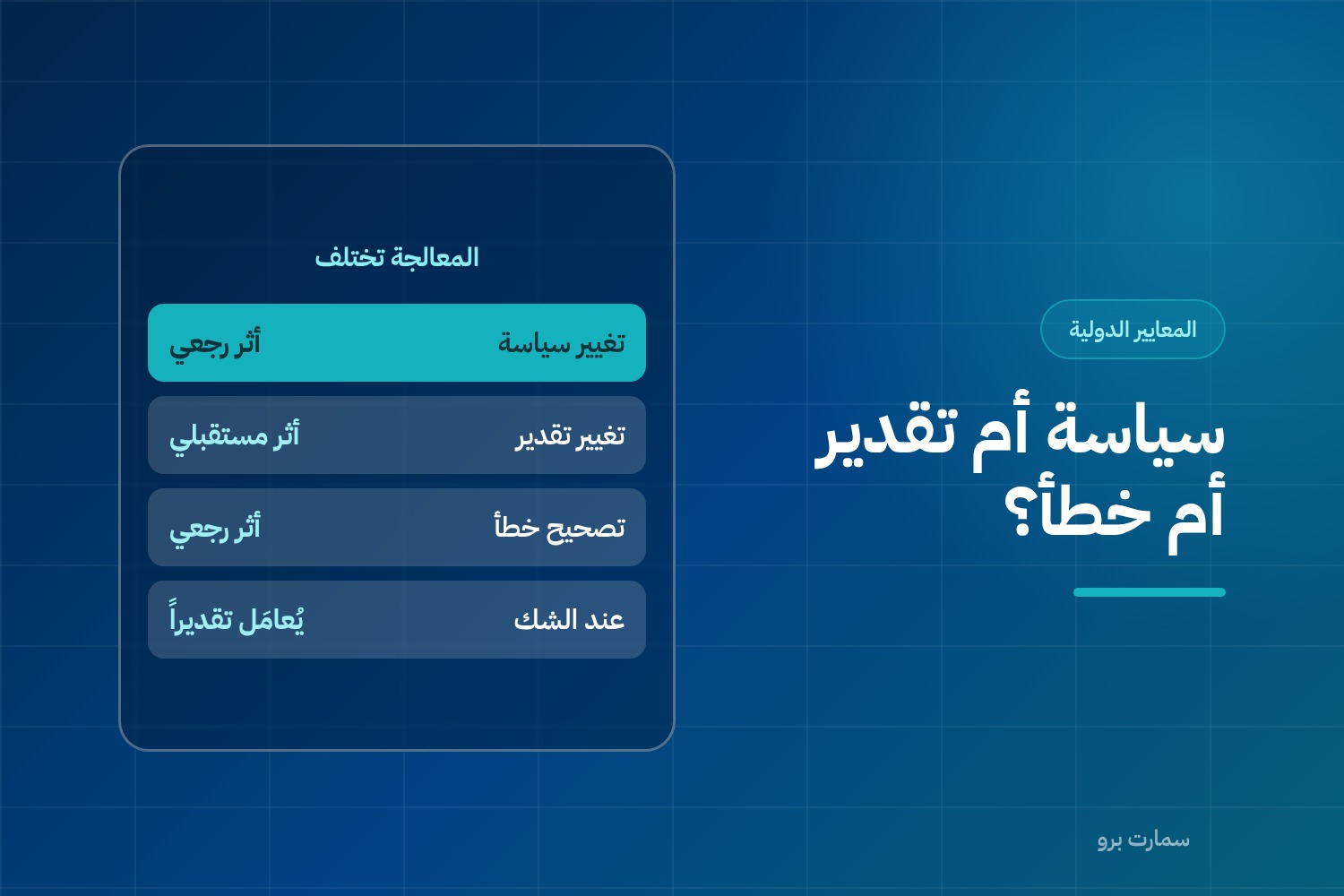
Three events look alike in the books but are treated very differently: changing your accounting policies, changing an accounting estimate, or discovering an error in a prior period. Mixing them up matters. The first and third are applied retrospectively and comparatives are restated, while the second applies prospectively only. That decides whether previously reported profits change.
What is an accounting policy in the first place?
An accounting policy is the set of principles, bases, conventions, rules and practices an entity applies in preparing and presenting its financial statements. Examples include the cost flow method chosen for inventory, the measurement model used for fixed assets after recognition, and the basis for presenting expenses (by nature or by function).
The rule is simple. A policy is selected in line with the applicable standard and applied consistently to similar transactions and events. You do not change it because it gives a better result this year.
When can you change an accounting policy?
A change is allowed in only two cases:
- A new standard, or an amendment to an existing standard, requires it.
- The change results in financial statements that provide reliable and more relevant information about the effect of transactions on financial position, performance and cash flows.
In both cases the change is applied retrospectively: the opening balances of equity for the earliest period presented are adjusted, and comparatives are restated as if the new policy had always been applied, unless doing so is impracticable.
You disclose the nature of the change, the reason for it, and the amount of the adjustment for each line item affected and each period presented.
Accounting estimates: a completely different treatment
An accounting estimate is a monetary amount in the financial statements that is subject to measurement uncertainty. Typical examples are an asset's useful life, its residual value, the allowance for doubtful debts, and the net realisable value of inventory.
A change in estimate is neither an error nor a correction. It results from new information or later developments, which is why it is applied prospectively: its effect is recognised in the period of the change and any future periods affected, and comparatives are left untouched.
Example: you review a machine's useful life and find it is eight years, not ten. You do not adjust past years; you spread the remaining net book value over the new remaining life. The related detail is in Fixed assets: recognition, measurement and depreciation.
Where it is hard to tell a change in policy from a change in estimate, it is treated as a change in estimate.
Errors: retrospective treatment
A prior period error is an omission or misstatement in a prior period's financial statements arising from failing to use, or misusing, reliable information that was available when those statements were authorised for issue and could reasonably have been expected to be taken into account.
A material error is corrected retrospectively in the first set of financial statements authorised for issue after its discovery: either by restating the comparative amounts for the period in which it occurred, or by adjusting opening balances if it occurred before the earliest period presented.
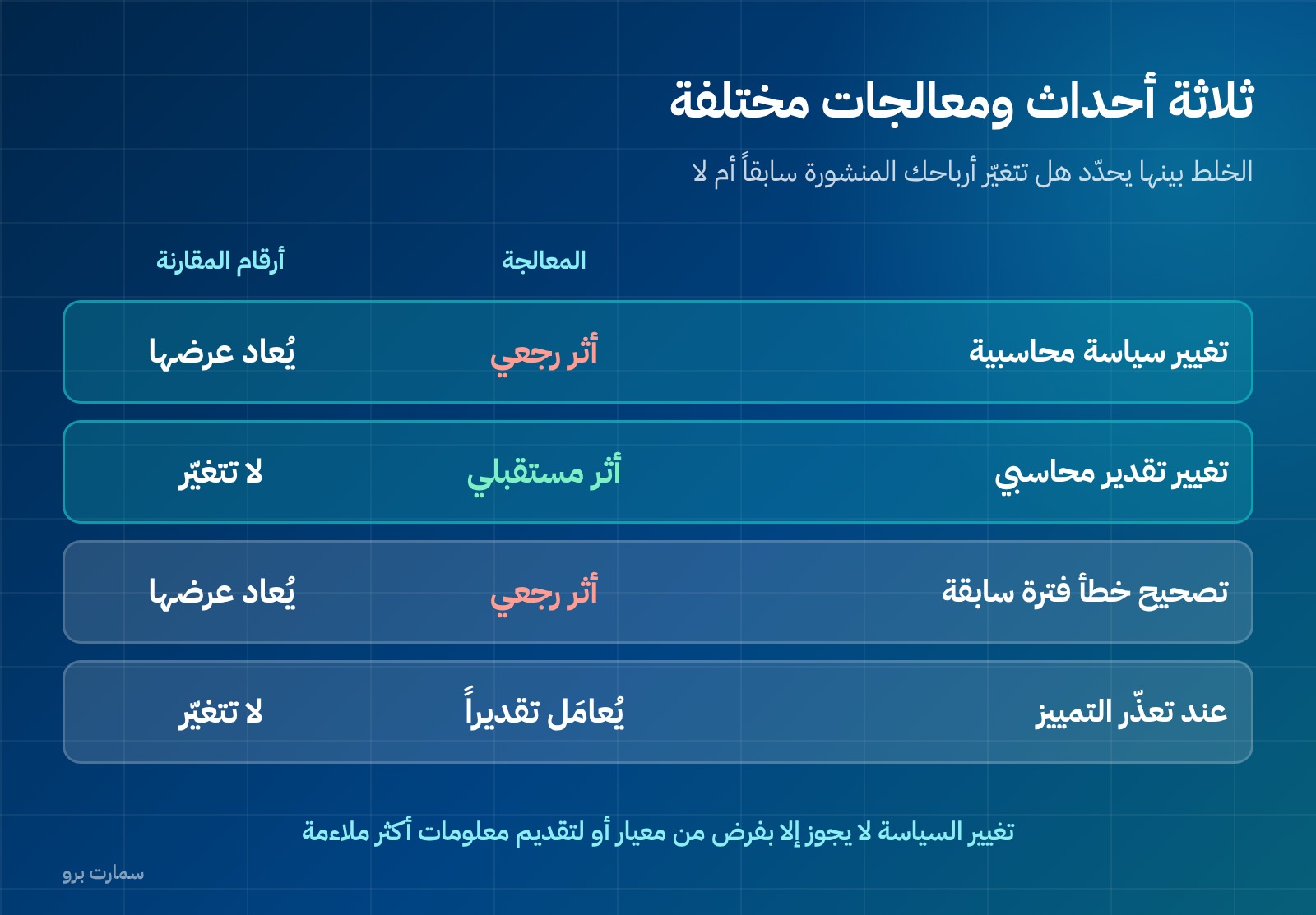
| Event | Treatment | Comparatives |
|---|---|---|
| Change in accounting policy | Retrospective | Restated |
| Change in accounting estimate | Prospective | Unchanged |
| Correction of a prior period error | Retrospective | Restated |
What changed in IAS 8?
With the adoption of IFRS 18, which replaced IAS 1, some IAS 1 requirements moved to other standards, including IAS 8, which has been renamed "Basis of Preparation of Financial Statements". In other words, IAS 8 is no longer limited to policies, estimates and errors; it now also carries requirements on the basis of preparation. The detail is in IFRS 18.
This has a practical consequence: references in your documented accounting policies and in your audit files need updating to the new title.
Where do mistakes happen in practice?
Changing the method to chase a number. Switching from weighted average to FIFO because the result looks better is not an acceptable change in policy. The effect of the two methods is explained in Inventory valuation.
Treating an error as an estimate. An expense invoice that was completely forgotten is not "an estimate that changed"; it is an error. Classifying it as an estimate avoids a restatement that should have been made.
Not documenting policies at all. You cannot prove consistency without a written policy document. A business that answers a question about its policy with "this is how we've done it for years" has a habit, not a policy.
Ignoring the zakat and tax effect. A restatement changes retained earnings and therefore the equity that feeds into zakat calculation, and it may change items in the reconciliation schedule of the income tax return.
Closing without reviewing estimates. Estimates are reviewed at every close, not once when they are first set. Their natural place is within adjusting entries.
Applying different policies to similar transactions. Two branches selling the same product but recognising revenue in two different ways, or two warehouses valuing the same item in two ways. Consistency is a requirement of a policy, not a recommendation, and without it your statements are not comparable internally before they are even compared with anyone else's.
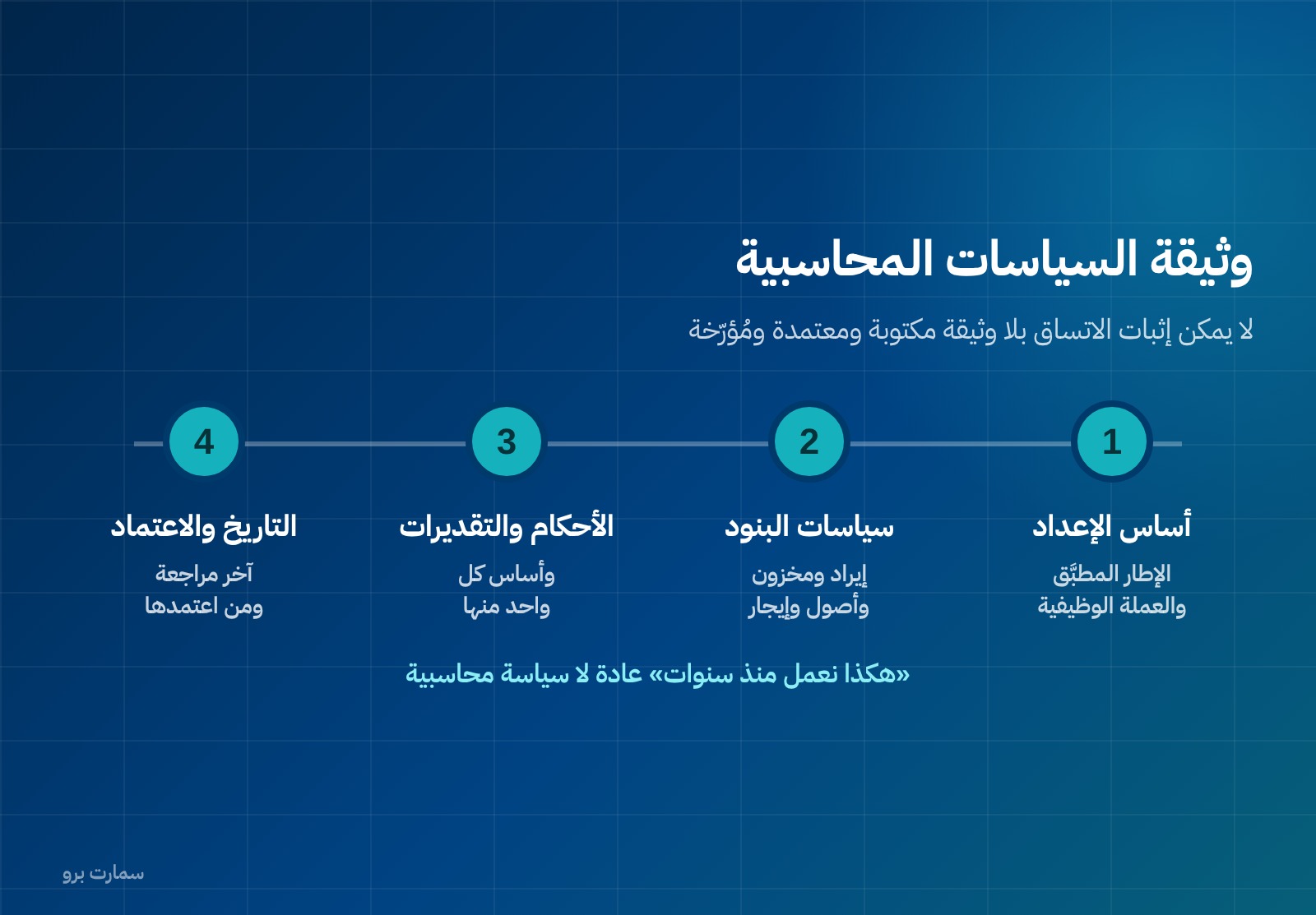
What should an accounting policies document contain?
- The accounting framework applied and the basis of preparation.
- The basis for recognising revenue for each line of business.
- The inventory cost flow method and the basis for determining net realisable value.
- The measurement model for fixed assets and the useful lives for each class.
- The basis for the allowance for doubtful debts.
- The treatment of leases and the exemptions chosen.
- The basis for presenting expenses: by nature or by function.
- The functional currency and the basis for translating foreign currencies.
- The date of the document's last review and who approved it.
The official reference
The international standards as endorsed in Saudi Arabia are published by the Saudi Organization for Chartered and Professional Accountants (SOCPA) on its website: socpa.org.sa, and the texts of the standards are available from the IFRS Foundation at ifrs.org.
Read also
Article visuals
Frequently asked questions
What is the difference between a change in accounting policy and a change in estimate?
A change in accounting policy is applied retrospectively and comparatives are restated, while a change in estimate is applied prospectively in the period of the change and later periods, without touching comparatives. Where it is hard to tell the two apart, the event is treated as a change in estimate.
When is a business allowed to change an accounting policy?
In only two cases: when a new standard or an amendment to an existing standard requires it, or when the change produces financial statements that provide reliable and more relevant information. A policy may not be changed simply because the other method gives a better result this year.
How is a prior period error corrected?
Retrospectively, in the first financial statements authorised for issue after the error is discovered. This is done either by restating the comparative amounts for the period in which the error occurred, or by adjusting the opening balances of assets, liabilities and equity if the error occurred before the earliest period presented.
Has the name of IAS 8 changed?
Yes. With the adoption of IFRS 18, which replaced IAS 1, some IAS 1 requirements moved to other standards, and IAS 8 was renamed "Basis of Preparation of Financial Statements". This means references in accounting policy documents and audit files need to be updated.