
Notes to the Financial Statements: What Must They Include?
How the notes to the financial statements are ordered and what they contain: accounting policies, judgements and estimates, and the new disclosures IFRS 18 adds for entities.
Author:سامي الحيدري
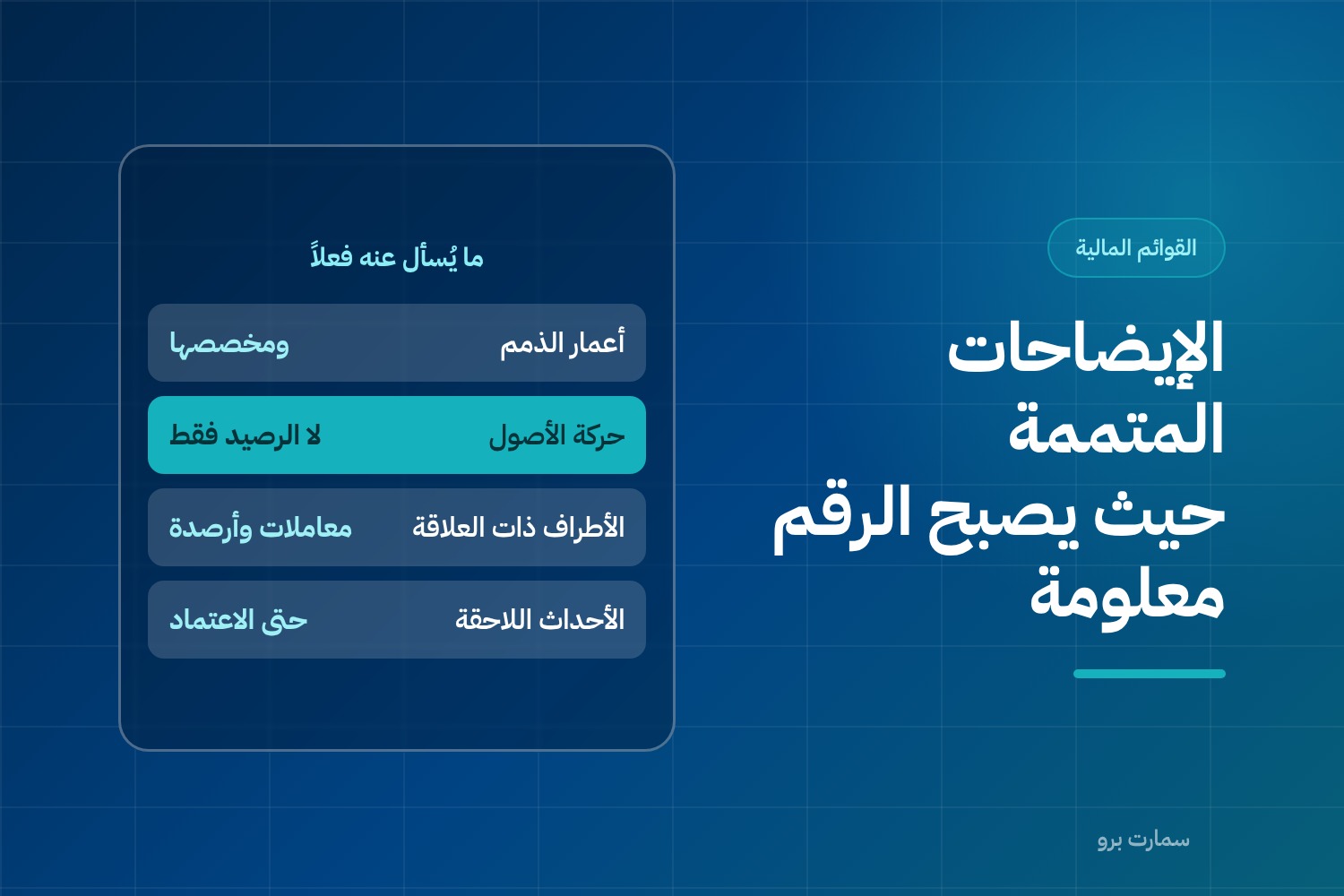
The four primary statements give you numbers; the notes to the financial statements give you their meaning. An "inventory SAR 4.2 million" line does not tell you the valuation method, how much of it is slow-moving, or how much was written down. A "trade receivables SAR 3.1 million" line does not tell you their ageing or the allowance against them. The notes turn the statements from numbers into information. In practice, they are the longest part of the financial report and the most neglected one in mid-sized businesses.
What are the notes to the financial statements for?
The notes are not an optional appendix; they are an integral part of the financial statements. They do three jobs:
- Present the basis of preparation and the accounting policies applied.
- Disclose information the standards require that is not shown on the face of the statements.
- Provide additional information that is not shown in the statements but is needed to understand them.
The governing principle: what appears in the statements and what appears in the notes should each play a role that complements the other. Do not cram everything onto the face of a statement, and do not bury what is material inside a note.
In what order are the notes usually presented?
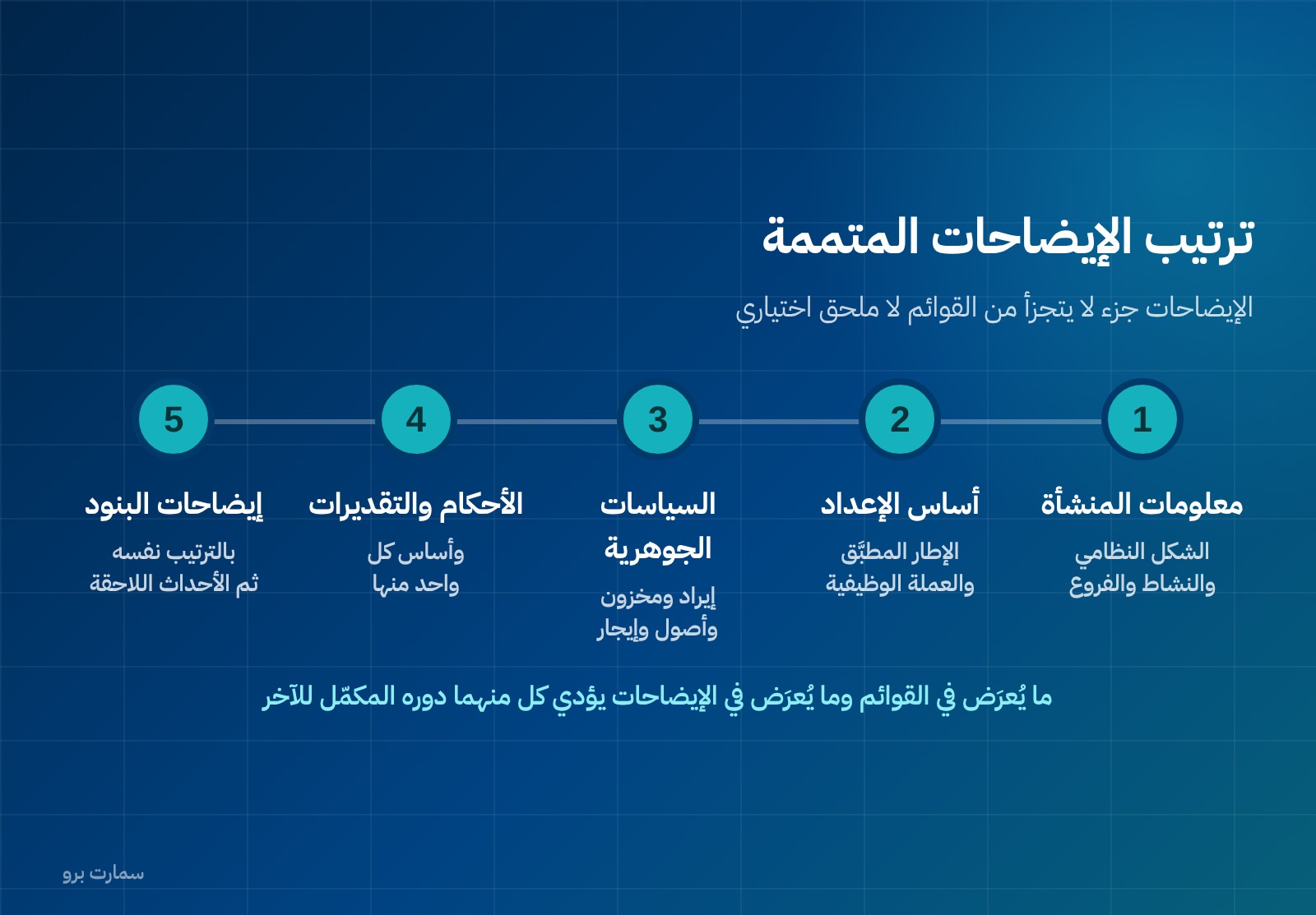
- Information about the entity: legal form, commercial registration, activity, place of business, branches.
- Basis of preparation: the accounting framework applied, the measurement basis, the functional currency and the presentation currency.
- Material accounting policies: revenue recognition, inventory, property and equipment, leases, provisions, zakat and tax.
- Judgements and estimates with a significant effect: what rests on management's judgement and could turn out differently.
- Notes to the line items in the same order they appear in the statements.
- Other disclosures: related parties, contingent liabilities and commitments, financial risk management.
- Subsequent events after the reporting date and before the statements are approved.
Which notes do reviewers actually ask about?
Trade receivables: the ageing analysis, the movement in the allowance for doubtful debts, and any concentration in a small number of customers.
Inventory: the classification, the cost-flow method, and the amounts written down to net realisable value and any reversals. Net realisable value is the estimated selling price less the costs to complete and sell. The detail is in inventory valuation.
Property and equipment: a movement schedule showing cost, additions, disposals, accumulated depreciation and net book value for each class, as covered in property, plant and equipment.
Leases: right-of-use assets, lease liabilities with their maturity analysis, and the exemptions chosen, as explained in lease accounting.
Revenue: a breakdown by business line or market, contract obligations, and the allocation basis, as set out in revenue recognition.
Zakat and tax: the calculation basis, the movement in the provision, and any outstanding assessments or objections, in line with calculating zakat and the income tax return.
Related parties: the nature of the relationship, the transactions, the balances, and key management compensation. This is one of the notes most often examined in tax reviews.
What does IFRS 18 add to the notes?
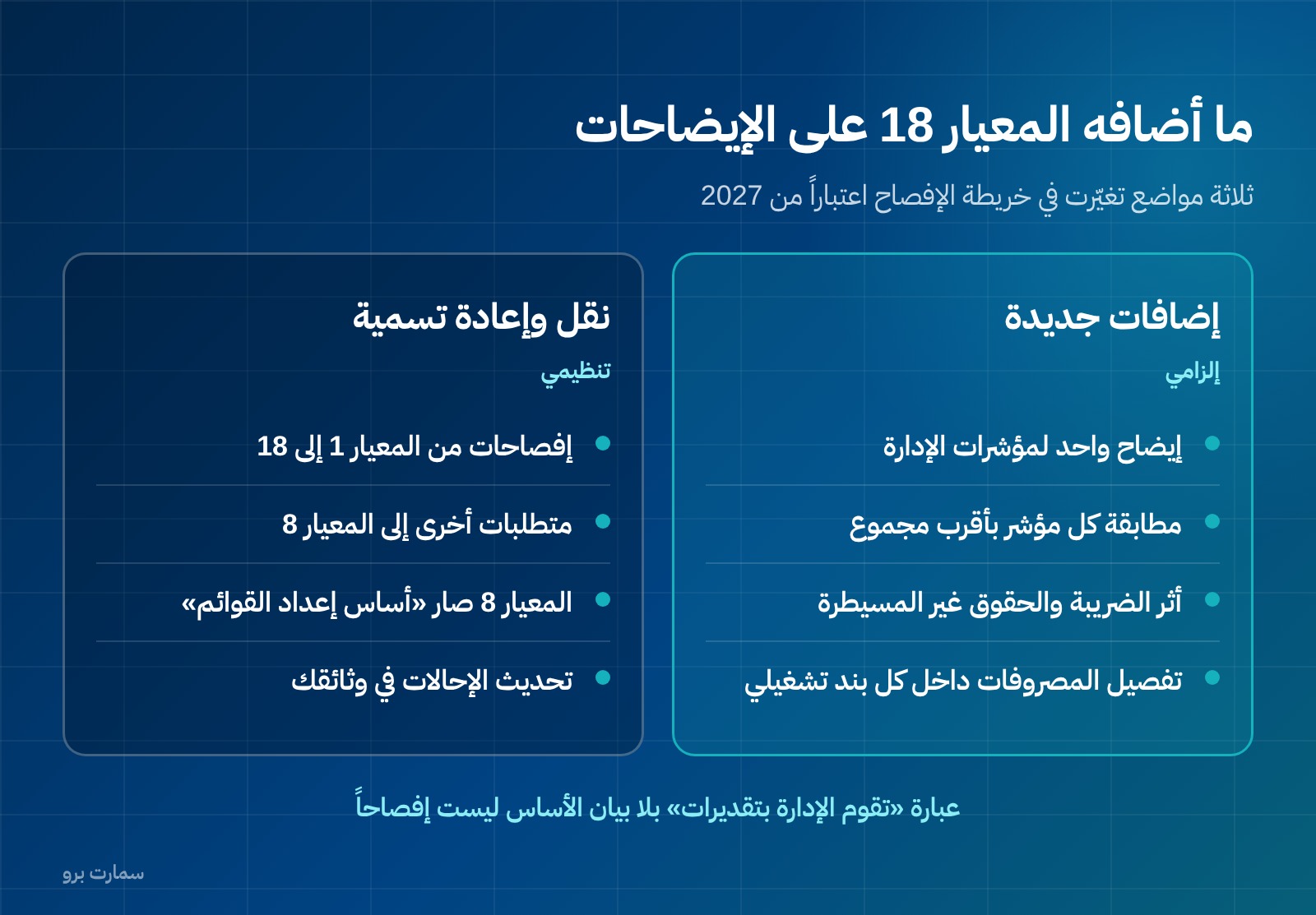
With the adoption of IFRS 18, effective for periods beginning on or after 1 January 2027, the map of the notes changes in three places:
Management-defined performance measures. These are measures management publishes outside the statements to express its view of performance. They all need to be gathered in a single note, with a reconciliation of each measure to the closest total specified by the standards, the tax effect and the effect on non-controlling interests for each reconciling item, a description of how the measure is calculated, and a statement that it may not be comparable with similarly named measures used by other entities.
Expense breakdown when presenting by function. An entity that presents expenses by function must disclose in the notes the depreciation, amortisation, employee benefits, impairment losses and inventory write-downs included in each operating line item.
Disclosures moved from IAS 1. The additional disclosures that the Saudi Organization for Chartered and Professional Accountants (SOCPA) used to require under IAS 1 have moved to IFRS 18, and other requirements have moved to IAS 8, which has been renamed "Basis of Preparation of Financial Statements". The detail is in IFRS 18 presentation and disclosure.
Why is the judgements and estimates note so important?
This note, more than any other, separates a carefully prepared financial report from one assembled in a few days. It discloses two different things:
Judgements are application decisions management made in applying its policies that have a significant effect: Is the entity a principal or an agent in a particular transaction? Is it reasonably certain that a lease extension option will be exercised? Is revenue recognised over time or at a point in time?
Estimates are sources of uncertainty that could lead to a material adjustment within the next year: useful lives, discount rates, the allowance for doubtful debts, and the net realisable value of inventory.
The value is not in listing them but in stating the basis on which they were made. A sentence such as "management makes estimates" with no basis is not a disclosure. How later changes in these estimates are treated is explained in accounting policies, estimates and errors.
What are the most common mistakes in the notes?
Copying policies from another entity's statements. A note describing a policy for construction contracts in a retail business is a clear sign of copying, and it undermines the credibility of the whole report.
Policies that do not match actual practice. Writing that you use weighted average cost while your system applies first-in, first-out (FIFO).
A note with no movement. Showing only the closing balance without a movement schedule strips the note of its purpose.
Burying what is material. An important fact mentioned in one sentence inside a long note. The standard does not allow aggregation to obscure material information.
Ignoring subsequent events. A material event after the reporting date and before approval must be disclosed, and it may require the figures to be adjusted if it provides evidence of conditions that existed at the reporting date.
Review checklist
- The accounting policies document is up to date and matches what the system actually applies.
- Every material line item in the statements has a corresponding note, in the same order.
- Movement schedules are complete for property and equipment, provisions and receivables.
- Judgements and estimates with a significant effect are stated explicitly, with their basis.
- Related-party transactions and balances are disclosed.
- Contingent liabilities and commitments have been reviewed with the legal function.
- Subsequent events up to the approval date have been reviewed and documented.
- The figures in the notes agree with the trial balance and with the statements.
Where is the official reference?
International standards as endorsed in the Kingdom are published by the Saudi Organization for Chartered and Professional Accountants (SOCPA) on its website: socpa.org.sa. The texts and summaries of the standards are available from the IFRS Foundation at ifrs.org.
Read also
Article visuals
Frequently asked questions
Are the notes part of the financial statements?
Yes. The notes are an integral part of the financial statements, not an optional appendix. They present the basis of preparation and the accounting policies, disclose what the standards require that is not shown on the face of the statements, and provide additional information needed to understand the figures.
In what order are the notes to the financial statements presented?
Information about the entity comes first, then the basis of preparation, then material accounting policies, then judgements and estimates with a significant effect. These are followed by notes to the line items in the same order they appear in the statements, then other disclosures such as related parties and contingent liabilities, and finally subsequent events.
What does IFRS 18 add to the notes?
It requires a single note gathering management-defined performance measures, with their reconciliation and the tax and non-controlling interest effects. Entities presenting expenses by function must disclose the depreciation, amortisation, employee benefits, impairment losses and inventory write-downs included in each operating line item. Some disclosures that previously sat under IAS 1 have also moved to IFRS 18.
What are the most common mistakes in the notes?
Copying policies from another entity's statements, so that policies appear that have nothing to do with the business, and writing a policy that does not match what the system actually applies. Other frequent mistakes are showing only the closing balance without a movement schedule, burying material information inside a long note, and ignoring subsequent events between the reporting date and the approval date.