
Events After the Reporting Period: When Do the Numbers Change?
The difference between adjusting and non-adjusting events after the reporting period, with practical examples, when the going concern basis falls away, and what must be disclosed before approval.
Author:سامي الحيدري
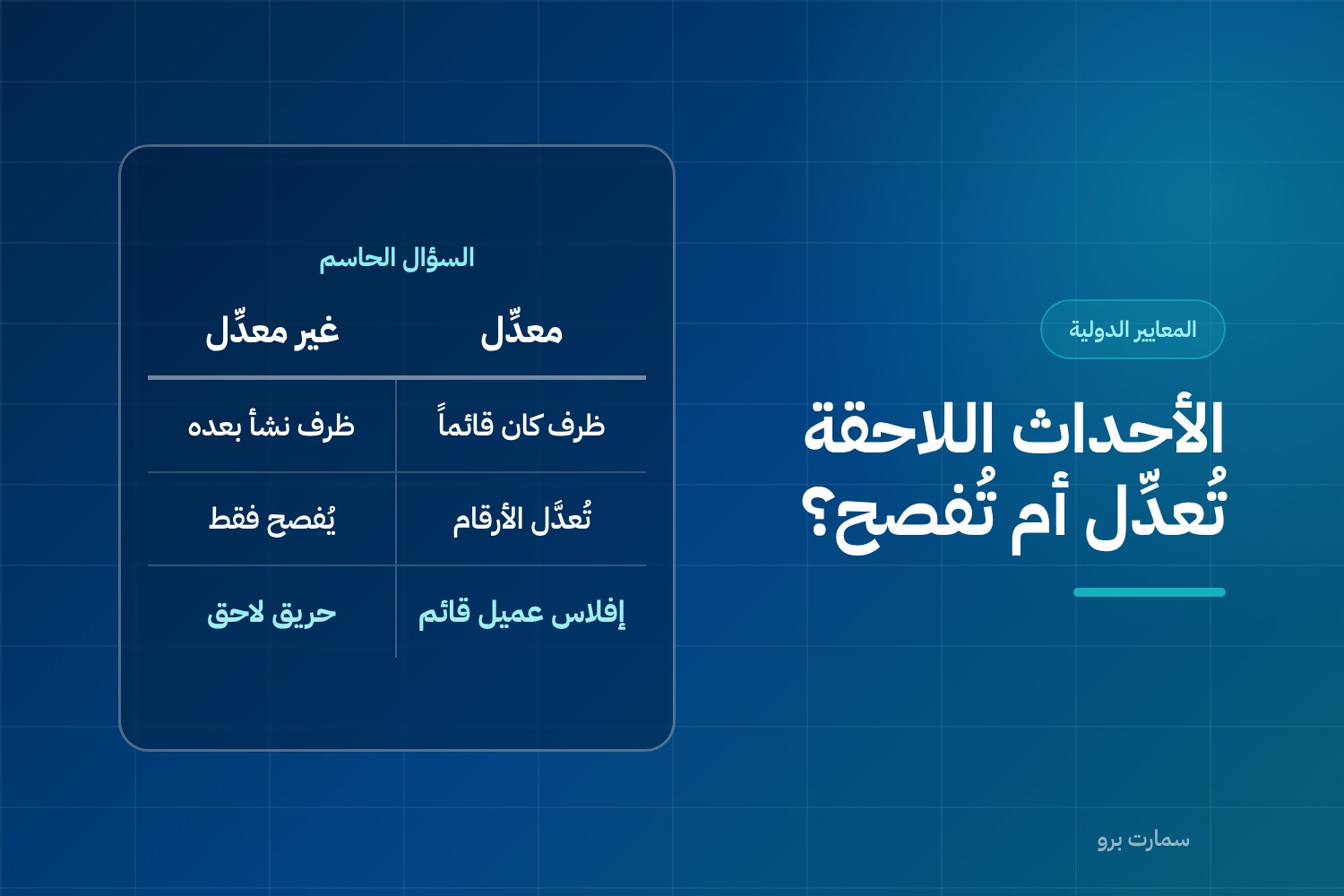
Financial statements are dated 31 December, but they are not approved on that day. Weeks or months pass between the reporting date and the approval date, and things happen. Some of these events after the reporting period must change the figures themselves, some only need disclosure, and some can remove the basis on which the statements are prepared.
The accounting standard that governs this is IAS 10, Events after the Reporting Period, part of the international standards adopted in Saudi Arabia.
Which period are we talking about?
The period starts at the reporting date and ends on the date the financial statements are authorised for issue, meaning the date they are approved by the authorised body. Every event that occurs within this window deserves a look.
Fixing the approval date is not a minor detail. It is what closes the period, and it is disclosed together with the name of the body that approved the statements.
What are the two types of events after the reporting period?
Adjusting events provide evidence of conditions that already existed at the reporting date. The figures are adjusted for them.
Non-adjusting events indicate conditions that arose after the reporting date. The figures are not adjusted for them, but they are disclosed if they are material.
The deciding question is always the same: did the condition exist at the reporting date and was only confirmed later, or did it arise afterwards?
Practical examples
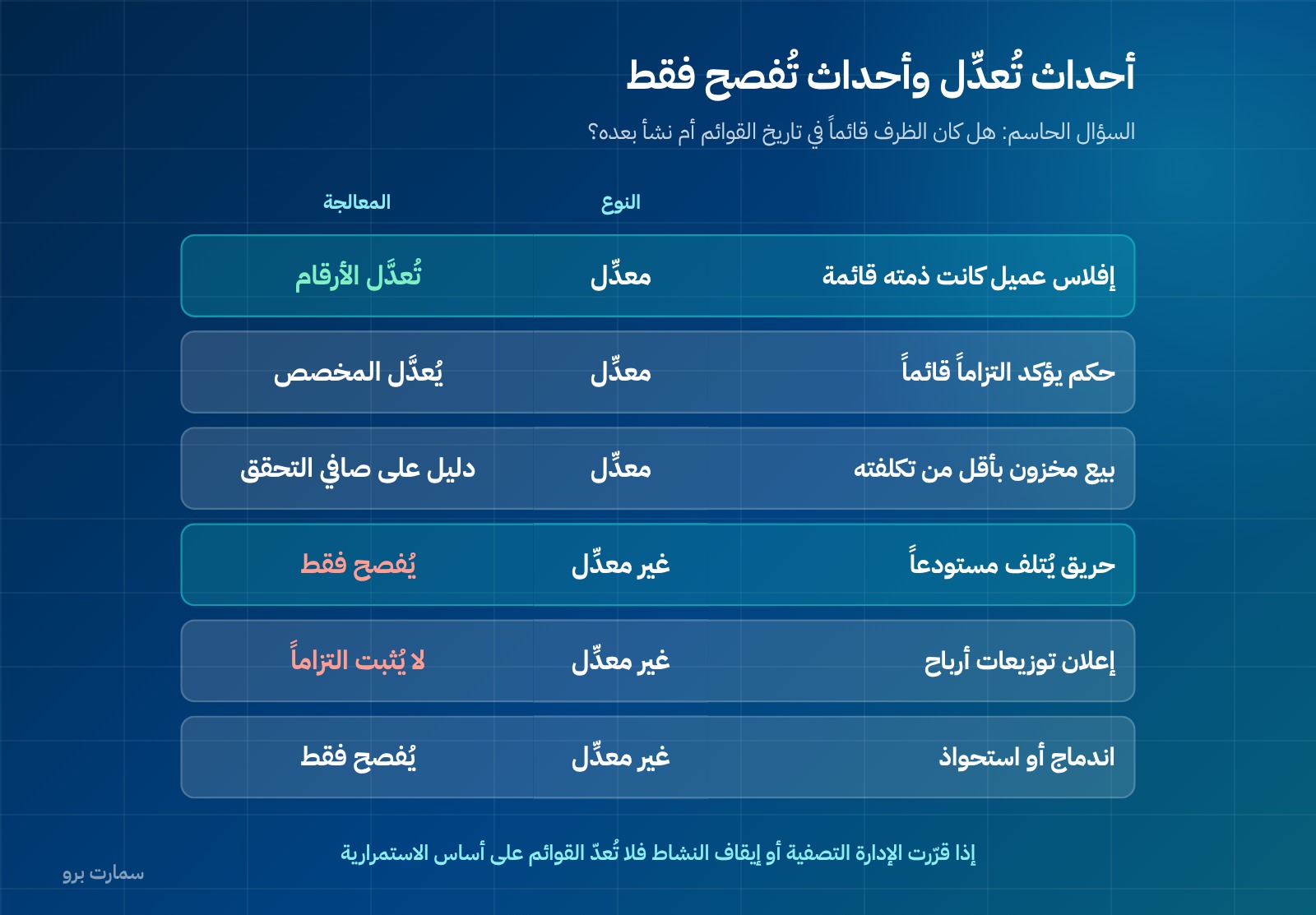
| Event | Type | Treatment |
|---|---|---|
| A customer goes bankrupt after the reporting date, and the receivable already existed | Adjusting | Expected credit losses are adjusted |
| A court ruling confirms an obligation that already existed | Adjusting | The provision is recognised or adjusted |
| Inventory is sold below cost after the reporting date | Adjusting | Evidence of net realisable value |
| Fraud or an error is discovered showing the statements are wrong | Adjusting | The figures are corrected |
| The amount of bonuses is determined, where the obligation already existed | Adjusting | The accrual is adjusted |
| A fire destroys a warehouse after the reporting date | Non-adjusting | Disclosed |
| Dividends are declared after the reporting date | Non-adjusting | Disclosed, no liability recognised |
| A major merger or acquisition after the reporting date | Non-adjusting | Disclosed |
| A material change in exchange rates after the reporting date | Non-adjusting | Disclosed |
The dividends line deserves a closer look. Dividends declared after the reporting date are not recognised as a liability in those statements, because the obligation did not exist at that date. They are only disclosed. This is one of the most common mistakes in family-owned businesses.
When does the going concern basis no longer apply?
If, after the reporting date, management decides it intends to liquidate the business or cease trading, or concludes it has no realistic alternative but to do so, the statements are not prepared on a going concern basis.
This is not an adjustment to a single line. It changes the entire basis of preparation. The standard requires that the statements not be prepared on a going concern basis in this situation, even though the reporting date came before the decision.
Which cases are most often confused?
A lawsuit settled for an amount different from the provision. If the lawsuit existed at the reporting date, the later settlement is evidence of a condition that already existed, and the provision is adjusted.
A credit note from a supplier for goods received before the reporting date. Adjusting, because the discount relates to a transaction that took place before that date.
A receivable collected after the reporting date. Adjusting, but in the opposite direction: it shows the receivable was collectible, so the estimated loss rate applied to it is revisited.
A drop in an investment's value after the reporting date for a sudden reason. Non-adjusting, because the cause arose after the reporting date.
A new law or regulation issued after the reporting date. Non-adjusting, and disclosed if its effect on the business is material.
One practical test settles every case: did the condition exist on 31 December and we simply did not know it yet, or did it happen afterwards?
What must be disclosed?
For material non-adjusting events, disclose:
- The nature of the event.
- An estimate of its financial effect, or a statement that such an estimate cannot be made.
The disclosure goes in the notes to the financial statements, in a separate section for events after the reporting period.
What is the mistake businesses keep making?
Many businesses close their books in January and approve their statements in April, with no review of what happened in between. The result: a customer who went bankrupt in February still appears with a full receivable and no allowance, or inventory sold at a loss in March is still carried at its original value.
The review is not a formality. It means reading the minutes of management meetings, following up on lawsuits, reviewing collections after the reporting date, and checking subsequent selling prices for inventory. That is where the evidence for adjusting expected credit losses, inventory valuation and provisions comes from.
Who should own this review?
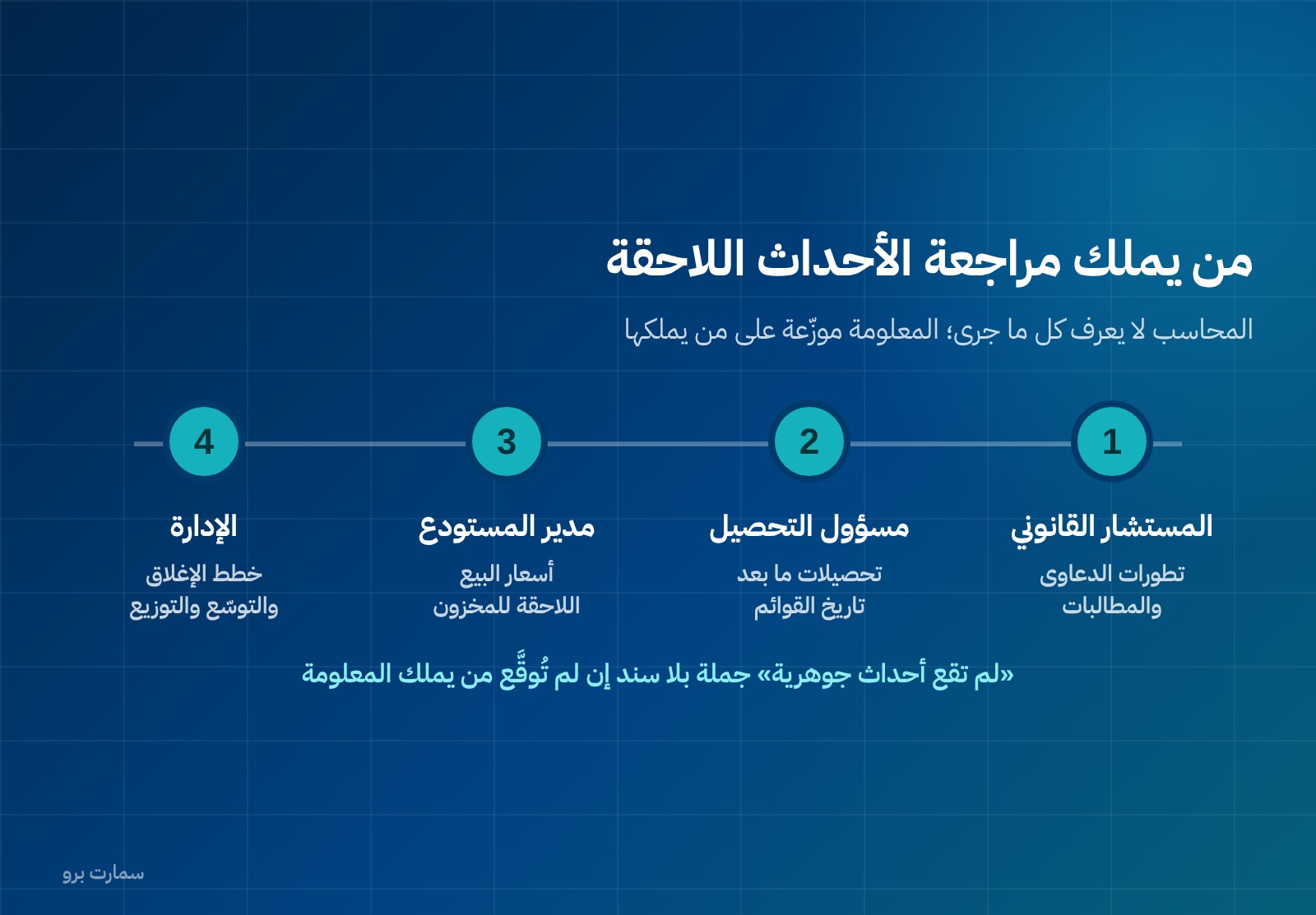
In small businesses, the accountant is assumed to know everything that happened. In practice, they do not: lawsuits sit with the legal adviser, closure decisions with management, and customer defaults with the collections team.
That is why the review of events after the reporting period should be a written procedure carried out before every approval, and signed by the people who hold the information: the legal adviser for lawsuits, the collections officer for receivables, the warehouse manager for inventory, and management for plans to close, expand or distribute dividends. Without it, the final paragraph in the notes, "no material events have occurred", is a sentence with nothing behind it.
Pre-approval checklist
- The date of authorisation for issue is set and the approving body is identified.
- Minutes of management meetings after the reporting date have been reviewed.
- Collections after the reporting date have been reviewed to assess outstanding receivables.
- Inventory selling prices after the reporting date have been reviewed to assess net realisable value.
- Developments in lawsuits have been reviewed with the legal adviser.
- Dividends declared after the reporting date are disclosed and not recognised.
- Material non-adjusting events are disclosed with their nature and estimated effect.
- The going concern basis has been reassessed in light of new developments.
Where is the official reference?
The international standards as adopted in the Kingdom are published by the Saudi Organization for Chartered and Professional Accountants (SOCPA) on its website: socpa.org.sa, and the full texts of the standards are available from the IFRS Foundation at ifrs.org.
Read also
- Notes to the financial statements
- Provisions and contingent liabilities
- Accounting policies, estimates and errors
Key takeaway: Adjust the figures only when an event gives evidence of a condition that existed at the reporting date; disclose material events that arose afterwards, and run a written review before every approval.
To see how SmartPro keeps receivables, inventory and journal entries connected for your year-end review, start a free trial.
Article visuals
Frequently asked questions
What is the difference between an adjusting and a non-adjusting event?
An adjusting event provides evidence of a condition that existed at the reporting date, so the figures are adjusted for it, such as the bankruptcy of a customer whose receivable already existed. A non-adjusting event indicates a condition that arose after the reporting date, so the figures are not adjusted and it is disclosed if material, such as a fire that destroys a warehouse after the reporting date.
Which period is reviewed for events after the reporting period?
The period runs from the reporting date of the financial statements until the date they are authorised for issue, meaning approved by the authorised body. The approval date and the body that approved the statements are disclosed, because that date is what closes the period under review.
Are dividends declared after the reporting date recognised in the financial statements?
No. Dividends declared after the reporting date are not recognised as a liability in those statements, because the obligation did not exist at that date; they are only disclosed. This is one of the most common mistakes in family-owned businesses.
When does the going concern basis no longer apply?
When, after the reporting date, management decides to liquidate the business or cease trading, or concludes it has no realistic alternative but to do so. In that case the statements are not prepared on a going concern basis, which changes the entire basis of preparation rather than adjusting a single line item.