
Functional Currency and Exchange Differences: The Accounting Treatment
How the functional currency is determined, how monetary and non-monetary items differ at period end, and where exchange differences are presented in the financial statements.
Author:سامي الحيدري

Exchange differences arise when foreign-currency transactions and balances are translated at rates that differ from those used when they were first recorded. On monetary items they go to the income statement; non-monetary items carried at cost are not retranslated at all. Everything starts with one question: what is the business's functional currency?
Picture a Saudi business that buys in US dollars, sells in euros and borrows in riyals. Which currency should its statements be prepared in, at what rate are balances translated at period end, and where do the resulting exchange differences go? The rules come from IAS 21, The Effects of Changes in Foreign Exchange Rates, and they all depend on the functional currency.
Is the functional currency a free choice?
No. The functional currency is the currency of the primary economic environment in which the business operates. It is determined by indicators, not by management's preference.
Primary indicators
- The currency that mainly influences the selling prices of your goods and services.
- The currency of the country whose competitive forces and regulations mainly determine those selling prices.
- The currency that mainly influences labour, material and other supply costs.
Supporting indicators when the picture is still unclear: the currency in which financing is raised, and the currency in which operating receipts are retained.
The functional currency is different from the presentation currency, which is the currency a business may choose to present its statements in. A business whose functional currency is the riyal may present its statements in US dollars for a foreign investor; that is a presentation translation, not a change in measurement.
How are foreign-currency transactions translated?
On initial recognition: a foreign-currency transaction is recorded at the spot exchange rate on the transaction date. In practice, an average rate for a short period may be used if rates have not fluctuated significantly.
At the reporting date, the treatment depends on the nature of the item:
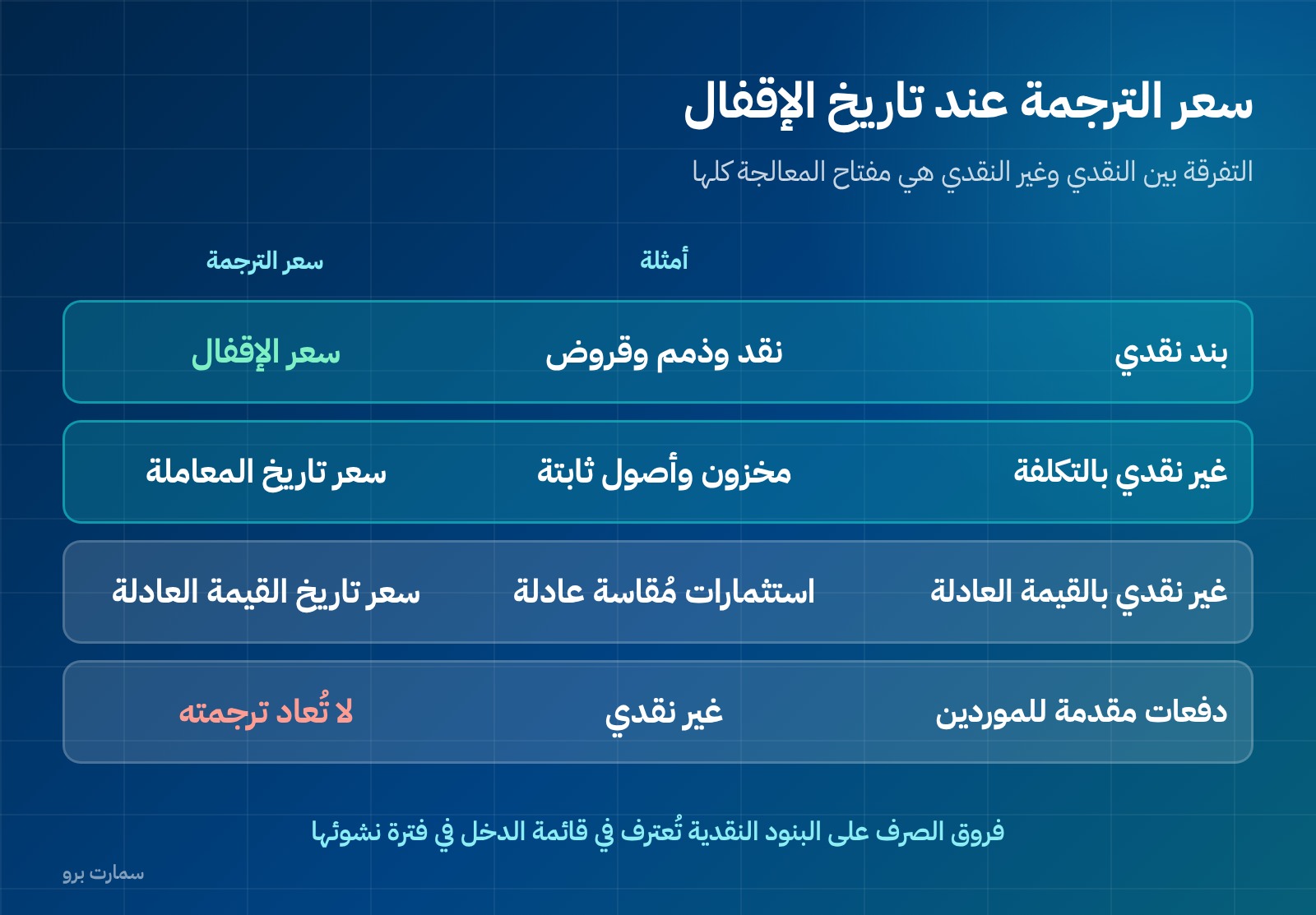
| Item type | Examples | Translation rate |
|---|---|---|
| Monetary item | Cash, receivables and payables, loans | Closing rate |
| Non-monetary item at historical cost | Inventory, fixed assets, advance payments | Rate on the transaction date |
| Non-monetary item at fair value | Investments measured at fair value | Rate on the date fair value was determined |
The split between monetary and non-monetary items is the key to the whole topic. A monetary item is a right to receive, or an obligation to deliver, a fixed or determinable number of units of currency. So a receivable in US dollars is monetary, while inventory bought in US dollars is non-monetary.
Where are exchange differences presented?
Exchange differences arising on the settlement of monetary items, or on translating them at rates different from those at initial recognition, are recognised in the income statement in the period in which they arise.
For non-monetary items whose gains or losses are recognised in other comprehensive income, the exchange component is also recognised in other comprehensive income. The reverse applies too: if the gain or loss goes to profit or loss, so does its exchange component.
Under IFRS 18, effective for periods beginning on or after 1 January 2027, where exchange differences sit among the five categories becomes a matter that needs a clear policy: do they relate to operating activity or to financing? See IFRS 18 and how your financial statements will change.
What mistakes do businesses commonly make?
Translating inventory at the closing rate. Inventory is a non-monetary item at cost. It is translated at the transaction-date rate and stays there. Retranslating it every year produces a wrong cost of sales.
Retranslating fixed assets. The same mistake: historical cost is fixed at the acquisition-date rate and is not updated.
Overlooking advance payments. An advance paid to a supplier is a non-monetary item, so it is not retranslated.
Not separating settlement differences from translation differences. The first are realised on settlement; the second are unrealised at period end. Separating them is essential to see the true effect.
Choosing the functional currency for administrative convenience. It is the result of a documented analysis, not a preference. It may only be changed when there is a real change in the underlying transactions, events and conditions, and the change is applied prospectively.
How are foreign operations translated for consolidation?
If your business has a branch or subsidiary abroad with a different functional currency, translating its statements for consolidation follows separate rules: assets and liabilities at the closing rate, and income and expenses at the rates on the transaction dates. In practice, the period's average rate can be used if rates have not fluctuated significantly.
The differences from this translation do not pass through the income statement. They are recognised in other comprehensive income and accumulated in a separate component of equity. This explains the "foreign operations translation differences" line in the statement of changes in equity of groups with activities abroad.
How do exchange differences affect tax and zakat?
Exchange differences affect the result of the business and therefore the tax base through the reconciliation schedule; see the income tax return in Saudi Arabia. They also affect retained earnings and therefore the equity that enters the zakat base calculation.
What should your accounting system support?
Working in several currencies is not a matter of one extra field on the invoice:
- An exchange rate for each transaction, stored with the document, not one monthly rate applied afterwards.
- Separate accounts for realised and unrealised exchange differences.
- A report that separates monetary foreign-currency balances from non-monetary ones.
- Automatic revaluation at period end, applied to monetary items only.
- One documented source of exchange rates, used consistently across periods.
A business that types the exchange rate by hand on every invoice builds up differences it cannot trace later. This is one of the criteria worth checking when you evaluate systems, as covered in how to choose an accounting system for small businesses. In SmartPro, multiple currencies is a paid option within Finance & Accounting, priced at SAR 1,000 one-time.
Checklist
- The functional currency is set by a documented analysis, not by preference.
- The presentation currency is stated explicitly in the notes if it differs from the functional currency.
- Items are classified as monetary or non-monetary in the chart of accounts.
- Only monetary items are retranslated at the closing rate.
- Inventory, fixed assets and advance payments are held at their transaction-date rates.
- The source of exchange rates is documented and consistent across periods.
- Realised differences are kept separate from unrealised ones.
- Balances agree with the trial balance.
Where is the official reference?
International standards as endorsed in the Kingdom are published by the Saudi Organization for Chartered and Professional Accountants (SOCPA) on its website: socpa.org.sa. The full texts of the standards are available from the IFRS Foundation at ifrs.org.
Read also
- IFRS 18: presentation and disclosure
- Statement of financial position: what it really says about your business
- Property, plant and equipment: recognition, measurement and depreciation
Key takeaway: Determine the functional currency from documented indicators, retranslate only monetary items at the closing rate, and send their exchange differences to the income statement, while foreign-operation translation differences go to other comprehensive income.
To see how per-transaction exchange rates and period-end revaluation work in practice, start a free SmartPro trial or book a demo.
Article visuals

Frequently asked questions
How is the functional currency determined?
It is determined by indicators, not by management's preference: the currency that mainly influences selling prices, the currency of the country whose competitive forces and regulations determine those prices, and the currency that mainly influences labour, material and supply costs. If the answer is still unclear, the currency of financing and the currency in which operating receipts are retained are used as supporting indicators.
What is the difference between a monetary and a non-monetary item?
A monetary item is a right to receive, or an obligation to deliver, a fixed or determinable number of currency units, such as cash, receivables, payables and loans, and it is retranslated at the closing rate. Non-monetary items such as inventory, fixed assets and advance payments stay at the transaction-date rate and are not retranslated.
Where are exchange differences presented?
Exchange differences on monetary items are recognised in the income statement in the period they arise, whether on settlement or on translation at the reporting date. For non-monetary items whose gains are recognised in other comprehensive income, the exchange component follows them into other comprehensive income.
Can the functional currency be changed?
Only when there is a real change in the underlying transactions, events and conditions that determine it, not because of management preference or to improve how results look. When it does change, the new currency is applied prospectively from the date of change, not retrospectively.