
Separate Financial Statements: The Three Options and Their Impact
What separate financial statements are and when they are prepared, the three options for measuring investments in subsidiaries and associates, and how dividends are treated.
Author:سامي الحيدري
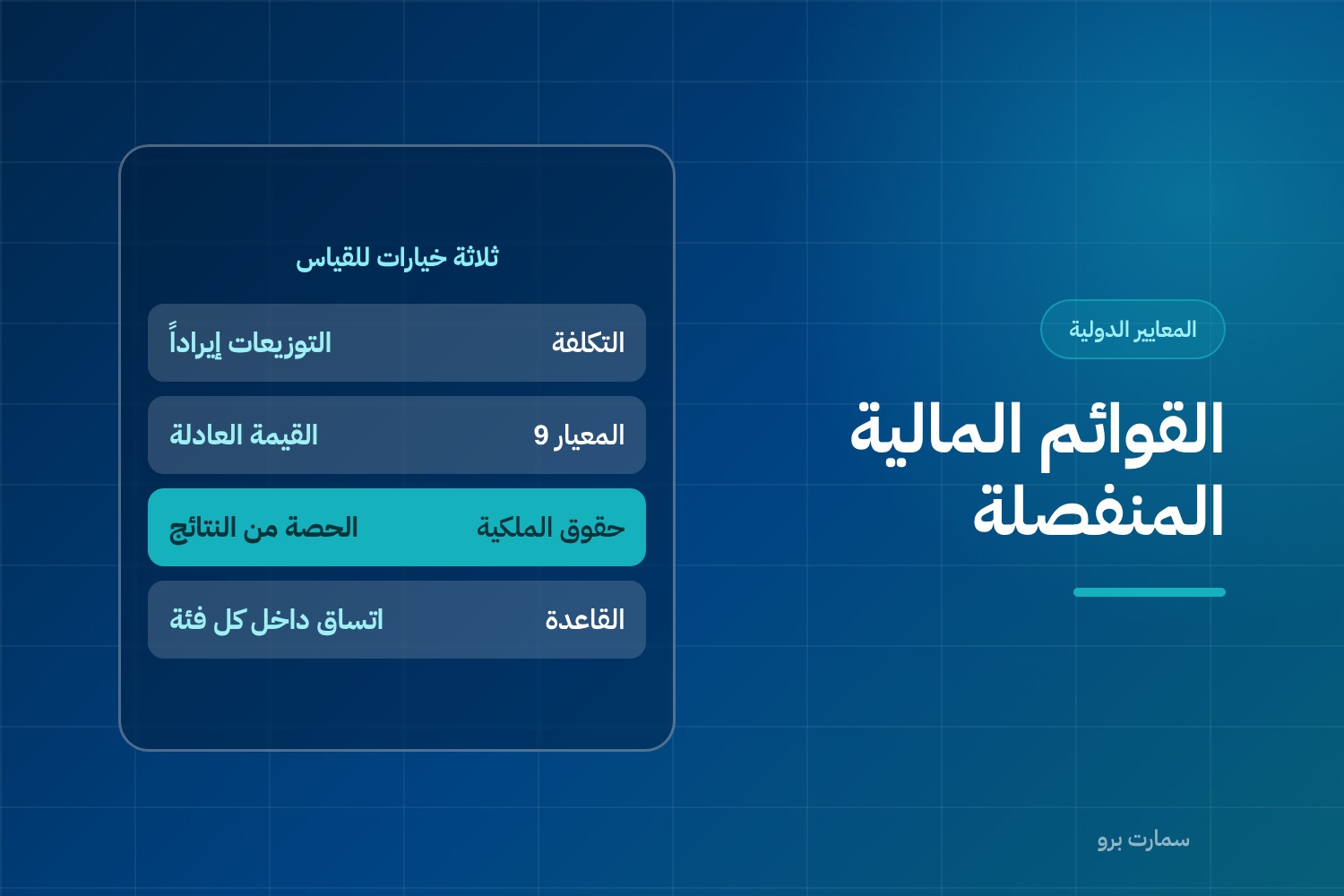
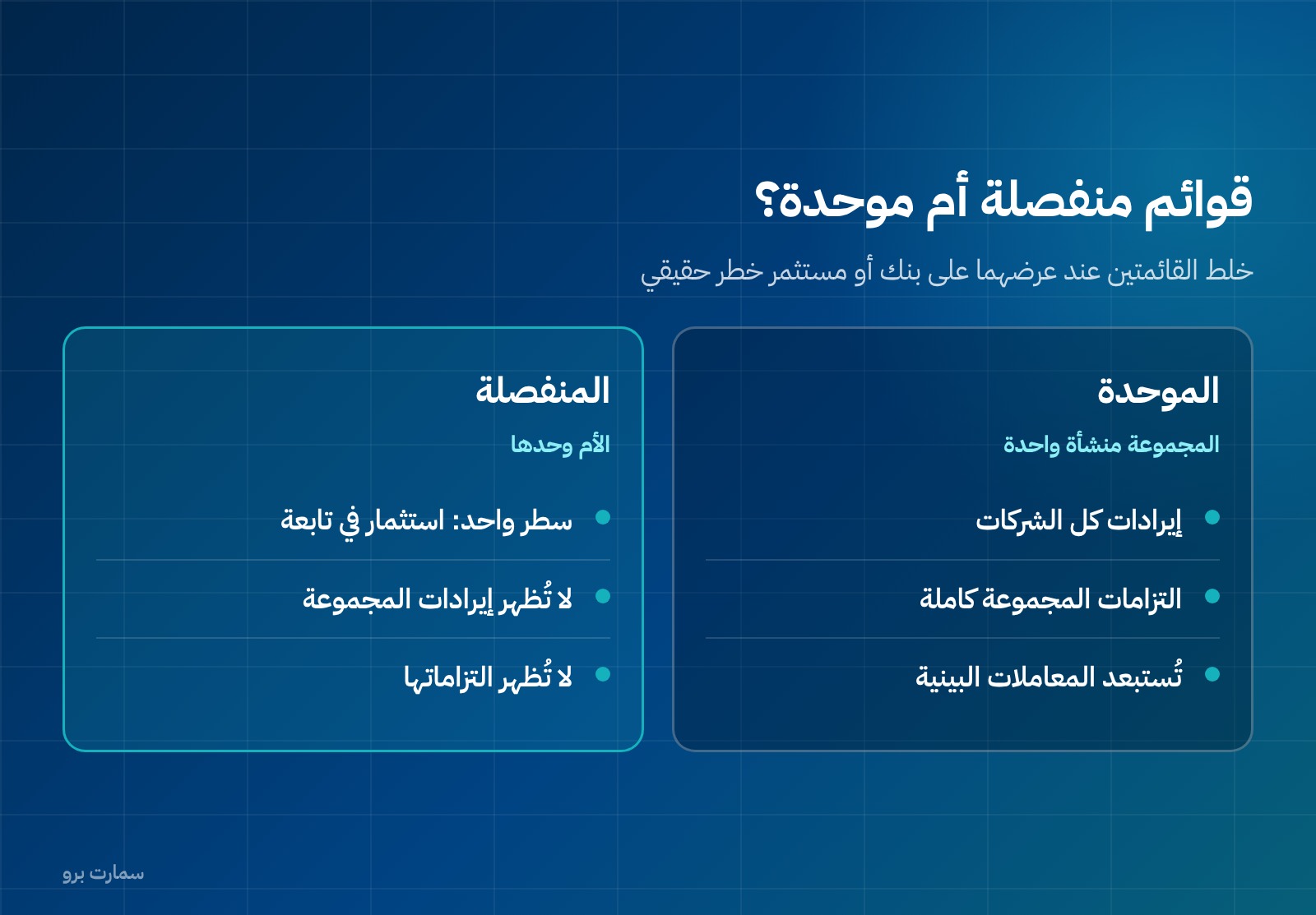
Many accountants confuse two very different sets of statements: consolidated financial statements, which present the group as if it were a single entity, and separate financial statements, which present the parent company on its own, with its investment in each subsidiary shown as a single line item. The standard that governs the second is IAS 27.
The first thing to correct is the name. Today the standard is titled simply "Separate Financial Statements". "Consolidated and Separate Financial Statements" is an old title that changed in the May 2011 revision, yet many Arabic and English references still use it.
When are separate financial statements prepared?
The standard does not require any entity to prepare separate financial statements. It applies only when an entity chooses to prepare them, or when local regulations require it to. If they are prepared under IFRS, this standard must be followed.
Consolidation itself is entirely outside its scope; that is the job of IFRS 10. The detailed mechanics of the equity method belong to IAS 28.
What are the three options for measuring the investment?
This is the heart of the standard. Investments in subsidiaries, joint ventures and associates are accounted for using one of three options:
| Option | What appears in the income statement | Effect on equity |
|---|---|---|
| Cost | Dividends received only | Stable unless the investment is impaired |
| In accordance with IFRS 9 | Changes in fair value | Moves with the market |
| Equity method | Share of the investee's results | Moves with the subsidiary's performance |
The governing condition: the entity applies the same accounting to each category of investments. You cannot measure one subsidiary at cost and another at fair value without a basis. Investments classified as held for sale or for distribution fall under IFRS 5.
The equity method option is the newest. It was added by an amendment issued in August 2014, effective for periods beginning on or after 1 January 2016.
How are dividends treated?
A dividend from a subsidiary, joint venture or associate is recognised when the right to receive it is established, not when the cash arrives. Then:
- If the investment is measured at cost or under IFRS 9: the dividend is recognised in profit or loss.
- If the equity method is used: the dividend reduces the carrying amount of the investment and does not pass through the income statement.
This difference can turn the parent's profitability picture in its separate statements upside down, which is why choosing the method is a decision, not a formality.
What happens in a reorganisation that inserts a new parent?
When a new parent company is set up on top of an existing structure, the standard applies a special cost measurement if three conditions are met: the new parent obtains control by issuing equity instruments in exchange for the existing ones, the group's assets and liabilities are the same immediately before and after the reorganisation, and the original owners' relative interests remain unchanged.
In that case the new parent measures cost at the carrying amount of its share of the equity items in the original parent's separate statements, not at fair value. The same rule extends to entities that are not parents. The aim is to prevent a reorganisation that changes nothing economically from generating gains or goodwill.
What disclosures are required?
A parent that has used the IFRS 10 exemption and does not consolidate must disclose:
- That these statements are separate, and that the exemption has been used.
- The name and address of the entity whose consolidated statements are available to the public, and where they can be obtained.
- A list of significant investments in subsidiaries, joint ventures and associates.
- The accounting method used for those investments.
Any other parent, or an investor with joint control or significant influence, identifies the statements prepared under IFRS 10, IFRS 11 and IAS 28, states that its statements are separate, and gives the reasons for preparing them if regulations do not require it.
How does the choice of method change the numbers? A worked example
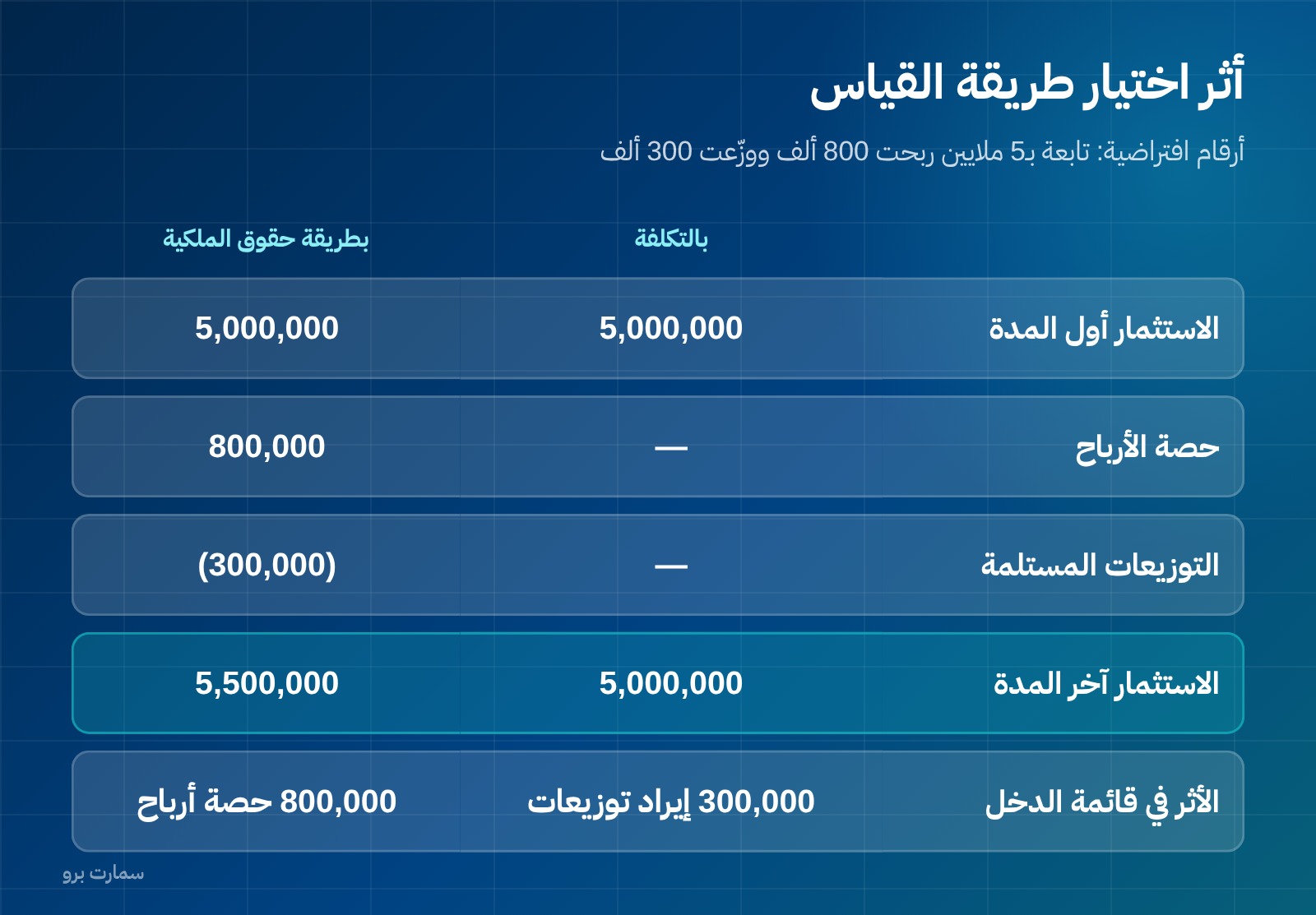
The figures below are hypothetical, to illustrate the method. A parent owns 100% of a subsidiary it bought for SAR 5,000,000. The subsidiary earned a profit of SAR 800,000 and paid dividends of SAR 300,000:
| Item | At cost | Equity method |
|---|---|---|
| Investment, opening | 5,000,000 | 5,000,000 |
| Share of profit | — | 800,000 |
| Dividends received | — | (300,000) |
| Investment, closing | 5,000,000 | 5,500,000 |
| Effect on the parent's income statement | 300,000 dividend income | 800,000 share of profit |
The same economic reality, two different figures in the income statement, and a SAR 500,000 difference in the investment's value. That is why the standard requires consistent treatment within each category and asks for the method used to be disclosed.
How does this relate to zakat and tax?
The zakat base is built from elements defined by regulation, and long-term investments are among the deductible items. Changing how the investment is measured therefore changes the carrying amount the calculation starts from. That is one more reason to fix the method and document it rather than change it from year to year. For more detail, see deferred tax.
What common mistake should you watch for?
Many businesses in Saudi Arabia prepare statements for the parent alone, call them "the company's statements", and then treat them as group statements when presenting them to a bank or investor. This is a dangerous mix-up: separate statements do not show the group's revenue or liabilities, only a single line called "investment in subsidiaries". Anyone reading them as a picture of the group is reading something else entirely. See notes to the financial statements to learn what must be disclosed.
The standard is effective for periods beginning on or after 1 January 2013, and its text is available on ifrs.org.
What is the official name adopted in Saudi Arabia?
The adopted Arabic name of this standard is "المعيار الدولي للمحاسبة 27: القوائم المالية المنفصلة" (International Accounting Standard 27: Separate Financial Statements). SOCPA has endorsed it without any modification for application in the Kingdom.
Reference: Saudi Organization for Chartered and Professional Accountants (SOCPA), the document endorsing IFRS for application in the Kingdom, updated on 1447/07/04 AH.
Article visuals
Frequently asked questions
What is the difference between separate and consolidated financial statements?
Consolidated statements present the group as a single entity after eliminating transactions between its companies. Separate statements present the parent company on its own, with its investment in subsidiaries shown as a single line item.
Is preparing separate financial statements mandatory?
IAS 27 does not require any entity to prepare them. It applies only when an entity chooses to prepare them or when local regulations require it to.
What are the options for measuring investments in subsidiaries?
There are three: cost, in accordance with IFRS 9, or the equity method. The same treatment must be applied to each category of investments.
How is a dividend received from a subsidiary treated?
It is recognised when the right to receive it is established. It is recorded in profit or loss unless the entity uses the equity method, in which case it reduces the carrying amount of the investment.
Has the title of the standard changed?
Yes. Since the May 2011 revision, the current title has been "Separate Financial Statements". "Consolidated and Separate Financial Statements" is an old title that still appears in secondary references.