
IFRS in Saudi Arabia: The Complete Guide
Which accounting framework applies to your business in Saudi Arabia and when it became mandatory, a full map of each standard and what it governs, and what changes in 2027.
Author:سامي الحيدري
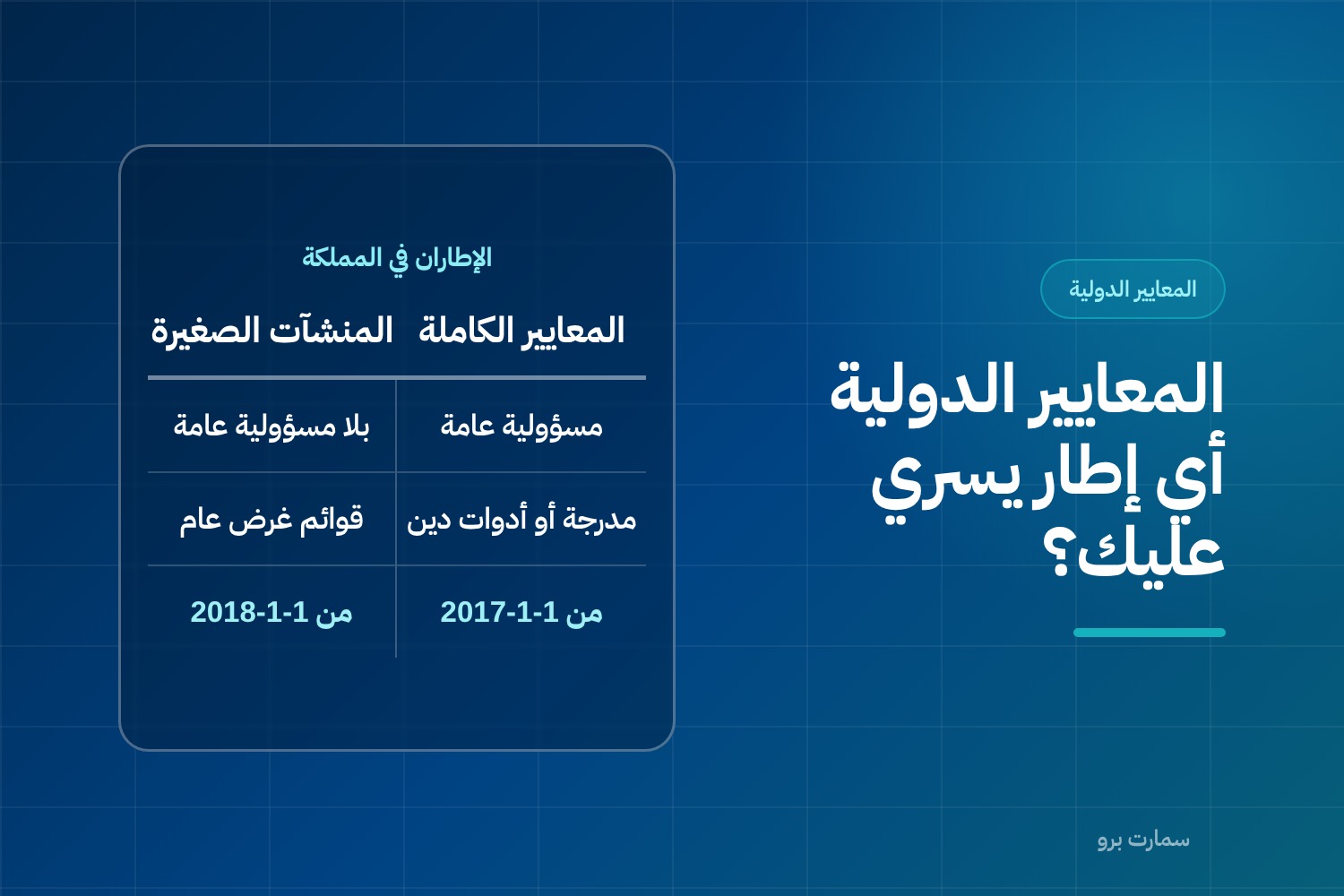
International Financial Reporting Standards (IFRS) are not something one business adopts and another skips. The first question to settle before any accounting work is: which framework applies to your business? You do not choose the answer; the Saudi Organization for Chartered and Professional Accountants (SOCPA) has defined it clearly. Once that is settled comes the map: which standard governs which item in your financial statements. This guide covers both and links each standard to its detailed explanation.
Which framework applies to your business?
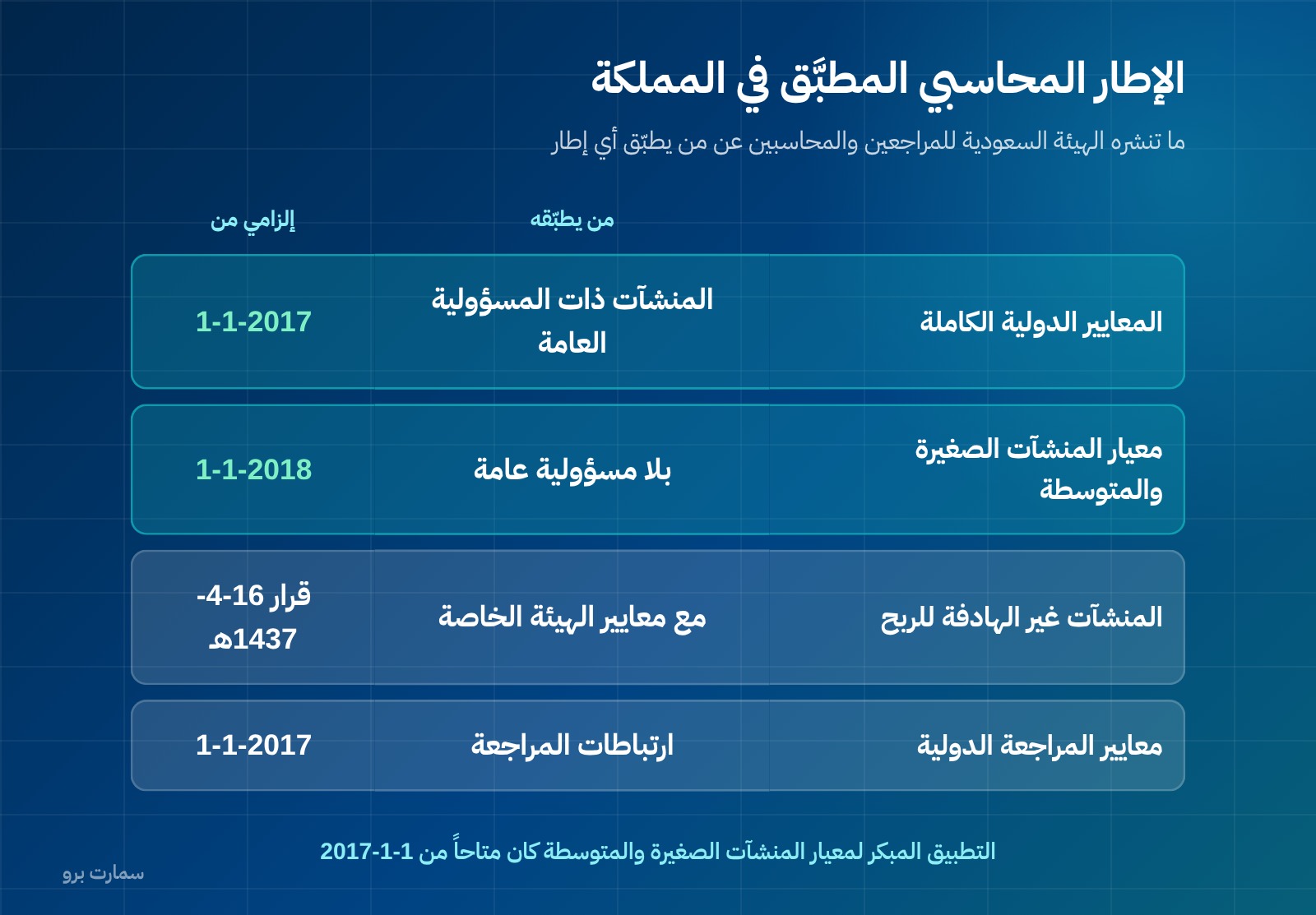
| Framework | Who applies it | Mandatory from |
|---|---|---|
| Full IFRS as endorsed by SOCPA | Entities with public accountability: those listed on the capital market or in the process of listing, those with traded debt instruments, and financial entities such as investment funds | Periods beginning on or after 1-1-2017 |
| IFRS for SMEs | Entities that publish general-purpose financial statements for external users and have no public accountability | Periods beginning on or after 1-1-2018 (with early adoption from 1-1-2017) |
| Standards for non-profit entities | Non-profit entities, alongside IFRS for SMEs | Board decision dated 16-4-1437H |
The dividing line between the two frameworks is public accountability, not size alone. A mid-sized business with traded debt instruments falls under the first framework, while a large family-owned business with no public accountability may fall under the second. Details are in IFRS for SMEs.
International Standards on Auditing have also been endorsed and apply to engagements beginning on or after 1-1-2017, regardless of the contract date.
The IFRS map: which standard governs which item?
Presentation and basis of preparation
- IFRS 18 — presentation and disclosure in financial statements; it replaces IAS 1.
- IAS 8 — accounting policies, estimates and errors; renamed "Basis of Preparation of Financial Statements".
- IFRS 19 — reduced disclosures for eligible subsidiaries.
Revenue and contracts
- IFRS 15 — revenue recognition using the five-step model.
- IFRS 16 — leases and the right-of-use asset.
Assets
- IAS 2 — inventory and cost-flow methods.
- IAS 16 — property, plant and equipment.
- IAS 38 — intangible assets.
- IAS 36 — impairment of assets.
- IAS 40 — investment property.
- IAS 23 — borrowing costs and when they are capitalised.
Liabilities and taxes
- IAS 37 — provisions and contingent liabilities.
- IAS 19 — employee benefits and the end-of-service provision.
- IAS 12 — income taxes and deferred tax.
Financial instruments and currencies
- IFRS 9 — expected credit losses and the doubtful-debt allowance.
- IAS 21 — functional currency and exchange differences.
Disclosure
- IAS 24 — related parties.
- IAS 10 — events after the reporting period.
- Notes to the financial statements — what they must include.
What is the biggest upcoming change? 2027
SOCPA endorsed IFRS 18 by board decision on 25-06-1446H (26-12-2024) to replace IAS 1, with early adoption permitted. The international effective date is annual periods beginning on or after 1 January 2027.
What changes:
- The income statement is classified into categories: operating, investing and financing, plus income taxes and discontinued operations.
- Two mandatory subtotals: operating profit, and profit before financing and income taxes.
- Disclosure of management-defined performance measures in a single note, with a reconciliation.
- An amendment to the cash flow statement: the indirect method starts from the operating profit subtotal.
In the same year, IFRS 19 takes effect internationally, allowing eligible subsidiaries to make reduced disclosures. Details are in IFRS 18.
What does each of the four statements tell you?
- Income statement — performance over a period; read it through its margins, not the bottom line.
- Statement of financial position — a snapshot at a point in time, and the starting point for the zakat base.
- Cash flow statement — why you can make a profit and still find no cash.
- Statement of changes in equity — the bridge between the first two statements.
Reading them together through ratios is covered in Financial ratios.
How does IFRS connect to zakat and tax?
Financial statements prepared under these standards are the source from which both obligations are built: the zakat base from the statement of financial position, as explained in zakat calculation, and the tax base from the result of operations after a reconciliation schedule, as explained in the income tax return. The difference between accounting depreciation and tax depreciation is explained in Accounting depreciation vs tax depreciation.
Where do you start in practice?
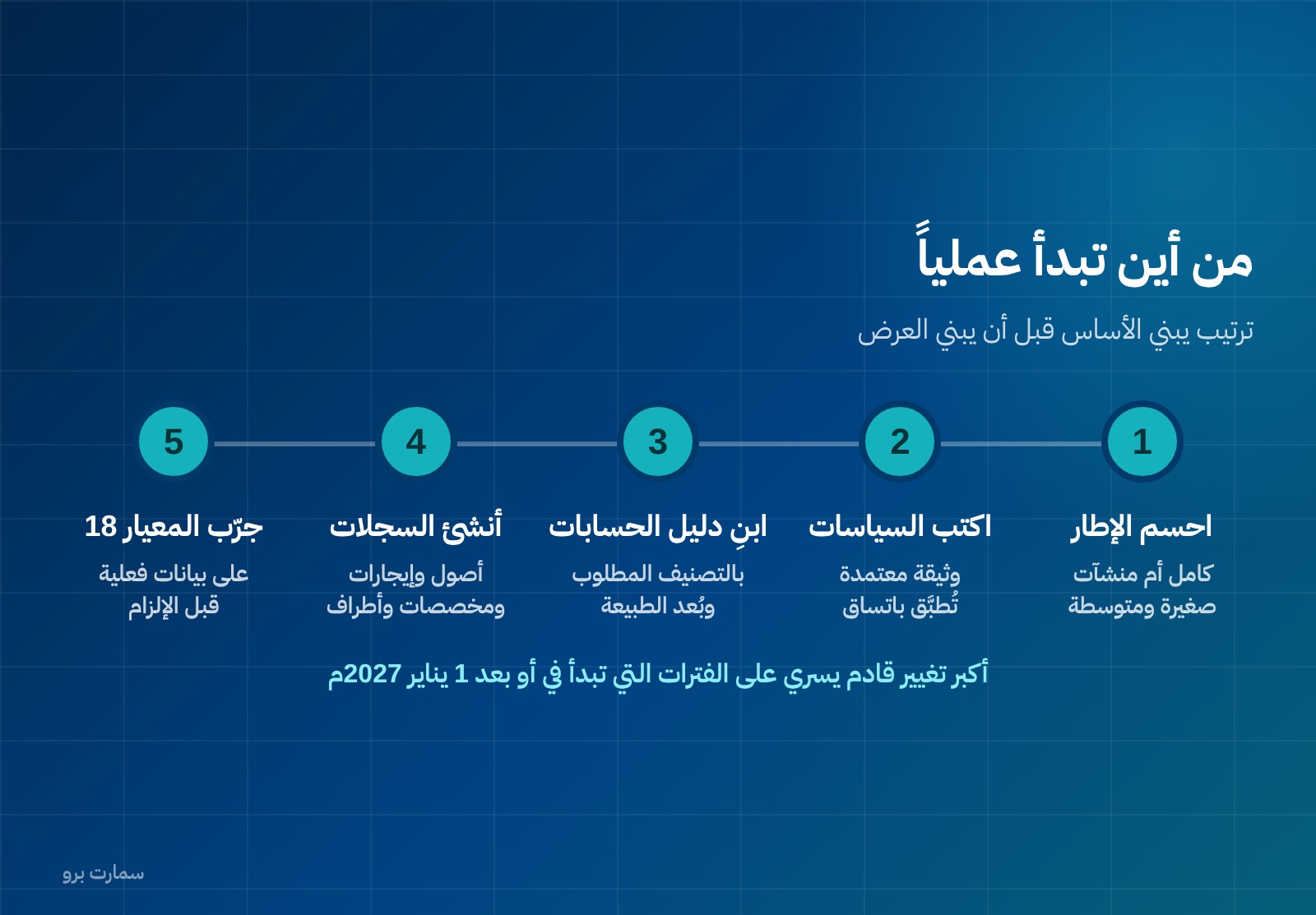
- Settle the framework that applies to your business: full IFRS or IFRS for SMEs.
- Write an accounting policies document and apply it consistently.
- Build a chart of accounts that carries the classification required by the new presentation, plus a nature dimension if you present expenses by function.
- Set up supporting registers: fixed assets, leases, provisions and related parties.
- Close each period with complete adjusting entries, not year-end estimates.
- Prepare the reconciliation schedule from accounting profit to the tax base.
- Start trialling IFRS 18 presentation on real data before it becomes mandatory.
Where is the official reference?
The standards endorsed in the Kingdom and their effective dates are published by the Saudi Organization for Chartered and Professional Accountants on its website, socpa.org.sa, and the original texts of the standards and their summaries are available from the IFRS Foundation at ifrs.org. The dates and frameworks above are taken from SOCPA's official pages, and any later update should be confirmed from the same source.
Read also
Article visuals
Frequently asked questions
Which accounting framework applies in Saudi Arabia?
There are two: full IFRS as endorsed by the Saudi Organization for Chartered and Professional Accountants (SOCPA) for entities with public accountability, and IFRS for SMEs for entities that publish general-purpose financial statements and have no public accountability. Non-profit entities apply IFRS for SMEs together with SOCPA's own standards for them.
When did IFRS become mandatory in the Kingdom?
Full IFRS became mandatory for entities with public accountability for financial periods beginning on or after 1-1-2017. IFRS for SMEs became mandatory for periods beginning on or after 1-1-2018, with early adoption permitted from 1-1-2017.
What does public accountability mean?
An entity has public accountability if it is listed on the capital market or in the process of listing, has traded debt instruments, or is a financial entity such as an investment fund. This test, not the size of the business alone, is what separates the two frameworks.
What is the biggest upcoming change to financial statements?
IFRS 18, which SOCPA endorsed by board decision on 25-06-1446H to replace IAS 1. It takes effect internationally for periods beginning on or after 1 January 2027, with early adoption permitted. It changes how the income statement is classified, requires two mandatory subtotals and adds disclosure of management-defined performance measures.