
Intangible Assets: When Do You Capitalise and When Is It an Expense?
The recognition criteria for intangible assets, how to treat research and development, software and trademarks, and the difference between finite and indefinite useful lives.
Author:سامي الحيدري
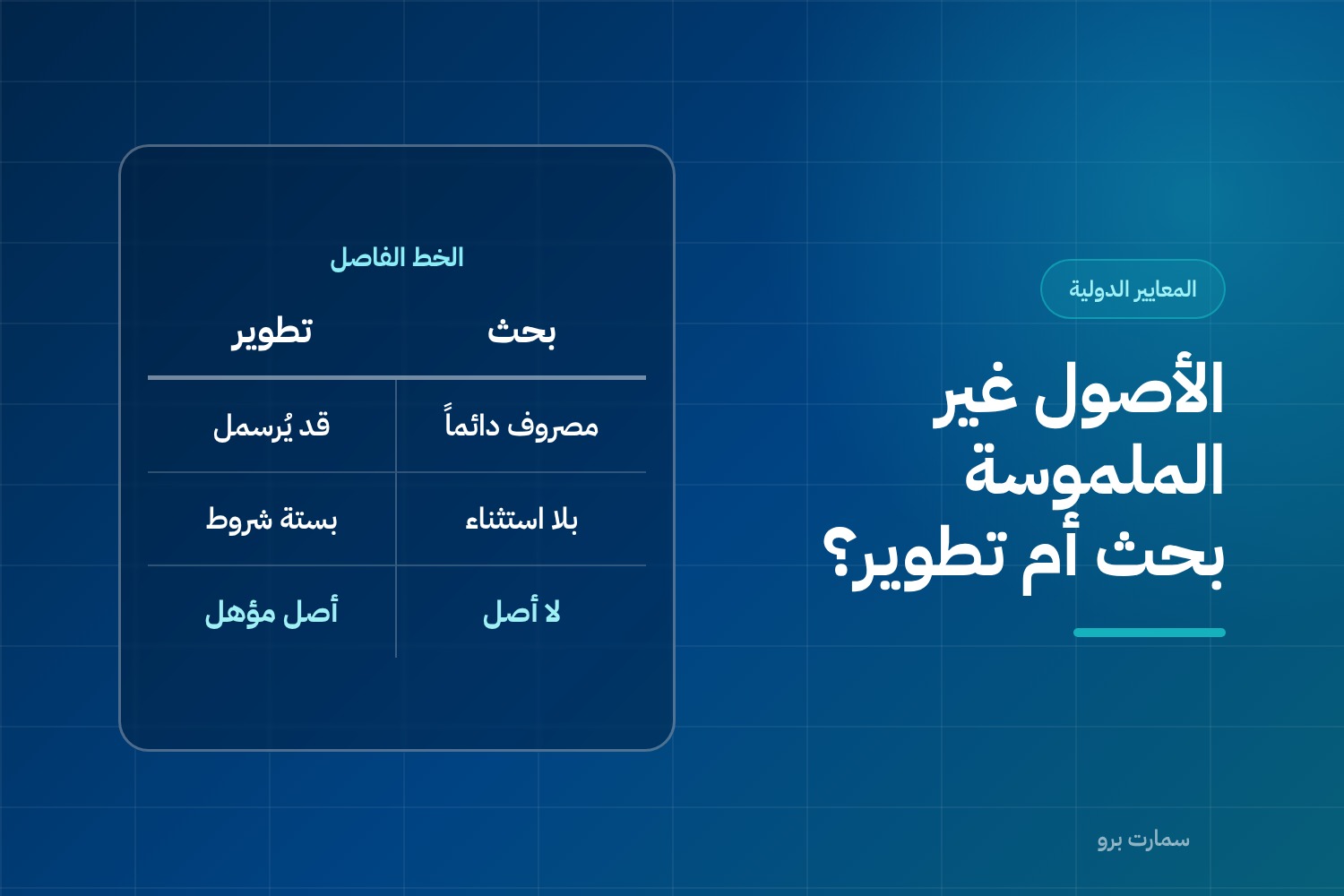
An intangible asset is capitalised only when it is identifiable, non-monetary and without physical substance, is likely to bring future economic benefits, and has a reliably measurable cost. Research spending is always an expense. Development spending is capitalised only when six conditions are all met. Internally generated brands, goodwill and customer lists are never capitalised.
Say a business spends SAR 1,000,000 developing an in-house system, SAR 200,000 on a brand campaign and SAR 50,000 on software licences. Which of these belongs on the balance sheet as an asset, and which goes to the income statement as an expense? The rules on intangible assets settle the question, and getting them wrong changes both the year's profit and the zakat deduction.
What is an intangible asset?
It is an asset that is non-monetary, identifiable and without physical substance. The identifiability test is met in one of two ways: the asset is separable, meaning it can be sold, licensed or rented out on its own, or it arises from contractual or other legal rights.
It is recognised as an asset when two conditions are met: future economic benefits are likely to flow from it, and its cost can be measured reliably.
Examples include purchased software, usage licences, franchise rights, purchased customer lists, patents and purchased trademarks.
Research and development: where is the line?
This is where most mistakes happen, yet the rule is clear.
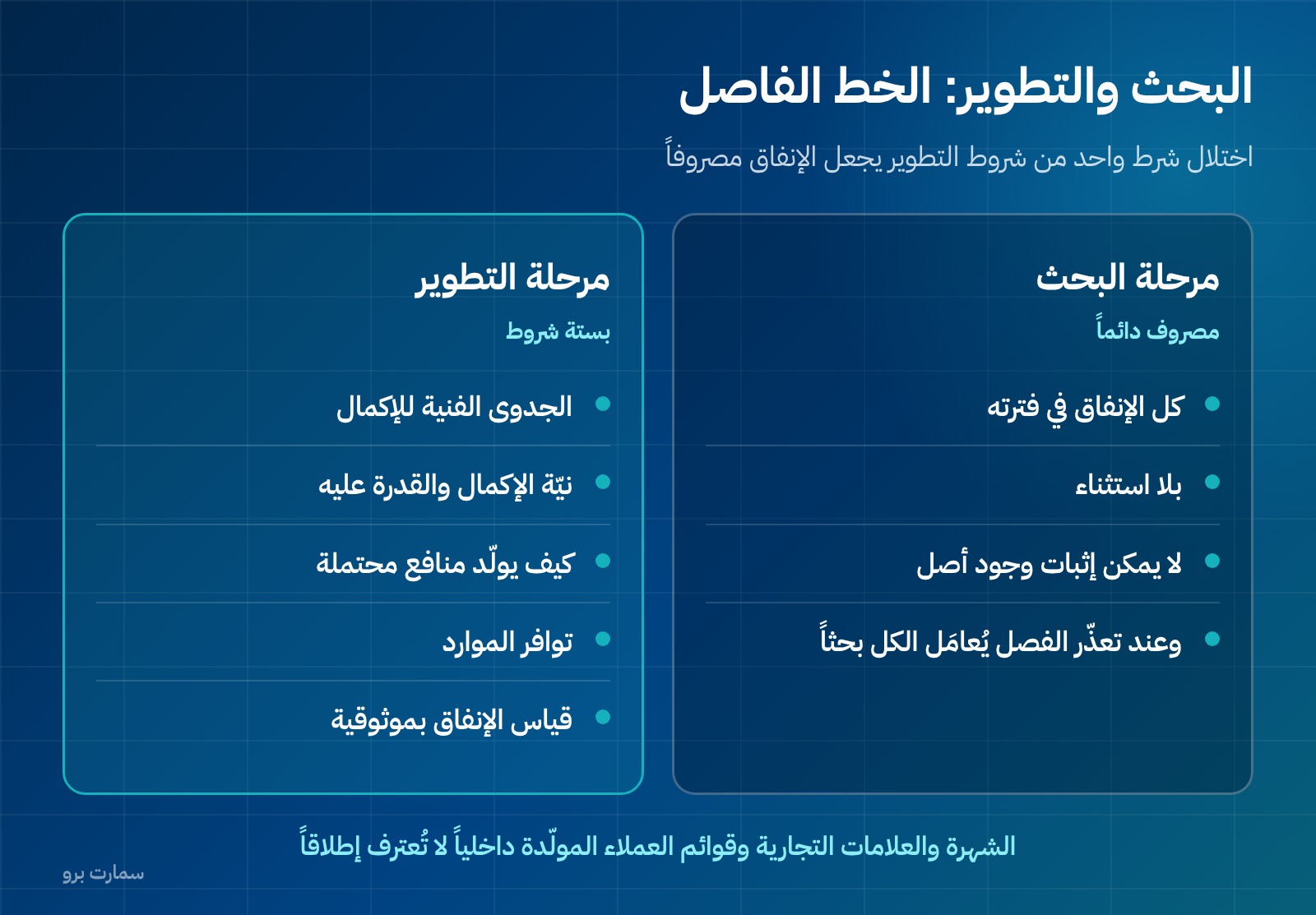
Research phase: all spending is an expense in the period it is incurred, without exception. At this stage the business cannot show that an asset exists that will generate benefits.
Development phase: spending is capitalised only if the business can demonstrate all of the following:
- The technical feasibility of completing the asset so it is available for use or sale.
- Its intention to complete the asset and use or sell it.
- Its ability to use or sell it.
- How the asset will generate probable future economic benefits.
- The availability of adequate technical and financial resources to complete it.
- Its ability to measure the spending reliably during development.
If even one condition fails, the spending is an expense. And if the two phases cannot be separated, all the spending is treated as research.
What is never capitalised?
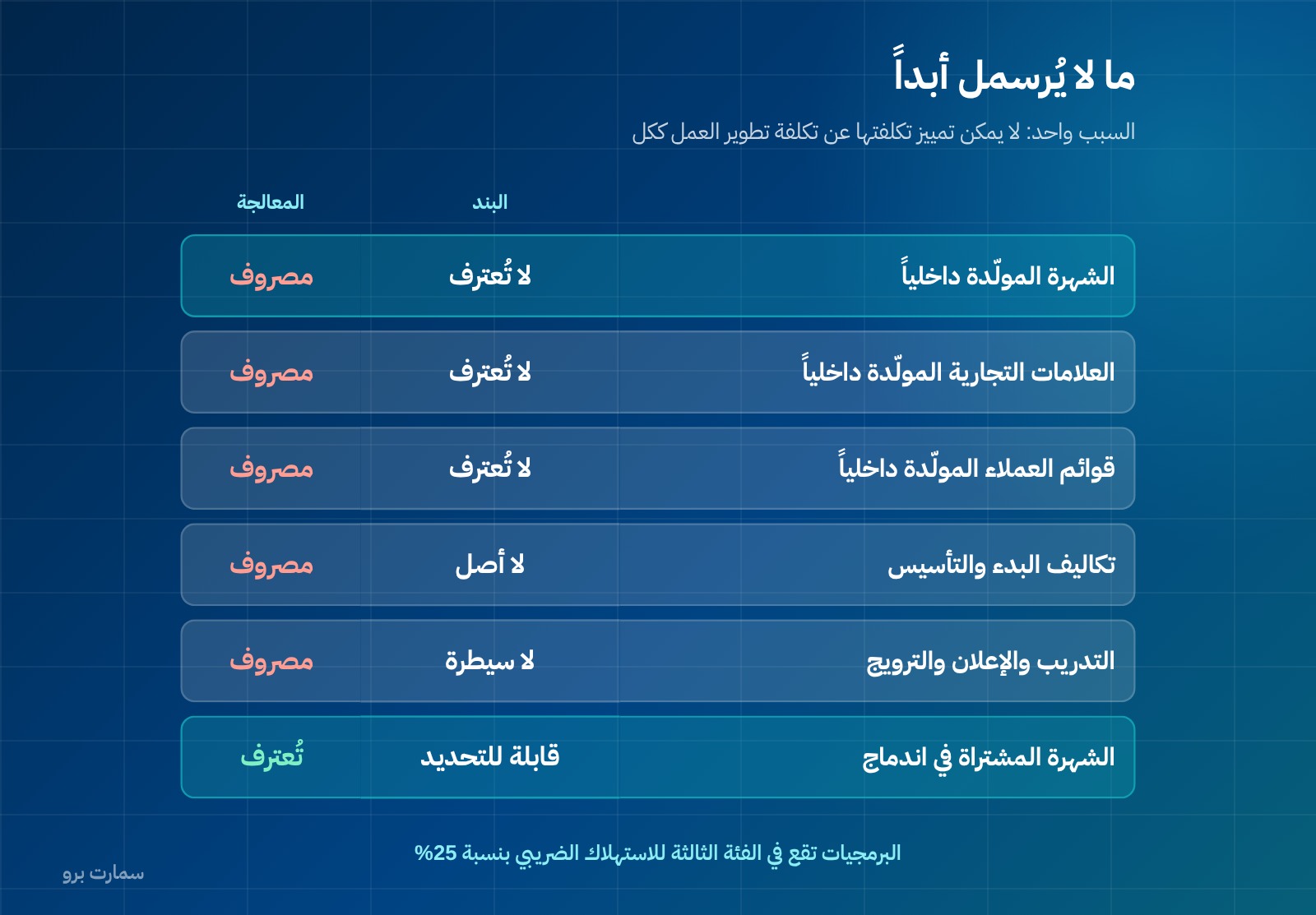
| Item | Treatment |
|---|---|
| Internally generated goodwill | Expense — never recognised |
| Internally generated trademarks | Expense |
| Internally generated customer lists | Expense |
| Internally generated publishing titles and mastheads | Expense |
| Start-up and formation costs | Expense |
| Training | Expense |
| Advertising and promotion | Expense |
| Relocation and reorganisation | Expense |
The reason is the same in every case: their cost cannot be distinguished from the cost of developing the business as a whole.
An important note: purchased goodwill acquired in a business combination is recognised, unlike internally generated goodwill. The difference is fundamental.
What is the difference between a finite and an indefinite useful life?
Finite life: the asset is amortised over its useful life using a method that reflects the pattern in which its benefits are consumed. The life and the method are reviewed every year. Amortisation (the intangible-asset equivalent of depreciation) starts when the asset becomes available for use.
Indefinite life: the asset is not amortised. Instead it is tested for impairment every year, and whenever there is an indication of impairment. The "indefinite" assessment is reviewed each period; if it changes to finite, the change is treated as a change in accounting estimate, as explained in accounting policies, estimates and errors.
"Indefinite" does not mean "infinite". It means there is no foreseeable limit to the period over which the asset is expected to generate benefits.
In both cases, impairment is applied under the asset impairment rules (IAS 36).
How is software treated?
Standalone purchased software is capitalised as an intangible asset.
Software embedded in a device that cannot work without it is treated as part of the fixed asset under the rules for property, plant and equipment.
A cloud subscription is usually not an asset, because the business does not control the software; it receives a service. The cost is expensed over the subscription term, unless a genuine right of control arises.
In-house development follows the research and development rules above.
A tax note: software falls in Class 3 for tax depreciation at 25%, which may differ from the accounting amortisation period and create a temporary difference (a gap between the accounting and tax values that reverses over time) — see accounting vs tax depreciation and the deferred tax rules (IAS 12).
How are intangible assets measured after recognition?
As with fixed assets, the business can choose for each class either the cost model (cost less accumulated amortisation and impairment losses) or the revaluation model. However, revaluation requires an active market for the asset, a condition rarely met for intangible assets. In practice, the cost model applies in most cases.
The useful life, amortisation method and residual value are reviewed every year. The residual value of an intangible asset is assumed to be zero unless a third party has committed to buy it at the end of its useful life, or there is an active market from which it can be determined and that market is expected to continue.
What are the common mistakes?
Capitalising spending because it is large. The size of the spending is not the test; the test is whether the recognition criteria are met.
Capitalising a whole team's salaries. Only costs directly attributable to creating and preparing the asset are capitalised, not the department's share of general salaries.
Amortising an indefinite-life asset. An indefinite-life asset is not amortised; it is tested for impairment every year.
Not revisiting "indefinite". The assessment is reviewed every period, and a change to finite is treated as a change in accounting estimate.
How do intangible assets affect zakat?
Intangible assets are among the items deducted from the zakat base under the Implementing Regulations for Zakat Collection. In other words, the capitalisation decision affects not only your profit but also your zakat base. The details are in zakat calculation for businesses.
Keeping each asset class on its own account in the chart of accounts makes this deduction easy to trace. In SmartPro's Finance & Accounting system, cost centres and custom reports help you track additions, amortisation and the balance of each class.
Checklist
- A written policy that separates research from development and defines the point of transition.
- A file for each capitalised project documenting that all six conditions are met.
- No asset in the register from the "never capitalised" list.
- Each asset's life classified as finite or indefinite, with the basis for the classification.
- Indefinite-life assets tested for impairment every year.
- Cloud software subscriptions treated as expenses unless proven otherwise.
- A movement schedule for each class: cost, additions, disposals and accumulated amortisation.
- The zakat deduction effect calculated.
Official references
International standards as endorsed in the Kingdom are published by the Saudi Organization for Chartered and Professional Accountants (SOCPA) on its website: socpa.org.sa, and the texts of the standards are available from the IFRS Foundation at ifrs.org. Tax depreciation classes and zakat deduction rules are published by the Zakat, Tax and Customs Authority (ZATCA) at zatca.gov.sa.
Read also
- Property, plant and equipment: recognition, measurement and depreciation
- Accounting depreciation vs tax depreciation
- Accounting policies, estimates and errors
Key takeaway: Capitalise an intangible only when the recognition criteria are met, never because the spend is large; expense research and internally generated brands, goodwill and customer lists. Your decision moves both profit and the zakat base, so document it.
To see how SmartPro keeps your asset accounts and reports in order, start a free trial or book a demo.
Article visuals
Frequently asked questions
When is development spending capitalised?
Development spending is capitalised only when six conditions are demonstrated together: technical feasibility of completion, the intention to complete, the ability to use or sell the asset, how it will generate probable economic benefits, the availability of technical and financial resources, and the ability to measure the spending reliably. If even one condition fails, the spending is an expense.
Is research spending capitalised?
No. All spending in the research phase is expensed in its period without exception, because the business cannot show that an asset exists that will generate benefits. If research and development cannot be separated, all the spending is treated as research.
What is never recognised as an intangible asset?
Internally generated goodwill, trademarks, customer lists and publishing titles, along with start-up and formation costs, training, advertising and promotion, and reorganisation costs. Their cost cannot be distinguished from the cost of developing the business as a whole. Goodwill purchased in a business combination, however, is recognised.
How are cloud software subscriptions treated?
They are usually expensed over the subscription term, because the business does not control the software but receives a service, unless a genuine right of control arises. Standalone purchased software is capitalised as an intangible asset, and software embedded in a device that cannot work without it is treated as part of the fixed asset.