
Asset Impairment: When to Test and How to Calculate
Impairment indicators, how the recoverable amount is calculated, cash-generating units, and when an impairment loss may be reversed.
Author:سامي الحيدري

Depreciation spreads an asset's cost evenly over its useful life. Asset impairment is different: it recognises that an asset is no longer worth its carrying amount at all, because a production line has stopped, the technology is obsolete or the market has turned. Depreciation is certain and scheduled. Impairment is an event that calls for a test and a decision.
When should you test assets for impairment?
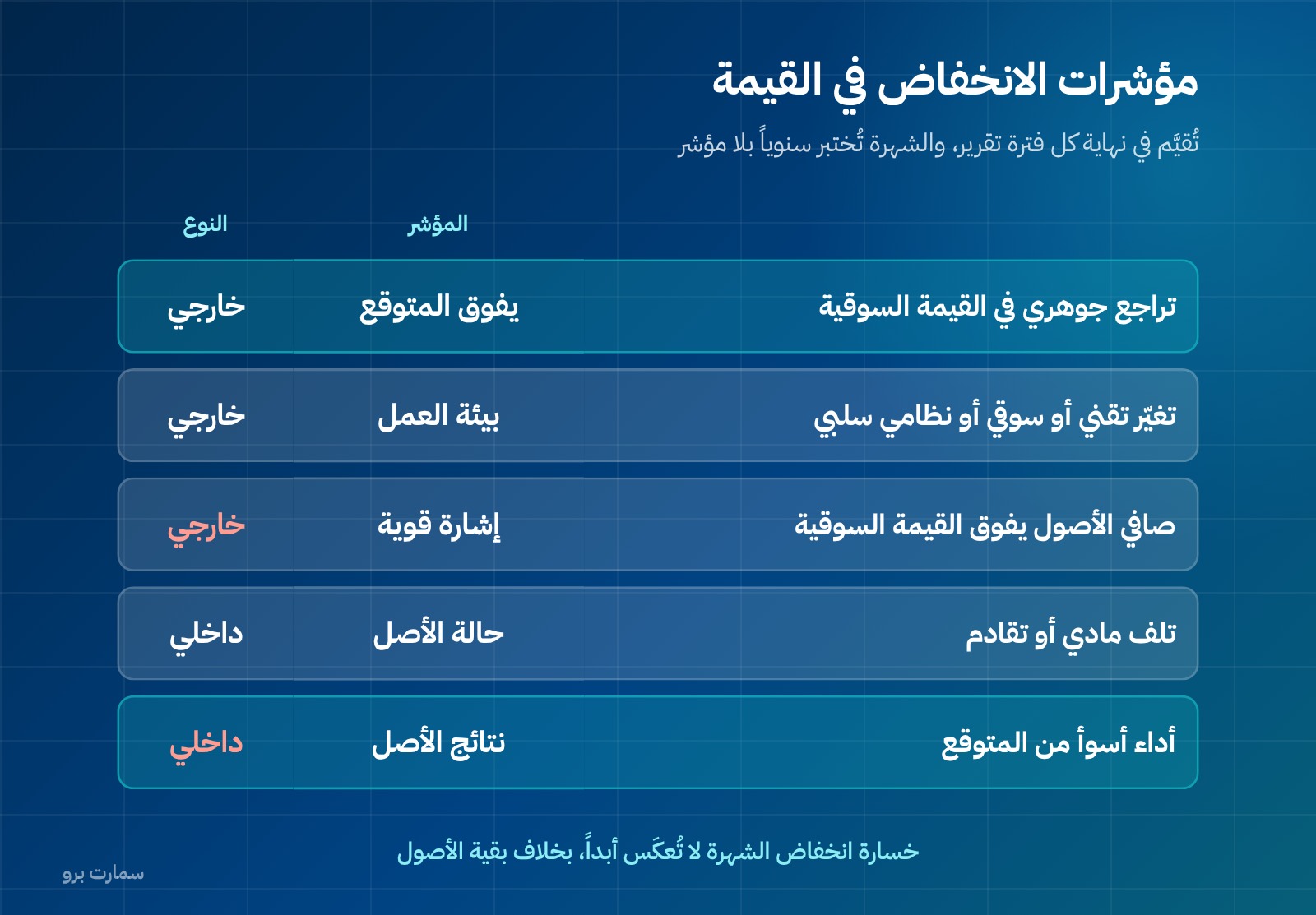
The general rule is that at the end of each reporting period, the business assesses whether there is any indication that an asset may be impaired. If there is, it estimates the asset's recoverable amount.
External indicators
- A significant fall in the asset's market value, beyond what normal use or the passage of time would explain.
- Adverse changes in the technological, market, economic or regulatory environment.
- Higher market rates of return that reduce the present value of future cash flows.
- The business's net assets exceeding its market value.
Internal indicators
- Physical damage or obsolescence.
- The asset falling idle, or plans to discontinue or restructure the activity, or to dispose of the asset early.
- Economic performance of the asset that is worse than expected.
What is the recoverable amount?
The recoverable amount is the higher of two values:
- Fair value less costs of disposal: what you would receive if you sold the asset today.
- Value in use: the present value of the future cash flows expected from continuing to use the asset.
If either value exceeds the carrying amount, there is no impairment, and you do not need to calculate the other one.
If the recoverable amount is below the carrying amount, the carrying amount is written down to the recoverable amount, and the difference is recognised immediately as an impairment loss in the income statement.
What is a cash-generating unit?
Many assets do not generate cash flows independently: a machine inside a production line, or a branch within a network. In these cases the test is performed at the level of the cash-generating unit, which is the smallest identifiable group of assets that generates cash inflows largely independent of those from other assets.
A loss at unit level is allocated in order: first to any goodwill allocated to the unit, then to the unit's other assets pro rata to their carrying amounts. No individual asset is written down below the highest of its fair value less costs of disposal, its value in use, or zero.
How is goodwill treated?
Goodwill is not amortised for accounting purposes. Instead, it is tested for impairment every year, whether or not there is an indicator, and also whenever an indicator appears. It is allocated to the cash-generating units expected to benefit from the synergies of the combination.
An impairment loss on goodwill is never reversed, even if conditions improve. This is an important exception to the general rule.
A note for the Saudi context: for tax purposes, goodwill is depreciated at 10% within Class 5 under the Income Tax Law, unlike the accounting treatment, which tests goodwill rather than amortising it. This difference needs managing in the reconciliation schedule. See accounting depreciation vs tax depreciation.
When can an impairment loss be reversed?
For assets other than goodwill: if the estimates used to determine the recoverable amount have changed in a way that justifies it, the impairment is reversed. However, the reversal is capped at the carrying amount the asset would have had, net of depreciation, if no loss had been recognised in the first place.
In other words, a reversal never lifts the asset above its normal path.
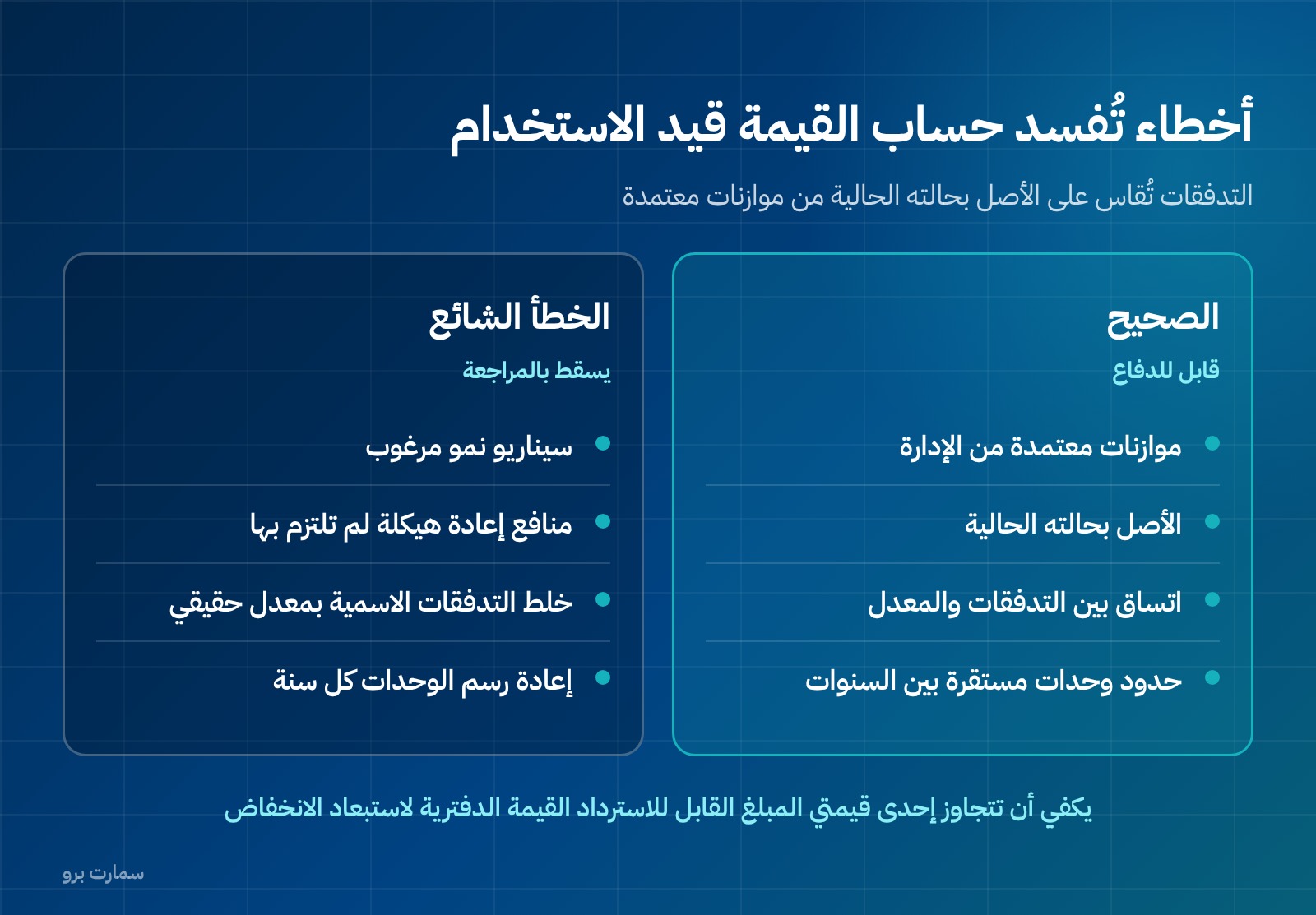
What are the common calculation mistakes?
Cash flows built on optimism. Value in use is calculated from budgets approved by management, not from a hoped-for growth scenario. The standard limits the period of detailed forecasts and requires a reasonable basis for the years beyond it.
Including future expansions. Cash flows are measured for the asset in its current condition. Do not include benefits from a restructuring the business has not yet committed to, or improvements that have not been carried out.
Mixing discounting and inflation. If the cash flows are nominal, the discount rate must be nominal; if they are real, the rate must be real. Mixing the two changes the result materially.
Redrawing unit boundaries between years. Redefining cash-generating units every year makes comparison impossible and opens the door to choosing the result.
Forgetting the annual goodwill test. Goodwill is tested every year, even when no indicator has appeared.
How does impairment affect the financial statements and zakat?
An impairment loss is charged to the income statement and reduces net assets in the statement of financial position. As a result, it also reduces the zakat deduction for net fixed assets. See zakat calculation for businesses.
Under IFRS 18, effective for periods beginning on or after 1 January 2027, a business that presents expenses by function must disclose the impairment losses included in each operating line item. The details are in IFRS 18: presentation and disclosure.
How is it different from an inventory write-down?
Writing inventory down to net realisable value is not impairment in the sense used here. It has its own standard and its own rule: the lower of cost and net realisable value, assessed item by item. The details are in inventory valuation. Confusing the two leads to the wrong treatment when a write-down is reversed, because the reversal rules differ in each case.
What should an annual impairment review checklist include?
- The assessment of impairment indicators is carried out and documented for each asset class.
- Cash-generating units are defined and stable between periods.
- Cash flows used in value in use are based on approved budgets, not optimism.
- The discount rate is documented and the basis for setting it is written down.
- Goodwill is tested every year, regardless of indicators.
- Unit-level losses are allocated in the correct order.
- Any reversals stay within the normal path and do not include goodwill.
- The effect on the zakat deduction is calculated.
Keeping an asset register, depreciation and journal entries in one connected system makes this review easier to document; SmartPro's finance and accounting handles automated entries and financial statements.
Where is the official reference?
The international standards as endorsed in the Kingdom are published by the Saudi Organization for Chartered and Professional Accountants (SOCPA) on its website, socpa.org.sa, and the full texts of the standards are available from the IFRS Foundation at ifrs.org. Tax depreciation classes are published by the Zakat, Tax and Customs Authority (ZATCA) at zatca.gov.sa.
Read also
- Property, plant and equipment: recognition, measurement and depreciation
- Inventory valuation: the permitted methods
Key takeaway: Test for impairment whenever an indicator appears, and test goodwill every year; write the asset down to the higher of fair value less costs of disposal and value in use, and reverse only within the asset's normal path, never for goodwill.
To see how connected accounting supports your year-end review, book a demo or start a free trial.
Article visuals
Frequently asked questions
What is the difference between depreciation and an impairment loss?
Depreciation systematically allocates an asset's cost over its useful life and happens regularly without any triggering event. An impairment loss recognises that an asset is no longer worth its carrying amount because of an event or circumstance, and it requires a test when an indicator appears.
What is the recoverable amount?
It is the higher of fair value less costs of disposal and value in use, which is the present value of the cash flows expected from continuing to use the asset. If either one exceeds the carrying amount, there is no impairment and the other does not need to be calculated.
What is a cash-generating unit?
It is the smallest identifiable group of assets that generates cash inflows largely independent of other assets. The impairment test is performed at this level when a single asset does not generate independent cash flows, such as a machine inside a production line or a branch within a network.
Can an impairment loss be reversed?
Yes, for assets other than goodwill, if the estimates have changed in a way that justifies it. The reversal is capped at the carrying amount, net of depreciation, that would have existed had no loss been recognised. An impairment loss on goodwill is never reversed, even if conditions improve.