
Investment Property: Classification, Measurement and Transfers
When a property counts as investment property, how the fair value model differs from the cost model, and when a property moves from one category to another.
Author:سامي الحيدري

Investment property is land or a building held to earn rentals, for capital appreciation, or both, rather than for the business's own use or for sale. Its classification decides whether the property is depreciated or remeasured, where value changes are recorded, and how it enters the zakat base. One building can hold three different classifications.
Take a building your company owns: one floor is occupied by your own management, two floors are leased to an outside tenant, and one floor is on the market for sale. That is three different accounting classifications in a single property. Classifying investment property correctly is not a formality.
What is investment property?
It is property (land, a building, or part of a building) held to earn rentals, for capital appreciation, or both. It is not held for use in production, for supplying goods or services, or for administrative purposes, and it is not held for sale in the ordinary course of business.
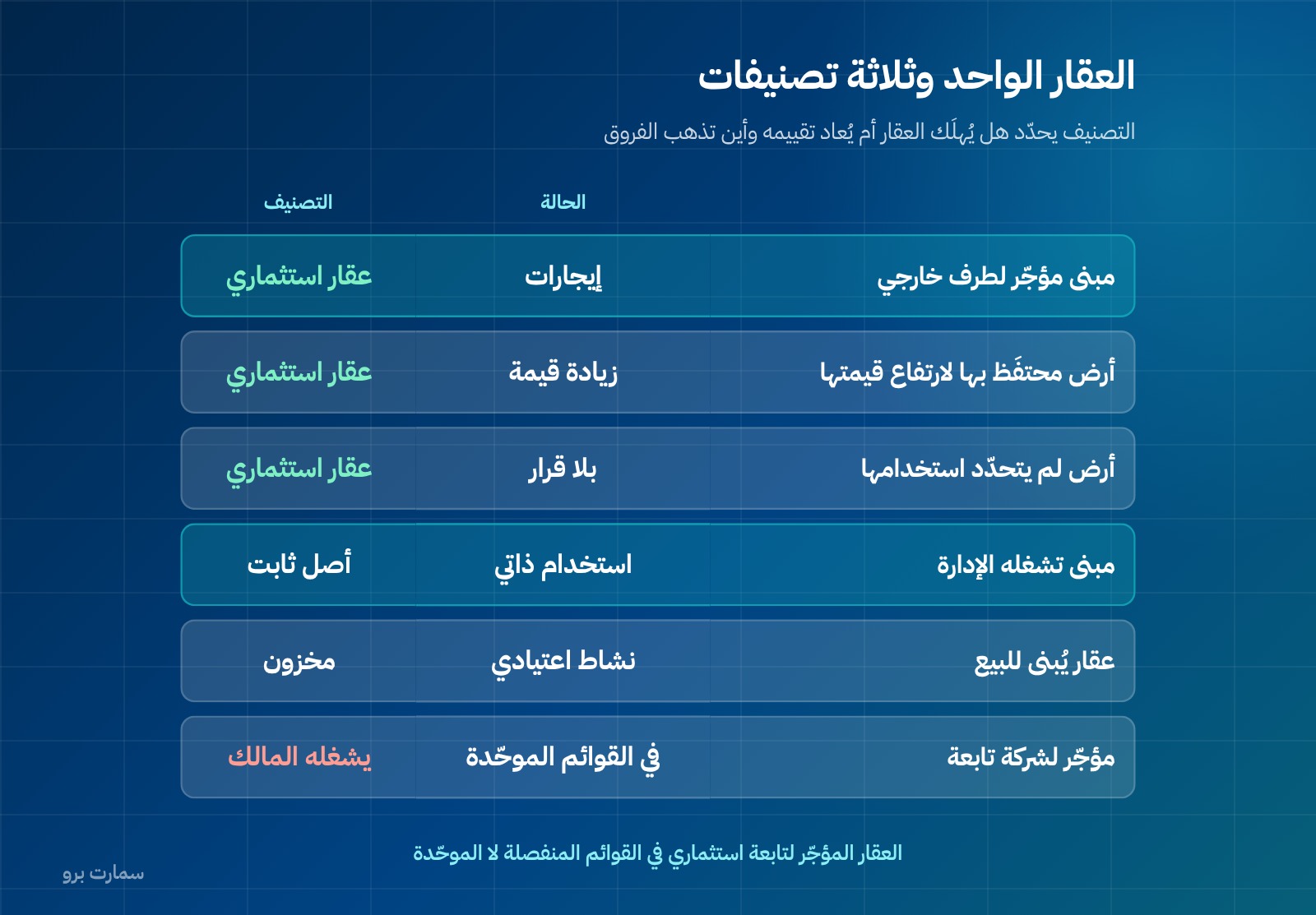
| Situation | Classification | Standard |
|---|---|---|
| Building leased to an outside party | Investment property | — |
| Land held for its rise in value | Investment property | — |
| Land whose future use is not yet decided | Investment property | — |
| Building occupied by management | Property, plant and equipment | Property, plant and equipment |
| Property being built for sale in the ordinary course of business | Inventory | Inventory valuation |
| Property leased to a subsidiary | Not investment property in the consolidated statements | — |
The last row needs care. A property leased to a subsidiary counts as investment property in the lessor's separate financial statements. In the group's consolidated statements, however, it is owner-occupied property, because the group as a whole uses it.
How is a dual-use property treated?
When part of a property is held for rental or capital appreciation and another part is used by the business itself:
- If the two parts could be sold or leased out separately: account for each part on its own.
- If they could not: the whole property is classified as investment property only if the portion the business uses is insignificant.
The same logic applies when you provide ancillary services to the occupants. The property remains investment property if those services are insignificant to the arrangement as a whole, such as security and maintenance. A hotel that provides significant services, by contrast, is owner-occupied property, not investment property.
What are the two measurement models?
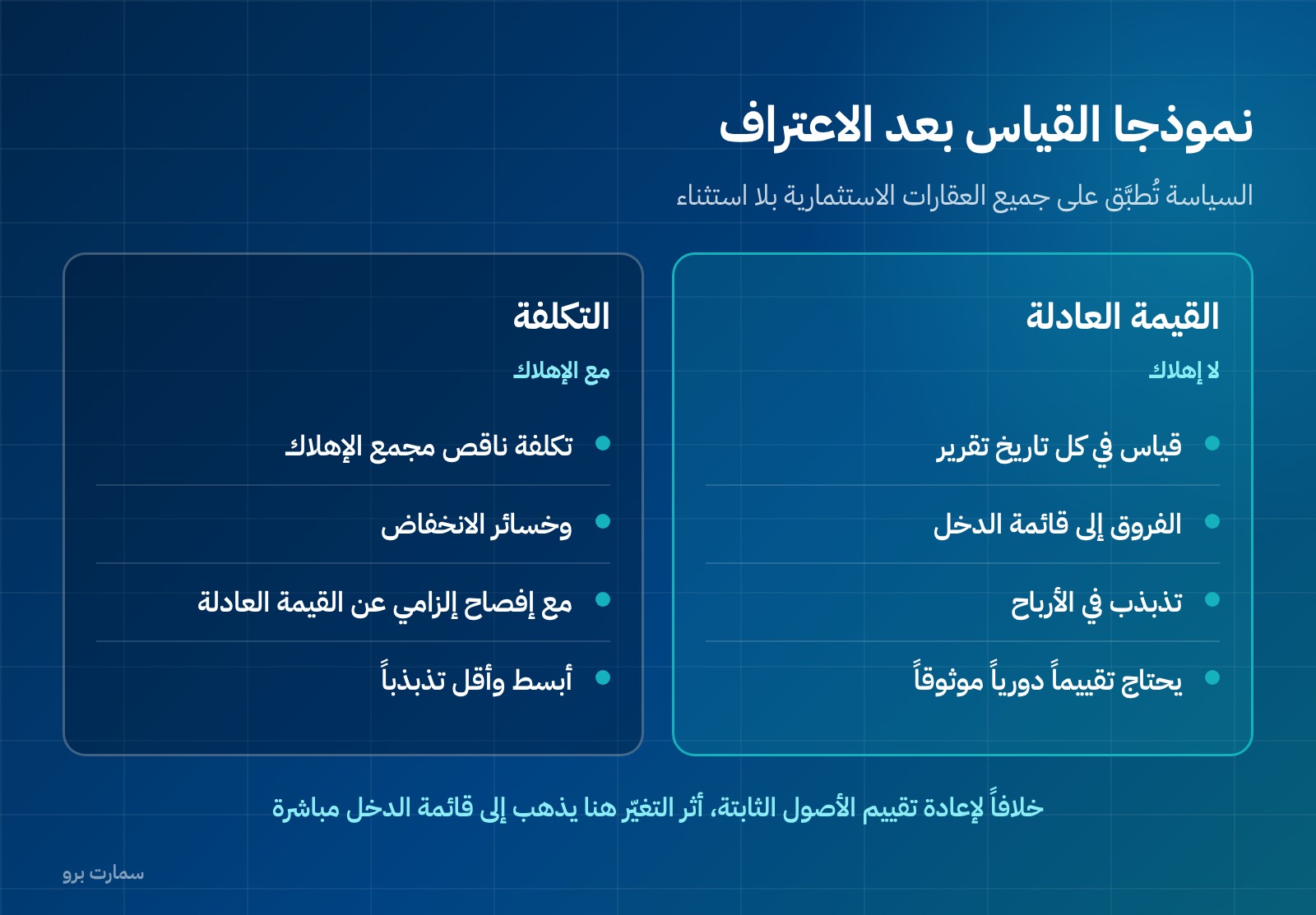
After initial recognition at cost, the business chooses one accounting policy and applies it to all of its investment property:
Fair value model: the property is measured at its fair value at each reporting date and is not depreciated. Gains and losses from changes in fair value are recognised in the income statement in the period in which they arise. Fair value is the price that would be received to sell the asset in an orderly transaction between market participants.
Cost model: the property is measured at cost less accumulated depreciation and impairment losses, just like property, plant and equipment. Even so, its fair value must be disclosed in the notes.
Note the key difference from revaluing property, plant and equipment. There, a revaluation surplus goes to other comprehensive income; here, the change in value goes straight to the income statement. That makes the fair value model a real source of volatility in reported profit.
When is a property transferred between categories?
Transfers are made only when there is evidence of a change in use:
- The owner starts occupying the property: from investment property to property, plant and equipment.
- Development starts with a view to sale: from investment property to inventory.
- Owner occupation ends: from property, plant and equipment to investment property.
- An operating lease to another party begins: from inventory to investment property.
Management's intention alone is not enough. A transfer requires an actual change in use.
Under the fair value model, the fair value at the date of transfer becomes the deemed cost for subsequent accounting.
Where do businesses go wrong with fair value?
The fair value model looks attractive because it shows an up-to-date value and removes depreciation. But it brings costs and obligations:
Reliable, regular valuation. Fair value is measured at every reporting date, not every few years. An internal estimate with no market basis will not hold up.
Profit volatility. The change in value goes straight to the income statement, so your profit moves with the property market rather than with the performance of your business. This distorts the operating margin and the profitability ratios covered in our guide to financial ratios.
No way back. The policy must be applied consistently, and a switch from fair value to cost is unlikely to produce a more relevant presentation, so in practice it is not available.
A narrow exception. Departing from the model for a particular property is allowed only in the limited case where its fair value cannot be measured reliably on a continuing basis.
What is the zakat and tax impact?
Investment property is presented within non-current assets, but it is not a "fixed asset" in the operating sense. Its classification affects the net fixed assets item that is deducted from the zakat base, so the deduction needs to be handled clearly. See our guide to zakat calculation for businesses.
Fair value gains are unrealised and are treated for tax purposes differently from their accounting treatment, so they become an item in the reconciliation schedule. See our guide to the income tax return in Saudi Arabia and the treatment of deferred tax.
When is investment property derecognised?
Investment property is derecognised on disposal, or when it is permanently withdrawn from use and no future economic benefits are expected from its disposal. The gain or loss, being the difference between the net disposal proceeds and the carrying amount, is recognised in the income statement in the period of disposal and is not presented as revenue.
Checklist
- Every property is classified in writing, with the reason for its classification.
- Dual-use properties are assessed against the separability and significance tests.
- A measurement model is chosen and applied to all investment property without exception.
- Fair value is disclosed even where the cost model is chosen.
- The source of the fair value estimate is documented, and independent where needed.
- Transfers are based on an actual change in use, not on intention.
- Property leased to a subsidiary is treated differently in the separate and consolidated statements.
- The effect of classification on the zakat deduction is calculated.
Official reference
The international standards as endorsed in the Kingdom are published by the Saudi Organization for Chartered and Professional Accountants (SOCPA) on its website: socpa.org.sa. The texts of the standards are available from the IFRS Foundation at ifrs.org.
Read also
- Property, plant and equipment: recognition, measurement and depreciation
- Lease contracts under IFRS 16: the right-of-use asset and the lease liability
- Notes to the financial statements: what must they include?
Key takeaway: Classify each property by how it is actually used, choose one measurement model for all investment property, and remember that fair value changes hit the income statement directly while still requiring a clear zakat treatment.
If you manage rental properties, you can try SmartPro's real estate solution through a free trial.
Article visuals
Frequently asked questions
What makes a property an investment property?
A property is investment property when it is held to earn rentals, for capital appreciation, or both. It must not be held for use in production, for supplying goods or services, for administrative purposes, or for sale in the ordinary course of business. Land whose future use has not yet been decided is also treated as investment property.
How is a dual-use property treated?
If the part held for rental or appreciation and the part used by the business could be sold or leased out separately, each part is accounted for on its own. If they could not, the whole property is classified as investment property only if the portion used by the business is insignificant.
What is the difference between the fair value model and the cost model?
The fair value model measures the property at fair value at each reporting date without depreciation, and changes in value go straight to the income statement. The cost model measures it at cost less depreciation and impairment losses, but fair value must still be disclosed in the notes. Whichever model is chosen applies to all of the business's investment property.
When is a property transferred from one category to another?
Only when there is actual evidence of a change in use: the owner starts occupying it, development starts with a view to sale, owner occupation ends, or an operating lease to another party begins. Management's intention alone is not enough to justify a transfer.