
IFRS 19: Reduced Disclosures for Eligible Subsidiaries
What IFRS 19 allows eligible subsidiaries to do, the eligibility conditions, what stays the same, and its effective date and link to IFRS 18.
Author:سامي الحيدري
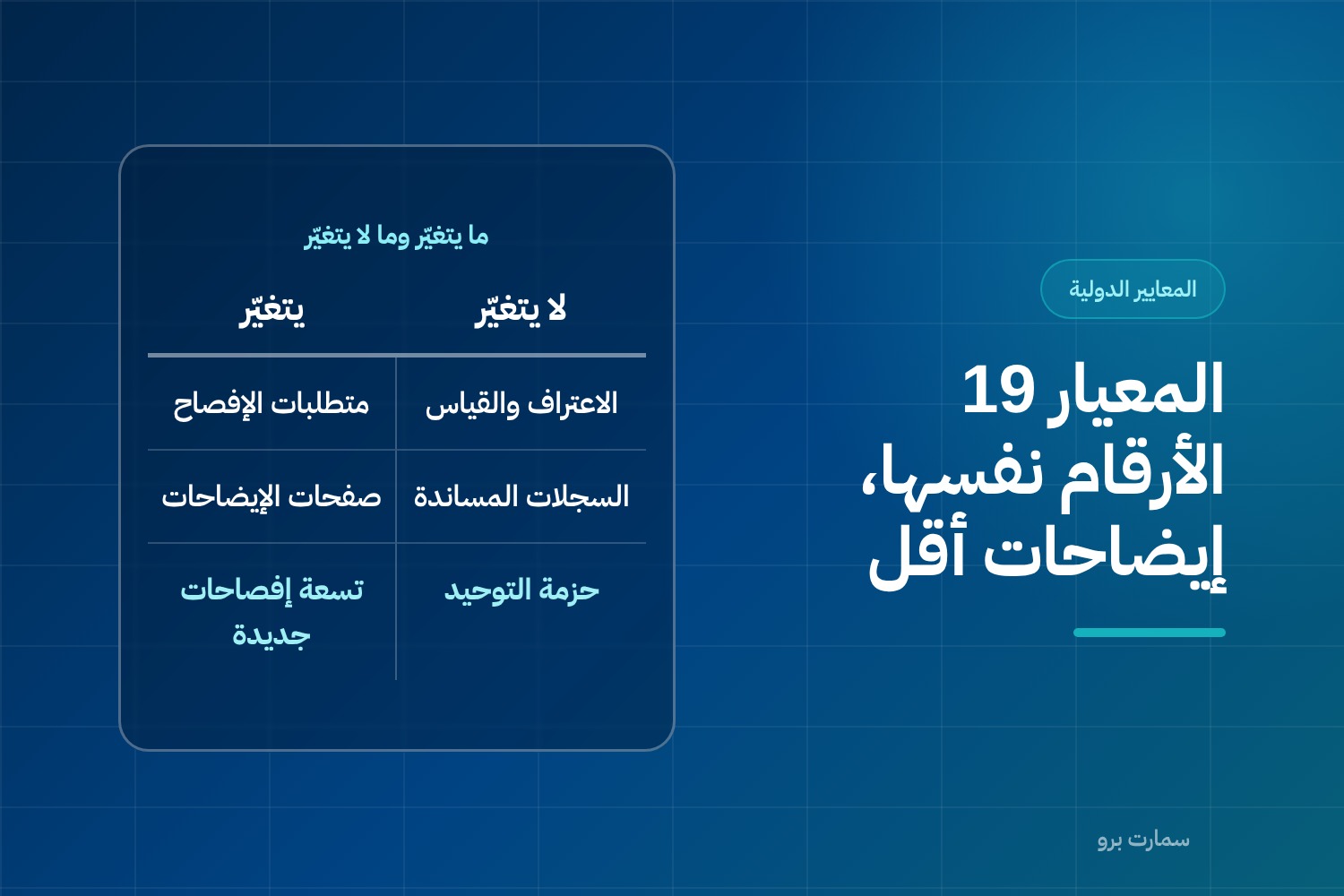
A subsidiary of a large group may prepare financial statements with every IFRS disclosure, yet its real readers are few: the parent, a bank and a regulator. The parent already publishes fully disclosed consolidated statements. IFRS 19 was issued to fix exactly this. It gives eligible subsidiaries reduced disclosures without changing what they recognise and measure.
What does IFRS 19 do, and what doesn't it do?
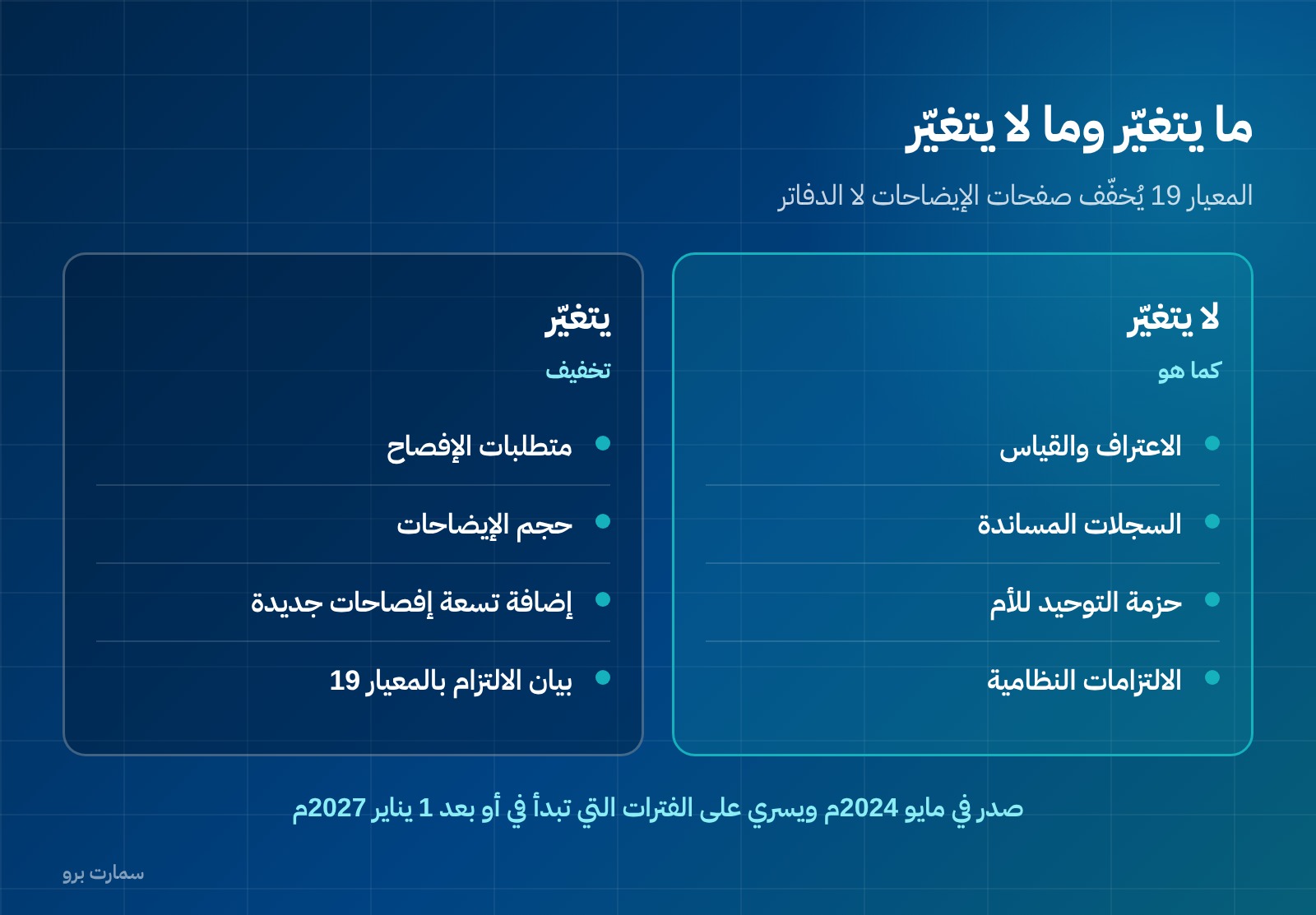
The decisive point first: IFRS 19 does not change recognition and measurement. The entity keeps applying the non-disclosure requirements of the other standards as they are, including revenue recognition, inventory measurement, asset depreciation and lease accounting.
What it replaces is the disclosure requirements only. An eligible entity applies a reduced set of disclosures drawn from the other standards instead of the full disclosures.
In one sentence: the same numbers, fewer notes.
Who is eligible for IFRS 19?
The standard is aimed at subsidiaries that meet a set of conditions. The main ones are that the entity is a subsidiary, that it has no public accountability, and that its parent, ultimate or intermediate, publishes consolidated financial statements available for public use that comply with IFRS (paragraph 7(c)).
The logic is simple. If the full information is already available to the public in the group's statements, repeating it in the subsidiary's statements is a burden with no added benefit.
Public accountability is the same concept that separates the two frameworks in Saudi Arabia. It covers entities that are listed or in the process of listing, entities with traded debt instruments, and financial institutions such as investment funds. See IFRS in Saudi Arabia: the complete guide.
What does IFRS 19 add?
Alongside the reductions, the standard adds nine new disclosure items, including:
- A statement of compliance that the entity has applied IFRS 19.
- Optional segment information; if it is presented, the entity must state that it does not comply with IFRS 8.
- The name of the parent, ultimate or intermediate, that publishes the qualifying consolidated statements.
- Additional explanations of management judgements.
The standard also refers to certain existing disclosures in other standards that remain in force despite the reductions.
When does IFRS 19 take effect?
The International Accounting Standards Board (IASB) issued the standard in May 2024. It applies to annual periods beginning on or after 1 January 2027, with early application permitted.
That is the same year IFRS 18 on presentation and disclosure takes effect, which makes 2027 a double turning point for how financial statements are presented and disclosed. The standard also allows an entity to apply it early, before the period in which it first applies IFRS 18.
The adoption status in the Kingdom is published by the Saudi Organization for Chartered and Professional Accountants (SOCPA) on its website, and that is the reference to rely on before any decision to apply it.
How is IFRS 19 different from IFRS for SMEs?
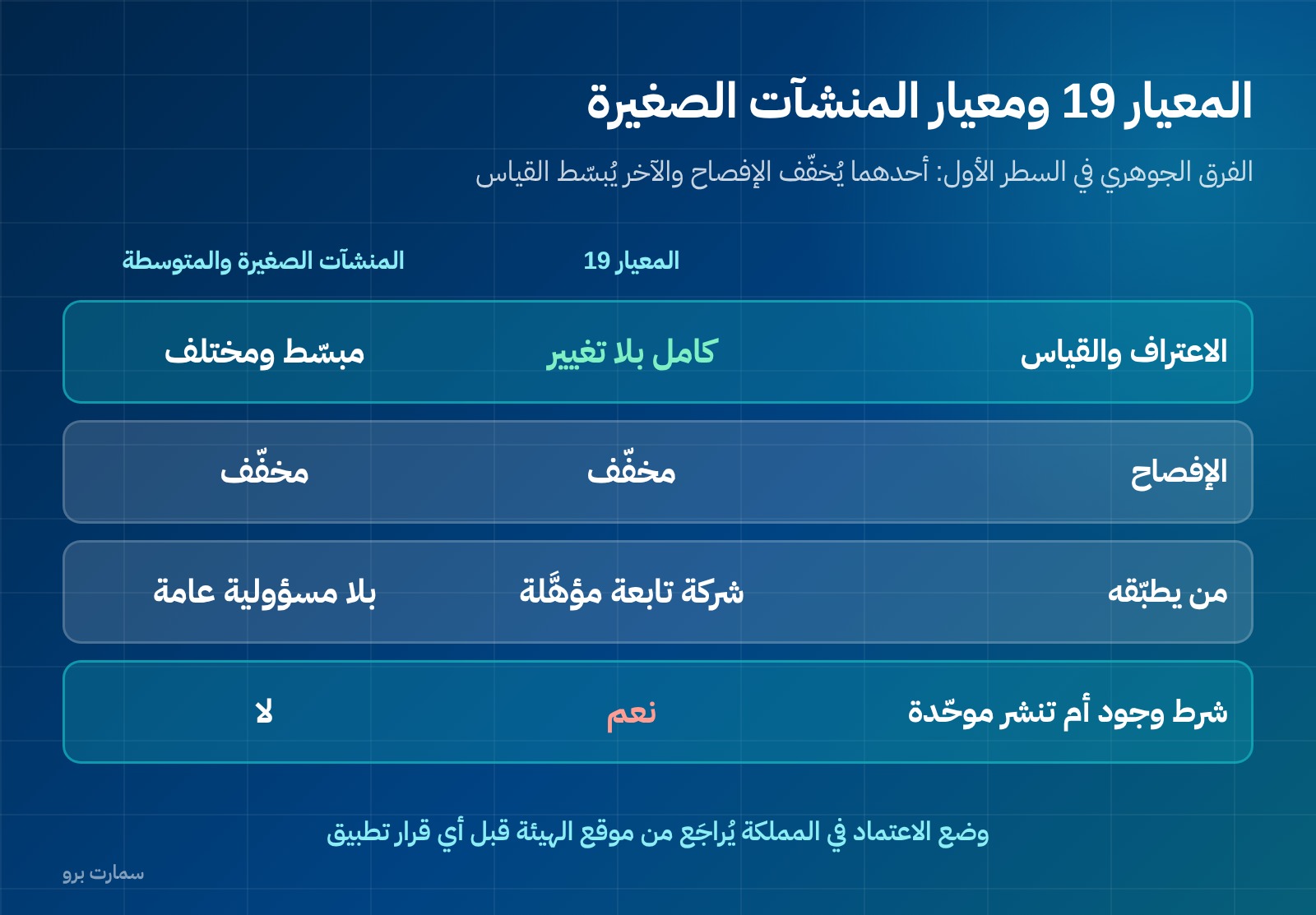
| Aspect | IFRS 19 | IFRS for SMEs |
|---|---|---|
| Recognition and measurement | Unchanged, as in full IFRS | Simplified and different for several items |
| Disclosure | Reduced | Reduced |
| Who applies it | Eligible subsidiary | Entity without public accountability that publishes general-purpose statements |
| Requires a parent publishing consolidated statements | Yes | No |
The essential difference is in the first row: IFRS 19 reduces disclosure while keeping full measurement, whereas IFRS for SMEs simplifies the measurement itself. For details, see our article on IFRS for SMEs.
Who benefits in practice?
Groups with several subsidiaries, each preparing fully disclosed statements with no real external reader.
Subsidiaries of foreign companies in the Kingdom that prepare local statements while the parent publishes full consolidated statements.
Entities with small finance teams, where preparing the notes takes up a large share of the year's work.
It does not help entities with public accountability, standalone entities without a parent, or entities whose parent publishes statements that do not comply with IFRS or are not available for public use.
What do the reduced disclosures not remove?
Lighter disclosure does not mean lighter accounting work. The entity is still required to maintain:
- Full measurement of every item under its own standard: provisions, employee benefits, deferred tax and expected credit losses.
- Supporting records that prove that measurement: the fixed asset register, provision movement schedules and the related-party file.
- The consolidation pack for the parent in full detail, because the parent needs the data to prepare its full consolidated statements.
- Non-accounting regulatory obligations: e-invoicing, tax returns and record keeping.
An entity expecting IFRS 19 to shorten its accounting work will be surprised: it shortens the pages of notes, not the books.
What should you do now?
- Determine whether your entity is a subsidiary of a group that publishes IFRS-compliant consolidated statements available for public use.
- Confirm that the entity has no public accountability.
- Check the adoption status in the Kingdom on SOCPA's website before any decision.
- List the notes you prepare today and estimate which would fall away.
- Coordinate with the parent: reduced disclosure in the subsidiary does not reduce the consolidation pack requirements.
- Agree the impact with your external auditor before the year-end close.
- Decide your position on early application and how it relates to the timing of IFRS 18.
Where is the official reference?
The adoption status of standards in the Kingdom is published by SOCPA on its website: socpa.org.sa. The original text of the standard, its effective date and summaries are available from the IFRS Foundation at ifrs.org. The issue date, effective date and nature of the standard described above are taken from the Foundation's publications.
Read also
- IFRS 18: what changes in your financial statements
- Notes to the financial statements
- IFRS in Saudi Arabia
Key takeaway: IFRS 19 cuts the notes, not the accounting: eligible subsidiaries keep full IFRS measurement and full records, but disclose less from periods beginning on or after 1 January 2027.
If you want your books, consolidation data and supporting records kept in one connected system, start a SmartPro free trial or book a demo.
Article visuals
Frequently asked questions
What does IFRS 19 change?
Only the disclosure requirements. It does not change recognition and measurement at all, so the entity keeps applying the non-disclosure requirements of the other standards as they are. The result is the same numbers with fewer notes.
Who can apply IFRS 19?
Eligible subsidiaries: the entity must be a subsidiary, have no public accountability, and have an ultimate or intermediate parent that publishes consolidated financial statements available for public use and compliant with IFRS. The logic is that the full information is already available in the group's statements.
When does IFRS 19 take effect?
The IASB issued it in May 2024, and it applies to annual periods beginning on or after 1 January 2027, with early application permitted. That is the same year IFRS 18 takes effect. Its adoption status in Saudi Arabia should be checked on the website of the Saudi Organization for Chartered and Professional Accountants (SOCPA).
How is IFRS 19 different from IFRS for SMEs?
IFRS 19 reduces disclosure while keeping full recognition and measurement, and it requires a parent that publishes qualifying consolidated statements. IFRS for SMEs simplifies the measurement itself and does not require a parent. It is applied by entities without public accountability that publish general-purpose financial statements.