
Credit Notes and Debit Notes: When to Issue Them and How
When the VAT Implementing Regulations require a credit note or debit note, what each one must contain, and how it is handled under ZATCA e-invoicing.
Author:سامي الحيدري
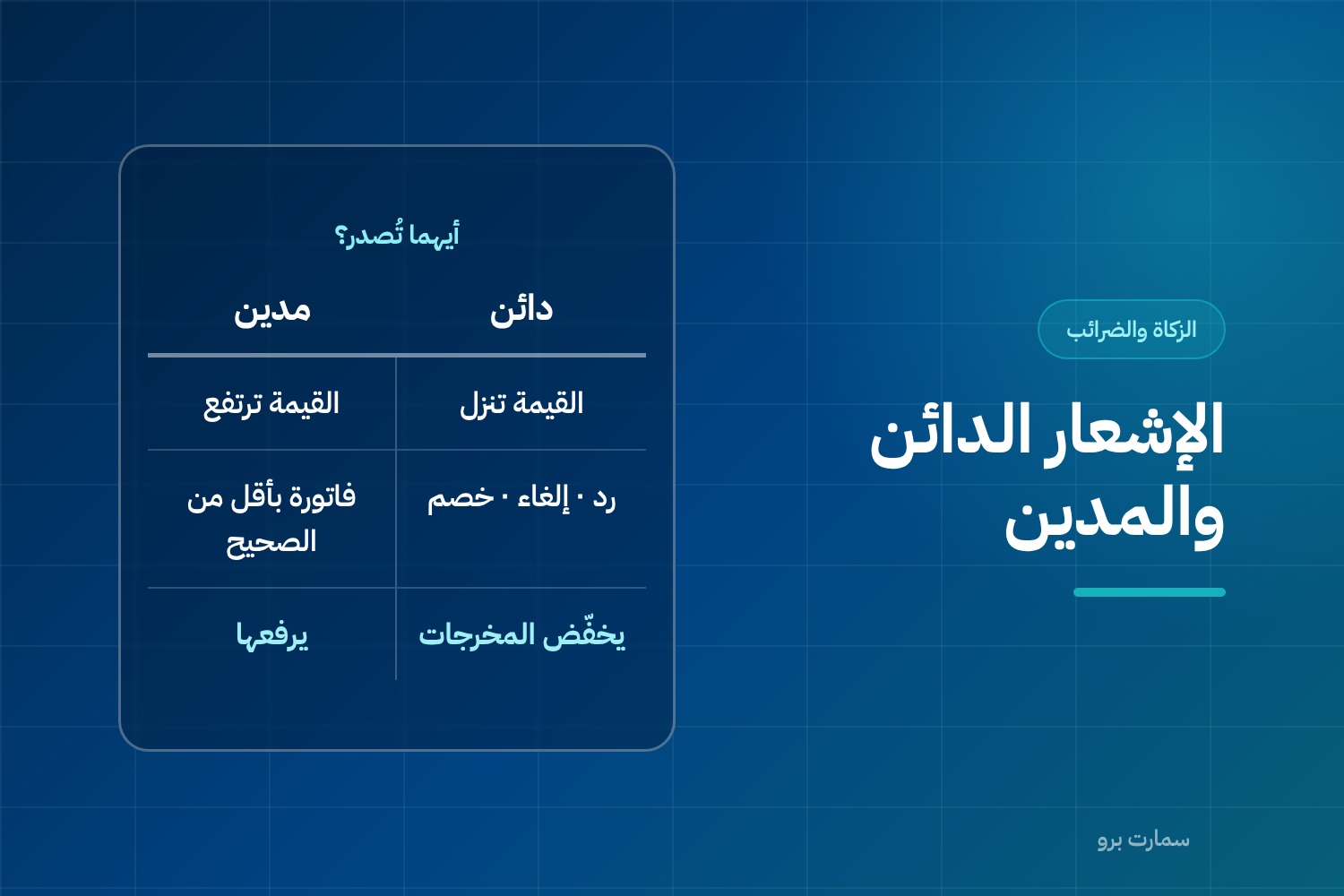
You issued a tax invoice, then the customer returned the goods, you found the price was wrong, or you gave a discount after the sale. What now? In every one of these cases the answer is a note. A credit note corrects the invoice when the value goes down, and a debit note corrects it when the value goes up.
The most important point comes first: an e-invoice cannot be cancelled directly. To cancel an issued invoice, you issue a credit note that reverses it, then issue a new, correct invoice. Any other approach, such as deleting it from the system or editing the invoice in place, is a violation.
When must you issue a credit note or debit note?
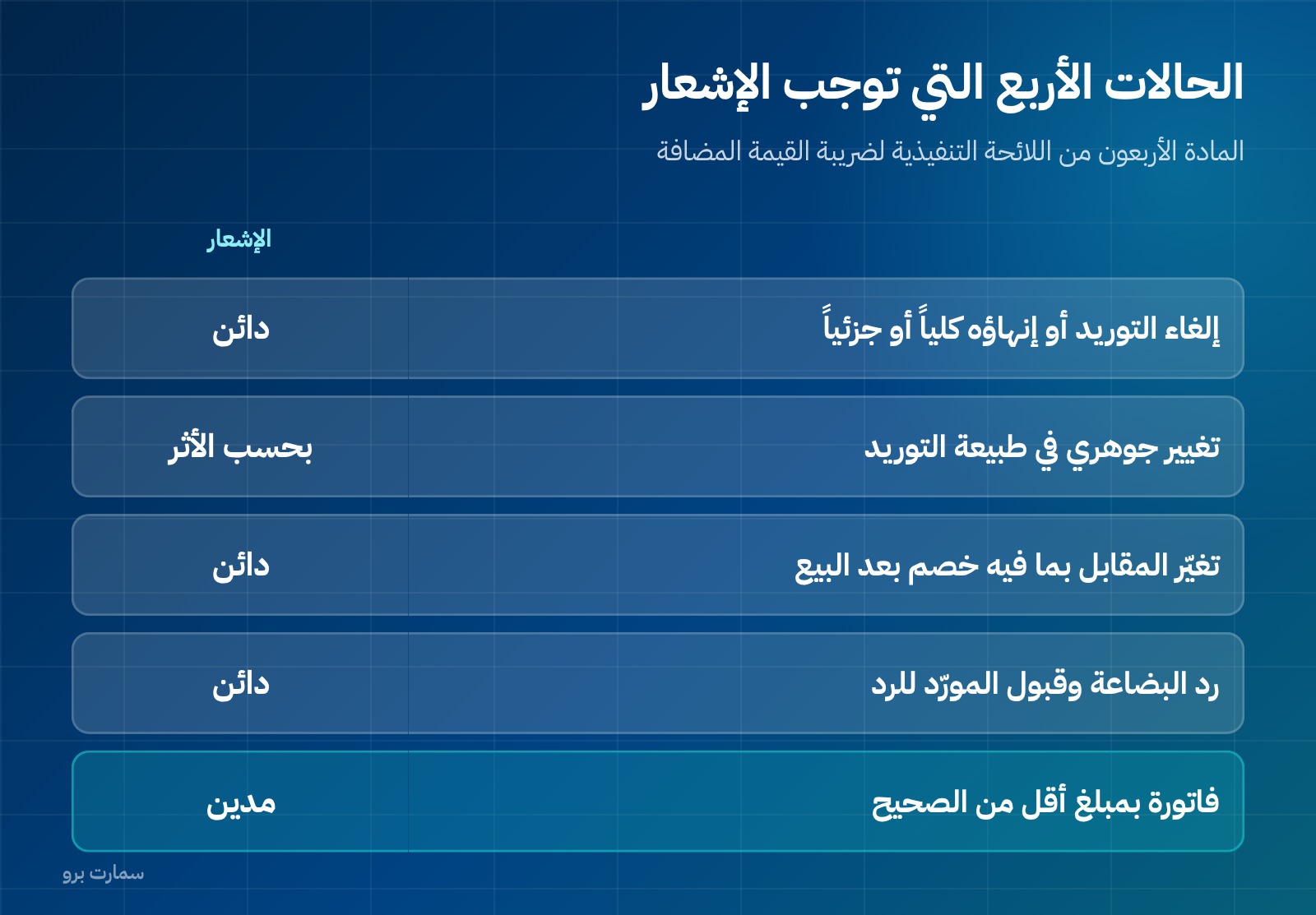
Article 40 of the VAT Implementing Regulations limits the cases for adjusting VAT to four:
- Cancellation or termination of the supply, in full or in part, after it has taken place or is treated as having taken place.
- A fundamental change in the nature of the supply that results in different VAT.
- A change in the agreed consideration for any reason, including a discount granted after the sale.
- Return of goods or services, or part of them, where the supplier accepts the return.
Article 54 adds a separate fifth case: the supplier discovers an error in its own details or the customer's details on the invoice. Correcting a commercial registration number or an address is done with a note, not by editing the original invoice.
Credit note or debit note: which one do you need?
| Situation | Effect on value | Note |
|---|---|---|
| Goods returned or supply cancelled | Decreases | Credit |
| Discount after the sale | Decreases | Credit |
| Invoice issued for more than the correct amount | Decreases | Credit |
| Damaged goods or goods not matching specifications | Decreases | Credit |
| Invoice issued for less than the correct amount | Increases | Debit |
| Price increase after the agreement | Increases | Debit |
The simple rule: if the VAT on the original invoice is higher than it should be, issue a credit note; if it is lower, issue a debit note.
What must a credit or debit note contain?
A note is not a free-form document. It must carry:
- All the tax invoice details set out in Article 53, as appropriate to the nature of the note.
- A clear statement of its type: credit note or debit note.
- The serial number of the original invoice and a clear reference to it. If one note adjusts several invoices, it must refer to each number or to the range of numbers.
- The discount information that Article 53 requires on the corresponding invoice.
- Arabic, which is mandatory, just as it is on the invoice.
ZATCA (the Zakat, Tax and Customs Authority) treats a missing mandatory element as a violation, even something as small as the document title or the QR code.
Does a note follow clearance or reporting?
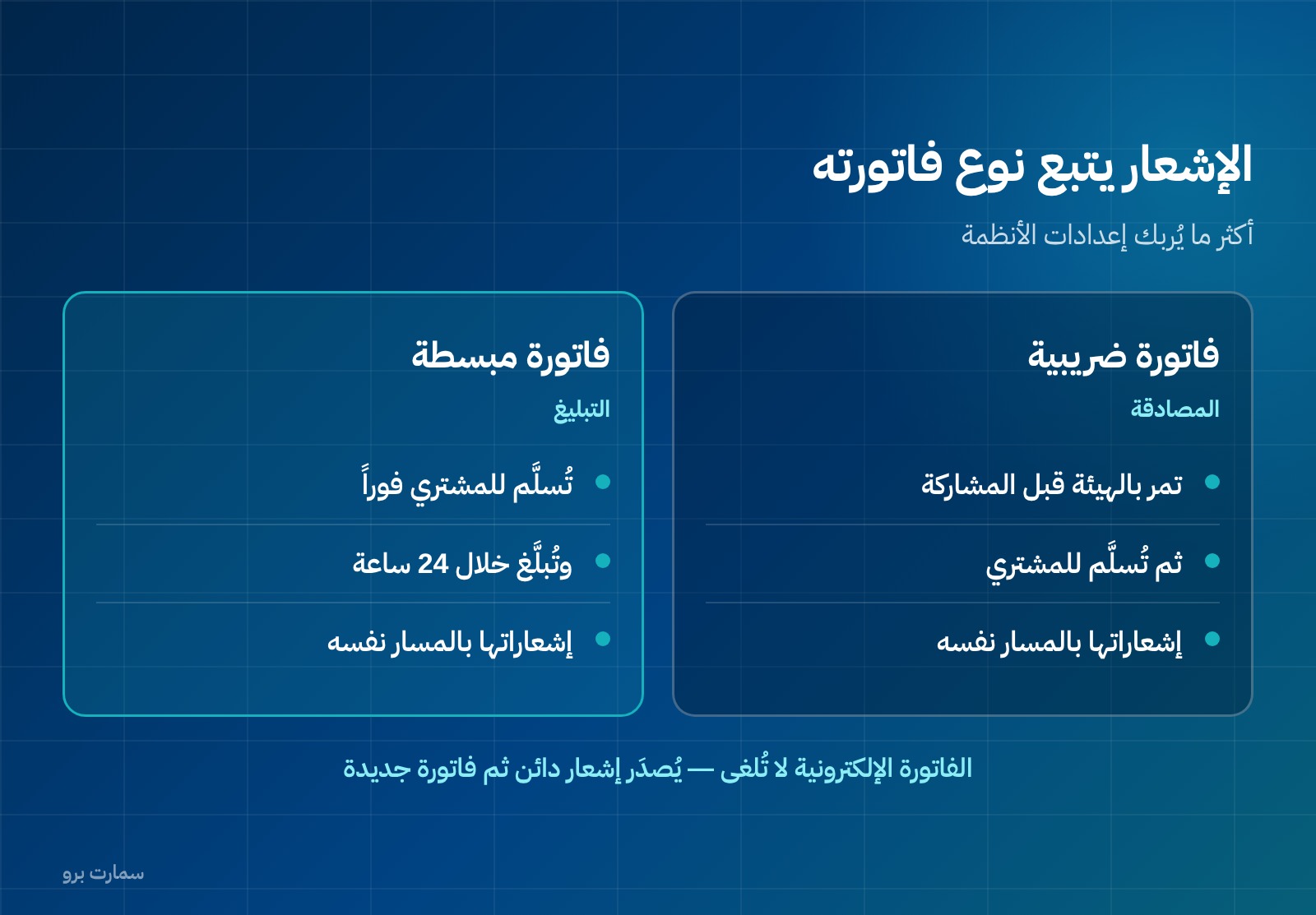
This is the point that trips up system configurations more than any other. A note follows the path of the invoice it relates to:
| Original invoice type | Path for the note |
|---|---|
| Tax invoice (standard) | Clearance by ZATCA before it is shared with the buyer |
| Simplified tax invoice | Reporting to the platform within 24 hours of issue |
Clearance means ZATCA validates the document before it reaches the buyer; reporting means the document is sent to ZATCA after it is issued. If your system sends all notes down a single path, you will be in breach on one of the two. See the difference between standard and simplified invoices.
What counts as an electronic note and what does not?
The E-Invoicing Regulation defines electronic notes as the debit and credit notes required under the VAT Law and its Implementing Regulations. A paper note that is scanned afterwards is not an electronic note.
The issuing solution must be connected to the internet, able to integrate through APIs, tamper-resistant with the ability to detect tampering, and compliant with data and cybersecurity requirements.
The regulation also states explicitly that electronic invoices and notes issued under it are themselves the tax invoices and notes for all VAT purposes, including penalties.
How does a credit note affect your VAT return?
A note is not a formality. A credit note reduces output VAT in the period it is issued, and a debit note increases it. If you issue notes but do not reflect them in your return, you pay VAT you do not owe, or less than you owe, which is the more serious problem. See filing your VAT return.
On the other side, a customer who receives a credit note must reduce the input VAT it previously deducted. See input VAT deduction.
What are the most common mistakes?
- Deleting the invoice from the system instead of issuing a credit note. An invoice that has been issued cannot be deleted.
- Issuing a note with no reference to the original invoice. The original's serial number is a requirement, not an option.
- Confusing a note with a new negative invoice. An invoice with a negative value is not a note and does not meet the document requirements.
How soon must the note be issued?
Amendments to the Implementing Regulations in November 2024 introduced an explicit deadline for issuing credit and debit notes, tied to the end of the month in which the triggering event occurred.
To be candid: the wording of this deadline differs between two official sources we reviewed, so we are not stating a specific date until it is settled from the Arabic text in force. The safe practical rule: issue the note in the same month the event occurred. That meets the deadline under either reading and avoids a timing gap between the note and your VAT return.
What should your system do?
A sound accounting system issues the note from within the original invoice, not as a separate document. It inherits the invoice's details, carries its number automatically, picks the correct path (clearance or reporting) based on the invoice type, and reflects the effect in the VAT return without manual work. A document built by hand in a separate file is the source of most violations in this area. SmartPro's Sales & POS issues ZATCA Phase 2 e-invoices, and its Finance & Accounting system turns transactions into journal entries automatically with a one-click VAT report.
Reference: Zakat, Tax and Customs Authority: VAT Implementing Regulations (Articles 40 and 54) and the E-Invoicing Regulation.
Key takeaway: Never delete or edit an issued e-invoice; correct it with a credit or debit note that references the original and follows the same clearance or reporting path. Issue it in the month the event occurred and reflect it in your VAT return.
To see how notes are issued from the original invoice, start a free trial of SmartPro.
Article visuals
Frequently asked questions
What is the difference between a credit note and a debit note?
A credit note is issued when the VAT on the original invoice is higher than it should be, such as for returned goods or a discount after the sale. A debit note is issued when it is lower, such as an invoice issued for less than the correct amount or a price increase.
Can an e-invoice be cancelled?
Not directly. You issue a credit note that reverses it, then a new, correct invoice. Deleting the invoice from the system or editing it in place is a violation.
What details must a credit or debit note include?
All the tax invoice details as appropriate to its nature, a clear statement of its type, and the serial number of the original invoice with a clear reference to it. It must also include the discount information and be in Arabic.
Does a note go through clearance or reporting?
It follows the type of the invoice it relates to. Notes on standard tax invoices go through clearance before being shared with the buyer, while notes on simplified invoices are reported to the platform within 24 hours of issue.
Does correcting an error in the customer's details require a note?
Yes. Article 54 allows a note to be issued when an error is discovered in the supplier's or customer's details on the invoice. The correction is not made by editing the original invoice.