
VAT Deregistration in Saudi Arabia: When and How?
When VAT deregistration is mandatory and when it is optional, the 30-day deadline, the 12-month lock for voluntary registrants, and the obligations that stay with you afterwards.
Author:سامي الحيدري
VAT registration is not a lifelong commitment. If your revenue has fallen, your business has closed or your activity has moved to another entity, you may be required to deregister, not just allowed to. Article 13 of the VAT Implementing Regulations governs every case of VAT deregistration.
When is VAT deregistration mandatory?
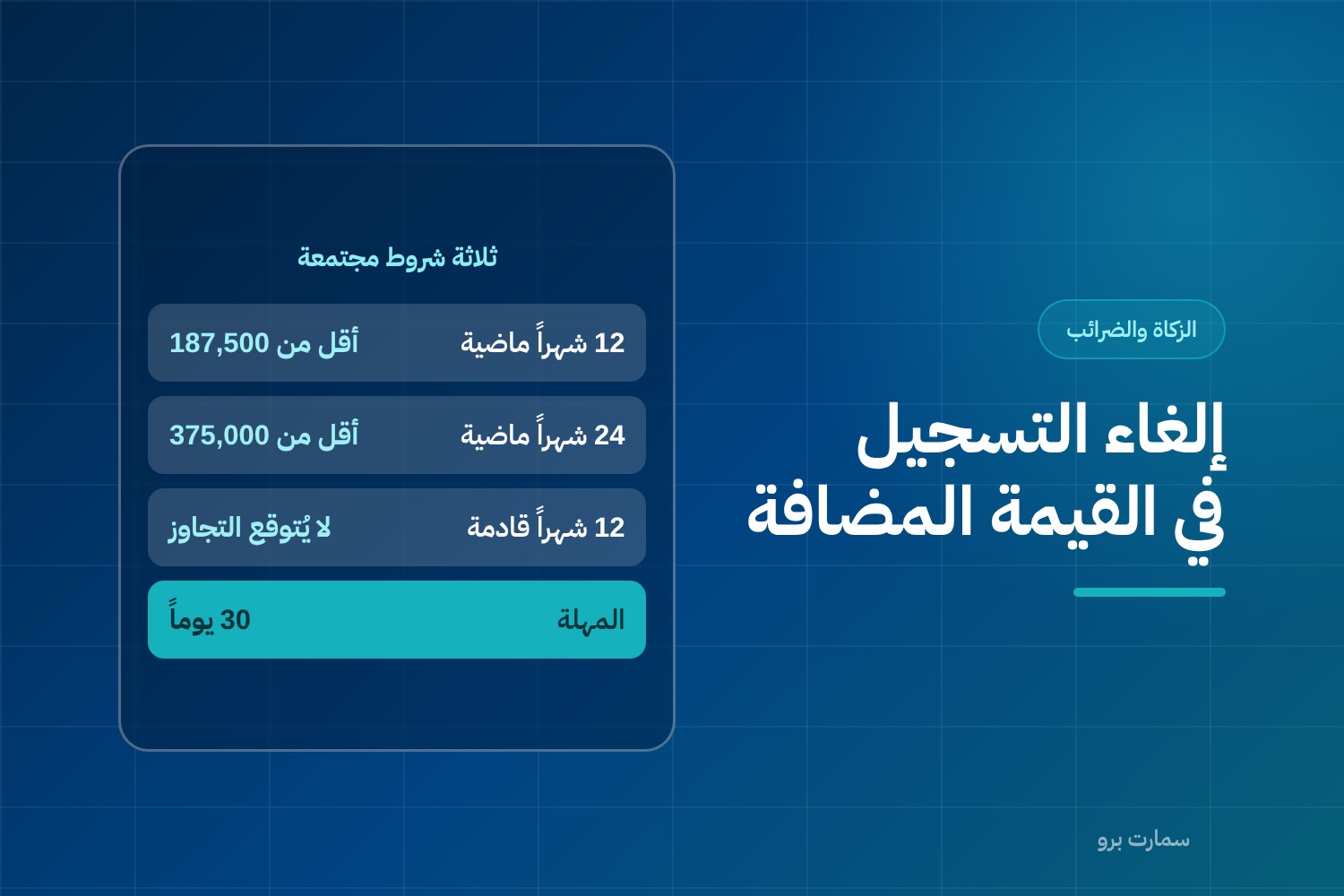
For a resident person, deregistration is mandatory when all three conditions are met together:
- The value of supplies or expenses over the past 12 months does not exceed the voluntary registration threshold.
- Their value over the past 24 months does not exceed the mandatory registration threshold.
- The voluntary threshold is not expected to be exceeded in the current month and the following 11 months.
The two thresholds are SAR 375,000 for mandatory registration and SAR 187,500 for voluntary registration.
Note that the third condition is forward-looking. A drop in revenue is not enough on its own; you must also not expect revenue to recover within the coming year.
What other cases make deregistration mandatory?
- A registered non-resident that has made no taxable supplies in the Kingdom during the past 12 months must deregister.
- Ceasing economic activity, or losing legal status.
- Transferring the economic activity in a way that ends it completely. This case was added by the November 2024 amendments. The transferee must notify ZATCA within 30 days of the transfer, unless the transferor has already applied for deregistration.
What is the deadline for VAT deregistration?
Deregistration applications must be submitted within 30 days of any of the triggering events. If you do not apply, ZATCA may deregister you on its own initiative and issue a notice to that effect.
This does not work in your favour. Deregistration at ZATCA's initiative means you missed a statutory deadline, with whatever follows from that.
Can a voluntary registrant deregister at any time?
A business that registered voluntarily, meaning with revenue between SAR 187,500 and SAR 375,000, cannot apply to deregister before 12 months have passed since registration, unless its economic activity has ceased.
Voluntary registration is therefore a commitment of at least a year, not a trial you cancel after a month. That is worth thinking about before you register, not after. See VAT registration in Saudi Arabia.
How do the three conditions work in practice?
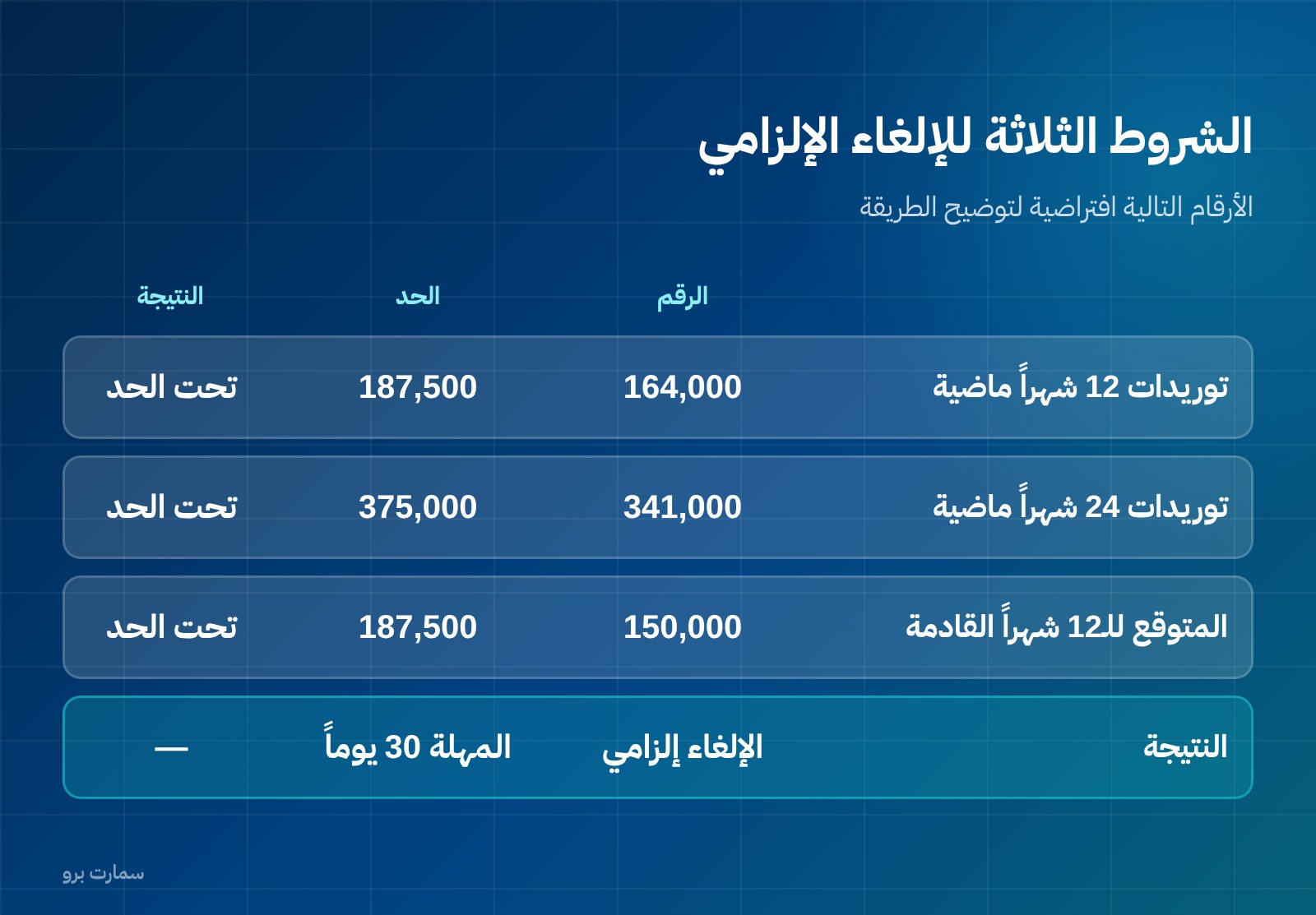
The figures below are hypothetical, to illustrate the method. A business is considering deregistration in November:
| Test | Amount (SAR) | Threshold (SAR) | Result |
|---|---|---|---|
| Supplies, past 12 months | 164,000 | 187,500 | ✅ Below threshold |
| Supplies, past 24 months | 341,000 | 375,000 | ✅ Below threshold |
| Expected, next 12 months | 150,000 | 187,500 | ✅ Below threshold |
All three conditions are met, so deregistration is mandatory, not optional, and the 30-day deadline applies.
If the expected figure for the coming year were SAR 210,000, for example because of a newly signed contract, the third condition would fail and the registration would stay in place, however much past revenue had fallen.
When would an owner keep their registration despite lower revenue?
There is no choice once all three conditions are met; deregistration is then required. Before that point, though, many small businesses deliberately keep a voluntary registration for two reasons: deducting input VAT on their purchases and expenses, and dealing with corporate customers who ask for a tax invoice. Input VAT is the VAT you pay on your own purchases, which a registered business can usually recover. Voluntary registration costs you periodic returns and compliance with e-invoicing, so weighing the two is a commercial decision, not an accounting one.
What stays with you after deregistration?
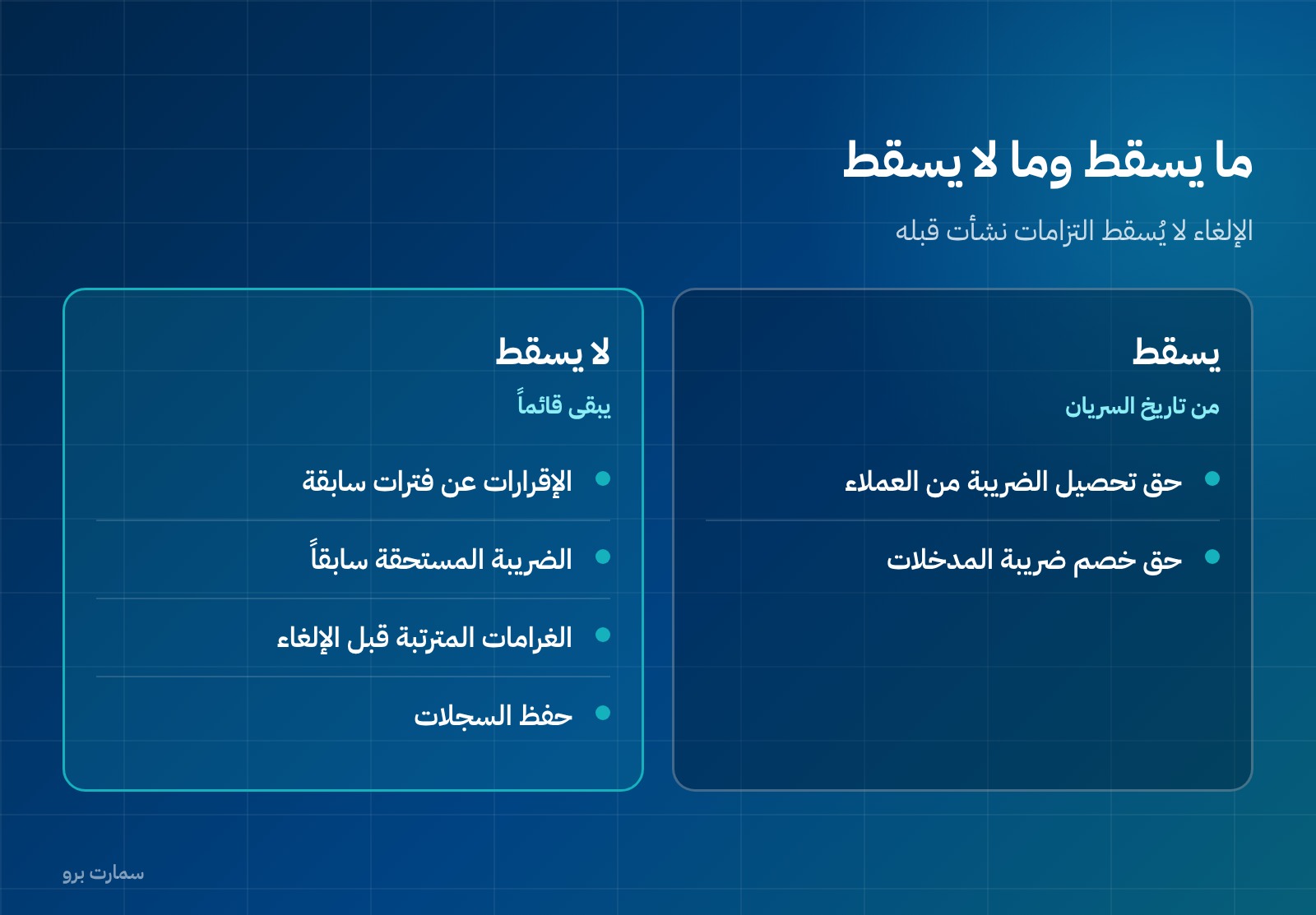
| Ends | Does not end |
|---|---|
| The right to charge VAT to customers | Returns for earlier periods |
| The right to deduct input VAT | VAT due for earlier periods |
| — | Penalties incurred before deregistration |
| — | Record keeping under Article 66 |
The governing rule: deregistration does not cancel obligations that arose before it. Your registration is not actually cancelled until outstanding amounts are settled first, and ZATCA decides the effective date of deregistration.
What about stock and assets?
A practical point that is often overlooked: if you deducted input VAT on goods or assets you still hold at deregistration, you need to review your VAT position on them. The deduction was based on using them in a taxable activity, and that activity has stopped. Read input VAT deduction before you submit the application, not after.
Is the effective date the date you applied?
No. ZATCA sets the effective date of deregistration, and it may differ from the date you applied. Between the two dates you remain bound by everything: charging VAT on your supplies, issuing e-invoices and filing the return for the period.
A business that stops issuing tax invoices as soon as it submits the application has breached the rules before its deregistration takes effect. The rule: keep meeting all your obligations until you receive the notice of the effective date.
What should you do before applying?
- Calculate both periods: supplies over 12 months and over 24 months, not your financial year.
- Estimate the next 12 months on a written basis, such as existing contracts or their expiry.
- Close any outstanding returns and pay what is due before submitting the application.
- Document the reason for deregistration: minutes recording the cessation of activity, a transfer contract or a revenue statement.
- Keep your records after deregistration; the obligation continues.
One last note: the service is free through ZATCA's portal, but free does not mean simple. An application submitted without prior settlement is rejected or put on hold.
Reference: Zakat, Tax and Customs Authority (ZATCA) — VAT Implementing Regulations, Article 13, and the November 2024 amendments.
Finally, deregistering for VAT does not mean closing your books. A business that has deregistered must still keep its accounts, prepare its financial statements and meet its zakat obligations, because VAT is one obligation among several, not all of them. See the difference between zakat and income tax.
Key takeaway: Deregistration is mandatory once all three tests are met and must be requested within 30 days, but every obligation that arose before it, including returns, VAT due and record keeping, stays with you.
To keep your VAT figures and records ready whatever your registration status, start a free SmartPro trial or book a demo.
Article visuals
Frequently asked questions
When is VAT deregistration mandatory in Saudi Arabia?
For a resident, it is mandatory when three conditions are met together: supplies over the past 12 months do not exceed the voluntary threshold of SAR 187,500, supplies over the past 24 months do not exceed the mandatory threshold of SAR 375,000, and the voluntary threshold is not expected to be exceeded in the coming year.
What is the deadline for applying to deregister for VAT?
You must apply within 30 days of the triggering event. If you do not apply, ZATCA may deregister you on its own initiative and issue a notice.
Can a voluntary VAT registrant deregister whenever they want?
No. A voluntary registrant cannot apply to deregister before 12 months have passed since registration, unless its economic activity has ceased.
Does VAT deregistration cancel earlier obligations?
No. Returns, VAT due and penalties for earlier periods remain in place, and the obligation to keep records under Article 66 continues.
What happens if the business is transferred to another entity?
Transferring the economic activity in a way that ends it completely is a ground for deregistration added by the November 2024 amendments. The transferee must notify ZATCA within 30 days unless the transferor has already applied.