
VAT Registration in Saudi Arabia: When It Becomes Mandatory and What Follows
The statutory threshold that makes VAT registration mandatory, how it is calculated over 12 months, the obligations that start from your registration date, and the penalty for registering late.
Author:سامي الحيدري
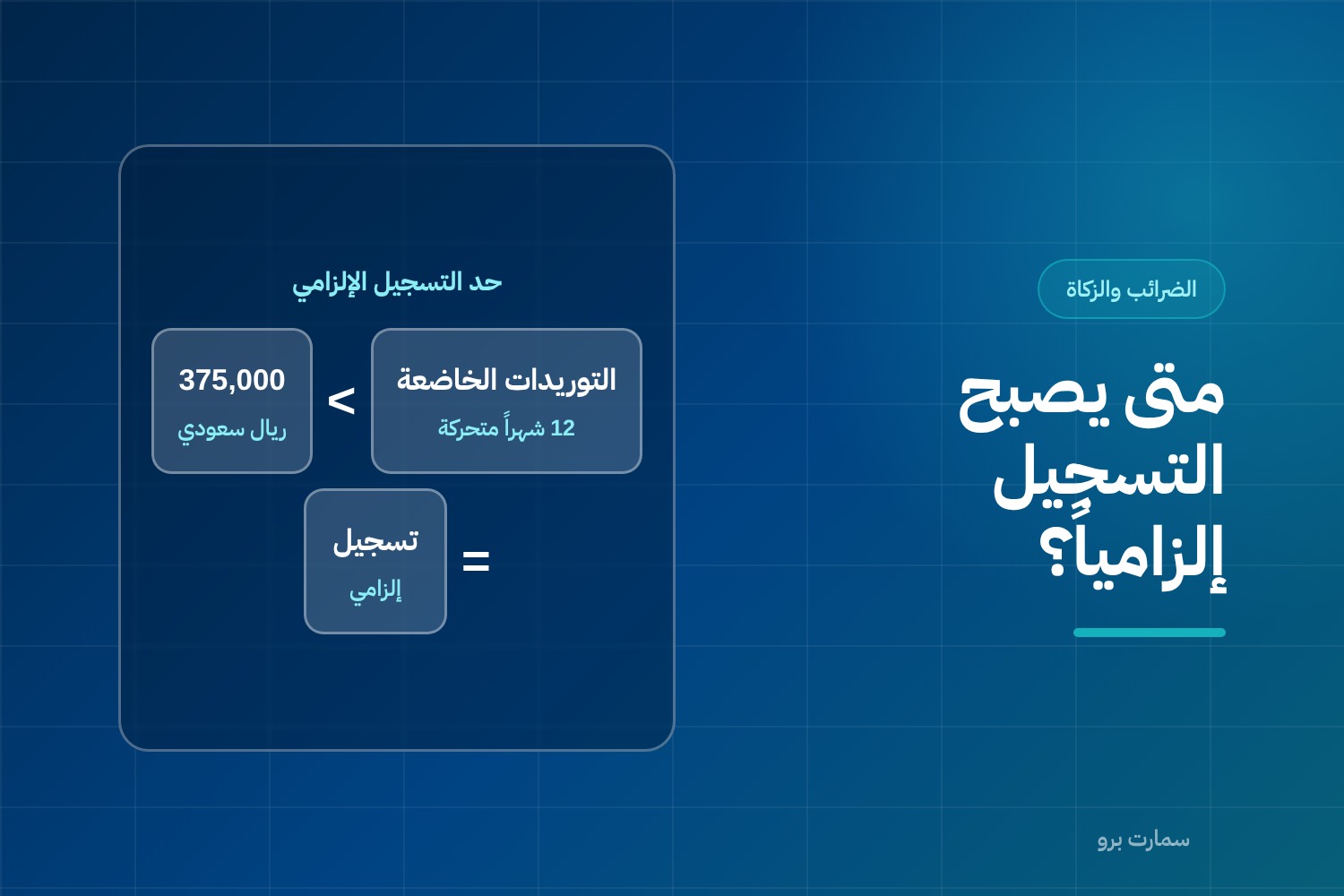
VAT registration in Saudi Arabia is not an administrative step you can postpone until your business settles. It becomes mandatory once your taxable supplies pass SAR 375,000 in any twelve months. Many small businesses find out late, then pay VAT out of their own profit on past sales whose prices never included it.
That is the usual story: a business sells at prices without VAT, then is asked to pay VAT for an earlier period it never collected from customers. This guide explains the threshold, how it is calculated, and what changes in your business on the first day after registration.
What is the VAT registration threshold?
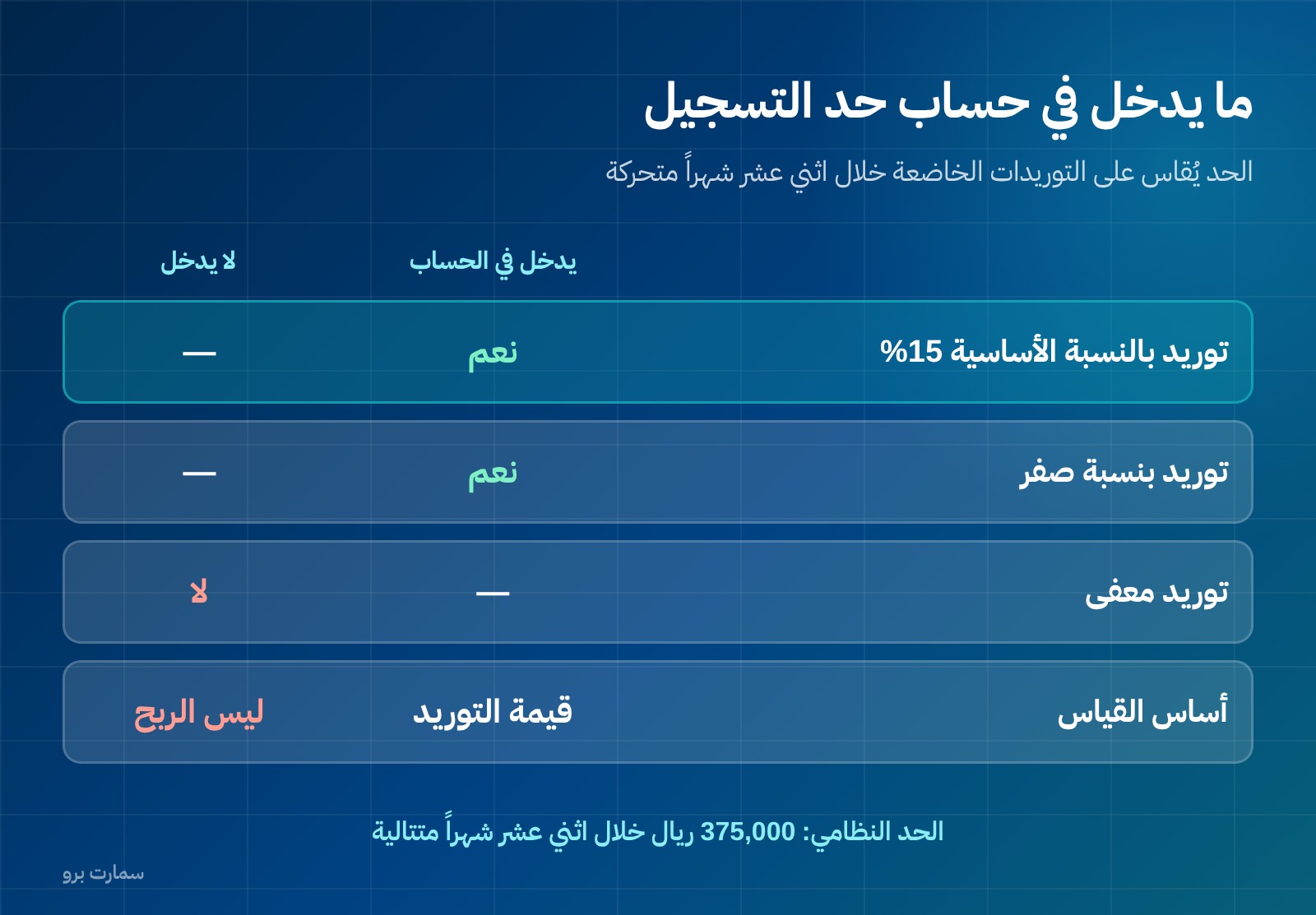
The statutory rule: a resident supplier must register if the total value of its taxable supplies over twelve months exceeds SAR 375,000. The rule comes from Article 50 of the Unified GCC VAT Agreement, and it is the threshold applied in the Kingdom.
Three parts of that sentence need careful reading:
"Taxable supplies", not total revenue. Supplies taxed at the standard rate and supplies taxed at the zero rate both count; exempt supplies do not. A business with SAR 500,000 in revenue, half of it exempt, may stay under the threshold, while a business with SAR 400,000 in fully taxable revenue exceeds it.
"Over twelve months", not the financial year. The calculation is rolling: each month you look at the twelve months just ended. A business selling SAR 35,000 a month crosses the threshold in its eleventh month, not at the end of its financial year.
"Total value", meaning the full value of the supply before VAT, not profit. This mix-up is common: an owner with a 10% margin assumes the threshold is measured on what stays in their pocket.
How do you monitor the threshold before you cross it?
A business that waits until it has crossed the threshold before starting registration enters a painful transition: its prices don't include VAT and its customers don't expect it. The right approach is a monthly report showing total taxable supplies for the twelve months just ended. That is a simple report in any accounting system, and very hard to produce from scattered Excel files.
- Calculate the rolling twelve-month total, not the financial-year total.
- Separate taxable from exempt supplies in your chart of accounts from the start, not when you need it.
- Watch the trend: if the total is approaching SAR 300,000, start preparing in earnest.
- Prepare your price list on a "VAT-inclusive price" basis before registration, not after.
The accounting structure that makes this possible is explained in the chart of accounts guide, and the difference in revenue recognition timing, which decides the month a supply is counted in, is explained in cash basis vs accrual basis accounting.
What changes in your business after registration?
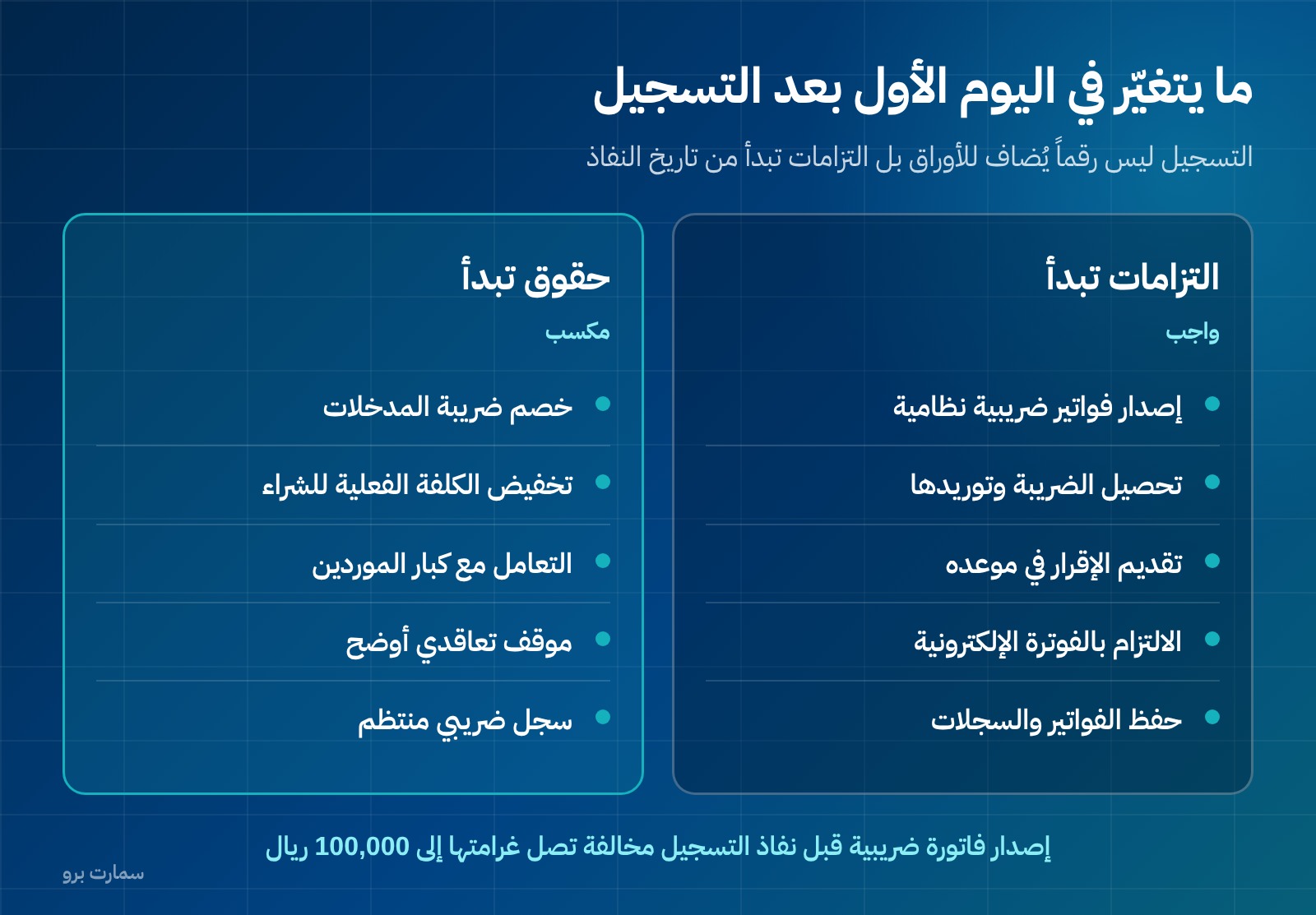
Registration is not just a number added to your official documents. It is a set of obligations that start from its effective date:
Issuing compliant tax invoices. Every sale needs an invoice carrying the legally required details, including the VAT number and the VAT breakdown. Details are in tax invoice requirements and the difference between a standard and a simplified tax invoice.
Collecting VAT from customers and paying it over. The VAT you collect is not your revenue; it is money you hold temporarily on behalf of ZATCA. Businesses that treat collected VAT as revenue find themselves short of cash when payment is due.
Filing returns on time. See the VAT return: deadlines and fields.
Complying with e-invoicing. A registered business falls within the scope of e-invoicing and its phases, and is called into Phase 2 in a wave that ZATCA sets according to its revenue. Details are in Phase 2 e-invoicing and the waves timeline.
The right to deduct input VAT. This is the side people forget: after registration you can deduct the VAT you paid on purchases from the VAT due on your sales. Input VAT is the tax you pay to suppliers on what you buy. A business with large purchases may find that registration lowers its actual cost.
Keeping records. Invoices, books and accounting records must be kept in an organised way that lets you retrieve any invoice by date and number on request. Failing to keep them is a separate violation with a fine of up to SAR 50,000 under the official penalties schedule.
What is the penalty for not registering?
The fine for failing to apply for registration on time is SAR 10,000 under the official penalties schedule. But the fine is not the heaviest part. The heavier part is that VAT remains due for the period in which you should have been registered, on sales you made at prices that did not include VAT. In practice you pay 15% of those sales out of your profit, plus the late-payment penalty of 5% for each month or part of a month.
There is also the opposite violation some businesses fall into: issuing a tax invoice while not registered. Its fine can reach SAR 100,000. So do not add VAT to your invoices until your registration is actually in effect.
Checklist before registering
- Calculate your total taxable supplies for the last twelve months, separated from exempt supplies.
- Review your price list: will you advertise prices including VAT or with VAT added on top?
- Make sure your system issues a tax invoice with all the required details.
- Open output VAT and input VAT accounts in your chart of accounts.
- Train whoever issues invoices to tell taxable, exempt and zero-rated supplies apart.
- Record the registration effective date: it is the dividing line between invoices without VAT and invoices with VAT.
- Set up a procedure for storing invoices and records so they can be retrieved during an inspection.
Where is the official reference?
The registration threshold, the penalties schedule and the obligations are published by the Zakat, Tax and Customs Authority (ZATCA) on its website: zatca.gov.sa. The SAR 375,000 threshold is based on Article 50 of the Unified GCC VAT Agreement, as stated in ZATCA's guidelines.
Read also
- Input VAT deduction: what you can and cannot deduct
- VAT penalties: the full schedule
- Exempt vs zero-rated supplies: the difference
Key takeaway: Registration becomes mandatory once taxable supplies pass SAR 375,000 over any rolling twelve months, so track that total monthly and prepare your prices, invoices and accounts before you cross it.
To see a rolling taxable-supplies report and ZATCA Phase 2 invoicing in practice, start a free SmartPro trial.
Article visuals
Frequently asked questions
What is the mandatory VAT registration threshold in Saudi Arabia?
SAR 375,000. A resident supplier must register if the total value of its taxable supplies over twelve months exceeds this amount, based on Article 50 of the Unified GCC VAT Agreement. The calculation covers supplies taxed at the standard and zero rates, and excludes exempt supplies.
Is the threshold calculated on the financial year or on any twelve months?
On any twelve consecutive months, as a rolling total reviewed every month. A business selling SAR 35,000 a month crosses the threshold in its eleventh month, not at the end of its financial year. That is why you need a monthly report of total taxable supplies for the twelve months just ended.
What is the penalty for not registering for VAT on time?
The fine for failing to apply for registration is SAR 10,000 under the official penalties schedule. The bigger impact is that VAT remains due on sales made during the period you should have been registered, which you never collected from customers. On top of that comes the late-payment penalty of 5% for each month or part of a month.
Can I issue a tax invoice before my VAT registration is complete?
No. Issuing a tax invoice while not registered is a violation with a fine of up to SAR 100,000. Do not add VAT to your invoices until your registration is in effect, and use the registration effective date as the dividing line between invoices without VAT and invoices with VAT.