
VAT Penalties in Saudi Arabia: The Full Table and How to Avoid Each One
The official table of VAT penalties with every item and amount, what actually causes each violation in day-to-day work, and how to close the gap before an audit.
Author:سامي الحيدري
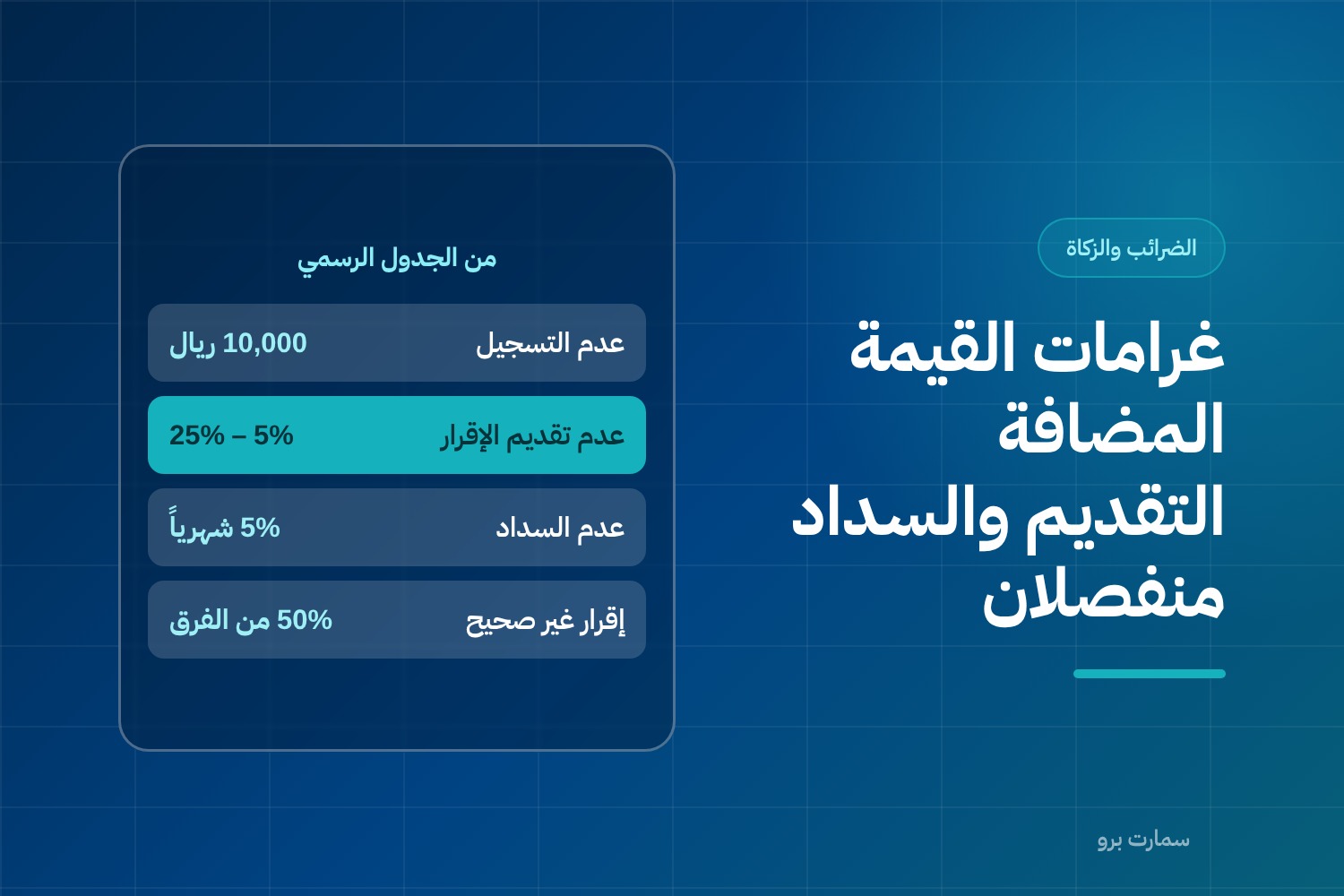
In most cases, VAT penalties don't come from bad intent but from small operational gaps: an invoice issued with missing details, a credit note that was never recorded, a return filed with rough figures and then amended. The problem is that the official table imposes a separate penalty for each of these violations, so they add up. This guide sets out the table as it stands, then explains what actually causes each item and how to close it.
What is the official table of VAT penalties?
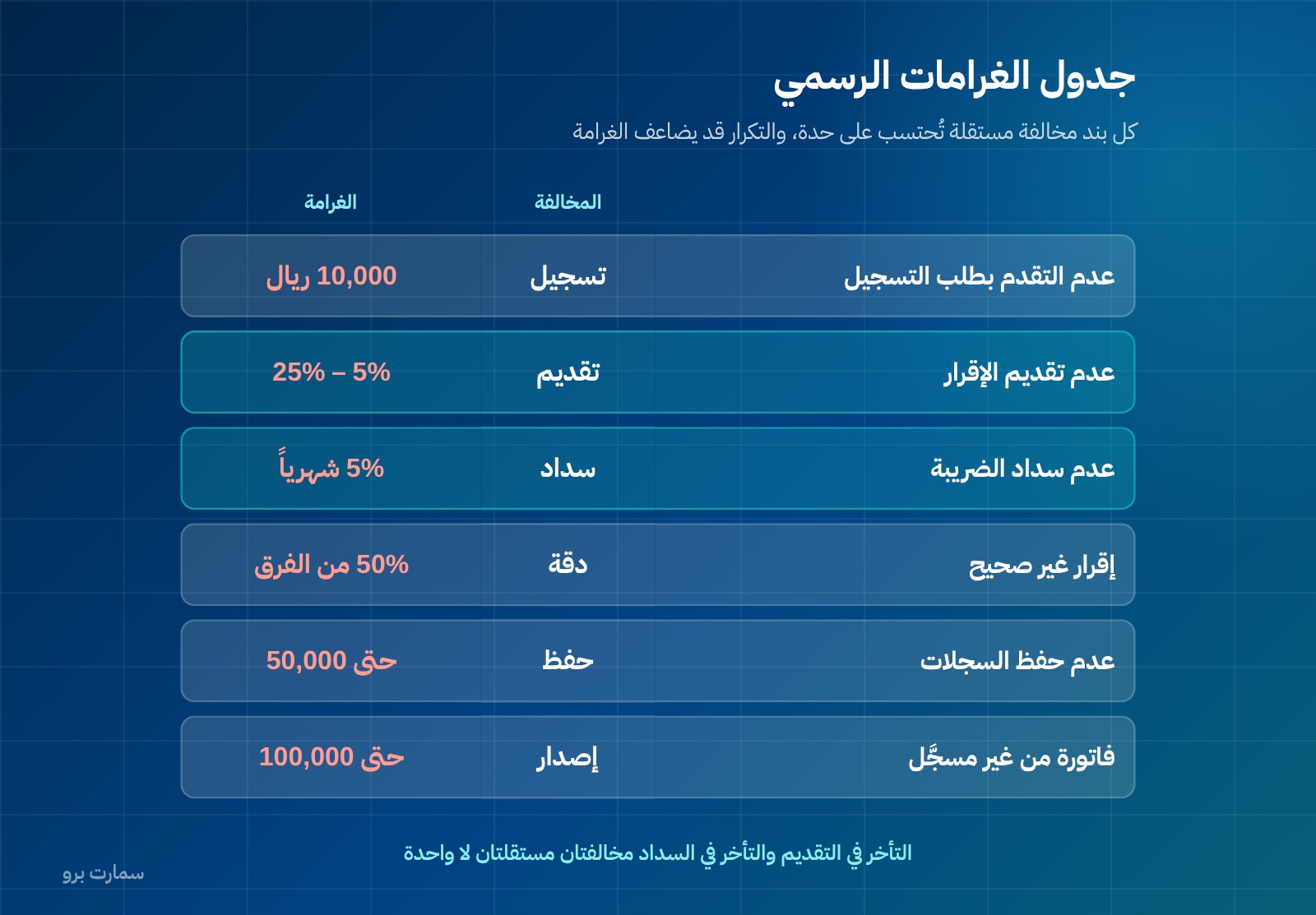
| Violation | Penalty |
|---|---|
| Failing to apply for registration on time | SAR 10,000 |
| Failing to file the return | 5% to 25% of the tax that should have been declared |
| Failing to pay the tax due | 5% of the unpaid tax for each month or part of a month |
| Issuing a tax invoice while not registered | Up to SAR 100,000 |
| Failing to keep invoices, books and accounting records | Up to SAR 50,000 |
| Preventing or obstructing ZATCA staff from performing their duties | Up to SAR 50,000 |
| Breaching any other provision of the law or its implementing regulations | Up to SAR 50,000 |
| An incorrect return, or an amendment that reduces the amount due | 50% of the difference between the tax calculated and the tax due |
| Submitting forged documents to evade tax or obtain a refund that isn't due | No less than the tax due and up to three times the value of the goods or services |
| Moving goods into or out of the Kingdom without paying the tax due | No less than the tax due and up to three times the value of the goods or services |
There is also an important escalation rule: if the same violation is repeated within three years of the date of ZATCA's final decision, the penalty imposed under that decision may be doubled.
Are late filing and late payment the same penalty?
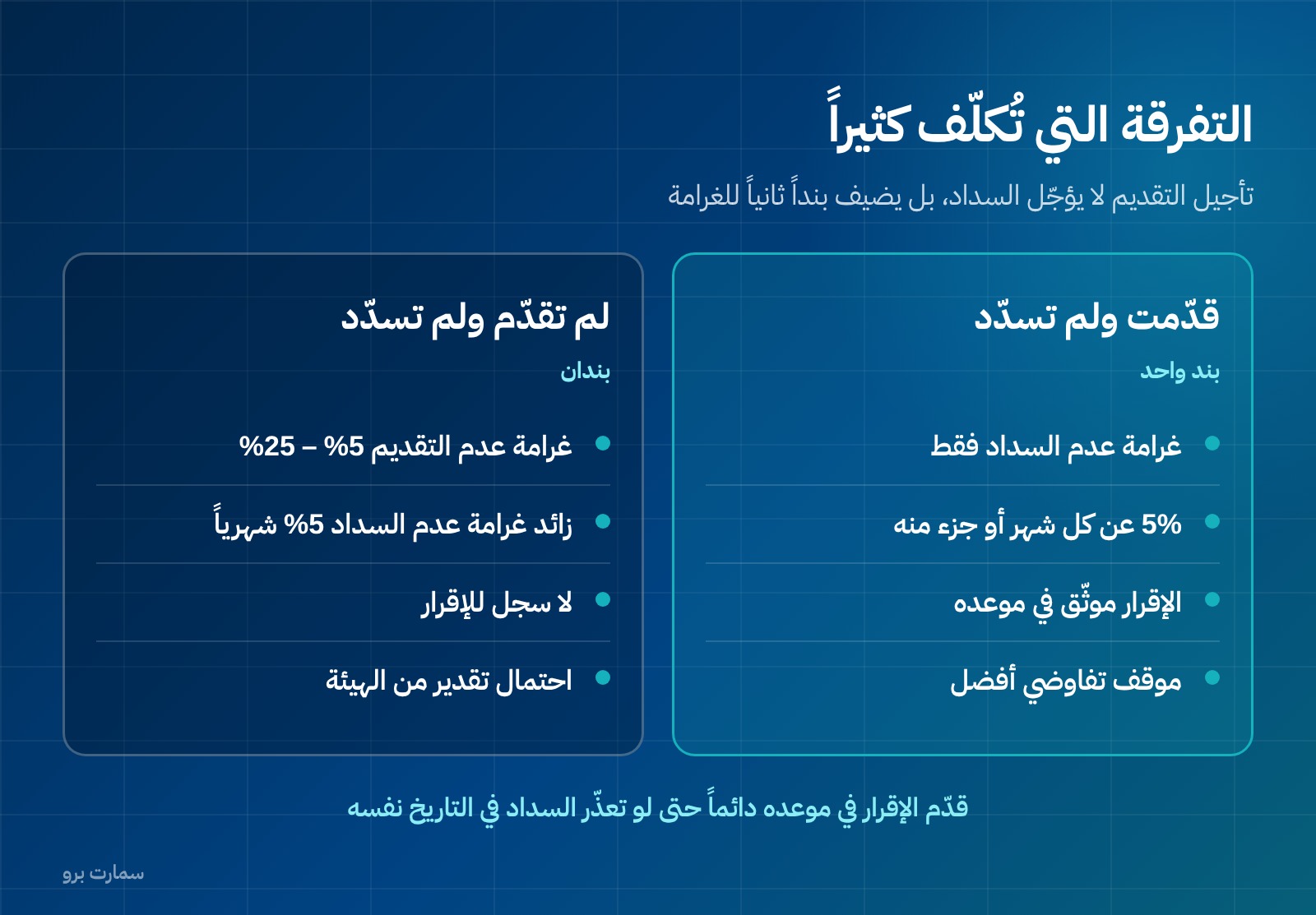
The most common misunderstanding is that a business thinks its delay is counted only once. The table separates the two:
- Failure to file: 5% to 25% of the tax that should have been declared.
- Failure to pay: 5% for each month or part of a month.
In other words, a single delay can produce two independent penalties. The practical consequence: if your cash flow doesn't allow you to pay on time, filing the return on time is still essential. Delaying the filing postpones nothing; it just adds another item. The deadlines are covered in detail in VAT return filing: deadlines and fields.
Why is an estimated VAT return more expensive than an accurate one?
The item many people miss is "an incorrect return, or an amendment that reduces the amount due", and its penalty is 50% of the difference. In practice, this means the approach some businesses follow, filing an approximate figure now and correcting it later, carries a penalty equal to half the difference if the correction goes downwards.
The operational cause of this mistake is well known: the books don't produce ready figures when the period closes, so an estimate gets put together. The fix isn't extra care at filing time but the accounting setup itself: two separate accounts for output VAT (the tax you charge on sales) and input VAT (the tax you pay on purchases), every invoice creating its own journal entry automatically, and a trial balance that gives you both balances in one click.
What causes each violation in day-to-day work?
Failure to register: not monitoring the SAR 375,000 threshold over a rolling twelve months. Details are in VAT registration in Saudi Arabia.
Invoice from an unregistered business: adding VAT to invoices before the registration takes effect, or continuing to issue them after the registration is cancelled.
Failure to keep records: relying on scattered files and personal devices. When asked, nobody can pull up an invoice by its date and number.
Incorrect return: deducting input VAT that isn't deductible. The excluded cases are covered in input VAT deduction.
Differences that surface during an audit: unrecorded credit and debit notes, and invoices recorded in a period other than the one in which they fell due. An invoice belongs in the period in which the tax became due, not the period in which it was entered into the system, and recording an invoice late means you declared it in the wrong period, even if the annual total is correct.
Preventing or obstructing ZATCA staff: this doesn't only mean direct confrontation. Delays in handing over requested documents, or being unable to access records at the time of an audit, are in practice read under this item, and its penalty goes up to SAR 50,000.
How do you close the gaps before an audit?
- Monitor the registration threshold with a monthly report showing the rolling twelve-month total.
- Always file the return on time, even if you can't pay on the same date.
- Make every sales and purchase invoice create its own journal entry automatically, with no manual entry of VAT.
- Keep non-deductible expenses in accounts that don't touch input VAT.
- Record every credit and debit note linked to its original invoice.
- Actually close the period in the system so no invoices can be recorded in it after filing.
- Keep a copy of every return together with the account balances it was drawn from.
- Test pulling up a single invoice by its date and number: if you can't do it within a minute, your records aren't ready.
- Review the items in the table once a year with whoever prepares your return, because the three-year repetition rule doubles the penalty.
Most items in the table are closed by setting things up correctly once, not by monthly effort. Businesses that pay repeated penalties usually pay them on the same item, and that is exactly where the doubling rule kicks in.
If you want your VAT accounts and journal entries generated from every invoice automatically, see how SmartPro Finance & Accounting handles it.
Where is the official reference?
The table of penalties and fines is published by the Zakat, Tax and Customs Authority (ZATCA) on its website: zatca.gov.sa, and the amounts and percentages above are taken from it as they are. Any later change should be taken from the same official page; penalties shouldn't be judged by experience or by stories of other cases.
Key takeaway: Filing and paying are separate violations, and an understated return costs 50% of the difference, so file on time and build your books to produce exact VAT figures. A correct setup done once closes most items in the table.
Read also
To see automatic VAT entries on your own data, start a free trial or book a demo with our team.
Article visuals
Frequently asked questions
Are late filing and late payment of VAT a single penalty?
No, they are two independent violations in the official table. Failing to file the return carries a penalty of 5% to 25% of the tax that should have been declared, and failing to pay the tax due carries 5% for each month or part of a month. That is why filing the return on time remains essential even when you can't pay on time.
What is the penalty for an incorrect VAT return?
It is 50% of the difference between the tax calculated and the tax due, and it also applies to amending a return in a way that reduces the amount due. This makes an accurate return the first time cheaper than filing an approximate figure and correcting it later.
Is the VAT penalty doubled if the violation is repeated?
Yes. If the same violation is repeated within three years of the date of ZATCA's final decision, the penalty imposed under that decision may be doubled. Businesses that face repeated penalties usually repeat them on the same item, which is exactly where this rule applies.
What is the penalty for not keeping invoices and records?
It goes up to SAR 50,000, and it is a separate violation from having an input VAT deduction rejected. The practical test is simple: ask your team to pull up a single invoice by its date and number; if they can't do it within a minute, your records aren't ready for an audit.