
The Difference Between Exempt and Zero-Rated Supplies Under Saudi VAT
Exempt and zero-rated supplies both show no VAT on the invoice, but they affect input tax deduction, the registration threshold and the VAT return very differently. Here is the difference and how to handle it in your books.
Author:سامي الحيدري
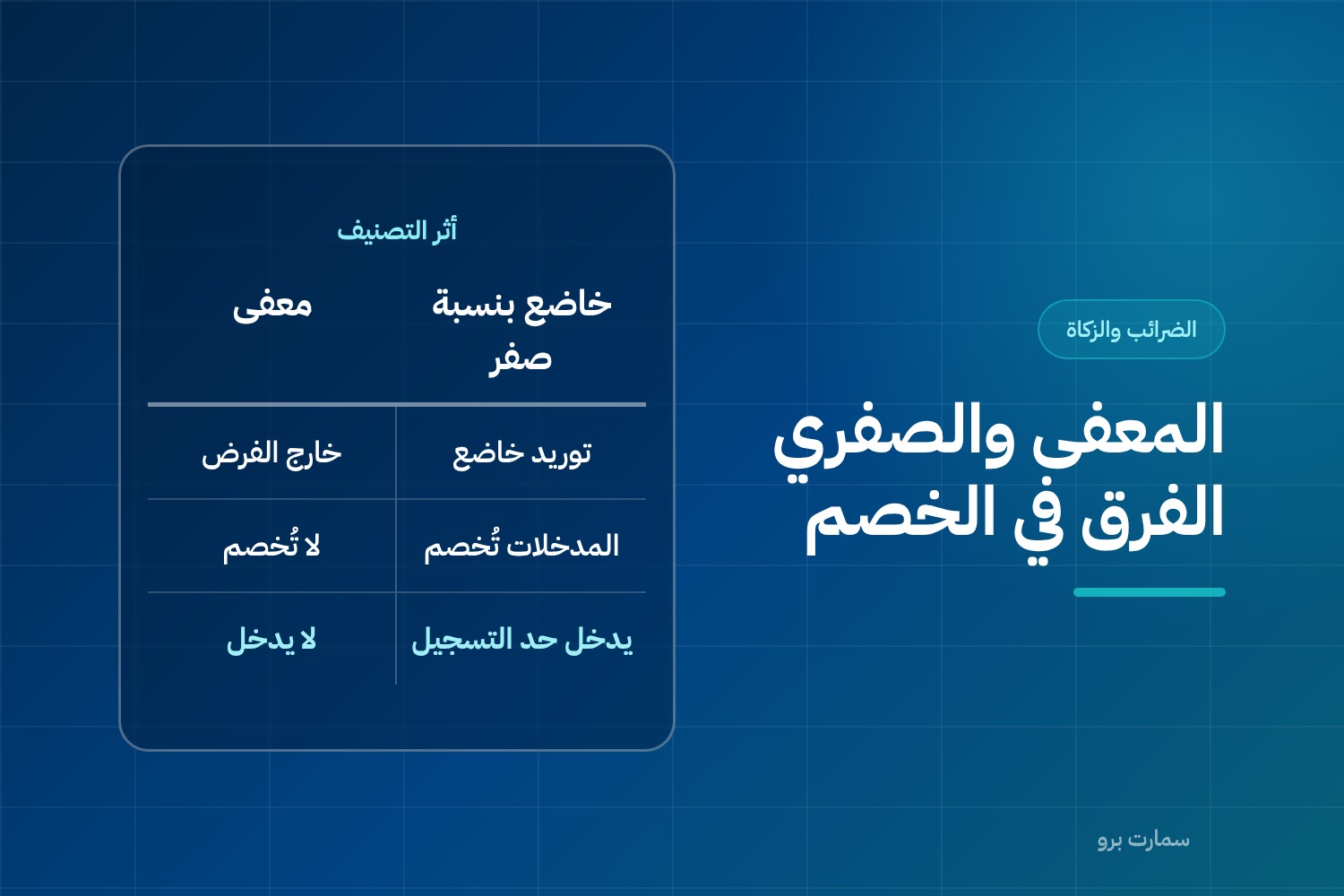
On the invoice the two lines look identical: no VAT charged. That is why many people confuse an exempt supply with a zero-rated supply and assume the label is a formality. It is not. The difference between exempt and zero-rated is direct and financial: zero-rating keeps your right to deduct input VAT, and exemption removes it. A business that misclassifies its supplies either loses a deduction it was entitled to or deducts tax it had no right to.
Where does the classification come from in the law?
Article 10 of the VAT Law makes clear that the detail is not in the Law itself. In translation, it says the Implementing Regulations "shall specify the supplies exempt from tax and the supplies subject to tax at the zero percent rate". Article 2 sets the standard rate at 15% and makes it the default "unless a provision grants an exemption" or applies the zero rate.
The practical meaning matters: the default is the standard rate, and exemption and zero-rating are exceptions that need an explicit provision. You cannot treat a supply as exempt because it "isn't mentioned", and you cannot reason by analogy from a similar activity. Classification needs the text of the Implementing Regulations or the sector-specific guideline for your activity, and those are the reference when there is a dispute.
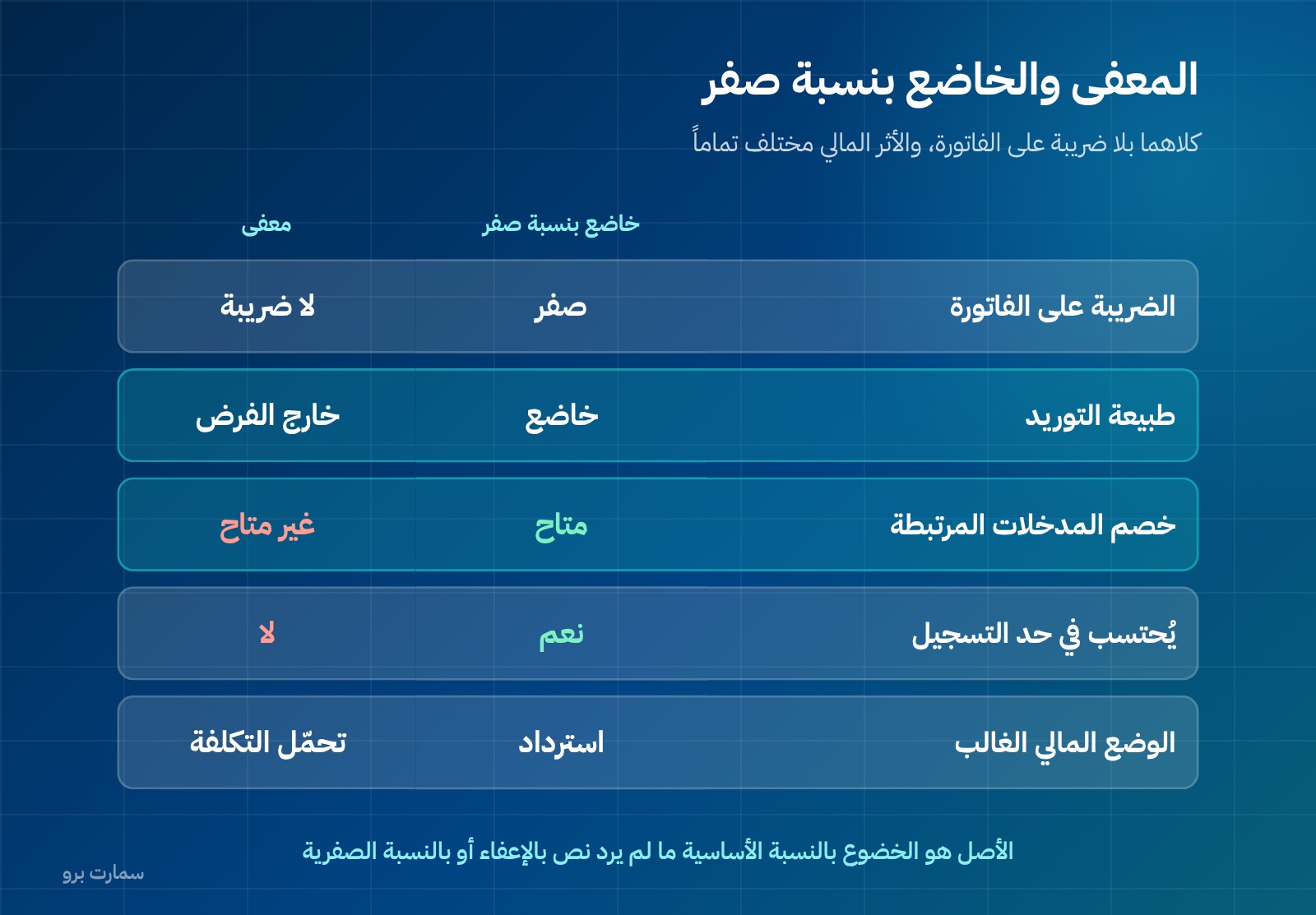
What is the difference between exempt and zero-rated in a table?
| Aspect | Zero-rated | Exempt |
|---|---|---|
| VAT on the invoice | Zero | No VAT |
| Nature | A taxable supply at 0% | A supply outside the charge to tax |
| Deduction of related input VAT | Allowed | Not allowed |
| Reported on the VAT return | Yes, in its own box | Yes, in its own box |
| Counts towards the registration threshold | Yes | No |
The third row is the heart of the matter. A zero-rated supply remains a taxable supply, so the input VAT linked to it stays deductible. An exempt supply produces no output VAT to deduct from, so the VAT you paid on its inputs becomes part of your cost. The full deduction conditions are covered in input VAT deduction.
How does it affect the VAT registration threshold?
The last row of the table is often overlooked. The mandatory registration threshold of SAR 375,000 is measured on taxable supplies, and a zero-rated supply is a taxable supply. So a business whose supplies are all zero-rated can exceed the threshold and be required to register, while a business whose supplies are exempt does not count them at all.
The financial result is different in each case:
- A business with zero-rated supplies: registers, charges its customers no VAT, and deducts its input VAT, so it is often in a refund position.
- A business with exempt supplies: does not reach the threshold, deducts nothing, and carries its input VAT as a cost.
The threshold and how to monitor it are explained in VAT registration in Saudi Arabia.
Mixed activity: where do most mistakes happen?
A business that makes both taxable and exempt supplies cannot deduct all its input VAT. There are three cases:
- An input serving taxable supplies only (standard-rated or zero-rated): deducted in full.
- An input serving exempt supplies only: not deducted.
- A shared input: deducted in proportion, using a fair basis that reflects its use in the taxable activity.
The recurring mistake is not choosing the wrong ratio; it is having no separation in the books at all. A chart of accounts that does not split standard-rated, zero-rated and exempt revenue turns any ratio into an unsupported estimate, which makes the VAT return itself impossible to defend. The separation starts with building your chart of accounts.
How do you build your books around the distinction?
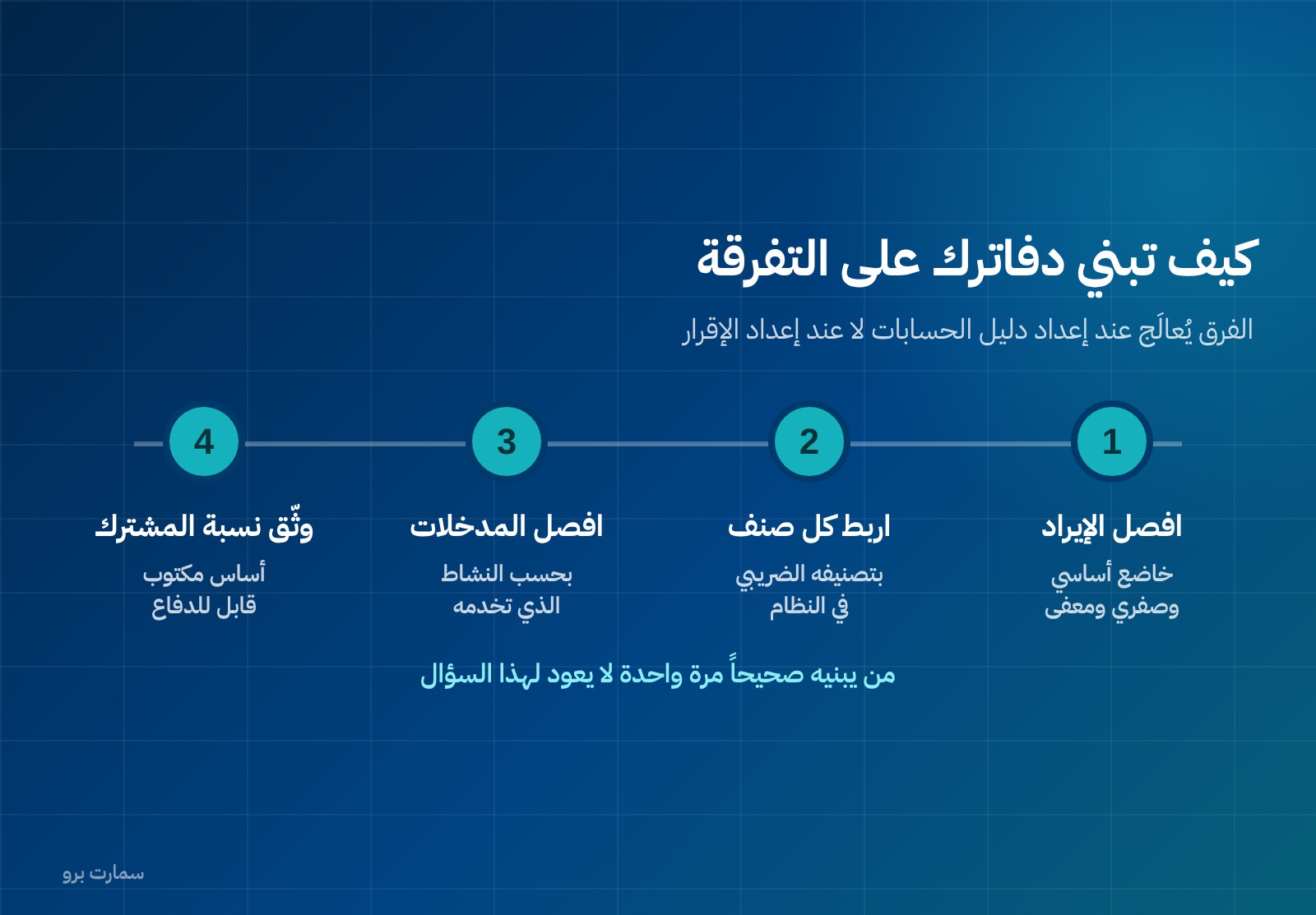
Three steps close this gap for good:
Split revenue into three levels in the chart of accounts: standard-rated, zero-rated and exempt. Not one revenue account that gets sorted out once a year.
Link every item or service to its tax classification in the system, so it is applied automatically when the invoice is issued and does not depend on the judgement of whoever issues it. This is a basic practical requirement when choosing an e-invoicing compliant system.
Separate inputs by what they serve: one account for inputs to taxable supplies, another for inputs to exempt supplies, and a third for shared inputs with a documented ratio. Your trial balance then gives you the VAT return figures ready to use.
A third common mistake: what does "out of scope" mean?
There is a third category that gets confused with both: a supply that falls outside the VAT Law altogether, such as one that takes place outside the Kingdom. It is neither exempt nor zero-rated, and putting it in the wrong box on the return creates a discrepancy. The rule: if the supply is within the scope of the Law, it is either standard-rated, zero-rated, or exempt by an explicit provision. If it is out of scope, it has its own separate treatment.
Checklist
- Every item and service has a defined tax classification in the system, not entered manually at the point of sale.
- Revenue is split in the books into standard-rated, zero-rated and exempt.
- Inputs are separated by the activity they serve.
- The deduction ratio for shared inputs is calculated and documented on a written basis.
- Classification relies on the text of the Implementing Regulations or the sector guideline, not on analogy with a similar activity.
- The registration threshold is calculated on taxable supplies, including zero-rated ones.
- VAT return boxes are filled from separate balances, not from a year-end sort.
The difference between exempt and zero-rated is not handled when you prepare the VAT return; it is handled when you set up the chart of accounts. Build it correctly once and you will not have to revisit the question.
Where is the official reference?
The VAT Law, its Implementing Regulations and the sector guidelines are published by the Zakat, Tax and Customs Authority (ZATCA) on its website: zatca.gov.sa. Article 10 refers the definition of exempt and zero-rated supplies to the Implementing Regulations, so the Regulations and the guideline for your sector are the reference for classifying any specific supply.
Read also
Article visuals
Frequently asked questions
What is the difference between exempt and zero-rated supplies?
Both show no VAT on the invoice, but a zero-rated supply is a taxable supply at 0%, so the input VAT linked to it remains deductible. An exempt supply is outside the charge to tax, so it produces no output VAT to deduct from and its input VAT becomes part of your cost. The difference is direct and financial, not a formality.
Do zero-rated supplies count towards the VAT registration threshold?
Yes. The mandatory registration threshold of SAR 375,000 is measured on taxable supplies, and a zero-rated supply is a taxable supply. A business whose supplies are all zero-rated may therefore be required to register, while exempt supplies are not counted towards the threshold.
How do I know whether my supply is exempt or zero-rated?
Article 10 of the VAT Law refers the definition of exempt and zero-rated supplies to the Implementing Regulations. The default is the standard rate of 15% unless a provision grants an exemption or applies the zero rate, so you cannot reason by analogy from a similar activity or treat a supply as exempt simply because it is not mentioned.
How are inputs treated in a business with both taxable and exempt activities?
An input serving only the taxable activity is deducted in full, an input serving only the exempt activity is not deducted, and a shared input is deducted in proportion using a fair, documented basis. In practice, revenue must be split in the chart of accounts into standard-rated, zero-rated and exempt; otherwise any ratio remains an unsupported estimate.