
Online Marketplaces and VAT: Who Charges VAT From January 2026
From January 2026, VAT falls on the platform, not the seller, when the seller is resident and not VAT-registered. Here is what changes for marketplace operators and for small sellers.
Author:سامي الحيدري

Online marketplaces and VAT are now one question, not two. From January 2026, an online marketplace that facilitates a sale by a resident seller who is not registered for VAT becomes liable for the VAT on that supply, not the seller. The 15% rate does not change; what changes is who owes the tax.
The legal basis is Article 47(3) of the VAT Implementing Regulations, as amended by ZATCA Board of Directors Resolution No. (01-06-24) dated 19 November 2024. The interpretive guide issued in April 2025 states that the part covering resident non-registered suppliers applies from January 2026.
How has the relationship between online marketplaces and VAT changed?
Before the amendment, the logic was simple: each seller was responsible for the VAT on its own sales, and the platform was an intermediary that took its commission and issued an invoice for it. If the seller was below the mandatory registration threshold (the level of taxable sales at which VAT registration becomes compulsory), there was no VAT on its sales at all.
After the amendment, the platform is treated as if it were the supplier in one specific case: the supplier is resident, it is not registered for VAT, and the supply was facilitated by the platform acting as an intermediary. In that case, the VAT on the supply is owed by the platform.
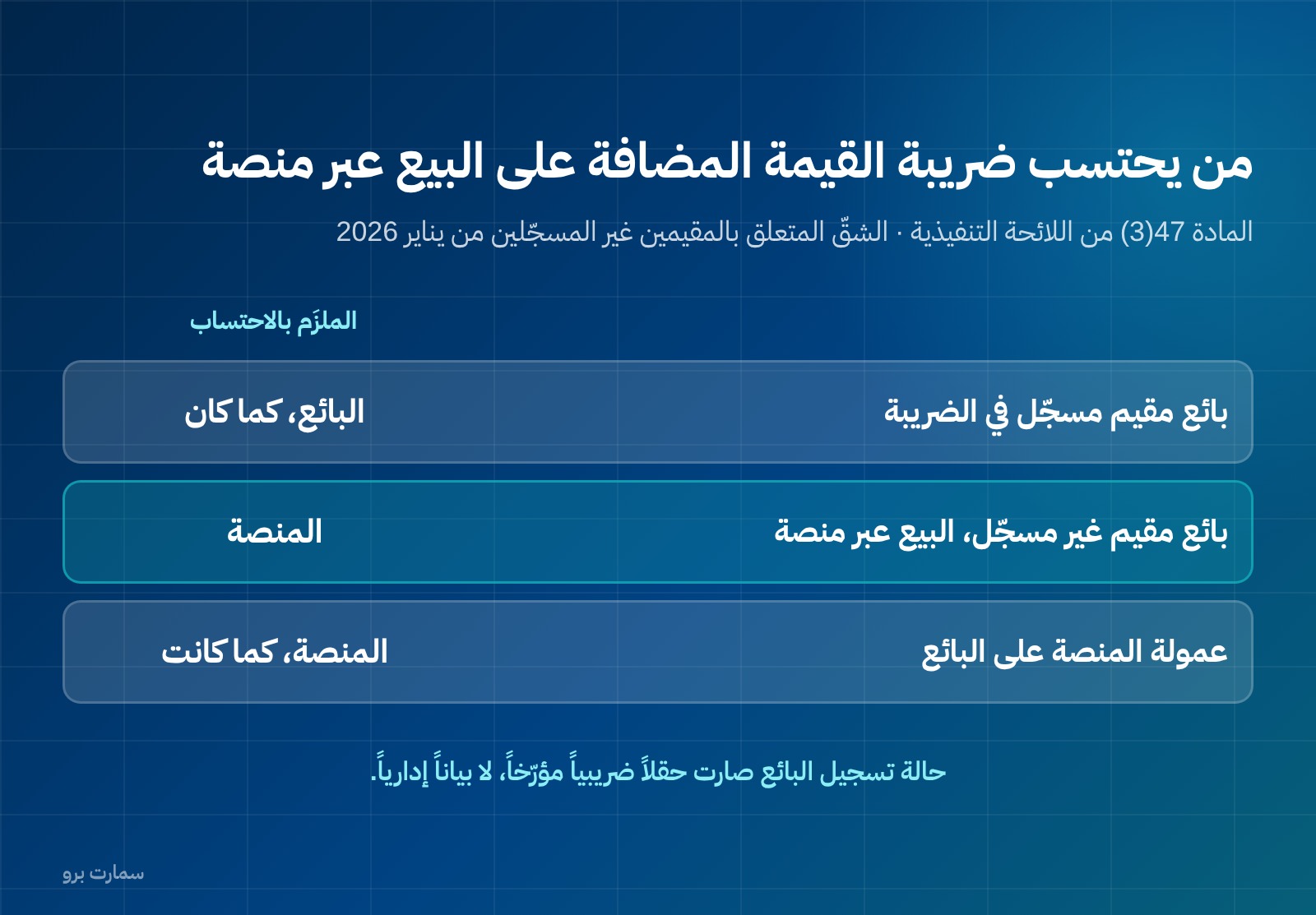
| Situation | Who must account for VAT |
|---|---|
| Resident seller registered for VAT | The seller, as before |
| Resident non-registered seller, selling through a platform | The platform, from January 2026 |
| Platform commission charged to the seller | The platform, as always |
Note the third row: the platform's commission was, and still is, subject to VAT as a service. What is new is that, in the second case, the platform now charges VAT on the value of the product itself, on top of its commission.
What does this mean for a marketplace operator?
The impact is technical and accounting at the same time:
- A seller's registration status is now a tax field, not an administrative detail. For every seller you need to know: resident or not, registered or not, and as of which date. A seller who changes status during the year changes who owes the tax from the date of that change.
- The invoice to the buyer, when the seller is not registered, is issued by the platform with its VAT, so it needs an issuing cycle separate from the commission invoice cycle.
- Settlement with the seller changes: the amount transferred is no longer the sale price minus commission, because the VAT the platform charged goes to ZATCA.
- The VAT return includes a line it never had before: output VAT (the tax charged on sales) accounted for on behalf of sellers, kept separate from the platform's own output VAT on its commissions.
If you sell through platforms and need to understand how invoices work under Phase 2 e-invoicing, see our ZATCA e-invoicing guide. For how this affects your choice of system, see SmartPro for e-commerce businesses, where the Online Store system connects store operations to sales and inventory.
What does it mean for a small seller on a platform?
If you are a seller below the mandatory registration threshold, this amendment does not force you to register, but it does change two numbers for you:
- The price the buyer sees now carries VAT it did not carry before. That means either your margin shrinks or your price goes up; there is no third option.
- The amount you receive from the platform drops by the VAT it remitted on your behalf, on top of the commission.
If you have reached the mandatory registration threshold, the picture is different: once you register, the liability returns to you, and you can then deduct your input VAT (the VAT you paid on your own purchases and expenses), which a non-registered seller cannot do. When registration becomes mandatory and when it is voluntary depends on your taxable turnover, so check your position against ZATCA's current registration rules.
What other changes in the same resolution deserve attention?
Resolution (01-06-24) was not a single article. It came with other amendments now in force that affect many systems:
- Article 54 — credit and debit notes: the note must be issued within 15 days from the end of the month in which the triggering event occurred. This is a clear deadline instead of a judgement call; details are in Credit Notes and Debit Notes: When to Issue Them and How.
- Article 50 — input VAT deduction: input VAT can now be deducted on services that employers are legally required to provide to employees, such as catering at remote sites and mandatory health insurance.
- Article 70 — refunds: a six-month time limit to submit the claim, a minimum of SAR 5,000, 20 working days to respond to document requests, and 30 working days for payment.
- Article 63: tighter rules for correcting errors in VAT returns.
- Article 69(5): ZATCA may offset refund amounts against other debts owed by the taxpayer.
- VAT groups: new restrictions, with a 180-day transition period from publication in the Official Gazette.
The Article 50 change alone is worth a review: many businesses routinely record VAT on mandatory health insurance as non-deductible, and that is no longer correct.
Who is the supplier in the eyes of the law?
The common mistake in reading this article is to treat it as shifting only the "collection responsibility". It does not. In this case the law treats the platform as the supplier, and that has consequences on three levels, not one.
At the invoice level, the buyer receives a tax invoice in the platform's name with its VAT, not an invoice in the seller's name. If the buyer is a registered business that wants to deduct its input VAT, the invoice that proves its right is the platform's invoice. A platform that gives the buyer a receipt in the name of the non-registered seller has unintentionally blocked that deduction.
At the bookkeeping level, the platform's entry is no longer a commission entry. The full sale value goes into a clearing account, the VAT goes into a VAT output payable account, and the net amount due to the seller goes into a payable account. Anyone who collapses this into a single commission entry will understate output VAT in the return.
At the contract level, the settlement clause needs rewriting. The price the seller sees on the dashboard and the amount transferred to them are no longer separated by the commission alone. A platform that has not updated the settlement clause in its contracts risks a commercial dispute over an unstated difference, not just a tax violation.
Which two cases cause the most confusion?
The seller who registers mid-year. Registration status is not permanent. A seller who crosses the mandatory threshold and registers in a given month takes the liability back from the effective date of their registration, not from the start of the year and not from the date they told the platform. So the platform needs the date, not just the current status; otherwise it will charge VAT on supplies it did not owe, or miss supplies it did owe.
The seller whose residency is unclear. The article requires residency. A platform that accepts sellers from outside the Kingdom needs a real way to distinguish resident from non-resident sellers, because the treatment differs. This should be verified with a document, not left to an option the seller ticks on the sign-up form.
In both cases, the field should be dated and tied to a supporting document, not a manual entry that can be changed without a trace. That is exactly what separates a system fit for a marketplace from one fit for a single store.
Short checklist
- If you run a platform: add each seller's VAT registration status as a mandatory field, with an effective date.
- In your books, separate output VAT on commissions from output VAT accounted for on behalf of non-registered sellers.
- If you are a non-registered seller: recalculate your margin on a price that now carries VAT.
- Review how you treat mandatory health insurance in light of Article 50.
- Set credit note issuing to the 15-day deadline from the end of the month.
The full text of the amendments and the interpretive guide is published on the ZATCA website. If your business model is mixed — resident and non-resident sellers, or cross-border digital services — your position needs to be read against your contracts, not a general rule.
Key takeaway: From January 2026, a marketplace that facilitates sales by resident non-registered sellers is treated as the supplier and owes the VAT on the product, which changes its invoices, books, returns and seller contracts. Sellers below the threshold do not have to register, but their prices and payouts change.
To see how connected sales, inventory and accounting handle invoices and VAT reports in one place, start a SmartPro free trial or book a demo.
Article visuals
Frequently asked questions
How have the rules on online marketplaces and VAT changed?
Under Article 47(3) of the VAT Implementing Regulations, as amended by Board Resolution (01-06-24) dated 19 November 2024, an online marketplace becomes liable for VAT on supplies it facilitates as an intermediary. The interpretive guideline states that the part covering resident, non-registered suppliers applies from January 2026.
Does a small seller have to register for VAT because of this amendment?
No, the amendment does not require registration. It does change two numbers: the price shown to the buyer now carries VAT it did not carry before, and the amount the platform transfers drops by the VAT paid on the seller's behalf, on top of the commission. A seller who registers takes the liability back and can deduct their input VAT.
Was the platform's commission subject to VAT before the amendment?
Yes. The platform's commission was, and still is, subject to VAT as a service. What is new is that the platform now also charges VAT on the product value itself when the seller is resident and not registered, in addition to the VAT on its commission.
What other changes are in Resolution 01-06-24?
The main ones are: credit or debit notes must be issued within 15 days of the end of the month in which the triggering event occurred; input VAT can be deducted on employee services mandatory by law, such as mandatory health insurance; refunds have a six-month time limit and a SAR 5,000 minimum; rules for correcting returns are narrower; and VAT groups face new restrictions.
What needs to change in a marketplace's system?
Each seller's VAT registration status must become a mandatory field with an effective date, not an administrative note. Output tax on commissions must be kept separate from output tax charged on behalf of non-registered sellers. The settlement cycle with sellers also changes, because the amount transferred is no longer simply the sale price minus commission.