
Accounting Software for Tailoring Shops: What a Generic System Doesn't Understand
Accounting software for tailoring shops differs from any generic system in four ways: fabric by the metre, customer deposits, order stages and the cost per piece. Worked through in numbers.
Author:سامي الحيدري
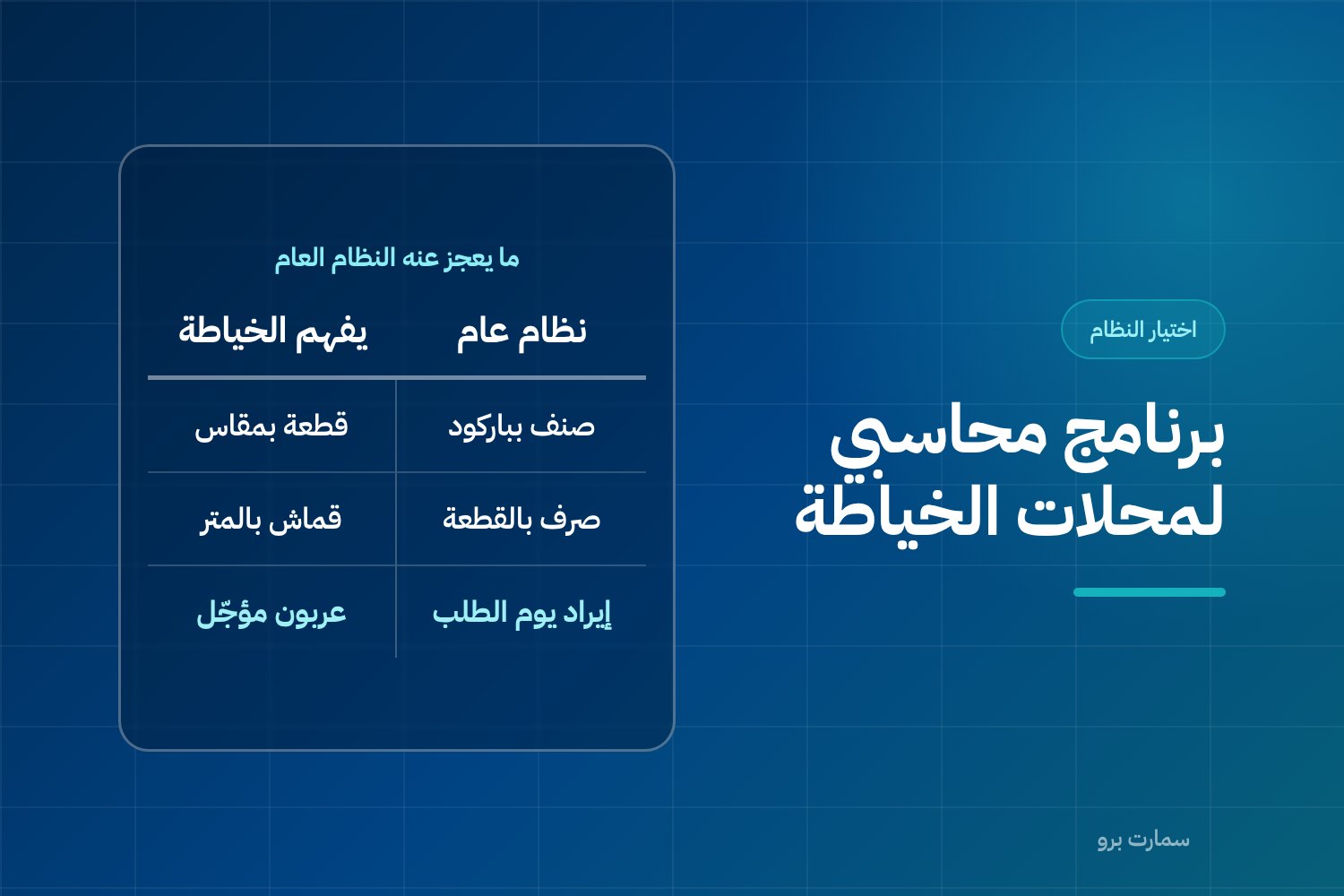
Accounting software for tailoring shops is not a cut-down version of a generic accounting program. A tailoring shop sells a garment made to a customer's measurements, from fabric issued by the metre, through stages that run for days, against a deposit paid weeks before delivery. A generic accounting system understands none of these four things.
That isn't a flaw in it. It was built for a shop that sells ready-made items: an item comes in at one price, goes out at another, and the whole thing is over in a minute at the till. You, on the other hand, take an order today, issue fabric two days later, pay the tailor a week after that, deliver three weeks later and collect the balance on delivery. That is five financial moments for one order, and the generic system sees only one.
The result is that you keep a parallel record: a deposits notebook, a measurements book and a slip of paper tucked into every order. Then you close the month on a figure you don't trust.
The figures below are hypothetical, used to illustrate the method, and do not represent prevailing market prices.
Accounting software for tailoring shops: the four things a generic system can't handle
First: an item isn't just an item. In a generic system, "thobe" is one line at one price. In your shop it is a standard thobe, a detailed thobe, an alteration and a hemming job, each with a different cost and a different time. If the system doesn't separate them, your reports tell you total sales but not where the profit came from.
Second: fabric is issued by the metre, not by the piece. A generic system deducts one piece from stock. You deduct 3.5 metres from a roll, and what's left on the roll is a remnant too short for a thobe but too good to throw away.
Third: a deposit is not a sale. Collecting SAR 112 today does not mean you sold SAR 112 today. A generic system records it either as a sale or as a debt, and both are wrong from an accounting point of view.
Fourth: an order moves through stages. Measuring, cutting, sewing, pressing, delivery. A generic system doesn't know where an order is right now, so it can't tell you how much of your production is work in progress that hasn't been invoiced yet.
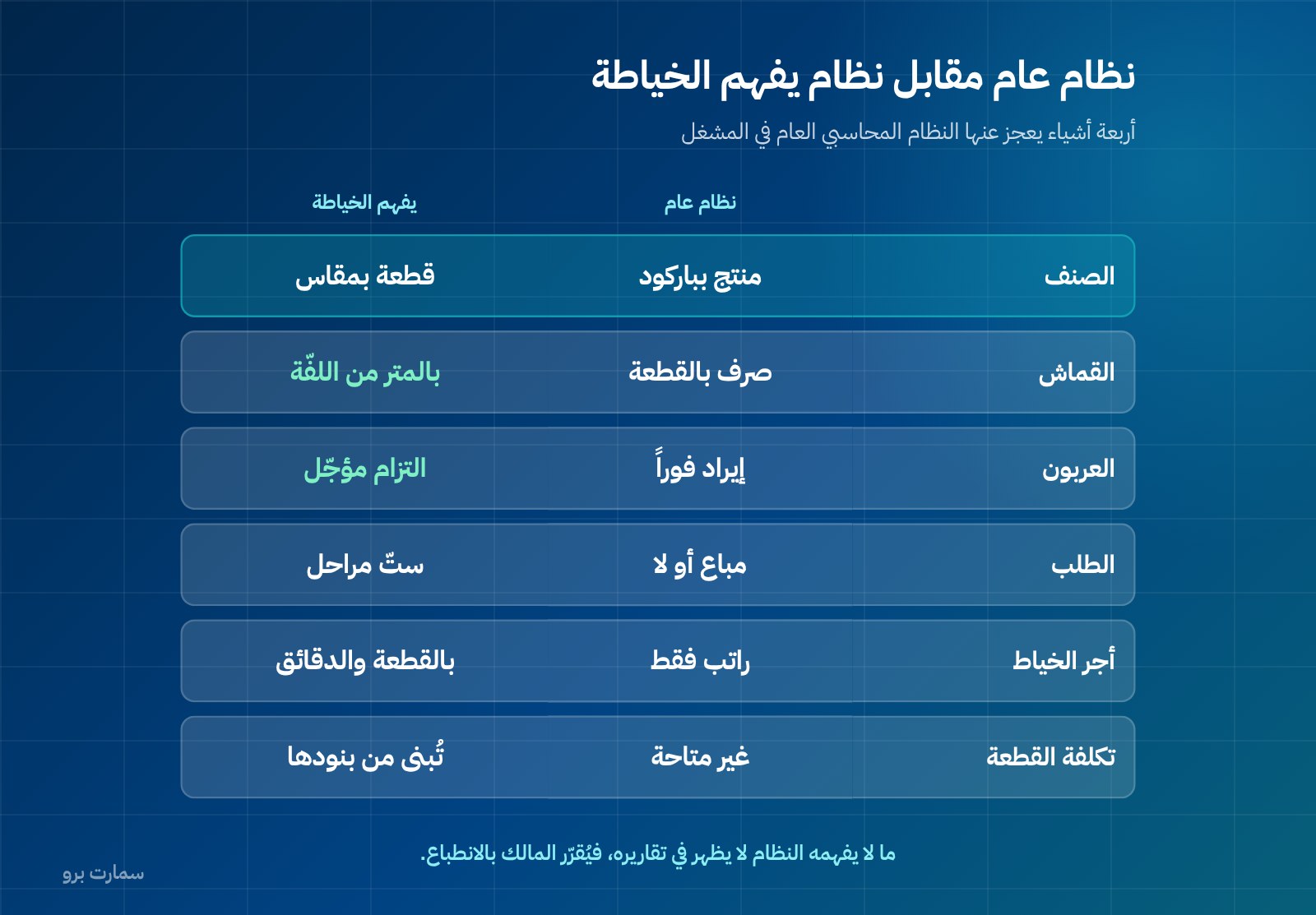
How does a generic accounting system compare with one built for tailoring?
| Item | Generic accounting system | System that understands tailoring |
|---|---|---|
| Items | One line at a fixed price | Items with different times and costs: thobe, detailed thobe, alteration, hemming |
| Fabric by the metre | Unit = piece | Unit = metre, with roll and remnant tracking |
| Deposit | Full sale or debt | Advance receipt: deferred revenue + output VAT on the day it is collected |
| Order stages | None | A status for each order from measuring to delivery |
| Tailor's piece-rate pay | Fixed salary in general expenses | Pay linked to the piece and included in its cost |
| Cost per piece | Rough overall estimate for the shop | Direct cost and full cost for each item type |
| Measurements | A notes field, or nothing | A measurement record for each customer, recalled on the next order |
Read the last row twice. A measurement record is not an organisational luxury; it is what brings the customer back to you instead of starting from scratch somewhere else.
How should a deposit be recorded? The most common accounting mistake in the sector
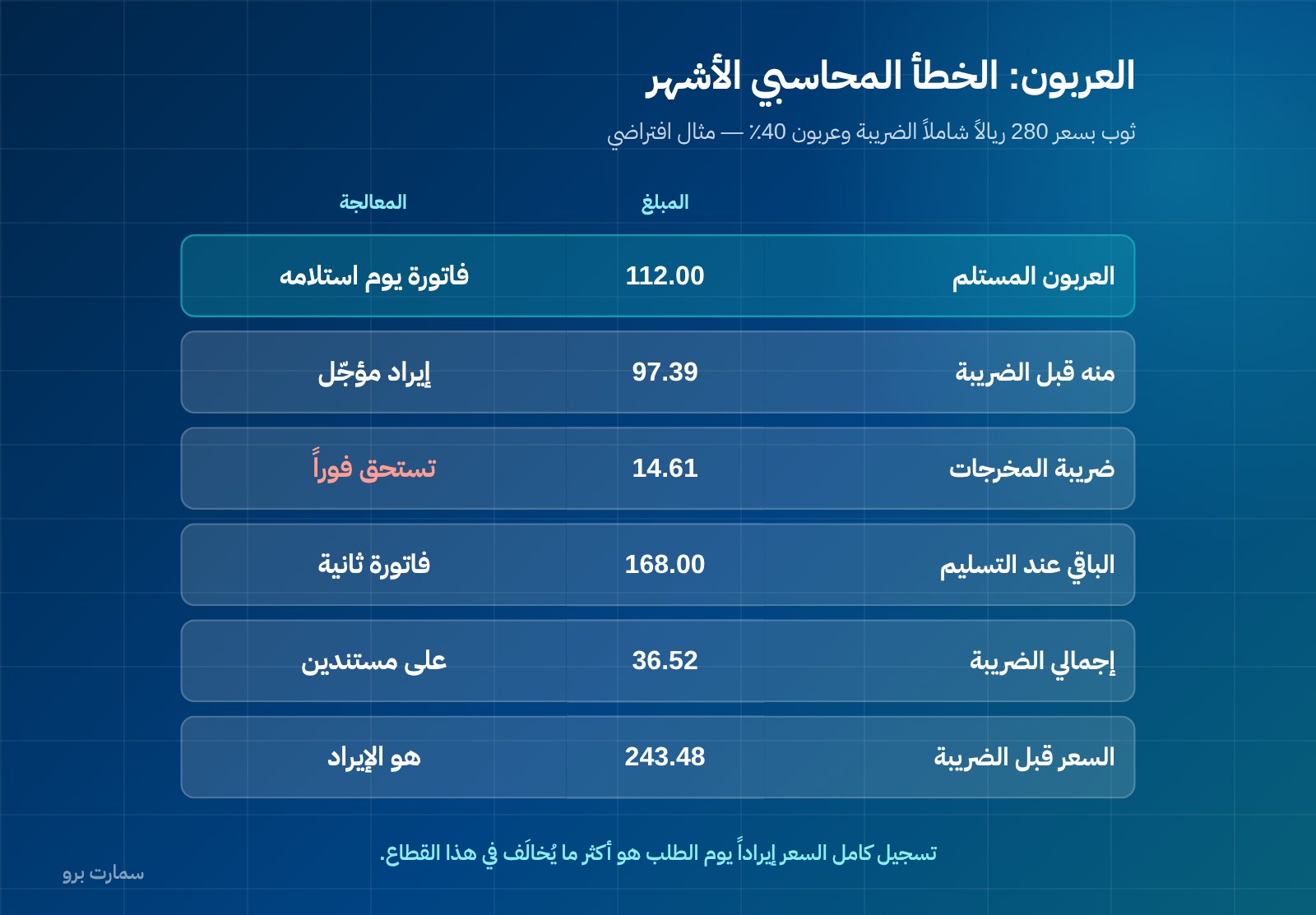
The mistake we see most often in tailoring shops is recording the full price as revenue on the day the order is taken. The order is SAR 280, the customer pays a 40% deposit, and SAR 280 is booked as a sale that day. This inflates revenue in the month you took the order, empties the month you delivered it, and makes month-on-month comparison meaningless.
The correct treatment separates two things that don't happen on the same day: revenue and VAT. Value Added Tax (VAT) is the 15% tax charged on sales in Saudi Arabia.
VAT is due on the amount received, on the day it is received. So a deposit requires a simplified tax invoice on the day it is collected, for the amount collected, followed by a second invoice for the balance on delivery. Simplified invoices must be reported within 24 hours of being issued.
Revenue, however, is not recognised before delivery. The amount received stays on your books as a liability (deferred revenue, meaning money received for work not yet delivered) until you hand over the garment.
| Amount incl. VAT | Before VAT | VAT | |
|---|---|---|---|
| Deposit (40%) on order day | 112.00 | 97.39 | 14.61 |
| Balance (60%) on delivery day | 168.00 | 146.09 | 21.91 |
| Total | 280.00 | 243.48 | 36.52 |
On order day: a simplified invoice for SAR 112, recording 97.39 as deferred revenue and 14.61 as output VAT. On delivery day: an invoice for SAR 168, moving the 97.39 from deferred revenue to earned revenue alongside the new 146.09.
That is three journal entries for a single order. Done by hand across 120 orders a month, it is 360 entries you won't keep accurately. A system that understands deposits generates them from a single screen. The full details are in deposit handling and VAT.
Why does issuing fabric by the piece break down?
In a generic system, the unit for fabric is "piece". So you receive the roll as one piece, issue it as one piece, and it leaves stock entirely with the first thobe. A month later your stock balance is fiction with no connection to what's on the shelf.
The right approach is for the unit to be the metre: the roll comes in at its number of metres, and each order deducts what was actually used. Our thobe takes 3.5 metres, so a 40-metre roll makes eleven thobes with 1.5 metres left over.
That remnant is the real problem in tailoring shop stocktakes. A metre and a half isn't enough for a thobe, but it's enough for an alteration, a pocket or a lining. Record it at its original price and your stock is worth less than it says. Ignore it and you lose usable fabric. A system that understands tailoring keeps remnants as a separate item with a location, a length and a balance, not a number that evaporates into "stocktake variances". For the stock level at which to reorder, see the fabric reorder level.
Cost per piece: how are 103.10 and 223.10 built?
This is where the software decision is settled. A system that can't give you the cost of a thobe leaves your price resting on gut feeling.
| Item | Calculation | SAR |
|---|---|---|
| Fabric | 3.5 metres × 15 | 52.50 |
| Waste | 5% of fabric | 2.60 |
| Sewing labour | 80 minutes × 0.50 | 40.00 |
| Supplies | Buttons, thread and pressing | 8.00 |
| Direct cost | 103.10 | |
| Share of fixed costs | 14,400 ÷ 120 thobes | 120.00 |
| Full cost | 223.10 |
The displayed price is SAR 280 including VAT, or 243.48 before it. So the margin on the thobe is SAR 20.38, not the SAR 140 it appears to be if you subtract 103.10 from 243.48 and forget fixed costs.
Because items differ in time, our series also allocates fixed costs by the minute: each minute's share of fixed costs is SAR 0.23. The full derivation of both figures is in the true cost of tailoring a thobe.
A generic system can tell you the shop's overall gross profit. It cannot tell you that alterations make money while the detailed thobe loses it. Those are two entirely different figures when it comes to making decisions.
Tailors' piece-rate pay: the missing link
In a generic system, the tailor's pay is an administrative expense at the bottom of the statement. In reality, it is the largest item in the cost of a piece after fabric, and it changes with the item type.
| Item | Standard minutes | Pay at SAR 0.50 per minute |
|---|---|---|
| Thobe | 80 | 40.00 |
| Detailed thobe | 110 | 55.00 |
| Medium alteration | 20 | 10.00 |
| Hemming | 12 | 6.00 |
These minutes are the backbone of the whole calculation: pay comes from them, the per-minute allocation of fixed costs comes from them, and they tell you your workshop's real capacity. A system that records who sewed which piece gives you these figures from the work data itself, not from a monthly estimate. The method is in piece rates for tailors.
What should you check before you buy?
Ask the vendor to do it in front of you, on their screen, rather than describe it:
- A measurement record for each customer: enter a customer with their measurements, then open a new order for them and recall the measurements without retyping.
- Order stages: move an order from measuring to cutting to sewing to delivery, and pull a list of what is in progress right now.
- A deposit invoice: collect SAR 112, issue a simplified invoice for it, then the balance invoice on delivery, and show me the journal entry in the accounts.
- Fabric by the metre: receive a 40-metre roll, issue 3.5 metres to an order, and show me the balance and the remnant.
- Piece-rate pay: link a piece to a tailor and show what they are owed at the end of the week.
- Reports by item type: show me the profit on alterations separately from the profit on thobes.
- Cost per piece: produce 103.10 and 223.10 from the system, not from a side sheet.
Six out of seven isn't enough. The item that fails is the item you'll be keeping by hand for two years. For the questions to put to a vendor before signing, see six questions before choosing a workshop system.
What does the system cost, and what does it save?
Compare against your margin, not the price. The margin on a thobe is SAR 20.38, and on 120 thobes a month the shop's profit is roughly SAR 2,445. So any small error in the numbers wipes it out completely: a lost deposit, an unrecorded fabric remnant, or an item that loses money without you knowing.
Our published packages: Mini at SAR 1,500 a year including VAT, Pro at 4,500 and Max at 20,500. Put whichever you like into the calculation and measure it by the errors it prevents, not by what appears on the quote.
For anyone who wants the same screens with tailoring items and stages ready to go, we've set it out in detail in the tailoring shop and workshop management system.
What are the three mistakes to avoid when switching?
First: migrating stock balances by the piece. If your old book counted rolls as pieces, start with a physical stocktake in metres. Otherwise you carry the error into a new system.
Second: leaving old deposits outside the system. Deposits collected on orders not yet delivered are an outstanding liability. Enter them all on switchover day, or your first month's revenue will look inflated.
Third: running the system for sales only. If you enter invoices but keep fabric and pay outside the system, you get an invoicing system, not accounting software that knows the cost of each piece.
Where is the official reference?
E-invoicing requirements and reporting deadlines are published on the website of the Zakat, Tax and Customs Authority (ZATCA). Note that ZATCA does not approve software; it publishes an indicative list of qualified e-invoicing solution providers. So the phrase "approved by ZATCA" in any sales pitch should be read on that basis, and responsibility ultimately rests with you for the compliance of what you use.
Read also
- The true cost of tailoring a thobe
- Deposit handling and VAT
- Six questions before choosing a workshop system
Key takeaway: A tailoring shop needs software that issues fabric by the metre, treats deposits as deferred revenue with VAT on collection, tracks order stages and calculates the cost of each piece. Anything less leaves you keeping a parallel notebook.
Try it with your own orders and fabric through a free trial of SmartPro.
Article visuals
Frequently asked questions
Is generic accounting software enough for a tailoring shop?
It is enough for issuing invoices and filing VAT returns, but not for running the shop. It doesn't issue fabric by the metre, treat deposits as deferred revenue, track order stages or calculate the cost per piece. The result is that you keep a parallel notebook alongside it and close the month on a figure you don't trust.
How do I record a customer deposit in the accounts?
VAT is due on the amount received on the day it is received, so you issue a simplified tax invoice for the deposit that day and another for the balance on delivery, and simplified invoices are reported within 24 hours of issue. Revenue, however, is not recognised before delivery; the amount received stays as deferred revenue. So a SAR 112 deposit on a SAR 280 order is recorded as 97.39 deferred revenue and 14.61 output VAT.
Why is the cost of a thobe 223.10 and not 103.10?
The first figure is the full cost and the second is the direct cost. Direct cost covers fabric, waste, sewing labour and supplies, while full cost adds the piece's share of fixed costs, which is SAR 120 when SAR 14,400 is spread over 120 thobes a month. These figures are hypothetical, used to illustrate the method, and do not represent prevailing market prices.
Does ZATCA approve accounting software?
No. The Zakat, Tax and Customs Authority (ZATCA) does not approve software; it publishes an indicative list of qualified e-invoicing solution providers. Any sales pitch claiming "approved by ZATCA" should be read on that basis, and responsibility rests with you for making sure the system you use complies with the requirements.