
The Item Card: What It Holds, With a Worked Example in SAR
An item card carries two balances, not one: quantity and value. Here is a filled-in example using the moving weighted average, plus the five mistakes that ruin it.
Author:سامي الحيدري
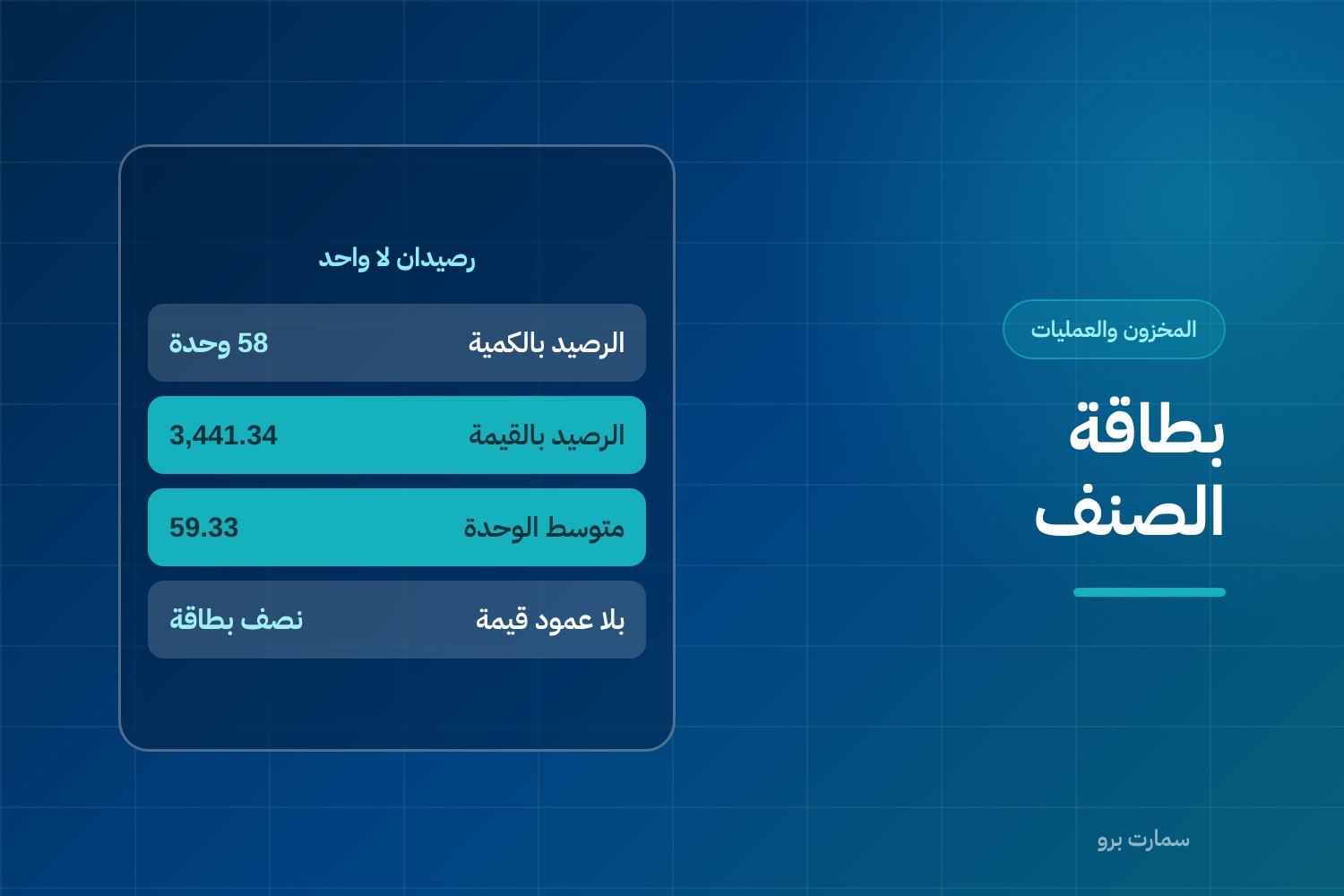
An item card (also called a stock card) is the record that tracks the movement of a single item: how much came in, how much went out, at what cost, and how much is left. Its job is to give every item two known balances at any moment: a quantity balance and a value balance.
On paper it was a card pinned to the shelf; in an accounting system it is a screen. The function has not changed.
Businesses that lose money in their warehouse rarely do so because they don't count. They lose it because their item cards don't carry cost. They know they have 40 units, but not what those units are worth.
What should an item card contain?
The card holds fixed data that identifies the item:
- Item code: unique, never repeated, and unchanged when the supplier changes.
- Name and description: specific enough to tell it apart from similar items, not a generic label.
- Unit of measure and any conversion factors (for example, 1 carton = 12 boxes).
- Category and storage location.
- Supplier or suppliers, the reorder level and the minimum stock level.
- Barcode if there is one, and the applicable VAT rate.
It also holds movement data recorded with every transaction: the date, the movement type, the reference document, the quantity in or out, the unit cost, and the balance afterwards in both quantity and value.
The last item is the most important. A card that ends with a quantity column only is half a card. The value column is what turns it into an accounting tool.
What does a completed item card look like in SAR?
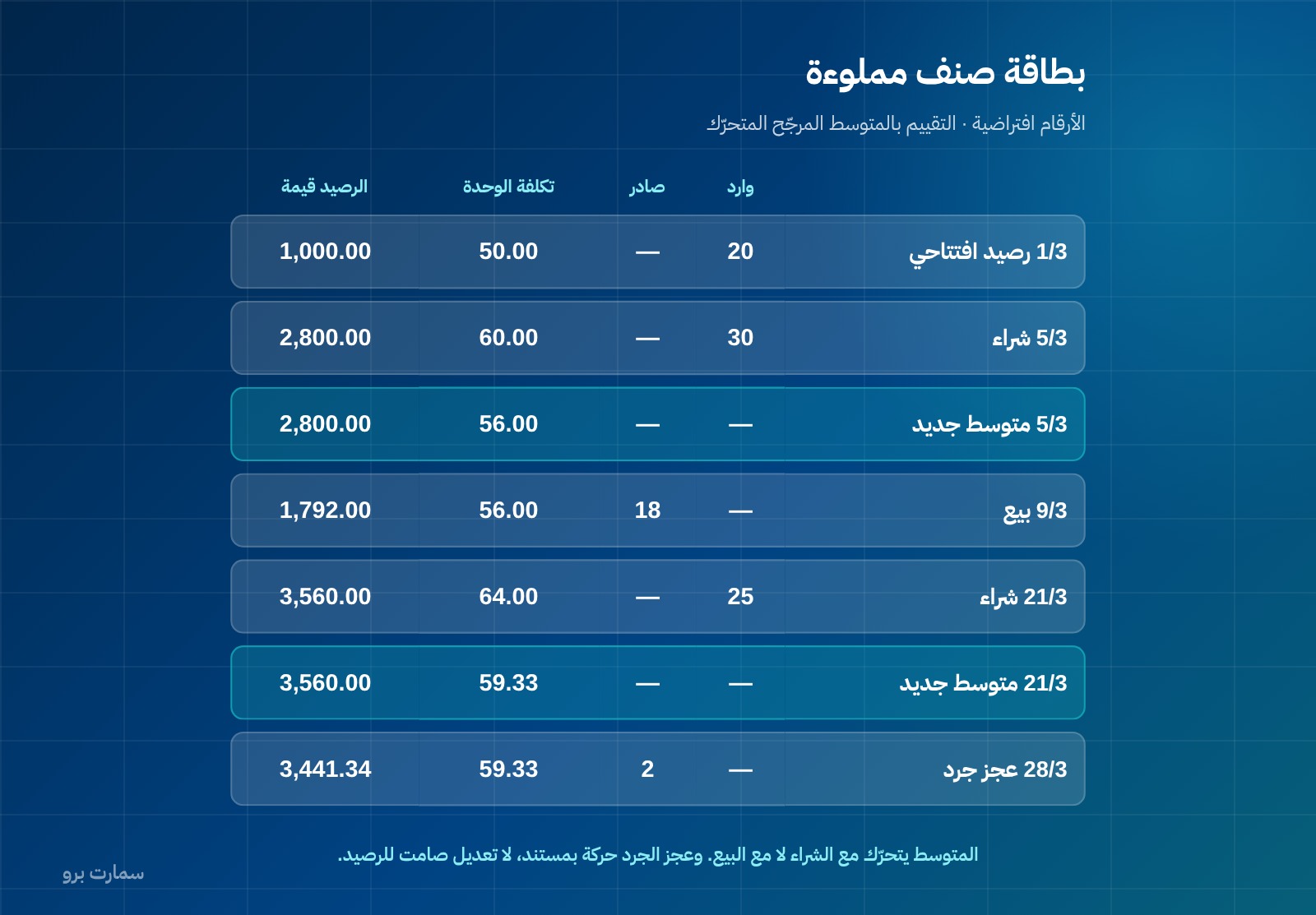
The figures below are hypothetical, used to illustrate the method, not taken from a real business. The item is valued using the moving weighted average, a method in which the unit cost is recalculated after every purchase by dividing the total value on hand by the total quantity on hand.
| Date | Movement | Document | In | Out | Unit cost (SAR) | Balance qty | Balance value (SAR) |
|---|---|---|---|---|---|---|---|
| 1 Mar | Opening balance | — | 20 | — | 50.00 | 20 | 1,000.00 |
| 5 Mar | Purchase | PI-1042 | 30 | — | 60.00 | 50 | 2,800.00 |
| 5 Mar | New average | — | — | — | 56.00 | 50 | 2,800.00 |
| 9 Mar | Sale | SI-318 | — | 18 | 56.00 | 32 | 1,792.00 |
| 14 Mar | Sales return | SR-07 | 3 | — | 56.00 | 35 | 1,960.00 |
| 21 Mar | Purchase | PI-1088 | 25 | — | 64.00 | 60 | 3,560.00 |
| 21 Mar | New average | — | — | — | 59.33 | 60 | 3,560.00 |
| 28 Mar | Stocktake shortage | ST-03 | — | 2 | 59.33 | 58 | 3,441.34 |
Read the table again and look at what it tells you:
- The average moves with every purchase, not with every sale. On 5 March it became (1,000 + 1,800) ÷ 50 = SAR 56. On 21 March it became (1,960 + 1,600) ÷ 60 = SAR 59.33.
- A sale goes out at the average in force at the time of sale, not at the last purchase price. So the 9 March sale was costed at 56, not 60.
- A return comes back at the same cost it went out at, not at today's cost.
- A stocktake shortage is a recorded movement with a document, not a silent edit to the balance. That is what makes it accountable.
Cost of sales for this item in March = (18 × 56) − (3 × 56) = SAR 840. Closing inventory is SAR 3,441.34. Any other figure your system produces for this item in this period is wrong.
Which mistakes ruin an item card?
Undisciplined coding. Two codes for the same item because the supplier changed. The result is two balances, both wrong, and a movement report nobody can read. The rule: the code describes the item, not where it came from.
Two units of measure with no conversion factor. The item is bought by the carton and sold by the box, but the card doesn't know a carton holds 12. The balance becomes a meaningless mix of two units.
Typing the cost of sales by hand. Once a user types in the unit cost of what goes out, there is no valuation system any more, only an opinion. The outgoing cost must be calculated by the system from the approved valuation method.
Overwriting the balance instead of recording the difference. Whoever opens the card and types in the correct balance, rather than recording a shortage movement, erases the evidence. The difference must be recorded as a movement with a document and a reason.
A card with no cost at all. This is the most common mistake in businesses that run their stock on a spreadsheet: quantity columns only. The stocktake becomes a count rather than a valuation, and cost of sales becomes a year-end estimate.
How does the item card connect to journal entries?
Every movement on the card has an effect in the general ledger:
| Movement on the card | Accounting effect |
|---|---|
| Purchase | Debit inventory, credit suppliers |
| Sale | Debit cost of sales, credit inventory |
| Sales return | Debit inventory, credit cost of sales |
| Stocktake shortage | Debit stocktake shortages and gains, credit inventory |
| Damage | Debit damaged-stock expense, credit inventory |
This link is what separates an accounting system from a stock spreadsheet: each movement generates its journal entry automatically. If you record warehouse movements in one place and journal entries in another, the two figures will differ at every close, and you will spend days on a reconciliation that never ends. The nature of these entries is covered in types of journal entries.
The cost column depends entirely on the inventory valuation method you have adopted, and on your system running a perpetual inventory rather than a periodic one. A perpetual inventory updates the balance with every movement, while a periodic one only updates it at the count, so a live item card can only exist under a perpetual system.
In SmartPro, the Inventory system keeps item balances by warehouse and branch, and because every system is connected, a sale updates stock and the accounts by itself through Finance & Accounting.
What should you do this week?
- Open the movement report for one item in your system and check that it has a value column, not just quantity.
- Trace an item you bought twice at two different prices, and confirm that the cost of sales came out using your approved method.
- Look for duplicate items with different codes, and merge them.
- Make sure stocktake shortages are recorded as movements, not edits.
- Link the reorder level to an actual alert; otherwise it is a field with no function.
The rules for measuring inventory and what goes into its cost are set by the IFRS Foundation.
Key takeaway: An item card is only useful if it carries value as well as quantity, with outgoing cost calculated by the system and every difference recorded as a documented movement.
To see a live item card with quantity and value side by side, start a SmartPro free trial.
Article visuals
Frequently asked questions
What is an item card and what is it for?
An item card is the record that tracks the movement of a single item: what came in, what went out, at what cost, and how much remains. Its purpose is to give every item two known balances at any moment: a quantity balance and a value balance. A card that ends with a quantity column only is half a card, because the value column is what makes it an accounting tool.
What data should an item card contain?
Fixed data: a unique code that doesn't change when the supplier changes, a distinct name and description, a unit of measure with its conversion factors, a category and storage location, the supplier and reorder level, and the barcode and VAT rate. Movement data with every transaction: the date, movement type, reference document, quantity, unit cost, and the balance afterwards in both quantity and value.
How does cost move on an item card using the weighted average?
Under the moving weighted average, the average cost is recalculated with every purchase, not with every sale. A sale goes out at the average in force at the time of sale, not at the last purchase price, and a return comes back at the same cost it went out at, not today's cost. A stocktake shortage is recorded as a movement with a document, never as a silent edit to the balance.
What are the most common item card mistakes?
There are five: undisciplined coding that creates two codes for the same item, two units of measure with no conversion factor, typing the cost of sales by hand instead of letting the system calculate it, overwriting the balance instead of recording the stocktake difference, and a card with no cost column at all. Each one makes either the quantity or the value balance unreliable.
How is the item card related to journal entries?
Every movement on the card has an effect in the ledger: a purchase debits inventory and credits suppliers, a sale debits cost of sales and credits inventory, a sales return reverses that, and a stocktake shortage debits the stocktake shortages and gains account and credits inventory. Generating the journal entry automatically from each movement is what separates an accounting system from a stock spreadsheet.