
Inventory Valuation Methods: The Three That Are Permitted, and a SAR Example That Shows the Difference
FIFO, weighted average and specific identification, and why LIFO is prohibited. Includes a SAR example showing the profit gap between two methods.
Author:سامي الحيدري

There are three inventory valuation methods under IFRS, not four as is often assumed: first-in, first-out (FIFO), weighted average cost, and specific identification of cost. Last-in, first-out (LIFO) is prohibited. Anyone building their books on LIFO today is using a method that is not accepted in financial statements.
The difference between the methods is not theoretical. The same quantities and the same purchases produce three different figures for cost of sales and for closing inventory, and therefore three different profit figures. If you don't know which method your system applies, you don't know where your margin comes from.
What are the three permitted inventory valuation methods?
First-in, first-out (FIFO) assumes the oldest units are sold first. Cost of sales is calculated at the older purchase prices, and closing inventory is left at the most recent prices. In a market where prices are rising, this shows a higher profit and an inventory value closer to its current worth.
Weighted average cost calculates the average cost per unit after each purchase, or at the end of the period, and issues stock at that cost. The effect of price swings is smoothed out instead of showing up line by line. It is the most widely used method among businesses that buy the same item from suppliers at similar prices.
Specific identification of cost tracks the cost of each individual unit. It only suits distinct items in small numbers: a car with a chassis number, a gold piece with its weight and number, a device with a serial number. In a warehouse holding thousands of identical units, it is neither practical nor required.
IFRS requires consistency: the same method must be used for all inventories of a similar nature and use. You cannot pick one method for one item and another for a similar item because the result looks better. The detailed rules are covered in our article on the inventory standard.
A SAR example: same transactions, two different figures
The following figures are hypothetical, to illustrate the method, not figures from an actual business.
A business bought one item three times and then sold 70 units:
| Transaction | Quantity | Unit price | Total |
|---|---|---|---|
| First purchase | 40 | SAR 10 | 400 |
| Second purchase | 30 | SAR 12 | 360 |
| Third purchase | 30 | SAR 15 | 450 |
| Available | 100 | — | 1,210 |
| Sales | 70 | — | — |
| Remaining | 30 | — | — |
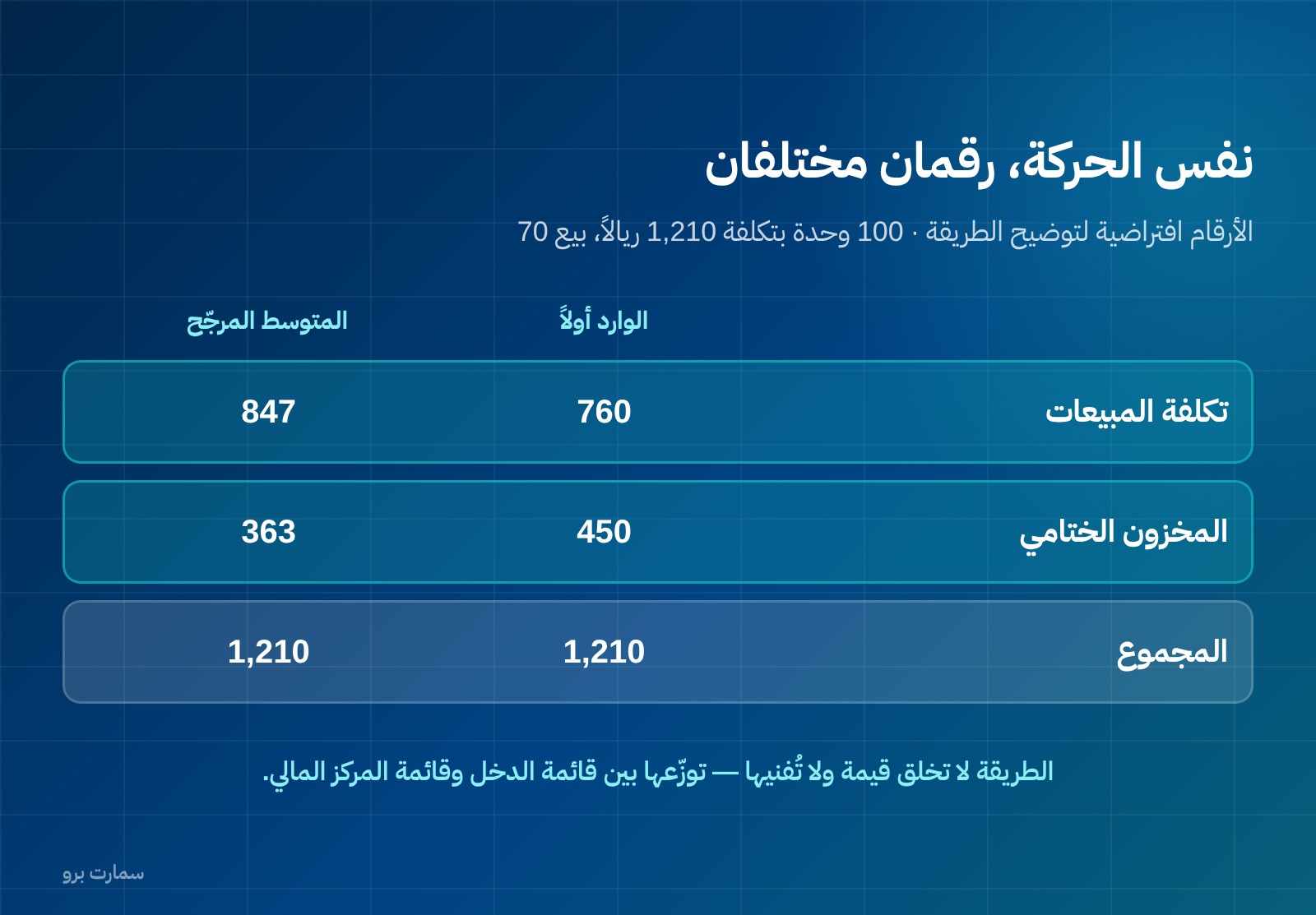
Using FIFO: 40 units are issued at SAR 10 and 30 at SAR 12 → cost of sales = 400 + 360 = SAR 760. Closing inventory is 30 units from the third purchase = 30 × 15 = SAR 450.
Using weighted average: average cost per unit = 1,210 ÷ 100 = SAR 12.10. Cost of sales = 70 × 12.10 = SAR 847, and closing inventory = 30 × 12.10 = SAR 363.
The difference in cost of sales is SAR 87 on one item and one set of transactions. Multiply that across hundreds of items and thousands of transactions, and you'll see why the auditor asks about the method before asking about the numbers.
Notice too that the total balances in both cases: 760 + 450 = 1,210, and 847 + 363 = 1,210. The method neither creates value nor destroys it. It allocates it between the income statement and the statement of financial position.
Which method should you choose?
No method is the "best" in absolute terms, but some fit your business better than others:
- Perishable items or items with expiry dates (food, medicines, cosmetics): FIFO, because it matches the actual movement of goods in the warehouse.
- Identical items bought continuously at fluctuating prices (raw materials, spare parts, supplies): weighted average, because it prevents artificial jumps in margin from one month to the next.
- Distinct, high-value items (gold, cars, serial-numbered devices): specific identification.
The practical consideration people overlook is what your system can actually do. A moving weighted average needs recalculating after every purchase, and FIFO needs cost layers to be tracked. A system that records a single price per item applies neither method in practice. It applies the last purchase price, and that is not a recognised method. Test it yourself: enter two purchases at two different prices, sell one unit, and see what cost it was issued at.
Which rule overrides the valuation method?
Whatever your method, inventory is measured at the lower of cost and net realisable value. Net realisable value is the estimated selling price less the costs needed to make the sale. If an item's selling price falls below its cost, through damage, slow movement or a market drop, it is written down to what it will realistically fetch, and the difference is an expense in that period.
This is often neglected in small businesses, so obsolete stock sits in the books at its original cost for years. It is one of the things that most distorts liquidity ratios in financial ratio analysis.
How does the method affect zakat and tax?
A point missed in most of what is written on this topic: the valuation method doesn't stay inside the financial statements. Its effect carries further.
Closing inventory enters the zakat base as a current asset, so the SAR 87 difference on one item in the example above becomes a real difference in the base once it repeats across every item. The method that raises closing inventory raises the zakat base and lowers cost of sales at the same time.
For businesses subject to income tax, cost of sales is a deductible item, so a change in it moves the tax base in the opposite direction. That is why switching methods from year to year is not accepted: the switch alone can move the base without anything changing in the business. The filing dates for both returns are in our zakat and tax calendar.
A recurring mistake: confusing cost with purchase price
Inventory cost is not the invoice amount. The standard includes in cost everything spent to bring the item to its present location and condition: the purchase price, customs duties, inbound freight and insurance, and handling. Trade discounts and rebates are deducted.
It also excludes anything that doesn't add to the item: storage costs after receipt (unless they are necessary for a later production stage), general administrative overheads, and selling costs.
So a business that books SAR 10,000 of freight as an expense in the income statement instead of loading it onto the items shows inventory below its value and lower profit in the year of purchase, then higher profit in the year of sale. The result is two distorted statements, not one.
VAT paid on purchases is not part of cost if it is deductible, because it is recovered. It is part of cost if the activity is exempt and has no right to deduct it. The deduction rules are explained in input VAT deduction.
How do you put this into practice? Five steps
- Open your system and find out its actual method: not what the manual says, but what comes out of the two-purchase test.
- Document the method in your accounting policy, with the date it took effect.
- Apply it consistently to all inventories of a similar nature and use.
- Check for obsolescence at every stocktake, and write down anything whose realisable value has fallen.
- Link the method to cost entries, so cost of sales flows automatically from inventory movements rather than a manual month-end entry. The nature of these entries is covered in types of journal entries.
Changing the method once adopted is not an operational decision. It is a change in accounting policy with its own conditions and disclosures, and it is not done to improve a figure in a given year.
Reference for the rules: IFRS Accounting Standards, and what the Saudi Organization for Chartered and Professional Accountants (SOCPA) endorses for application in the Kingdom.
Key takeaway: Only FIFO, weighted average and specific identification are permitted, and the one you choose changes cost of sales, profit and your zakat base. Confirm what your system actually applies, then use it consistently.
To see how a sale updates stock and accounts automatically in SmartPro, start a free trial.
Article visuals
Frequently asked questions
Which inventory valuation methods are permitted?
Three: first-in, first-out (FIFO), weighted average cost, and specific identification of cost. Last-in, first-out (LIFO) is prohibited under IFRS and is not accepted in financial statements. The same method must be applied consistently to all inventories of a similar nature and use.
What is the difference between FIFO and weighted average?
FIFO assumes the oldest units are sold first, so cost of sales is calculated at older prices and closing inventory stays at the latest prices. Weighted average calculates the average unit cost after each purchase or at the end of the period, which smooths out the effect of price swings. The result is two different figures for cost of sales and profit from the same transactions.
Which method suits my business?
Perishable items or items with expiry dates suit FIFO, because it matches the actual movement of goods in the warehouse. Identical items bought continuously at fluctuating prices suit weighted average. Distinct, high-value items such as gold and cars suit specific identification of cost.
How do I know which method my system actually applies?
Test it: enter two purchases of the same item at different prices, then sell one unit and see what cost it was issued at. A system that records a single price per item applies no recognised method. It simply applies the last purchase price.
What is the lower of cost and net realisable value rule?
Whatever valuation method you use, inventory is measured at the lower of its cost and its net realisable value. If an item's selling price falls below its cost because of damage, slow movement or a market drop, it is written down to what it will realistically fetch. The difference is recorded as an expense in that period.