
Types of Journal Entries: Two Classifications, Not One
A journal entry is classified by its form (simple or compound) and by its function in the accounting cycle (opening, adjusting, closing, reversing or correcting). Every entry carries both labels at once.
Author:سامي الحيدري

Types of journal entries are usually taught as one mixed list: simple, compound, opening, closing, reversing, adjusting. That list blends two separate classifications. An entry is classified once by its form, meaning how many accounts it contains, and once by its function in the accounting cycle. Every entry carries both labels at the same time.
A profit-closing entry, for example, is compound in form and closing in function. Neither label replaces the other. Once you see the two classifications, the question that puzzles beginners, "Is this a compound entry or an adjusting entry?", answers itself: it is both.
This is not an academic distinction. The presentation and disclosure of financial statements is governed by explicit standards: IFRS 18 replaces IAS 1 for periods beginning on or after 1 January 2027. What reaches those statements is the sum of these entries of every type. An entry recorded in the wrong period distorts two periods, not one.
What are the types of journal entries by form?
This classification is purely about structure: the number of accounts on the two sides of the entry.
A simple entry has one debit account and one credit account. You pay an electricity bill in cash: debit electricity expense, credit cash. Two sides, nothing more.
A compound entry has more than two accounts: one debit against several credits, several debits against one credit, or several of each. You buy goods worth SAR 10,000, paying SAR 6,000 in cash and leaving the rest on account: debit purchases SAR 10,000, credit cash SAR 6,000, credit suppliers SAR 4,000.
One rule never changes in either case: total debits equal total credits. This is the rule of double-entry bookkeeping, and it applies to the totals, not to each line.
A common mistake deserves a warning here. Splitting a compound entry into several simple ones is not "simplifying"; it destroys the unity of the transaction. One entry represents one economic event. Split it, and you lose the ability to review the transaction as a whole, while the ledger fills with scattered figures that have no visible link.
What are the types of journal entries by function?
This is the classification that matters in practice, because it determines when an entry is recorded and who records it.
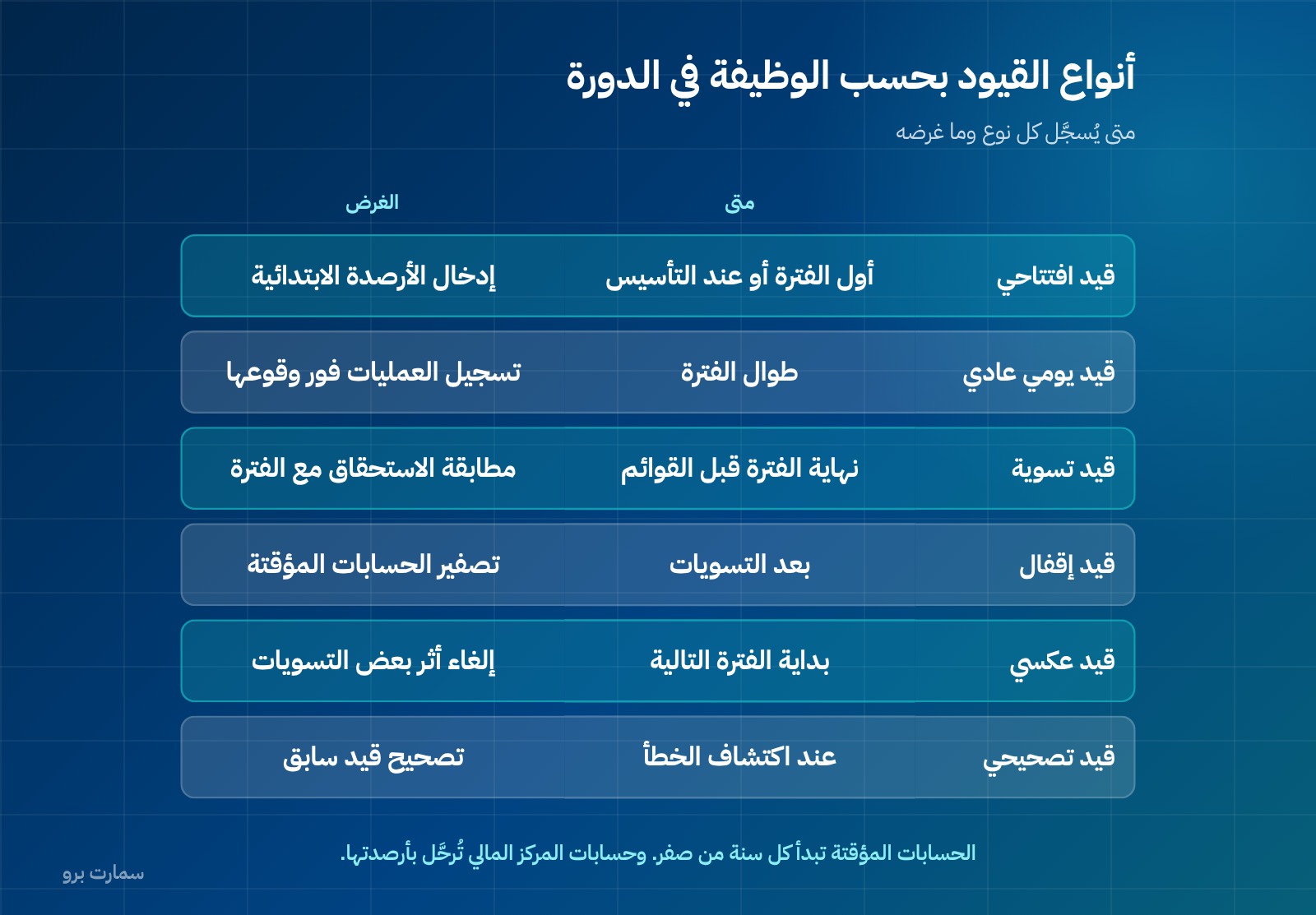
| Type | When | Purpose |
|---|---|---|
| Opening entry | Start of the period or at incorporation | Enter the opening balances |
| Regular daily entry | Throughout the period | Record transactions as they happen |
| Adjusting entry | End of the period, before the statements | Match accruals to the right period |
| Closing entry | End of the period, after adjustments | Reset temporary accounts to zero |
| Reversing entry | Start of the following period | Cancel the effect of certain adjusting entries |
| Correcting entry | When an error is found | Correct an earlier entry |
The opening entry
It is recorded once when you start using a system, or on the first day of each financial period by carrying forward the previous balances. It is the most consequential entry in the life of an accounting system, because everything after it is built on it: a trial balance that starts out of balance stays out of balance forever.
The point that sinks most system migrations is that the opening entry is not just account balances but balances with their detail. Not "receivables 400,000" but each customer's balance separately; not "inventory 250,000" but quantities by item. Enter only the totals and you lose the ability to reconcile any sub-account afterwards. This is one of the most common ways to damage a move from one accounting system to another.
Regular daily entries
These are transaction entries: sales, purchases, receipts, payments, transfers between accounts. They make up ninety per cent or more of the entries in any business, and most are now generated automatically from a source document rather than typed by hand: the invoice generates its entry, the receipt voucher generates its entry, and the payroll run generates the payroll journal entry.
The practical test of your system here is simple: how many entries are typed manually each month? A high number does not show diligence; it shows that documents are not linked to their entries. Every manual entry is a potential error that nobody discovers until the stocktake.
Adjusting entries
These come at the end of the period, before the statements are prepared. Their purpose is to assign revenue and expenses to the period they actually belong to, not the period in which cash came in or went out. This is the accrual basis.
Recurring examples are depreciation, accrued expenses not yet paid, prepaid expenses, accrued revenue not yet collected, revenue received in advance, and the allowance for doubtful debts. They are covered in detail in adjusting entries.
Closing entries
These follow the adjustments. Their purpose is to reset the temporary accounts, meaning revenue and expense accounts, to zero and transfer their net result to equity. Income statement accounts start each year from zero, unlike statement of financial position accounts, which carry their balances forward.
This is the core difference between the two kinds of account, and anyone who misses it will not understand why the sales account is closed and the cash account is not. Modern systems run the close with a single command, but knowing what that command does remains essential: closing is a decision, not a button, and it is not run until the adjustments are complete and the trial balance has been reviewed.
Reversing entries
The least understood type, and one of the most useful. A reversing entry is recorded on the first day of the following period and reverses a specific adjusting entry recorded at the end of the previous period.
Why? Take an example. You owe staff wages for days in December that have not been paid, so you record an adjusting entry: debit salaries expense, credit accrued salaries. Then in January you pay the full salary. If you record the payment the usual way, debit salaries expense and credit bank, the expense is charged twice: once in December through the adjustment and again in January through the payment.
You have two options. The first is to remember, at payment time, to split the amount between "accrued salaries" and "salaries expense" in the right proportion. The second is to reverse the adjusting entry on 1 January, then record the full payment as an expense as usual. The reversal offsets the excess and the figure comes out right.
The second option is safer, because it shifts the burden of remembering from a person to the system. A reversing entry is not added complexity; it removes a step that depends on human attention. That is why accrued expense and accrued revenue entries are usually reversed, while depreciation and allowance entries are not.
Correcting entries
These are recorded when an error is found in an earlier entry. The regulatory and professional rule is the same: the wrong entry is neither deleted nor edited in place. Instead, an entry is recorded that corrects its effect, and both remain in the ledger.
This is not a formality. An accounting ledger is a record of events, and deleting an event strips it of its status as a record. A system that lets you edit a posted entry without leaving a trace is not an accounting system but a spreadsheet with a nicer interface. Ask the vendor about this before you buy; it is one of the questions to ask before buying an accounting system.
How do the two classifications overlap?
Now the confusion in the common lists becomes clear. Take three examples:
- A monthly depreciation entry on a single asset: simple in form, adjusting in function.
- An entry closing revenue and expenses to the income summary: compound in form, closing in function.
- An opening entry with the balances of twenty accounts: compound in form, opening in function.
So the right question about any entry is really two questions: how many sides does it have, and where does it sit in the cycle? Ask only one and you get half the answer.
What must every journal entry contain?
Whatever its type:
- A date that falls within an open period, not a closed one.
- A sequential number that is never repeated and never skips.
- A description of the event, not a repeat of the account name. "Payment received from customer" is a description; "debit cash" is not.
- A reference to the source document that gave rise to the entry.
- Balance between the two sides.
The description is the most neglected element, and it is the first thing you need a year later when someone asks about an entry you do not remember. The step-by-step method is in how to write a journal entry, and the foundation of it all is in debit and credit.
Key takeaway: Classify every journal entry twice: by form (simple or compound) and by function (opening, daily, adjusting, closing, reversing or correcting). Both labels apply at once, and missing either gives you half the picture.
To see how documents generate their entries automatically in SmartPro Finance & Accounting, start a free trial or book a demo.
Article visuals

Frequently asked questions
What are the types of journal entries?
They are classified in two ways, not one. By form: a simple entry with only two accounts, and a compound entry with more than two. By function in the cycle: opening, regular daily, adjusting, closing, reversing and correcting. A single entry carries both labels, so a closing entry is compound in form and closing in function.
What is the difference between a simple and a compound journal entry?
A simple entry has one debit account and one credit account. A compound entry has more than two accounts: one debit against several credits, the reverse, or several of each. The rule is the same in both cases: total debits equal total credits, applied to the totals rather than to each line.
What is a reversing entry and why is it used?
It is an entry recorded on the first day of the next period to reverse an adjusting entry made at the end of the previous period, so that an expense or revenue is not counted twice when it is actually paid or collected. Its benefit is that it moves the burden of remembering from the person to the system. It is usually used for accrued expenses and accrued revenue, not for depreciation or allowances.
Can a wrong journal entry be deleted or edited?
No. The rule is to record a correcting entry that reverses the effect of the error, with both entries remaining in the ledger. The accounting ledger is a record of events, and deleting an event strips it of its status as a record. A system that lets you edit a posted entry without a trace is not fit to serve as an accounting ledger.
What is the difference between adjusting entries and closing entries?
Adjusting entries are recorded at the end of the period before the financial statements are prepared, to assign revenue and expenses to the period they belong to under the accrual basis. Closing entries come afterwards, resetting the temporary accounts (revenue and expenses) to zero and transferring their net result to equity. In short, adjusting corrects the figures and closing transfers them.