
Retirement Age Under the New GOSI Law: 65 Gregorian Years and the Transitional Group
The statutory age is 65 Gregorian years, the minimum is 180 months and the pension formula uses 2.25%. The transitional table goes down to 58 years and 4 months.
Author:سامي الحيدري
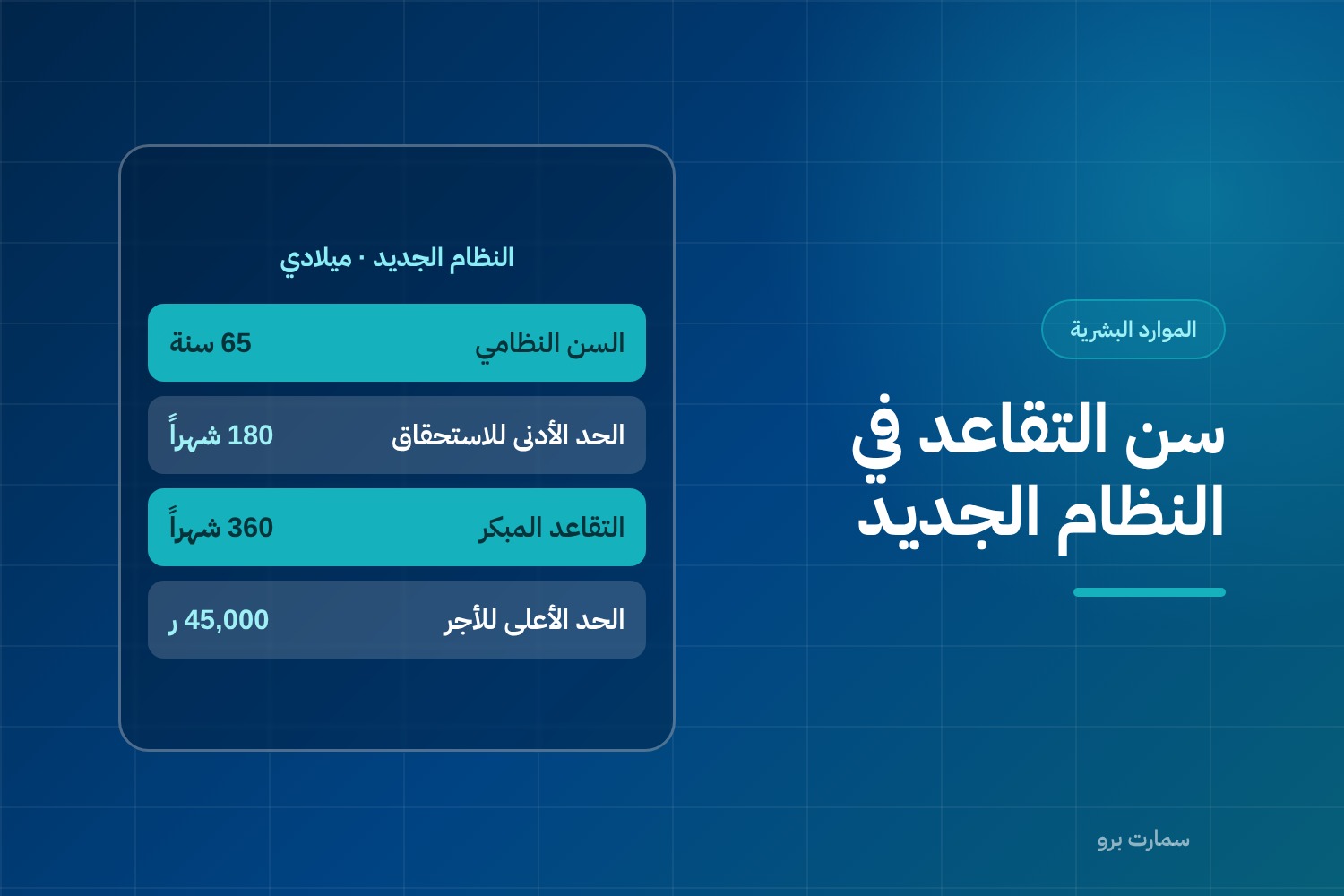
The retirement age under the new GOSI law is 65 Gregorian years. The key word is Gregorian: the previous system counted 60 Hijri years. Because Hijri years are shorter, the real gap in actual age between the two figures is more than six years, not the five the subtraction suggests.
The new system is the Social Insurance Law issued by Royal Decree M/273 and Council of Ministers Resolution No. 1022 dated 26/12/1445H. It has been in force since 3 July 2024 and applies to anyone who has no uncompensated contribution periods before that date. In other words, it covers new entrants to the labour market, not people already working.
What is the retirement age under the new GOSI law, and who qualifies?
| Item | Rule |
|---|---|
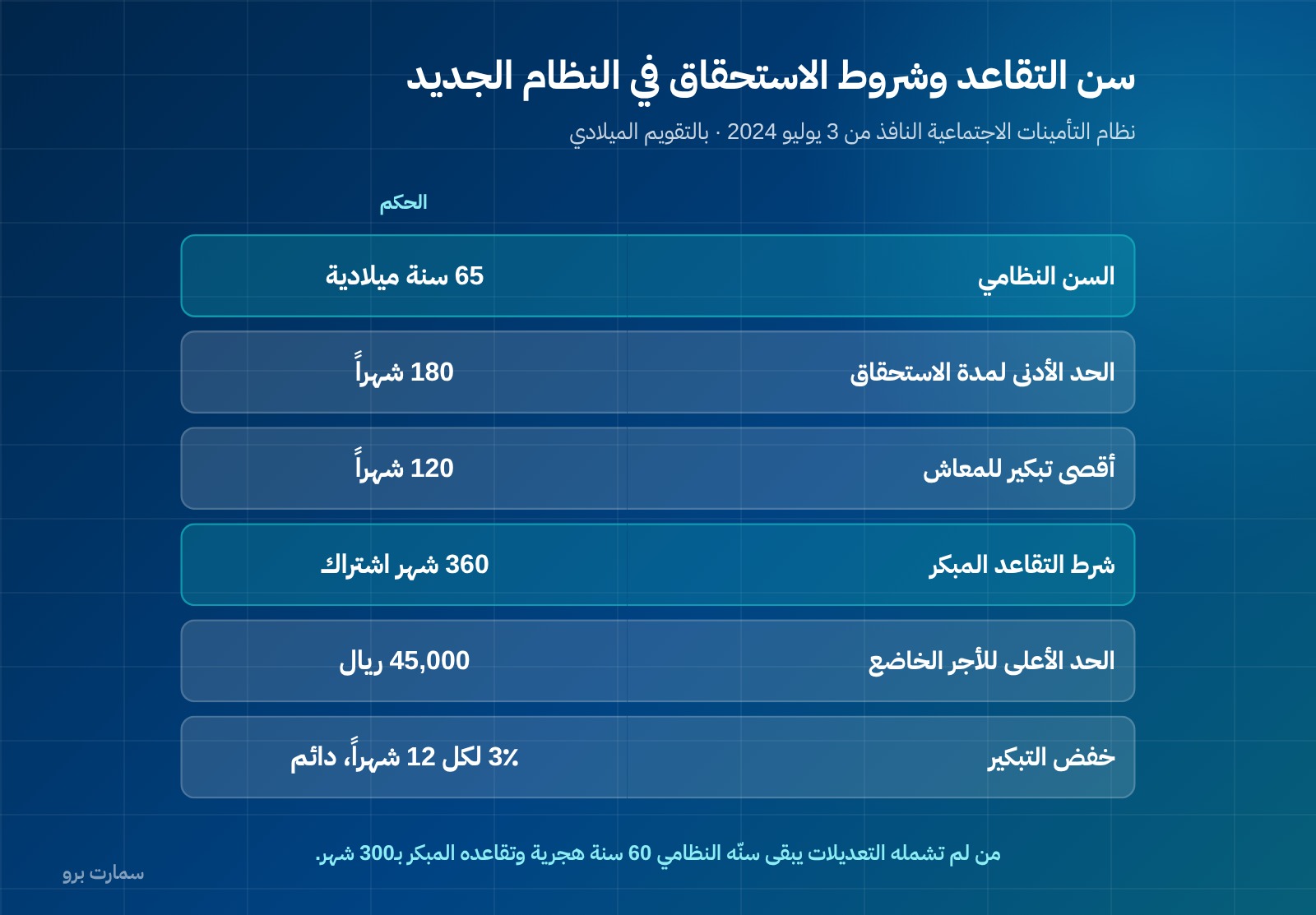
| Statutory age | 65 Gregorian years |
| Minimum qualifying period | 180 months (15 years) |
| Early retirement | Up to 120 months before the statutory age |
| Early retirement condition | Stopped covered employment + 360 months of contributions |
| Maximum contributory wage | SAR 45,000 per month |
The law explicitly defines the year and the month as Gregorian, so every calculation in this article uses the Gregorian calendar.
The early retirement condition has two parts. Reaching 55 is not enough: you must also have stopped covered employment and have 360 months of contributions, which is 30 years. Someone who started work at 25 only reaches 30 years of contributions by 55 if their service never broke for a single month.
How is the pension calculated?
The formula is 2.25% × average contributory wage × number of contribution months ÷ 12, capped at 100% of that average. The contributory wage is the portion of pay on which GOSI contributions are calculated.
The average is based on the highest 180 months of contributory wage, not the last two years as was common in some systems. This changes the direction of the calculation: the whole career now matters, not just its final stretch.
Three figures shape the result:
- Minimum pension: SAR 4,000 per month at 480 contribution months (40 years), and SAR 2,000 at the minimum qualifying period, graduated in between.
- Early retirement reduction: 3% for every 12 months retired early, or for every 12 months below 480 months, permanently. The reduction is not reversed later.
- Deferral incentive: 3% for every 12 contribution months after the statutory age.
"Permanently" means the reduction is not a temporary adjustment that is restored when you reach the statutory age. Anyone who retires early carries the reduction for life.
Who is in the transitional group, and what is their retirement age?
Not everyone in work on 3 July 2024 is completely outside the new system. There is a transitional group: people with less than 240 months of contributions before that date who were under 50 Hijri years old when the law took effect.
For this group, a table sets the statutory age according to the person's age on the effective date:
- Under 29 Gregorian years on 3 July 2024 → statutory age of 65.
- 29 years or older → a graduated table that falls from 64 years and 8 months (for those aged 29 to 30) to 58 years and 4 months (for those aged 48 to 48.5), in steps of four months.
The qualifying period for early retirement is graduated for this group too: from 300 months for those who had 228 to 239 months at the effective date, up to 360 months for those who had fewer than 180 months.
Anyone not covered by the amendments at all keeps a statutory age of 60 Hijri years, with early retirement after 300 months at any age.
The result is that a single business can now have three groups of employees with three different retirement ages. This belongs in each employee's file; it is not one rule applied to everyone.
What does this mean for employers?
The pension itself is a matter between the contributor and GOSI. The impact on you is in three areas that touch your books:
- Succession planning. If you have employees in the transitional group, their expected retirement dates are spread out by months, not neat round years. The table has to be read case by case.
- Rising contributions. The pension branch rate under the new system rises by half a percentage point a year until it settles; the full schedule is in GOSI contribution rates. The cost of each employee does not stay fixed, so any three-year cost model needs to be built on a rising rate.
- Contributory wage. The ceiling is SAR 45,000 per month, and anything above it is not counted. What goes into the contributory wage and what stays out is explained in the GOSI contributory wage, and it is where payroll most often goes wrong.
The penalty for paying contributions late is 2% of the contribution due for each month of delay or part of a month, and it accumulates in the same way as tax penalties.
Keeping each employee's group, contribution start date and contributory wage on record makes these calculations far easier. SmartPro's Human Resources system holds full employee files and payroll connected to accounting, and if you still work in spreadsheets, the payroll Excel template with GOSI contributions is a practical starting point.
Is the pension branch rate 10.75% in 2026?
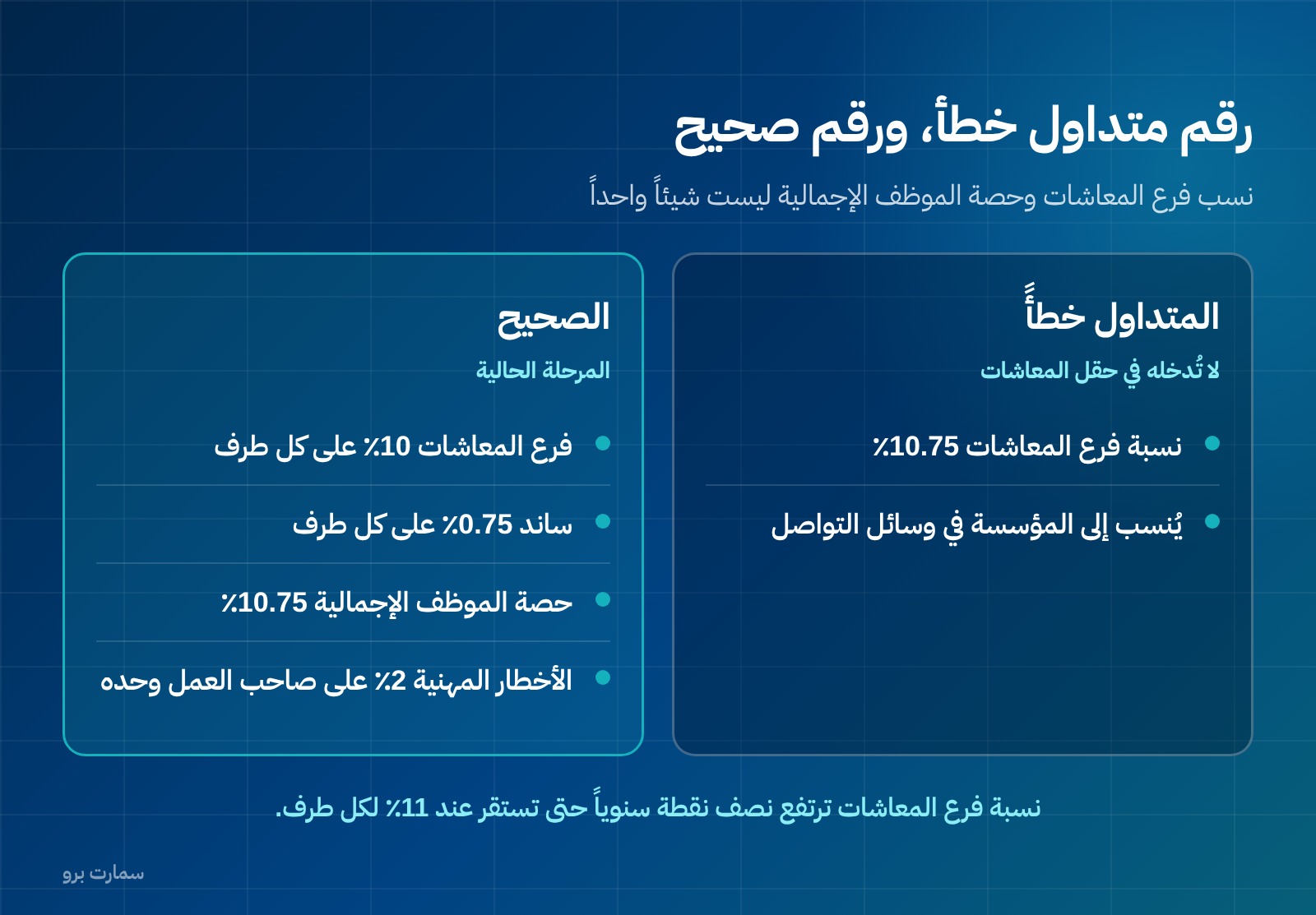
A figure circulating on social media says the pension branch rate for 2026 is 10.75%. That mixes two things up. The pension branch rate is 10% on each of the employer and the contributor at this stage. The 10.75% is the employee's total share: 10% pension + 0.75% unemployment insurance (SANED). Entering 10.75% in the pension field alone produces the wrong deduction.
The occupational hazards branch is 2%, paid by the employer alone, and it is not split.
The full texts of the law, the Royal Decree and the Council of Ministers resolution are published on the General Organization for Social Insurance website. This article is a general explanation; any individual case, especially in the transitional group, should be checked against the person's own record with GOSI rather than a general table.
Key takeaway: New entrants retire at 65 Gregorian years, the transitional group follows a table that goes down to 58 years and 4 months, and those outside the amendments keep 60 Hijri years, so record each employee's group individually.
To keep employee files, payroll and GOSI deductions in one connected system, start a free trial of SmartPro.
Article visuals
Frequently asked questions
What is the retirement age under the new GOSI law?
It is 65 Gregorian years, and the law explicitly defines the year and the month as Gregorian. It applies to anyone with no uncompensated contribution periods before 3 July 2024. The previous system counted 60 Hijri years, and the real difference in age between the two is close to six years.
How is the pension calculated under the new law?
The formula is 2.25% multiplied by the average contributory wage, multiplied by the number of contribution months, divided by 12, capped at 100% of that average. The average is calculated over the highest 180 months of contributory wage, not the last two years.
What are the conditions for early retirement?
Early retirement is allowed up to 120 months before the statutory age, provided the person has left covered employment and has at least 360 months of contributions. The pension is reduced by 3% for every 12 months retired early, or for every 12 months short of 480 months, and the reduction is permanent and is not reversed later.
Who is in the transitional group under the new law?
The transitional group covers people with fewer than 240 months of contributions before 3 July 2024 who were under 50 Hijri years old when the law took effect. Their statutory age depends on their age on the effective date: 65 for those under 29, then a graduated scale falling from 64 years and 8 months down to 58 years and 4 months in four-month steps.
What is the minimum pension and the cap on the contributory wage?
The minimum pension is SAR 4,000 per month at 480 months of contributions and SAR 2,000 at the minimum qualifying period, graduated in between. The contributory wage is capped at SAR 45,000 per month, and anything above that is not counted.