
Probation Period in Saudi Labor Law: 180 Days and the Days That Don't Count
Probation must be written into the contract, it is capped at 180 days in total, and the two Eids, National Day, Founding Day and sick leave do not count towards it.
Author:سامي الحيدري
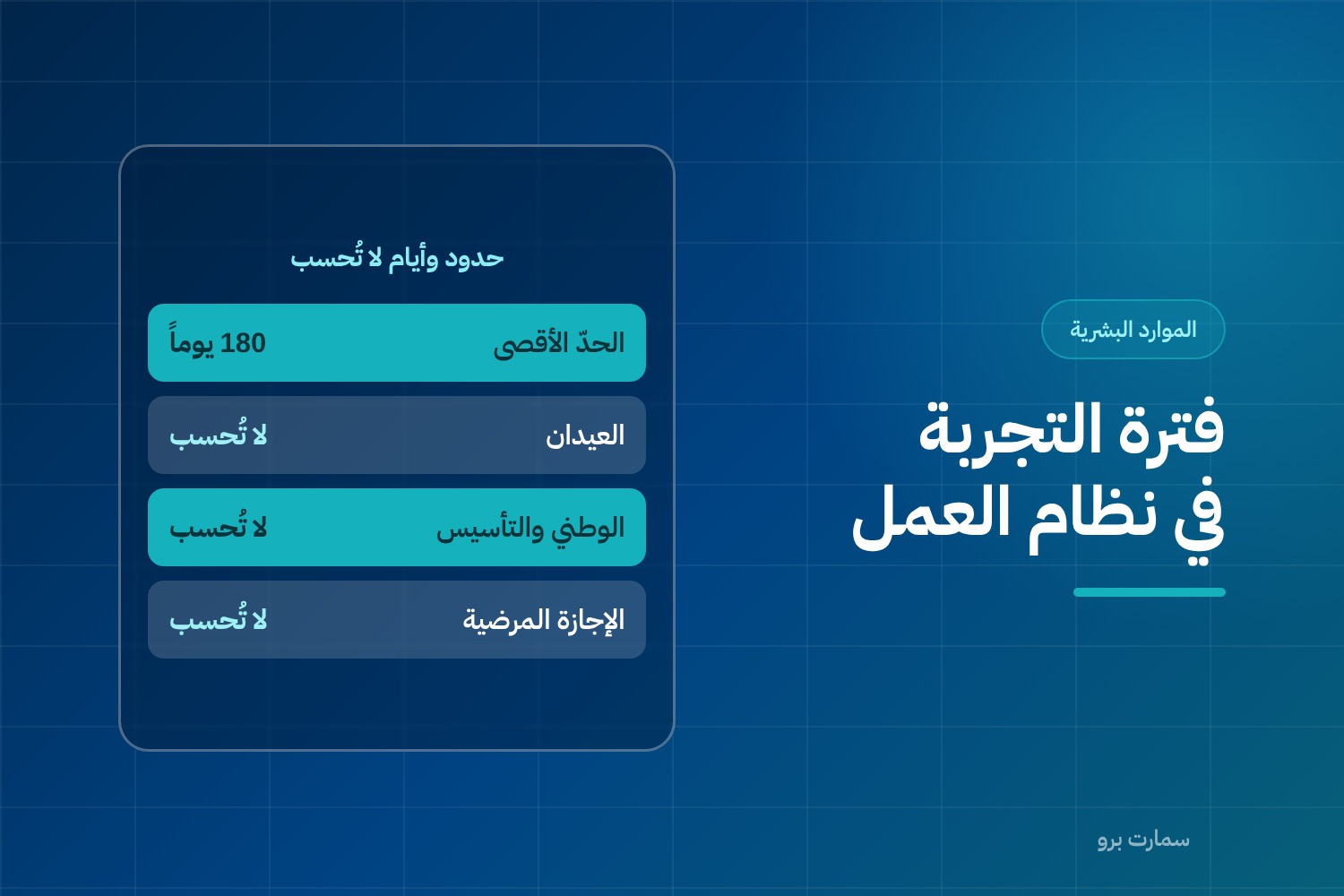
The probation period in Saudi labor law is now narrower than it was, and its conditions are stricter. Under the Labor Law amendments in force from 19 February 2025, probation can no longer be implied by custom or by a passing reference. The contract must state it expressly, with a clearly defined length. It is capped at 180 days in total, and certain days are excluded from the count.
This is not a drafting detail. A contract that does not provide for probation has no probation, and terminating it is an ordinary contract termination with all the consequences that follow.
What are the conditions for a probation period in Saudi labor law?
Three conditions apply together:
- An express clause in the contract. No clause means no probation, and an open-ended period is not allowed. The length must be stated clearly.
- A maximum of 180 days in total, according to the amendments FAQ guide issued by the Ministry of Human Resources and Social Development.
- No repeated probation with the same employer, unless both parties agree on a different job or profession.
The no-repetition rule shuts down a common practice: putting an employee on a fresh probation after the first one ends, so that termination stays easy. This is only valid when the agreement is for a different job or profession, meaning a genuine change of role, not a renewed piece of paper.
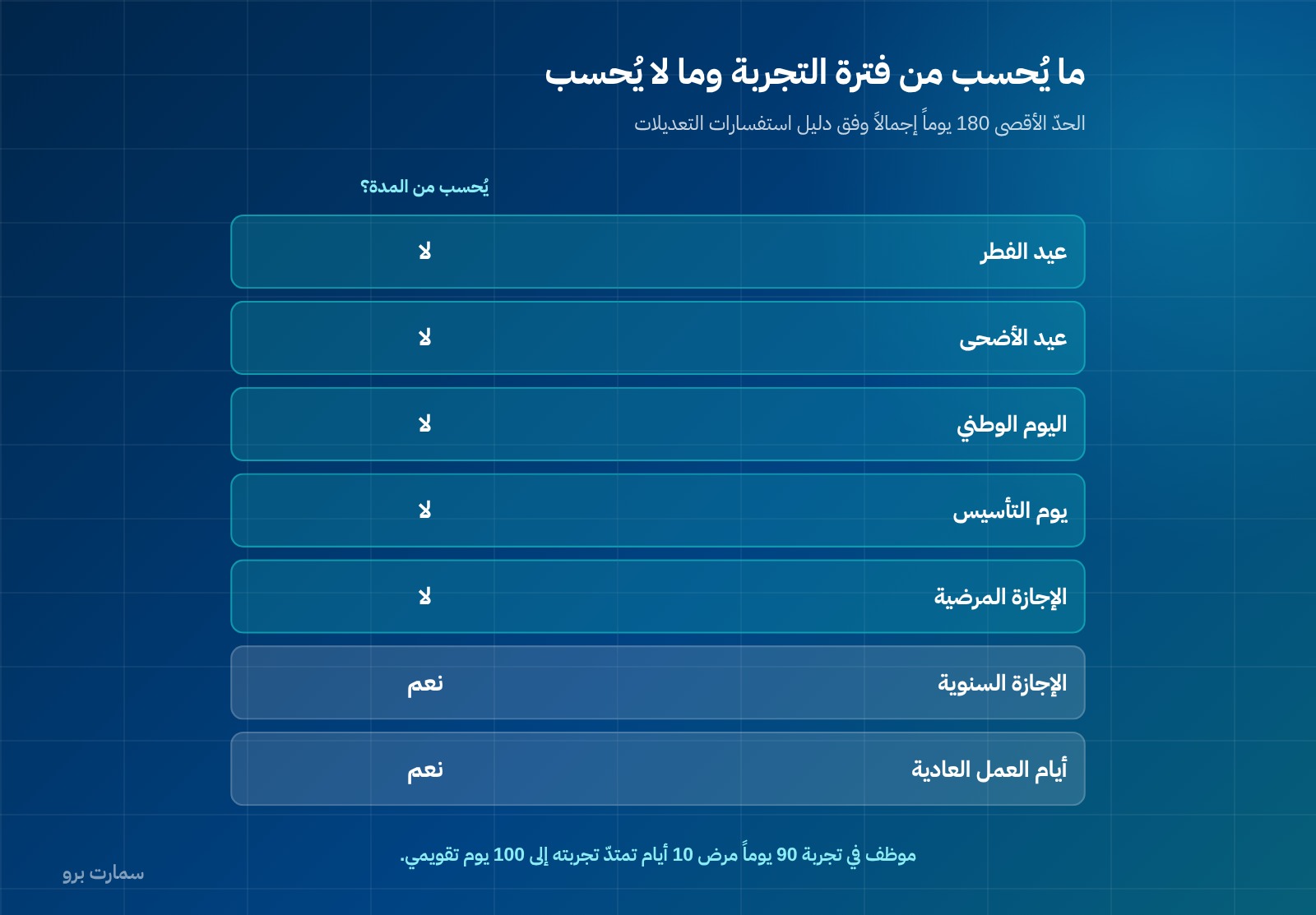
Which days don't count towards probation?
| Item | Counts towards probation? |
|---|---|
| Eid Al-Fitr | No |
| Eid Al-Adha | No |
| National Day | No |
| Founding Day | No |
| Sick leave | No |
| Annual leave | Yes |
| Normal working days | Yes |
National Day and Founding Day are additions to the familiar exclusion of the two Eids and sick leave. In practice, a probation that starts in mid-January and includes Founding Day in February ends one day later than the date worked out on the calendar.
The effect grows with sick leave. An employee on a 90-day probation who is off sick for 10 days has a probation that stretches to 100 calendar days. An employer who counts on the calendar and terminates on day 90 may believe they acted within probation, yet be outside it in reality if the calculation is wrong in the other direction. That is why the period needs to be tied to attendance and leave records, not to a date on paper, and one reason to keep attendance linked to payroll in a single system.
Can either party terminate during probation?
Either party may terminate the contract during the probation period, unless the contract gives the right of termination to one of them only. The default is that the right is mutual, and the contract can restrict it to one side if it says so.
No end-of-service award is due for service that ends during probation. That much is explicit. But be clear about what this rule does not cover:
- Wages for days actually worked are payable in full.
- Annual leave pay earned for the period worked is payable pro rata.
- GOSI contributions (social insurance contributions paid to the General Organization for Social Insurance) are due for the period, so probation is no exemption from registration.
- Overtime hours are paid at the basic hourly wage plus 50%, as explained in calculating overtime.
A business that assumes probation means no entitlements is wrong on three items out of four.
How should the probation clause be worded?
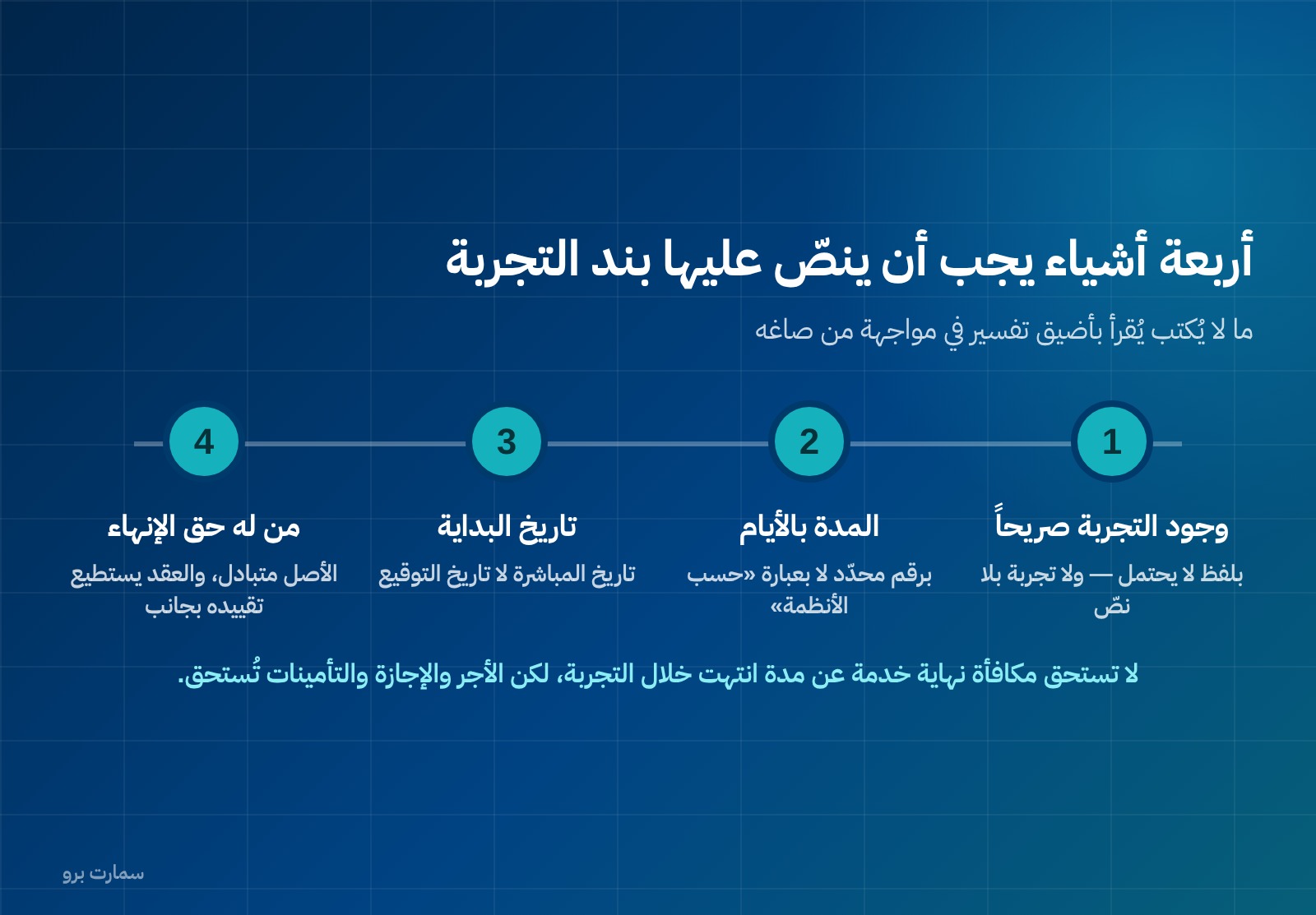
An incomplete clause is what most often undermines the employer's position. Wording that holds up states four things:
- That probation exists, expressly, in terms that leave no doubt.
- Its length in days, as a specific number, not a phrase such as "as per the regulations".
- Its start date, which is usually the date the employee starts work, not the date the contract is signed. The gap between the two can be weeks.
- Who has the right to terminate, if you want to limit it to one side. Otherwise it is mutual.
Whatever is not written on these points will later be read in the narrowest way, against the party that drafted it.
Why does this clause deserve more attention than its size suggests?
Probation is a small clause in the contract, but it is the clause that sets the cost of a hiring mistake. The amendments tightened it on three fronts at once: they made its form stricter (an express clause with a defined length), limited repetition (once only, unless for a different job), and widened what is excluded from the count (National Day and Founding Day, alongside the two Eids and sick leave).
The practical result is that probation is now a tool to use on time, not an extended safety net. A business that delays the decision to confirm or terminate until after the period has run out loses the benefit of the clause altogether.
On the other hand, the tighter rules also protect the business when it is on the other side. An employee who ends the contract during a properly stated probation does not face the consequences of ending an ordinary contract, and a business that took care to word the clause correctly benefits from this as much as the employee does.
How does probation affect the end-of-service provision?
The probation period affects the end-of-service benefit provision, the amount a business sets aside in its accounts for future end-of-service awards. Service that ends during probation earns no award, so a business that books a provision for every employee from their start date overstates the provision for employees still on probation.
But take care in the other direction too. An employee who passes probation and is confirmed has their service counted from the start date, not the confirmation date, so their provision reaches back over the whole probation period. In other words, the provision for employees on probation is neither set to zero nor charged in full; it is estimated based on the likelihood of confirmation. The principles for calculating it are covered in the end-of-service benefit provision.
What does this change in your hiring process?
The change requires a clear sequence in the first three months of every hire:
| Step | Timing |
|---|---|
| Document the contract on Qiwa with the probation length stated | On start date |
| Record the actual start date, not the contract date | On start date |
| Calculate the days excluded from the period | Monthly |
| Written evaluation two weeks before the period ends | Before expiry |
| Decision to confirm or terminate before the period runs out | Before expiry |
The last step is the one most often missed. The period expires on its own, and an employer who has not decided before it ends has confirmed the employee by silence. After that, the contract can no longer be ended as a probation termination; it needs a legitimate reason and a notice period, as explained in the notice period in Saudi Arabia.
One point to treat with caution
The amendments FAQ guide sets a total maximum of 180 days, while the legal text addresses probation as a single period and prohibits repeating it except for a different job or profession. The consistent reading is that 180 days is a total cap on all probation periods combined, not on a single period. Anyone building contracts around this upper limit would do well to get legal advice on their specific wording rather than rely on a general reading.
The laws in force are on the Bureau of Experts at the Council of Ministers website, and the guide is on the Ministry's website.
Key takeaway: Probation only exists if the contract states it with a defined length, it is capped at 180 days in total, and Eid holidays, National Day, Founding Day and sick leave extend it. Track the real end date from attendance and leave records, and decide before it passes.
To track start dates, leave and attendance in one place, start a free trial of SmartPro Human Resources or explore the HR system.
Article visuals
Frequently asked questions
What is the maximum probation period in Saudi labor law?
The Labor Law amendments FAQ guide sets a total maximum of 180 days. Probation must be stated expressly in the contract with a clearly defined duration. An employee cannot be placed on probation more than once with the same employer, unless both parties agree on a different job or profession.
Which days are not counted towards the probation period?
Eid al-Fitr, Eid al-Adha, National Day, Founding Day and sick leave are excluded. A 90-day probation in which the employee is off sick for 10 days extends to 100 calendar days. This is why the period should be calculated from attendance records, not from a date on paper.
Is an end-of-service award due for the probation period?
No end-of-service award is due for service that ended during probation. However, the employee is still owed wages for days actually worked, pro-rata annual leave pay and overtime pay. Social insurance contributions must also be paid for the period.
Who has the right to terminate the contract during probation?
Either party may end the contract during probation, unless the contract gives the right of termination to only one of them. The default is a mutual right. The contract can restrict it to one side, but only if it says so expressly.
What happens if the contract does not mention probation?
There is no probation. If the contract does not state it expressly with a defined duration, probation cannot be assumed. Ending the contract is then an ordinary termination with all its consequences, including the need for a legitimate reason, a notice period and an end-of-service award where one is due.