
Resignation in Saudi Labor Law: 30-Day Deemed Acceptance, 60-Day Deferral and 7-Day Withdrawal
A resignation is deemed accepted after 30 days, can be deferred up to 60 days with a written reason, and can be withdrawn within 7 days. Each deadline also affects end-of-service pay.
Author:سامي الحيدري

Resignation in Saudi labor law is no longer a letter an employee hands in before waiting indefinitely for a reply. Under the Labor Law amendments in force since 19 February 2025, a resignation runs on fixed deadlines: 30 days for deemed acceptance, 60 days as the maximum deferral, and 7 days to withdraw. Missing them can cost a right or create an unintended obligation.
The details are set out in the Labor Law amendments FAQ guide issued by the Ministry of Human Resources and Social Development (HRSD), which explains the mechanisms that now govern resignation.
What are the three deadlines for resignation in Saudi labor law?
| Deadline | Period | Who it applies to |
|---|---|---|
| Deemed acceptance | 30 days from submitting the resignation | The resignation is treated as accepted if the employer does not respond |
| Deferral | Up to 60 days | The employer, with a written reason |
| Withdrawal | 7 days from submission | The employee, unless it has already been accepted |
Deemed acceptance. Deemed acceptance means a resignation is treated as accepted by law, even without an explicit reply. If the employer does not respond within 30 days, the resignation counts as accepted. This is a fundamental shift in who carries the burden of responding: silence no longer stalls the matter, it becomes acceptance. An employer who leaves a resignation in a drawer while looking for a replacement finds the employment relationship over after a month without ever deciding.
Deferral. The employer may defer acceptance for up to 60 days, but only on two conditions: the deferral must be based on a written reason, and that reason must be delivered before the first 30 days run out. Deferral is not automatic; it is a decision that has to be made and communicated within a set window. An employer who passes the 30-day mark without notifying the employee loses the right to defer, and deemed acceptance applies.
Withdrawal. The employee may withdraw the resignation within 7 days of submitting it, unless the employer has already accepted it. A quick acceptance closes the door to withdrawal, while a deferral keeps it open for that week.
What makes a resignation valid in the first place?
A resignation must be in writing and free of coercion.
The writing requirement rules out verbal resignations: "I quit" said in a tense meeting is not a resignation on which employment can be ended. An employer who ends someone's employment on the strength of a spoken remark has terminated the contract itself rather than accepted a resignation, and the difference in entitlements between the two is significant.
The no-coercion requirement carries more weight. A resignation submitted under threat or pressure does not count as a resignation. A business that asks an employee to resign instead of terminating them puts itself in a weak position, because if coercion is proven, the outcome is a termination by the employer with all its consequences.
How does resignation affect end-of-service benefits?
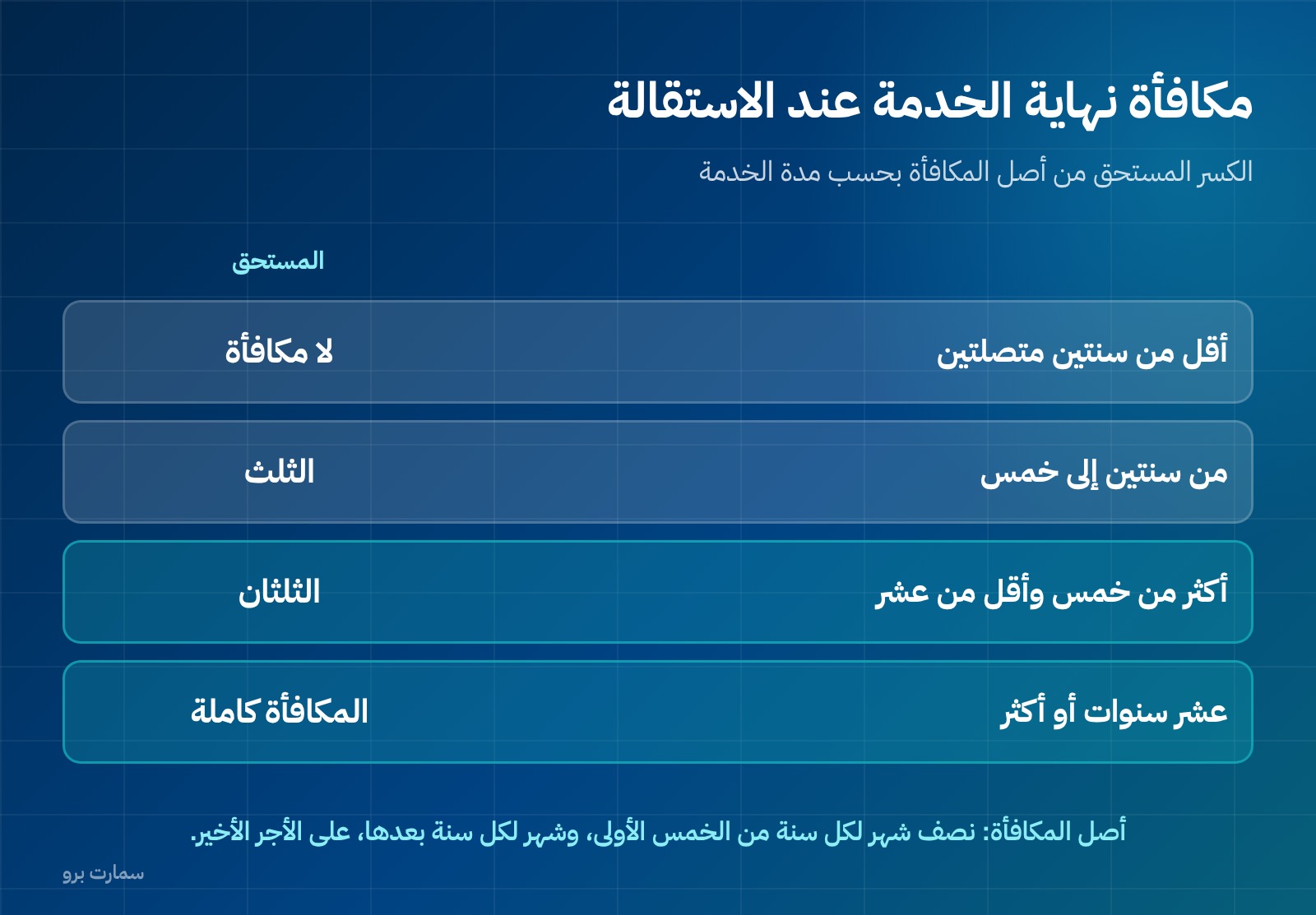
This is where the financial difference lies. End-of-service benefit (the lump sum owed to an employee when employment ends) is only paid in full on resignation after ten years:
- Less than two consecutive years: no benefit.
- Two to five years: one third.
- More than five and less than ten years: two thirds.
- Ten years or more: the full benefit.
Before these fractions are applied, the base benefit is half a month's pay for each of the first five years and a full month's pay for each year after that, calculated on the last wage and pro-rated for part years. The detailed calculation is in how to calculate end-of-service benefits, and the resignation case specifically in end-of-service benefits on resignation.
Note how the deadlines feed into this calculation. The benefit is based on length of service, and service ends when the employment relationship ends. A 60-day deferral adds two months to the service period and can move an employee from "less than five years" to "more than five", turning their share from one third into two thirds. Deferral is not a purely administrative decision; it is a decision with a number attached.
Which situations cause confusion in practice?
The employee who resigns and then stops coming to work. Submitting a resignation does not end the contract that day. The relationship continues until acceptance, whether explicit or deemed, or until the agreed notice period expires. Stopping work during this time is absence, not the end of service, and it is treated under its own rules, which are entirely different from those for resignation.
Resigning in the middle of the probation period. No end-of-service benefit is due for service that ended during probation, so the question of one third or two thirds does not arise at all. Wages and accrued leave allowance are still payable.
Resigning a few weeks before completing the fifth or tenth year. This is where the numbers show most clearly. The gap between one third and two thirds, or between two thirds and the full benefit, can equal several months' pay. Service is pro-rated for part years in the base benefit, but the fraction (one third, two thirds or full) is set by explicit yearly thresholds. An employee with four years and eleven months of service receives one third, while one with five years and one month receives two thirds, on a broadly similar base.
This is exactly where the deferral decision meets the calculation. A 60-day deferral is legitimate if it rests on a written reason, but in some cases it costs the business money and in others it saves money. A business that makes the decision without running the numbers is acting blind.
What goes into the final settlement, and when?
A resignation triggers a full settlement, not just a benefit payment. The items usually calculated are:
- Wages for days worked up to the actual end date, not the date the resignation was submitted.
- Allowance for unused annual leave. The balance is calculated on 21 days a year, rising to at least 30 days after five consecutive years with the same employer.
- End-of-service benefit at the applicable fraction.
- Any variable entitlements: commissions, overtime or bonuses that were earned but not yet paid.
- A deduction for any advances or debts, within the limits the law allows. Those limits are explained in limits on salary deductions.
Putting these items into a single entry with the correct date is what is known as the final settlement. An employer who pays it in instalments without one consolidated entry loses the ability to prove what was paid.
Is the notice period the same as the resignation deadlines?
This common mix-up deserves a clear separation. For an open-ended contract, the notice period is currently at least 30 days if the employee is paid monthly and at least 15 days otherwise, and termination requires a stated legitimate reason. The details are in notice period in Saudi Arabia.
But the notice period is one thing, and the deadlines for deemed acceptance, deferral and withdrawal are another. The first concerns the time between giving notice and the end of employment; the second concerns how the request itself is decided. The two can coincide at 30 days, which makes them look like the same rule, but they are not.
What should your company's resignation procedure include?
- A written resignation form with a proven submission date. Every one of the three deadlines runs from that date, so recording it is not a formality.
- An automatic reminder on day 25. The limit is 30 days, and the decision is made before it, not on it.
- A ready-made deferral letter that states the reason, delivered with proof of receipt before the 30 days expire.
- A calculation of the deferral's effect on the end-of-service benefit before the decision is made, not after.
- A log of withdrawal requests received within the 7-day window.
- A link between the end date and payroll, so wages are neither paid for a period that has ended nor withheld for a period that is still running. This is one of the most frequent payroll mistakes.
A business that manages all this through email and memory will get roughly one employee in ten wrong. The problem is not that the rule is hard; it is that the three deadlines run at the same time across several cases, each with different dates. An HR system such as SmartPro's Human Resources, which keeps employee files, attendance and payroll connected to accounting, helps keep those dates in one place.
The current text of the Labor Law is available on the Bureau of Experts at the Council of Ministers website, and the FAQ guide on the Ministry of Human Resources and Social Development website. This article is a general explanation, not legal advice on any specific case.
Key takeaway: Silence for 30 days means acceptance, a deferral needs a written reason delivered within those 30 days, and the employee has 7 days to withdraw. Calculate how each date changes the end-of-service fraction before you act.
To see how resignation dates, payroll and settlements fit together in one system, start a free SmartPro trial or book a demo.
Article visuals

Frequently asked questions
What happens if the employer does not respond to a resignation in Saudi Arabia?
The resignation is deemed accepted if the employer does not respond within 30 days of its submission. Silence no longer stalls the matter; it now counts as acceptance. An employer who leaves a resignation unanswered will find the employment relationship has ended after a month without having decided.
Can a Saudi employer defer accepting a resignation?
Yes, for up to 60 days, but on two conditions: the deferral must be for a written reason, and that reason must be delivered before the first 30 days end. An employer who lets the 30 days pass without notifying the employee loses the right to defer, and deemed acceptance applies.
Can an employee withdraw a resignation under Saudi labor law?
Yes, within 7 days of submitting it, unless the employer has already accepted it. A quick acceptance closes the door on withdrawal, while a deferral keeps it open for that week.
What makes a resignation valid in Saudi Arabia?
It must be in writing and free of coercion. A verbal resignation cannot support ending someone's employment, and an employer who ends service based on spoken words has terminated the contract itself rather than accepted a resignation. A resignation submitted under pressure does not count as a resignation.
How much end-of-service benefit is paid on resignation in Saudi Arabia?
Nothing before two continuous years, one third from two to five years, two thirds for more than five and less than ten years, and the full benefit at ten years or more. The base benefit is half a month's pay for each of the first five years and a full month's pay for each year after that, calculated on the last wage.