
Laundry Management Software: How to Choose One for a Laundry in Saudi Arabia
A guide to choosing laundry management software in Saudi Arabia: item-level tracking from drop-off to collection, pricing by service, prepaid bundles, and a demo checklist.
Author:سامي الحيدري
Good laundry management software tracks every individual garment from drop-off to collection, prices each item by the service it receives, and handles prepaid bundles as a liability rather than income. It should also issue ZATCA Phase 2 e-invoices. Judge any system by three tests: find one garment by its ID, run a multi-service order, and open the uncollected-orders report.
Choosing laundry software differs from choosing any other sales system for one reason: a laundry does not sell goods from its own stock. It takes in the customer's belongings and promises to return them. The item that comes through your door is not a line in a stocktake. It is a man's thobe he needs for an occasion, or a woman's abaya worth far more to her than the price of washing it.
Every requirement of the system flows from this: identification, tracking, and proof at drop-off and collection. A generic retail system has no such model, because it assumes that whatever leaves the shop belonged to the shop.
This guide compares criteria and types of system, not product names. Every figure in it is hypothetical, meant to show the method of calculation, not to quote a price or a statistic.
Why is every garment the customer's property in your care?
This is the rule everything in a laundry is measured against. The goods in your hands are not yours, and your responsibility for them starts at drop-off and ends only at a documented handover. So the first requirement of the system is that every item has a known identity at every moment of its cycle.
In practice, that means:
- Number the item, not just the order. One order can hold twelve items across three different services. If numbering is at order level only, you know the order is in the building but not where each item in it is.
- A physical tag linked to the record. The label or tag attached to the garment must carry the same identifier as the system, and survive water, heat and chemicals. A tag that fades in the first wash cycle breaks the whole chain of tracking.
- Condition notes at drop-off. An old stain, a tear in the sleeve, a missing button, faded colour. Record it at drop-off, not after a complaint. Ideally the system lets you attach a photo to the item itself.
- A drop-off receipt. The customer's copy, showing the number of items, their description, the ready date and the stated terms. In practice this receipt is the contract, and it is what you both refer to if you disagree.
- A log of who did what, and when. Who received it, who sorted it, who put it in the wash, who ironed it, who handed it over. When an item goes missing, this log is the difference between an argument and a solution.
When an item is lost (and it happens in every laundry), the system should answer: what was the last stage recorded for this item, who was responsible for it, and did it leave by mistake with another customer's order? Most losses are neither theft nor damage, but an item handed to another customer as part of their order. You only catch that with item-level numbering and a check at handover.
How should a laundry price by item and service?
In a laundry, the price is not the price of the item but the price of the item in a given service. A shirt washed and ironed has one price, a shirt ironed only has another, and a suit dry-cleaned has a third. Carpets are charged by the square metre, not by the piece. So the system needs a matrix linking item type to service type, not a flat price list.
| Service type | Unit of charge | What the system must support |
|---|---|---|
| Wash and iron | Item | A different price for each item type |
| Iron only | Item | A separate rate from washing for the same item |
| Dry cleaning | Item | Fabric categories and special handling |
| Carpets and rugs | Square metre | Entering length and width and calculating the area |
| Curtains and bedding | Item or weight | An alternative unit of measure on the same order |
| Add-on services | Surcharge per item | Stain removal, fragrance, wrapping, starch |
| Express | Percentage or amount | A fee tied to an earlier ready date |
The decisive requirement: one customer order holds several services at different prices, prints on one receipt, and is paid in one payment. If the system forces you to open a separate order per service, you double the work at drop-off and confuse the accounts at collection. If you need a fast cashier screen at the counter, the selection criteria are covered in how to choose a POS system in Saudi Arabia.
Don't forget contract pricing either. Hotels, companies and hospitals have their own price lists and monthly credit invoices. The system should keep a price list per corporate customer and consolidate a month's orders into one invoice.
Which order stages matter, and which report do you need?
A laundry order moves through six stages: drop-off → sorting → washing → ironing → ready → collected. The system's value is not in drawing the stages, but in updating a stage taking one second on a device on the shop floor, with every update recording the time and the user.
| Stage | What is recorded | The risk if it isn't |
|---|---|---|
| Drop-off | Items, condition, ready date | Disputes over count and condition |
| Sorting | Allocation of items to services | An item goes into the wrong wash cycle |
| Washing | Time in and time out | An order sits in the machine and runs late |
| Ironing | Person responsible and time | A hidden backlog in front of the ironing station |
| Ready | Location on the rack | A ready item nobody can find |
| Collected | Who collected and payment | Handover without proof, or without payment |
Then comes the one report you cannot run a laundry without: what hasn't been collected yet, and how many days old it is. One list, each line an order, showing its days in the laundry and its current stage.
This report does four things at once. It exposes stuck orders before the customer calls, shows where work is really piling up, measures rack space occupied for nothing, and protects your reputation. Ask for it by name in the demo, and open it sorted oldest first.
How should prepaid bundles and subscriptions be handled?
Many laundries sell bundles: a set number of items at a discounted price paid upfront, or a monthly subscription. This is where the accounting problems that surface late usually start. Money received for a service not yet delivered is not revenue; it is a liability, also called deferred revenue.
VAT, however, becomes due at the earliest of three events: the supply, the issue of the invoice, or receipt of payment. So once you have received the money, VAT is due on what you received and an invoice is issued at receipt, even if not a single item has been washed yet.
The figures below are hypothetical, to illustrate the method, and do not represent market prices:
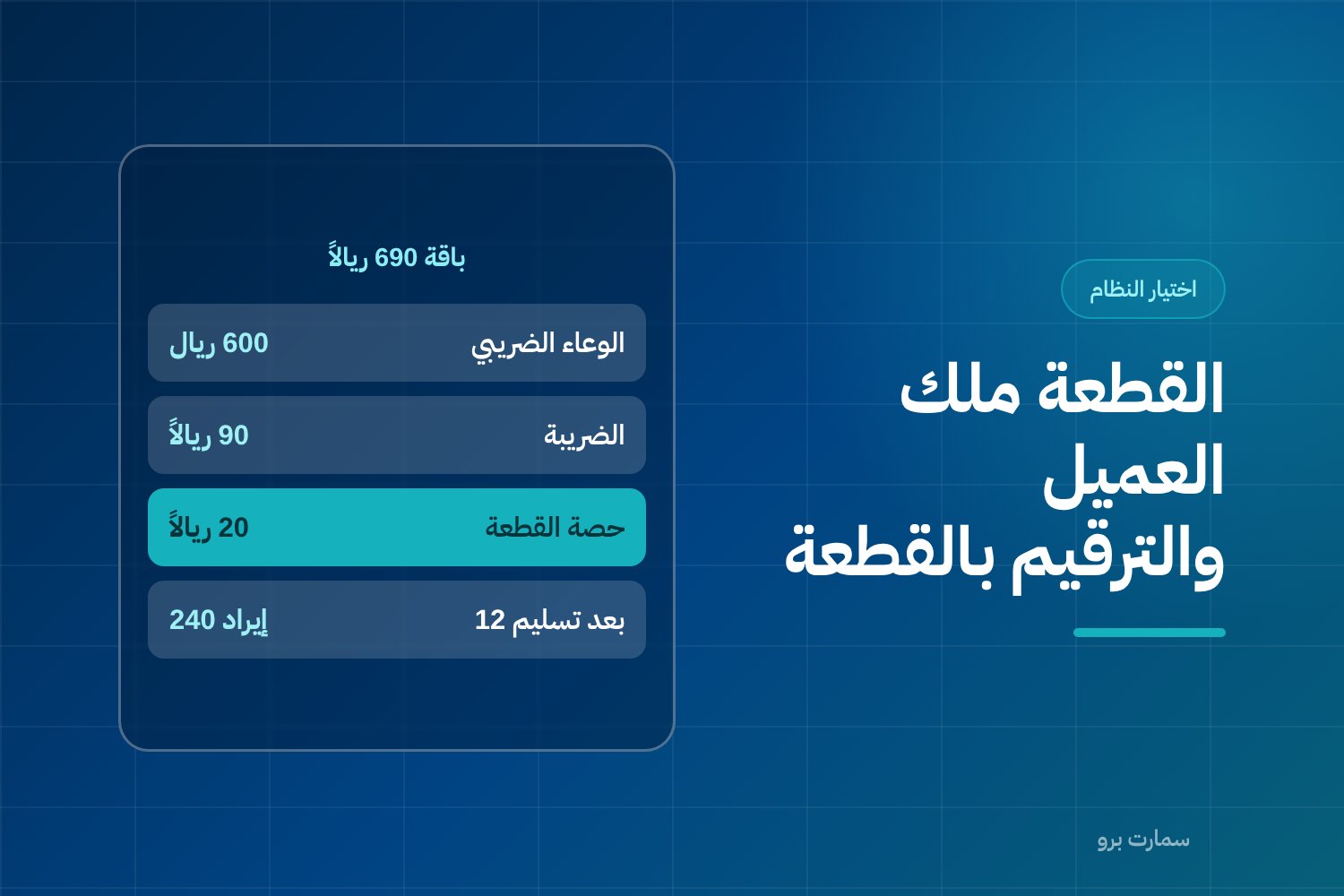
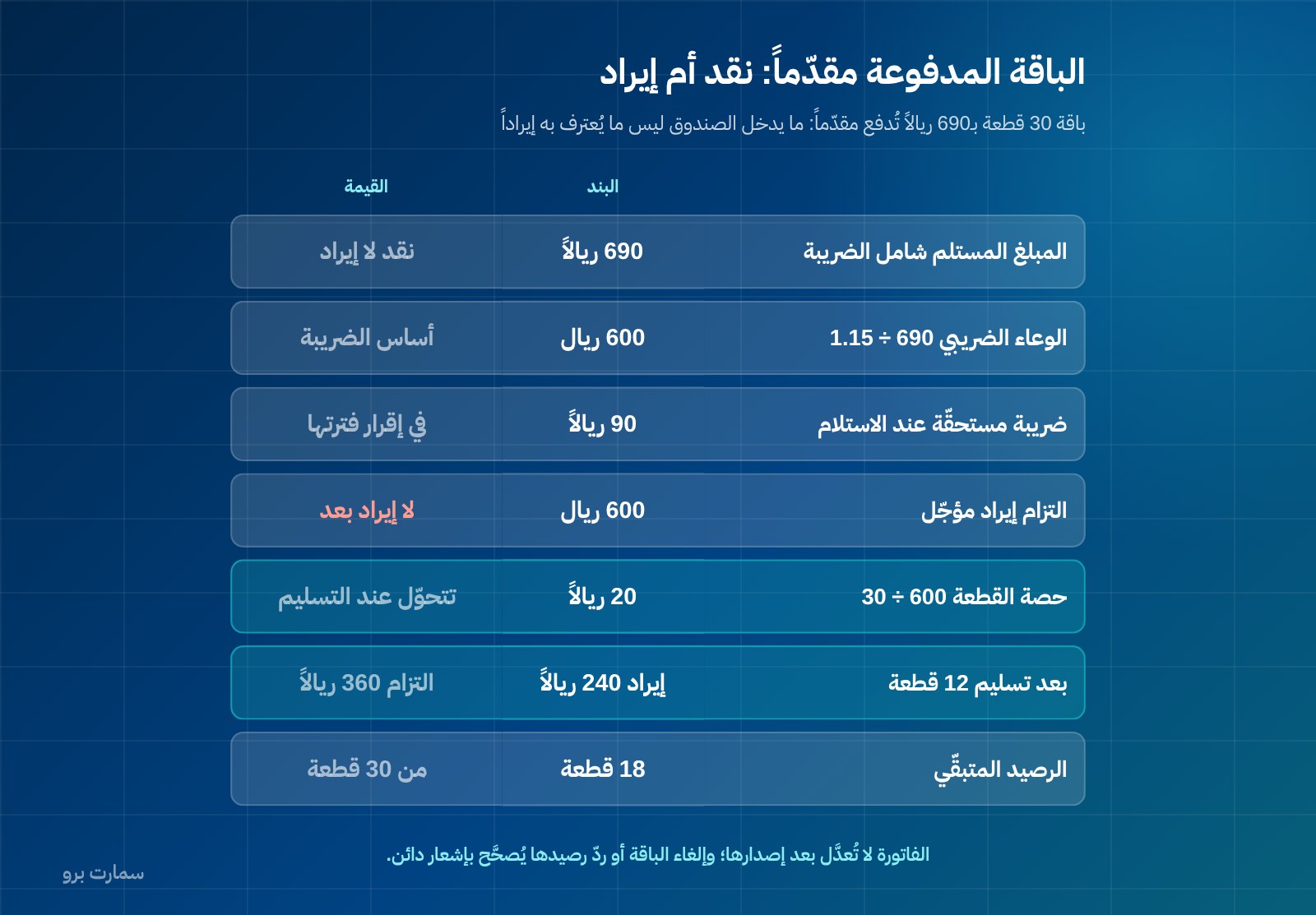
A customer buys a 30-item bundle for SAR 690, paid upfront.
- Amount received: SAR 690, including VAT.
- Taxable amount: 690 ÷ 1.15 = SAR 600. VAT: SAR 90, due at receipt and included in that period's return.
- In the books at receipt: SAR 600 as a liability (deferred revenue), not revenue.
- Value per item: 600 ÷ 30 = SAR 20.
- Each time an item from the bundle is collected, SAR 20 moves from the liability to revenue, and the balance goes down.
- After 12 items are collected: recognised revenue SAR 240, remaining liability SAR 360, balance 18 items.
What the system should do automatically: store the bundle balance in items, deduct from it at every collection, block use after the bundle expires, and separate cash received from revenue earned in your reports.
Note that an invoice cannot be edited once issued. If a bundle is cancelled or its remaining balance refunded, the correction is a credit note, not an edit to the original invoice. The rules for the standard tax invoice your corporate customers need and the simplified invoice given to individuals are covered in the ZATCA e-invoicing guide.
The biggest danger without this separation is reading the cash in the till as profit, then distributing or spending it while you still owe services you haven't delivered. The basics of keeping this separate in the books are explained in how to choose the best accounting software in Saudi Arabia.
What do you do about uncollected orders and rack space?
Every laundry has a rack of orders that have been ready for weeks with no one coming for them. The cost is twofold: space that produces nothing, and an ongoing duty of care. The longer an item stays, the higher the chance of damage, loss or dispute.
The system alone doesn't solve this. You need a policy announced at drop-off, printed on the receipt and displayed on the wall: the storage period, when a storage fee starts if there is one, and what happens after the period ends.
The system's job is to make the policy enforceable: grouping orders by age, alerting when a threshold is passed, producing a ready call list of owners, and logging contact attempts in the order record itself. Solving this starts with a call on day five, not a decision on day fifty. Because the rack is limited space managed like any store, the principles of organising locations and shelves help here; see SmartPro's inventory features.
How should delivery and drivers be tracked?
Keep this part simple and remember one rule: a delivered order is not a collected payment. The driver hands over the order and either collects cash or doesn't, and the difference shows in the driver's cash custody, not in the delivery report.
So for every delivered order the system needs to record who delivered it, when, whether payment was collected, and by which method. Then a custody report per driver at the end of each shift, matched against the cash they hand in. Recording proof of delivery at the door, a signature or a photo, settles a dispute before it starts.
How do branches and a central laundry work together?
The common growth model is drop-off and collection branches close to customers, with one central laundry doing the work. This model adds a step no generic retail system has: moving items from branch to plant and back.
What the system should track here:
- A transfer sheet from the branch to the central laundry, listing item count and IDs, not number of bags.
- A matching receipt at the central laundry that checks against what was sent and flags differences immediately.
- A return sheet from the central laundry back to the branch that originally took the order.
- Order age broken down by stage, so you know where time is lost: in the branch, in transit or in the plant.
- Reports per branch and consolidated, with a separate cash box for each branch.
The biggest difference between random loss and accountable loss is a matched transfer sheet in both directions. Without it, every loss becomes an argument between branch and plant with no conclusion.
What criteria should you use to choose laundry management software?
Compare systems on these criteria, not on vendor names:
| Criterion | What exactly to ask for | How to check it in the demo |
|---|---|---|
| Item tracking | An ID per item and a tag linked to the record | Search for one item by its ID alone |
| Item condition | Description and photo at drop-off | Enter a stain and a missing button, attach a photo |
| Pricing | Item × service matrix, and per-metre charging | One order with three services and a carpet by the metre |
| Stages | Fast updates recording time and user | Move an order from drop-off to ready |
| Uncollected report | List with age in days, oldest first | Open the report in front of you |
| Bundles | Balance in items and deferred revenue separated | Sell a bundle and use two items from it |
| E-invoicing | Full Phase 2 requirements | Issue an invoice and a credit note |
| Delivery | Driver custody and proof of delivery | Close a driver's shift and reconcile the cash |
| Branches | Transfer sheets matched both ways | Send an order to the central laundry and back |
| Corporate customers | Own price list and consolidated monthly invoice | Consolidate a month's orders into one invoice |
On e-invoicing specifically, Phase 2 requirements are clear: the invoice is XML in the UBL 2.1 format, with a cryptographic stamp, a counter that is never reset, a hash chain linking invoices, and a QR code on simplified invoices. Simplified invoices are reported to ZATCA's Fatoora platform within 24 hours of issue without prior clearance, which suits a laundry counter because it doesn't hold up the handover.
Invoices cannot be edited after issue; corrections are made with a credit note. And be careful with the phrase "approved software": the Zakat, Tax and Customs Authority (ZATCA) does not approve software, but publishes an indicative list of solution providers.
If you want a system built around this model from the start, see SmartPro's laundry solution.
What should you test in a laundry software demo?
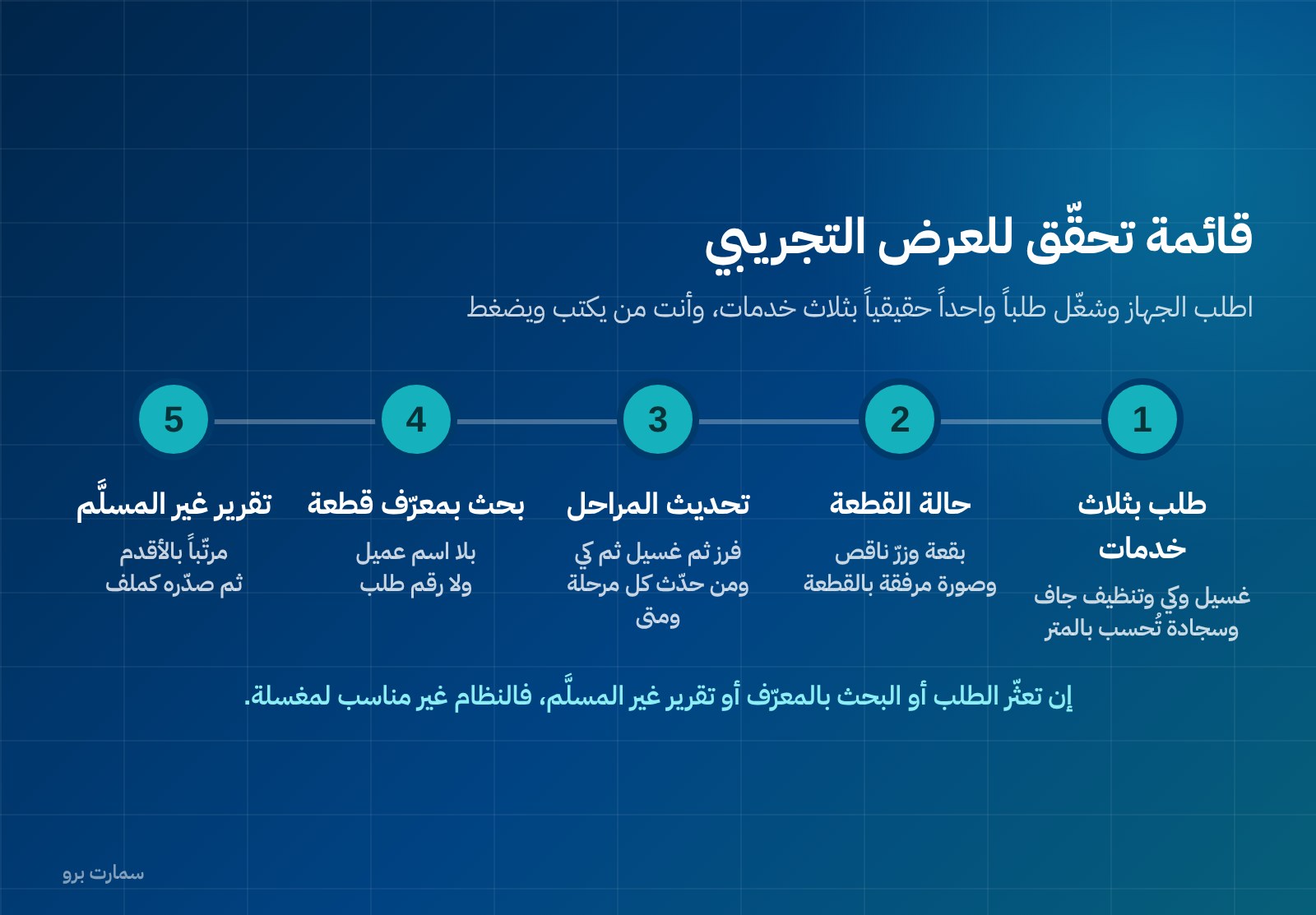
Don't watch a prepared demo on the vendor's data. Ask for the device, run one real order with three services, and do the typing and clicking yourself:
- Take an order for one customer: five items to wash and iron, a suit for dry cleaning, and a carpet charged by the metre. Time it in minutes.
- Record a stain on a shirt and a missing button on the suit, and attach a photo to the item.
- Print the customer receipt and check it shows the item count, ready date and storage policy.
- Move the order through sorting, washing, ironing and ready. Then ask who updated each stage and when.
- Search for one item by its ID alone, without the customer's name or the order number.
- Sell a prepaid bundle, use two items from it, and ask for its balance and the deferred revenue.
- Issue the invoice, try to edit it after issue, then issue a credit note.
- Open the uncollected-orders report sorted oldest first, and export it.
- Close a driver's shift and reconcile their cash custody against their delivered orders.
- Send the order to the central laundry and back, and ask for the transfer sheet in both directions.
- Ask to export all your data as a file.
If steps 1, 5 or 8 stumble, the system is not right for a laundry, whatever its other features.
What should you cost before you buy?
Cost four items, not one: the annual licence; setting up master data (customers, item types, the price matrix, existing bundle balances); training measured in hours, not promises; and the cost of devices and labels at the drop-off counter. Set against them the cost of how things are now: a lost item every month, orders on the rack of unknown age, and bundles with unknown balances.
SmartPro publishes its prices on the pricing page, all including 15% VAT: the Mini package is SAR 1,500 a year with 1 user, Pro is SAR 4,500 a year with 3 users and the mobile app, and Max is SAR 20,500 a year with 10 users. Only the main branch is included; each additional branch costs SAR 1,000 a year. Implementation, data migration and Fatoora onboarding cost SAR 0, and the exact total depends on your users, branches and any systems you add.
Where is the official reference?
For e-invoicing requirements in both phases, the rules on standard and simplified tax invoices, VAT due on amounts received in advance, and the indicative list of solution providers, the only authoritative source is the Zakat, Tax and Customs Authority: zatca.gov.sa. Check any regulatory claim you hear in a sales pitch there before you build an internal procedure on it.
Read also
- How to choose the right POS system in Saudi Arabia
- How to choose the best accounting software in Saudi Arabia
- ZATCA e-invoicing guide
Key takeaway: Choose laundry software that tracks each garment by its own ID, prices item by service, and treats prepaid bundles as a liability. If it fails item search, multi-service orders or the uncollected-orders report in the demo, walk away.
To see how this works on your own orders, start a free trial or book a demo with a SmartPro product expert.
Article visuals
Frequently asked questions
Why isn't a generic POS system enough to run a laundry?
A retail system is built around selling items the shop owns, while a laundry takes in customers' belongings and promises to return them. That means the system needs an ID for every item rather than every order, a record of each item's condition at drop-off, and a log of who handled it at every stage. Laundries also price by item and service together and charge carpets by the square metre, which a flat price list cannot handle.
How are prepaid laundry bundles treated for tax and accounting?
Money received for a service not yet delivered is not revenue but a liability, and revenue is recognised gradually as items are collected. VAT becomes due at the earliest of the supply, the invoice issue or receipt of payment, so a prepaid amount is invoiced at receipt and its VAT falls in that period. If the bundle is cancelled or its balance refunded, the correction is made with a credit note, because an invoice cannot be edited after issue.
Which report should I ask for by name in a laundry software demo?
Ask for the report of orders not yet collected, showing each order's age in days and sorted oldest first. It exposes stuck orders before customers call, shows the stage where work is piling up, and measures rack space occupied for nothing. Ask to open it in front of you on your own data and to export it as a file.
What does a laundry system need for ZATCA e-invoicing?
Under Phase 2, invoices are issued as XML in the UBL 2.1 format with a cryptographic stamp, a counter that is never reset, a hash chain linking invoices, and a QR code on simplified invoices. Simplified invoices are reported within 24 hours of issue without prior clearance, which suits a drop-off counter because it doesn't hold up the handover. Invoices cannot be edited after issue, so corrections are made with a credit note, and ZATCA does not approve software but publishes an indicative list of solution providers.